Frequently Asked Questions
Autonomous Cloud Optimization vs. Recommendation Tools
What is the main difference between autonomous cloud optimization and traditional recommendation tools?
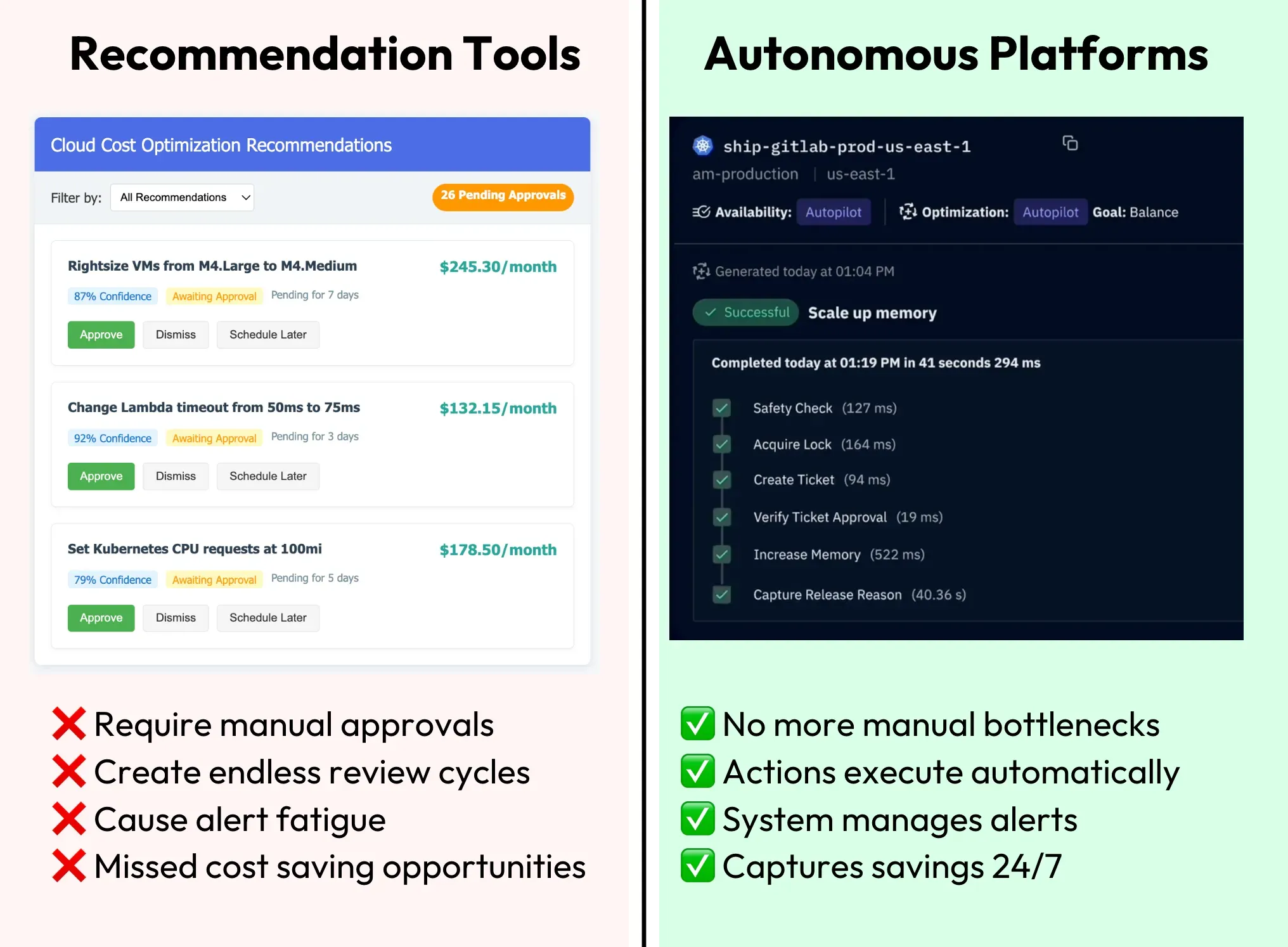
Traditional recommendation tools generate lists of suggestions that require manual review and approval, creating more work for engineering teams. In contrast, Sedai's autonomous platform takes immediate action, eliminating bottlenecks and capturing savings automatically without engineer involvement. This means no more manual bottlenecks, zero reviews needed, and 24/7 cost savings without engineer intervention. Source
How does Sedai eliminate the backlog created by recommendation tools?
Sedai's autonomous platform uses machine learning-driven guardrails to take safe, precise actions immediately, eliminating optimization backlogs. The system handles everything from analysis to execution, saving both engineering time and cloud costs with proven savings of 30% or more. Source
What are the main drawbacks of recommendation-based cloud optimization tools?
Recommendation-based tools require manual approvals for every action, create endless review cycles, cause alert fatigue, and often result in missed cost-saving opportunities (over $500 per month per workload). Most of these tools are just recommendation engines that create more work for already stretched engineering resources. Source
How quickly does Sedai deliver optimization results compared to recommendation tools?
Sedai delivers autonomous execution and immediate results (in seconds), whereas recommendation tools often result in delayed savings due to manual review cycles that can take 7 or more days. Source
How does Sedai help engineering teams focus on innovation?
By automating cloud optimization and eliminating manual review cycles, Sedai frees engineering teams to focus on building and improving products instead of reviewing optimization recommendations. Source
Features & Capabilities
What features does Sedai offer for autonomous cloud optimization?
Sedai offers autonomous optimization, proactive issue resolution, release intelligence, smart SLOs, comprehensive integrations, cloud cost optimization, and productivity enhancements. These features enable real-time resource optimization, cost savings, performance improvements, and reduced manual toil. Source
Does Sedai support integration with major cloud platforms?
Yes, Sedai integrates with Amazon AWS, Google Cloud, Microsoft Azure, IBM Cloud, and Oracle Cloud, as well as a wide range of notification, ITSM, monitoring, APM, IaC, CI/CD, and data streaming tools. Source
What is Sedai's Smart SLOs feature?
Sedai's Smart SLOs automatically set and monitor Service Level Objectives based on past performance, alerting teams for breaches and helping maintain reliability and latency targets. Source
How does Sedai's Release Intelligence work?
Sedai's Release Intelligence tracks the impact of new releases on latency, cost, and errors using scorecards, ensuring smoother deployments and fewer errors. Source
What technical documentation is available for Sedai users?
Sedai provides a comprehensive Getting Started Guide, Dataflow Optimization Documentation, and other resources to help users configure and utilize the platform effectively. Documentation
Implementation & Ease of Use
How long does it take to implement Sedai?
Sedai's plug-and-play implementation takes just 5 minutes for general setup and 15 minutes for specific use cases like AWS Lambda, ensuring minimal disruption to workflows. Source
What support resources are available during onboarding?
Sedai offers live onboarding assistance, personalized onboarding calls, comprehensive documentation, and access to a Slack community for real-time support and collaboration. Source
How easy is it to start using Sedai?
Sedai is designed to be user-friendly and easy to adopt, with quick setup, live onboarding support, detailed guides, and a supportive Slack community. Source
What resources are required to get started with Sedai?
To get started, you need cloud access (via IAM), a monitoring source, and, for Kubernetes clusters, integration via Sedai's Smart Agent. Security team assistance may be needed to provide sufficient access. Source
Business Impact & Customer Success
What business impact can customers expect from using Sedai?
Customers can expect significant cost savings (e.g., KnowBe4 achieved up to 50% savings, Palo Alto Networks saved $3.5 million), productivity gains (over 90% reduction in manual toil), performance improvements (up to 77% latency reduction), and superior ROI (762% with a 3-month payback period). Source
Can you share specific customer success stories with Sedai?
Yes. KnowBe4 achieved up to 50% cost savings in production, Palo Alto Networks saved $3.5 million, Belcorp reduced AWS Lambda latency by 77%, and Campspot achieved a 34% reduction in latency. More stories are available on the customer stories page.
Who are some of Sedai's notable customers?
Sedai's customers include Palo Alto Networks, HP, Experian, KnowBe4, Capital One, Flex, Guidewire, Oak Ridge National Laboratory, and Freshworks. Source
What industries are represented in Sedai's case studies?
Industries include cybersecurity, information technology, information services, financial services, SaaS, supply chain solutions, insurance software, scientific research, e-commerce, and online travel. Source
Security & Compliance
What security and compliance certifications does Sedai have?
Sedai is SOC 2 certified, demonstrating adherence to stringent security requirements and industry standards for data protection and compliance. Source
Competition & Comparison
How does Sedai compare to recommendation-based tools?
Sedai provides 100% autonomous optimization, executing improvements in real-time without manual intervention, while recommendation-based tools only provide suggestions that require manual action. This leads to faster results, reduced engineering workload, and higher realized savings. Source
What makes Sedai different from competitors like StormForge, nOps, or Kubecost?
Sedai stands out by offering 100% autonomous execution, comprehensive optimization across platforms, AI-driven insights, proactive issue resolution, and release intelligence. Competitors like StormForge and nOps focus on recommendations, while Kubecost emphasizes visibility and tracking. Source
Why should a customer choose Sedai over other cloud optimization solutions?
Customers should choose Sedai for its autonomous execution, comprehensive optimization, AI-driven insights, proactive issue resolution, and proven business impact (e.g., millions in savings, productivity gains, and improved performance). Source
What are the advantages of Sedai for different user segments?
Enterprises benefit from significant cost savings and compliance, DevOps teams gain productivity, cloud engineers reduce manual toil, and startups/SMBs enjoy quick setup and flexible pricing. Source
Pain Points & Problems Solved
What core problems does Sedai solve for cloud operations teams?
Sedai addresses high cloud costs, application latency, availability issues, manual toil, and release quality challenges by providing autonomous optimization, performance improvements, and proactive issue resolution. Source
How does Sedai help with cloud cost optimization?
Sedai autonomously optimizes cloud resources, reducing overprovisioning and improving resource utilization. Customers like KnowBe4 achieved 50% savings in production, and Palo Alto Networks saved $3.5 million. Source
How does Sedai improve application performance?
Sedai reduces latency and improves response times, as seen with Belcorp's 77% reduction in AWS Lambda latency and Campspot's 34% reduction. Source
How does Sedai enhance availability and reliability?
Sedai ensures higher uptime and reliability by reducing cold start latency and proactively resolving issues before they impact users. Companies like Inflection and Freshworks benefited from these enhancements. Source
How does Sedai reduce manual toil for operations teams?
Sedai automates repetitive tasks and operational processes, reducing manual intervention by over 90% and allowing engineers to focus on high-value work. Source
Use Cases & Target Audience
Who can benefit from using Sedai?
Sedai is ideal for Site Reliability Engineers, Platform Engineers, DevOps teams, Engineering Leaders, CTOs, and Architects in organizations managing cloud operations across industries such as cybersecurity, SaaS, financial services, e-commerce, and more. Source
Is Sedai suitable for startups and SMBs?
Yes, Sedai's quick setup (10-15 minutes) and flexible pricing plans make it accessible for startups and SMBs looking to optimize cloud resources without significant upfront investment. Source
What use cases does Sedai address?
Sedai addresses cloud cost optimization, application performance improvement, availability enhancement, operational productivity, and release quality for organizations of all sizes. Source
How does Sedai support FinOps and SRE teams?
Sedai automates cloud cost optimization and reliability improvements, helping FinOps and SRE teams meet their goals with less manual effort and more predictable outcomes. Source