What is AWS Elasticsearch Service (now Amazon OpenSearch Service)?
Amazon Elasticsearch Service, now called Amazon OpenSearch Service, is a fully managed search and analytics engine on AWS. It allows you to deploy, operate, and scale clusters for use cases like log analytics, full-text search, and real-time application monitoring without managing infrastructure yourself. AWS handles scaling, patching, backups, and security, so you can focus on extracting insights from your data.
How do I set up my first AWS Elasticsearch domain?
To set up your first AWS Elasticsearch (OpenSearch) domain, go to the AWS Management Console, search for "OpenSearch Service," and click "Create domain." Configure your cluster settings (domain name, engine version, instance type, storage, and instance count), set access policies, and deploy. For production, use at least three nodes for high availability and enable fine-grained access control.
What are the core concepts I should know before deploying AWS Elasticsearch?
Key concepts include clusters (groups of nodes), node roles (master, data, ingest), indices (collections of documents), shards (partitions for parallel queries), and replicas (copies for redundancy). Best practices include having at least three master nodes for high availability and adjusting shard/replica counts based on workload.
How do I ingest and query data in AWS Elasticsearch?
You can ingest data using the Bulk API for large datasets, AWS Lambda for pre-processing, or Kinesis Firehose for streaming ingestion. Query data using full-text search for unstructured data or aggregations for summarizing metrics. Avoid wildcard queries in production for better performance.
What are the main use cases for AWS Elasticsearch?
Main use cases include log analytics (real-time log collection and visualization), full-text search (e-commerce, documentation, knowledge bases), and real-time application monitoring (tracking metrics and anomalies). Choose "Search" mode for speed and precision, or "Analytics" mode for exploring large datasets and trends.
Performance & Cost Optimization
How can I optimize costs when running AWS Elasticsearch?
Optimize costs by right-sizing your instances, using UltraWarm storage for older data (up to 90% cheaper), and committing to Reserved Instances for long-term workloads (up to 75% savings). Automate data rollover with Index Lifecycle Management (ILM) to move older indices to cheaper storage tiers.
What are the best practices for improving AWS Elasticsearch performance?
Define explicit mappings (avoid dynamic fields), use keyword fields for filtering, enable doc_values for numeric/date aggregations, and avoid wildcard queries in production. Monitor cluster health and scale nodes as needed to prevent slow queries and errors.
How do I prevent common pitfalls like red/yellow cluster status and 429 errors?
Keep disk usage below 85%, use ILM policies to manage index sizes, and balance shards across nodes. For 429 errors, reduce bulk request sizes, add retry logic, and scale up nodes or use memory-optimized instances to handle higher loads.
How does Sedai help optimize AWS Elasticsearch clusters?
Sedai automates scaling to match workload demands, detects anomalies early to prevent downtime, and analyzes usage trends to cut unnecessary spend. It monitors clusters in real time, flags bottlenecks, and recommends or executes configuration changes before they impact performance or cost.
Can Sedai automate Elasticsearch management tasks?
Yes. Sedai can automate cost optimization, scaling, and monitoring for AWS Elasticsearch, reducing manual intervention and helping you maintain healthy, cost-efficient clusters.
Security & Compliance
What are the security best practices for AWS Elasticsearch?
Enable fine-grained access control, assign permissions based on roles, encrypt data at rest with AWS KMS, enforce TLS 1.2+ for data in transit, restrict public access using VPC isolation or AWS PrivateLink, and monitor VPC flow logs for unusual traffic.
How does Sedai address security and compliance?
Sedai is SOC 2 certified, demonstrating adherence to stringent security and compliance standards for data protection. For more details, visit the Sedai Security page.
Troubleshooting & Monitoring
How do I check if my Elasticsearch cluster is healthy?
Run GET _cluster/health?pretty in Kibana or via curl. Green means healthy, yellow means some replicas are missing, and red means data loss risk due to missing primary shards.
Why am I getting 429 “Too Many Requests” errors in Elasticsearch?
429 errors indicate your cluster is overloaded. Fix this by reducing bulk request sizes, adding retry logic with exponential backoff, or scaling up nodes to handle more requests.
What’s the fastest way to speed up slow queries in Elasticsearch?
Define explicit mappings (avoid dynamic fields), use keyword fields for filtering, and enable doc_values for numeric/date aggregations. These steps improve query performance and reduce latency.
How do I prevent shard allocation issues in Elasticsearch?
Keep disk usage below 85%, use ILM policies to manage index sizes, and avoid imbalanced shards by setting total_shards_per_node. Redistribute shards evenly across nodes for optimal performance.
Features & Capabilities of Sedai
What is Sedai and how does it relate to AWS Elasticsearch?
Sedai is an autonomous cloud management platform that can automate optimization, scaling, and cost management for AWS Elasticsearch clusters. It helps reduce manual toil, proactively resolves issues, and ensures clusters are cost-efficient and performant.
What are the key features of Sedai for cloud optimization?
Sedai offers autonomous optimization, proactive issue resolution, full-stack cloud coverage (including AWS, Azure, GCP, Kubernetes), release intelligence, plug-and-play implementation, and enterprise-grade governance. It reduces cloud costs by up to 50% and improves performance by reducing latency up to 75%.
Does Sedai support integration with monitoring and automation tools?
Yes. Sedai integrates with monitoring and APM tools like CloudWatch, Prometheus, Datadog, and Azure Monitor; Kubernetes autoscalers; IaC and CI/CD tools like GitLab, GitHub, Bitbucket, and Terraform; ITSM tools like ServiceNow and Jira; and notification platforms like Slack and Microsoft Teams.
What modes of operation does Sedai offer?
Sedai offers three modes: Datapilot (observability), Copilot (one-click optimizations), and Autopilot (fully autonomous execution). This flexibility allows teams to choose the right level of automation for their needs.
Use Cases & Customer Success
Who can benefit from using Sedai with AWS Elasticsearch?
Platform engineers, IT/cloud operations, technology leaders, site reliability engineers (SREs), and FinOps teams managing AWS Elasticsearch clusters can benefit from Sedai's automation, cost optimization, and proactive issue resolution capabilities.
What business impact can Sedai deliver for AWS Elasticsearch users?
Sedai can reduce cloud costs by up to 50%, improve performance by reducing latency up to 75%, deliver up to 6X productivity gains, and reduce failed customer interactions by up to 50%. Customers like Palo Alto Networks saved $3.5 million, and KnowBe4 achieved 50% cost savings in production using Sedai.
Can you share a customer success story related to cloud optimization?
Yes. KnowBe4 achieved up to 50% cost savings in production and saved $1.2 million on their AWS bill using Sedai. Palo Alto Networks saved $3.5 million and reduced Kubernetes costs by 46%. Read more in the KnowBe4 case study and Palo Alto Networks case study.
What industries use Sedai for cloud optimization?
Sedai is used across industries such as cybersecurity (Palo Alto Networks), IT (HP), financial services (Experian, CapitalOne Bank), security awareness training (KnowBe4), travel (Expedia), healthcare (GSK), car rental (Avis), retail/e-commerce (Belcorp), SaaS (Freshworks), and digital commerce (Campspot).
Implementation & Support
How long does it take to implement Sedai for AWS Elasticsearch optimization?
Sedai's setup process is quick: 5 minutes for general use cases and up to 15 minutes for specific scenarios like AWS Lambda. For complex environments, timelines may vary. Personalized onboarding and a 30-day free trial are available.
What support resources are available for Sedai users?
Sedai provides detailed technical documentation, onboarding sessions, a dedicated Customer Success Manager for enterprise customers, a community Slack channel, and email/phone support. Access documentation at docs.sedai.io/get-started.
What feedback have customers given about Sedai's ease of use?
Customers highlight Sedai's plug-and-play implementation (5–15 minutes), agentless integration, personalized onboarding, and extensive support resources. The 30-day free trial allows users to experience the platform's value risk-free.
Where can I find more technical documentation about Sedai?
Comprehensive technical documentation is available at docs.sedai.io/get-started. Additional resources, including case studies and datasheets, can be found at sedai.io/resources.
Competition & Differentiation
How does Sedai differ from other cloud optimization tools for AWS Elasticsearch?
Sedai offers 100% autonomous optimization, proactive issue resolution, application-aware intelligence, full-stack cloud coverage, release intelligence, and rapid plug-and-play implementation. Unlike competitors that rely on static rules or manual adjustments, Sedai continuously optimizes based on real application behavior and delivers measurable ROI.
What unique features does Sedai provide for AWS Elasticsearch users?
Sedai provides autonomous optimization, proactive issue resolution, application-aware intelligence, release intelligence, and enterprise-grade governance. These features enable continuous improvement, cost savings, and enhanced reliability for AWS Elasticsearch clusters.
Why should I choose Sedai for AWS Elasticsearch optimization?
Sedai delivers up to 50% cost savings, 75% latency reduction, 6X productivity gains, and proactive issue resolution. It is trusted by industry leaders like Palo Alto Networks, KnowBe4, and HP, and offers rapid implementation, extensive integrations, and proven business impact.
What problems does Sedai solve for AWS Elasticsearch users?
Sedai addresses cost inefficiencies, operational toil, performance and latency issues, lack of proactive issue resolution, complexity in multi-cloud environments, and misaligned priorities between engineering and FinOps teams. It automates optimization, aligns objectives, and ensures reliable, cost-effective operations.
If you’ve faced cluster crashes, sluggish queries, or downtime, you know how fast things can unravel. Managed well, AWS Elasticsearch delivers powerful search and analytics without the pain of manual infrastructure work.
This guide covers everything you need to run it like a pro, from core features and use cases to cost optimization, security, and common pitfalls. You’ll also see how automation tools like Sedai can handle tuning, scaling, and troubleshooting.
Understanding Amazon ElasticSearch Service
Amazon Elasticsearch Service (now Amazon OpenSearch Service) is a fully managed search and analytics engine that makes it simple to deploy, operate, and scale clusters in the AWS cloud. It’s designed for use cases like log analytics, full-text search, and real-time application monitoring, without the need to manage infrastructure yourself.
AWS takes care of scaling, patching, backups, and security, so you can focus on extracting insights from your data. It also integrates natively with AWS services like Kinesis for real-time ingestion, Lambda for serverless processing, and CloudWatch for monitoring, making it a strong choice for cloud-native applications.
AWS costs are manageable when someone is watching them around the clock. Book a demo to see how Sedai acts as that continuous layer of optimization across your AWS environment.
By removing the complexity of self-managed clusters, AWS Elasticsearch helps you get to value faster, while still allowing fine-grained control over performance and cost.
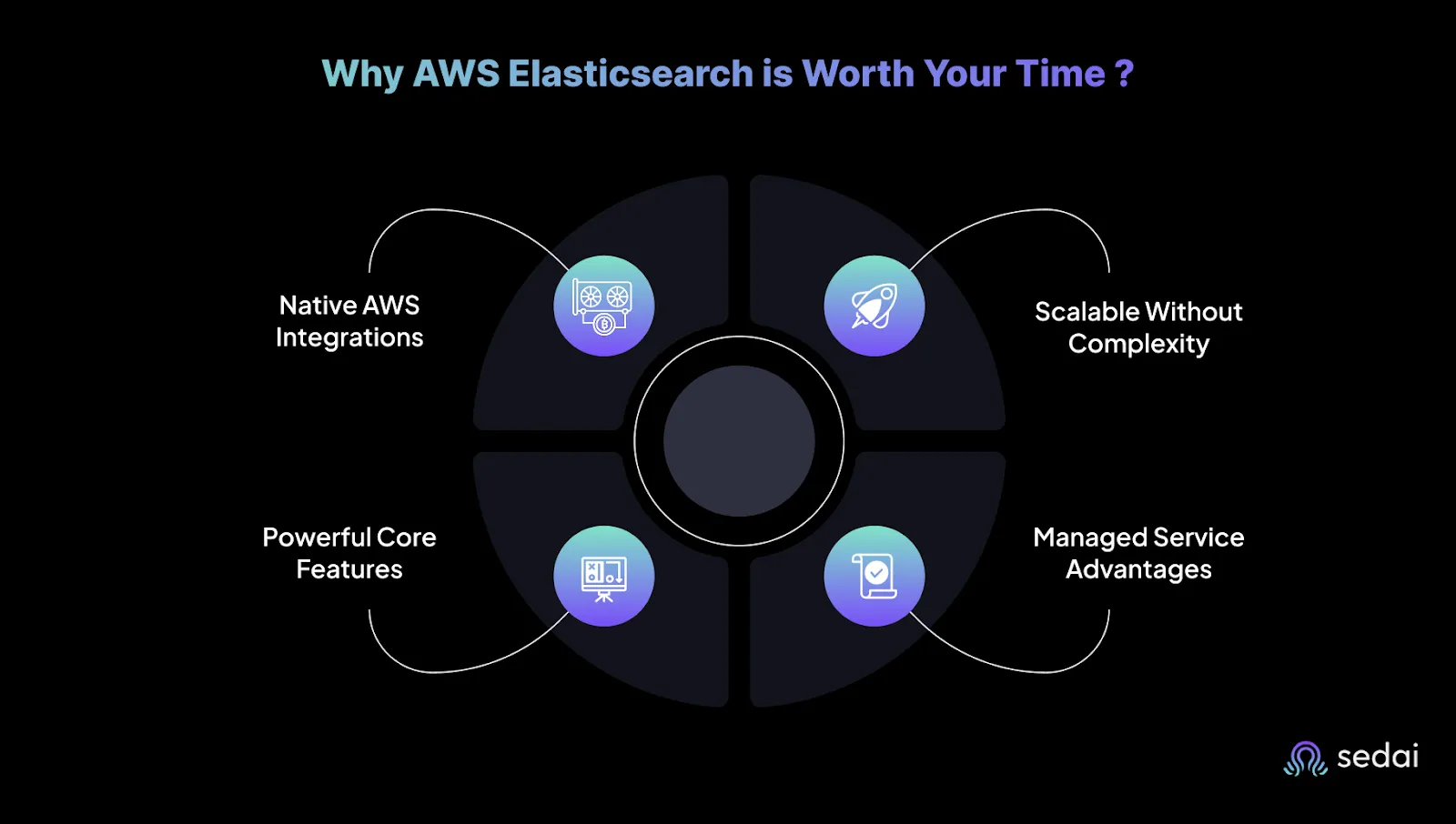
Why AWS Elasticsearch is Worth Your Time
AWS Elasticsearch combines the flexibility of open‑source Elasticsearch with the convenience of a fully managed AWS service. Here’s what makes it valuable for both beginners and experienced teams:
1. Scalable Without Complexity
Whether you’re processing a few gigabytes or terabytes of data, AWS automatically handles scaling. You don’t have to manage sharding, node provisioning, or failure recovery manually simply scale up or down as your workload changes.
2. Managed Service Advantages
Security patches, backups, and high‑availability configurations are built in. AWS manages cluster health behind the scenes, freeing you to focus on data analysis instead of infrastructure.
3. Powerful Core Features
Managed Clusters: AWS provisions, patches, and recovers nodes automatically.
Automated Backups: Point‑in‑time recovery (PITR) and snapshots to S3 protect your data.
Built‑in Kibana Dashboards: Visualize and query data without extra setup.
4. Native AWS Integrations
AWS Elasticsearch works seamlessly with:
Kinesis: Stream real‑time data directly into your cluster.
Lambda: Process and transform data before indexing.
CloudWatch: Monitor metrics and forward logs for deeper analysis.
These features let you start small, scale confidently, and integrate search and analytics into broader AWS‑based workflows without complex setup.
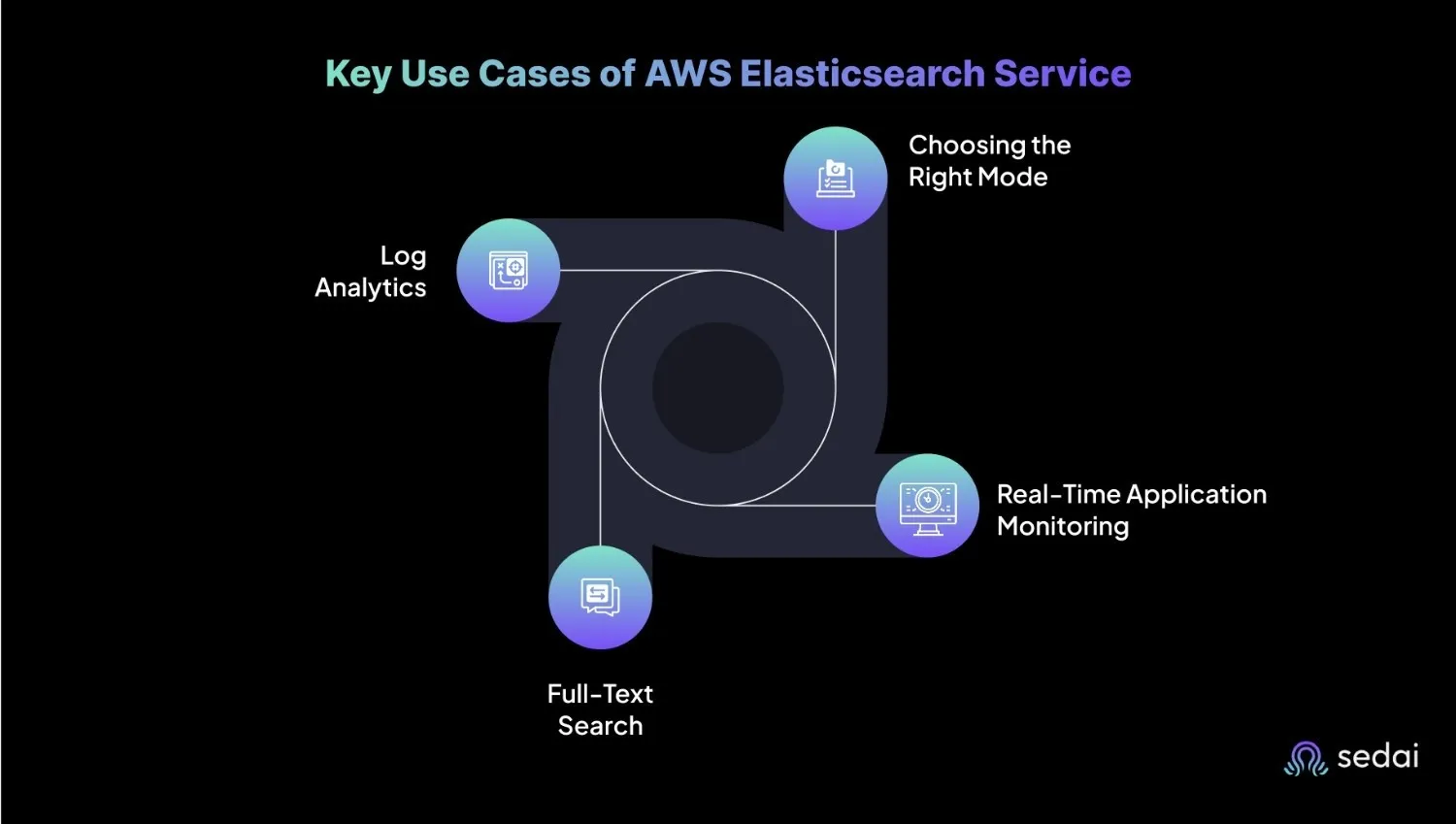
Key Use Cases of AWS Elasticsearch Service
AWS Elasticsearch is built to handle diverse workloads across industries. Here’s where it shines and how to choose the right approach for each scenario.
Log Analytics
Collect and index logs from servers, applications, and cloud services in real time. Combined with services like Kinesis or Lambda, you can process streaming logs and visualize them in Kibana for faster troubleshooting and security analysis.
Best mode: Analytics — optimized for aggregations like “errors by hour” or “most common failure codes.”
Full‑Text Search
Deliver lightning‑fast search for e‑commerce catalogs, documentation libraries, or internal knowledge bases. Elasticsearch supports fuzzy matching, synonyms, and even geospatial queries to return relevant results quickly.
Best mode: Search — built for sub‑100ms response times and precise keyword matching.
Real‑Time Application Monitoring
Ingest application metrics and traces into Elasticsearch to track performance, detect anomalies, and respond to issues before they escalate. Pair with CloudWatch or APM tools for deeper observability.
Best mode: Both — search for specific error patterns, then run analytics to spot performance trends.
Choosing the Right Mode: Search vs. Analytics
Search: Ideal when speed and precision are critical (e.g., product lookup, log filtering).
Analytics: Best for exploring large data sets, aggregating metrics, and spotting trends.Pick based on the question you’re trying to answer — “find this exact thing now” vs. “show me patterns over time.”
Ready to optimize your Elasticsearch costs?
Book a Sedai demo to improve search performance, reduce infrastructure spend, and maximize efficiency.
Core Concepts You Should Know
Before deploying AWS Elasticsearch, it’s important to understand a few foundational elements that will save you time, prevent bottlenecks, and help your clusters run smoothly.
Clusters and Nodes
An Elasticsearch cluster is a group of servers called nodes, each with a role:
Master Node: Manages cluster state and shard allocation. Best practice is to have at least 3 dedicated master nodes for high availability.
Data Node: Stores indexed data and processes queries. Add more as your dataset or search load grows.
Ingest Node: Pre‑processes incoming data before indexing, such as parsing logs or enriching fields.
Misconfigured nodes can cause outages or slow performance, especially if a master node fails.
Indices, Shards and Replicas
Index: A collection of related documents, similar to a database (e.g., logs-2025).Shard: A partition of an index that allows queries to run in parallel.
Replica: A copy of a shard for redundancy and faster reads.
Best practice: Adjust the default 5 primary shards and 1 replica based on workload. Too many shards cause overhead, too few cause slow queries. Use Index Lifecycle Management (ILM) to roll older indices into cheaper storage tiers automatically.
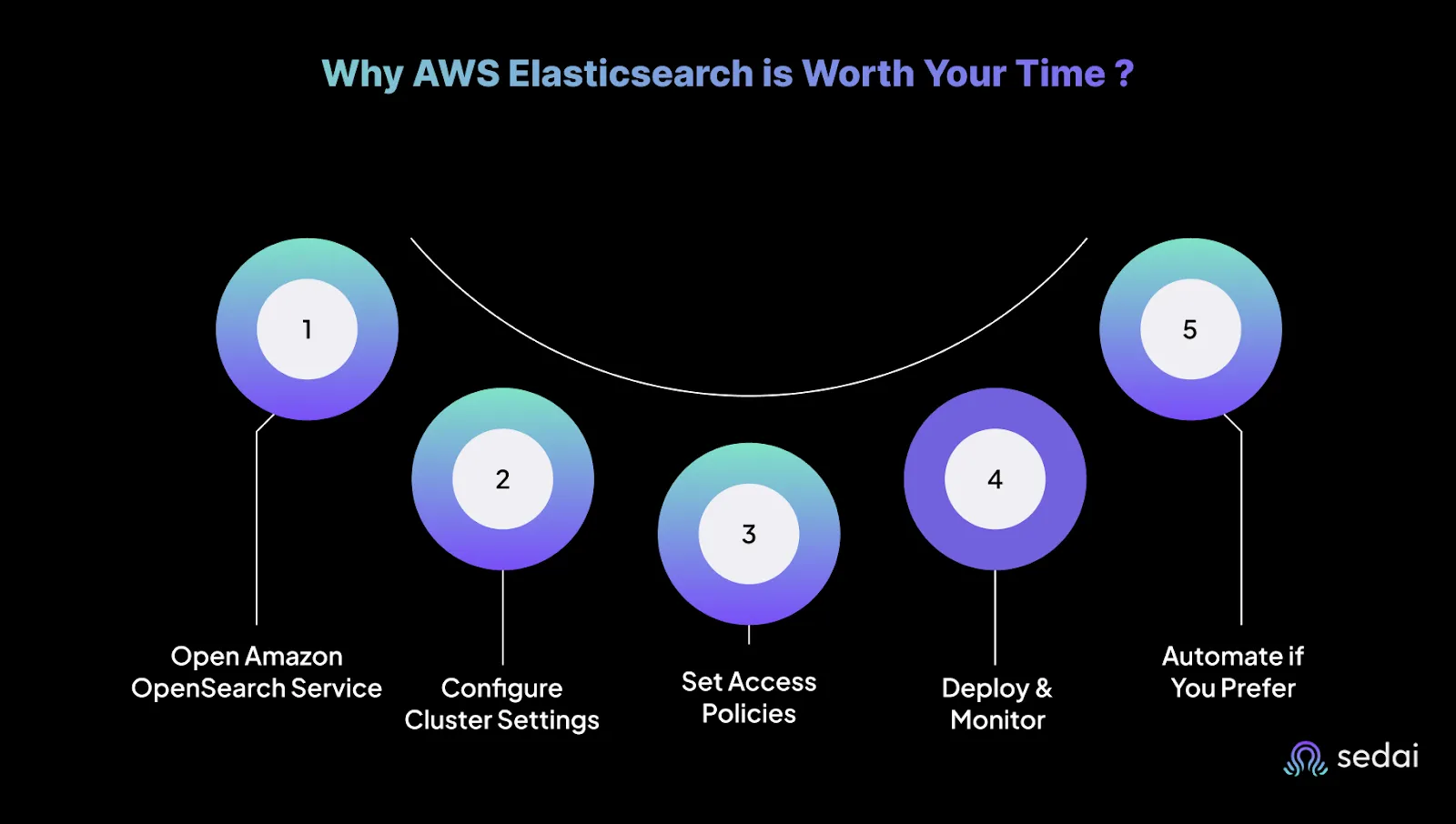
Setting Up Your First AWS Elasticsearch Domain
AWS Elasticsearch lets you deploy a production‑ready search and analytics cluster in minutes. Here’s how to set it up without overcomplicating things.
Step 1: Open Amazon OpenSearch Service
Go to the AWS Management Console and search for “OpenSearch Service” (AWS renamed it from Elasticsearch, but the core technology is still the same). Click Create domain.
Step 2: Configure Cluster Settings
Domain name: Use something clear like prod-search.
Engine version: Choose Elasticsearch 7.10 (last version before AWS forked to OpenSearch).
Instance type: For dev/test, use t3.small.elasticsearch; for production, start with m6g.large.elasticsearch.
Storage: EBS defaults work for most; increase size for heavy log indexing.
Instance count: Use at least 3 for high availability.
Step 3: Set Access Policies
Fine‑grained access control: Enable it.
Master user: Create a dedicated admin account, not your AWS root account.
Network access: Restrict access to specific IAM roles or IP ranges. Avoid public endpoints.
Step 4: Deploy and Monitor
Click Create and wait ~10 minutes.
Check the cluster health dashboard (green is good, red means fix it now).
Use CloudWatch to monitor CPU, memory, and search latency.
2. Aggregations:Summarize data without external processing.
Examples: average response time, count of errors per hour.
Pro tip: Avoid wildcard queries in production — they’re performance heavy.
Cost Optimization for AWS Elasticsearch
Elasticsearch is fast, but your AWS bill can balloon just as quickly if you’re not careful. Here’s how to keep performance high without torching your budget.
Right‑Size Your Instances: Pick the smallest instance type that meets your needs, then scale up only when necessary.
Dev/test: t3.small.elasticsearch is cheap and good enough.
Production: Graviton2 (r6g.large.elasticsearch or bigger) delivers ~20% better price‑performance than x86.
Cut Storage Costs with UltraWarm: Archive old, infrequently accessed data into UltraWarm storage up to 90% cheaper than hot storage.
Best for: compliance logs, historical analytics, audit trails.
Automate with Index Lifecycle Management (ILM) to roll data over after 30–60 days.
Commit with Reserved Instances: If you know your cluster will run 24/7 for at least a year, Reserved Instances can save you up to 75% compared to On‑Demand. Convertible RIs let you switch instance types later if your workload changes.
A single misconfiguration can expose sensitive logs, customer data, or internal systems. Follow these steps to keep your cluster secure.
Fine‑Grained Access Control
Assign permissions based on role.
Map AWS IAM roles to Elasticsearch access:
Read‑only for analysts, write access for developers.
Use Kibana’s role management to control dashboard and index visibility.
Encrypt Data at Rest and in Transit
At rest: Enable AWS KMS encryption when creating the cluster.
In transit: Enforce TLS 1.2 or higher for all connections.
Rotate encryption keys annually and track usage with AWS CloudTrail.
Restrict Public Access
Avoid public endpoints. Use VPC isolation or AWS PrivateLink.
Limit access to trusted IPs or AWS services like Lambda and EC2.
Monitor VPC flow logs for unusual or unauthorized traffic.
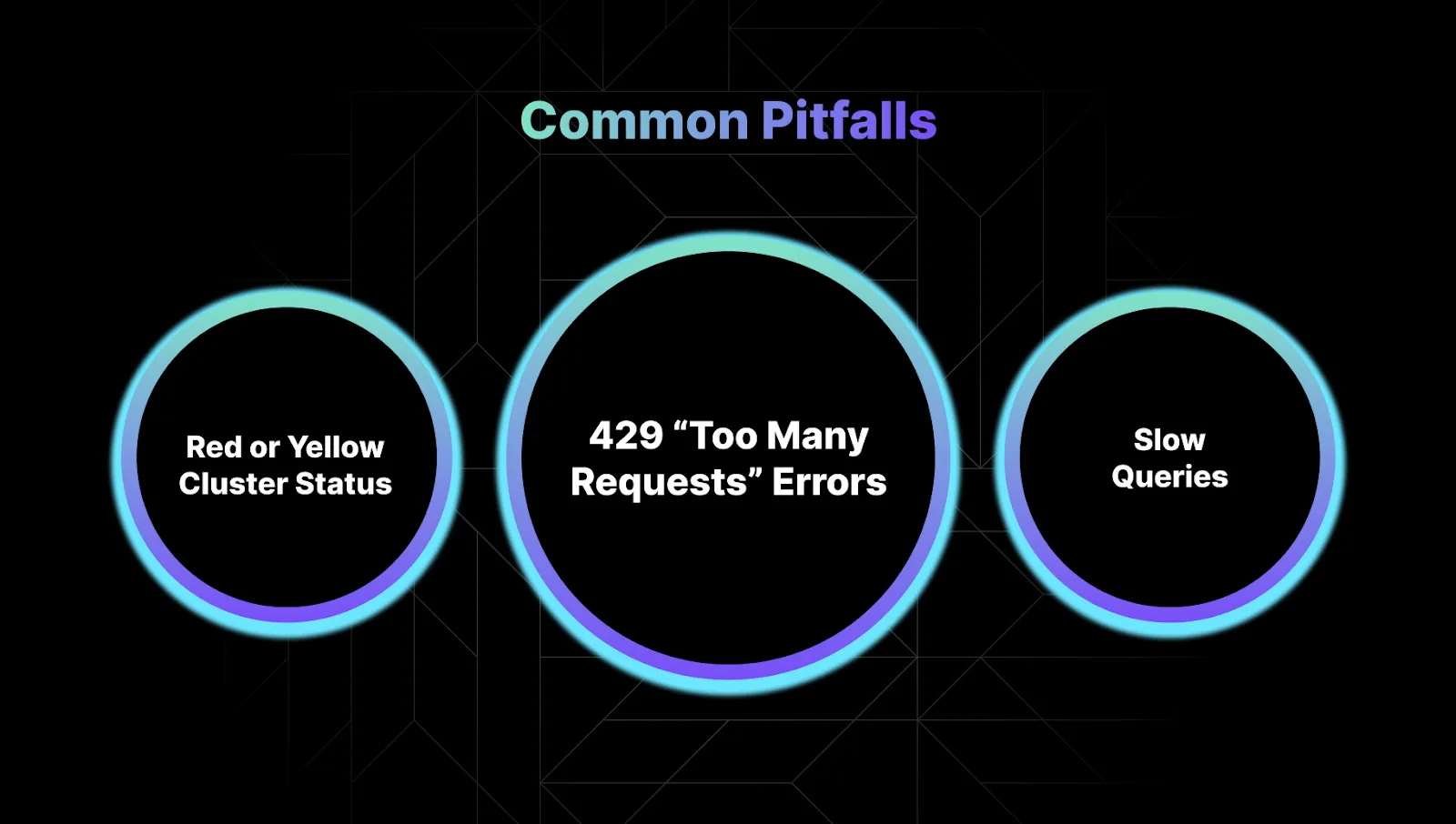
Common Pitfalls and How to Fix Them
Even with AWS managing the heavy lifting, Elasticsearch clusters can still run into issues. These are the most common problems and how to solve them.
1. Red or Yellow Cluster Status
A red status means at least one primary shard is missing, which puts your data at risk. A yellow status means that one or more replica shards are unassigned, which reduces redundancy.
How to fix: You can check _cluster/health to identify the issue. If your nodes are over 85% disk usage, either free up space by deleting old indices or scale your storage. Redistribute shards evenly across nodes and use Index Lifecycle Management (ILM) to automatically prevent indices from growing too large.
2. 429 “Too Many Requests” Errors
A 429 error means Elasticsearch is overloaded and cannot handle more requests. You can fix this by reducing your bulk request size and adding retries with exponential backoff in your ingestion pipeline.
How to fix: Scale your cluster by adding more data nodes or upgrading to memory‑optimized instances. Limiting the number of concurrent search requests can also reduce load and prevent this error.
33. Slow Queries
Slow queries often happen when mappings are too complex or index settings are inefficient.
How to fix: Always define explicit mappings rather than relying on dynamic ones, which can bloat your index with unnecessary fields. Use keyword fields for filtering to improve performance. Sorting indices by timestamp can also speed up time‑based queries significantly.
How Sedai Can Help Optimize AWS Elasticsearch
As Elasticsearch clusters grow, it becomes harder to keep them performant and cost‑efficient. Many companies now use AI platforms like Sedai to help manage this complexity.
Sedai monitors clusters in real time, flags potential bottlenecks, and recommends scaling or configuration changes before they affect performance. It also provides cost insights so teams can right‑size resources and avoid waste.
AWS Elasticsearch delivers powerful search and analytics capabilities without the overhead of running your own clusters. But keeping it fast, reliable, and cost‑efficient over time still requires careful monitoring and tuning.
AI‑driven tools like Sedai can help simplify this ongoing work by optimizing clusters automatically, detecting issues early, and keeping costs in check. If you want to spend less time troubleshooting and more time building, explore how Sedai can support your Elasticsearch operations. Join the movement today.
Keeping Elasticsearch fast, reliable, and cost-efficient over time requires more than initial tuning. Book a demo to see how Sedai monitors cluster performance continuously and adapts configuration as indices and query patterns evolve.
FAQ
1. How do I check if my Elasticsearch cluster is healthy?
Run GET _cluster/health?pretty in Kibana or via curl. Green = good, Yellow = replicas missing, Red = data loss risk.
2. Why am I getting 429 “Too Many Requests” errors?
Your cluster is overloaded. Reduce bulk request sizes, add retry logic, or scale up nodes.
3. What’s the fastest way to speed up slow queries?
Define explicit mappings (avoid dynamic fields).
Use keyword (not text) for filtering.
Enable doc_values for numeric/date aggregations.
4. How do I prevent shard allocation issues?
Keep disk usage below 85%.
Use ILM policies to auto-manage index sizes.
Avoid imbalanced shards with total_shards_per_node.
5. Can Sedai automate Elasticsearch management?
Yes. Sedai can help cut costs so you don’t have to micromanage, it automates your spending and makes the monitoring process easier than before which actually helps in your Elasticsearch management.