What are the most common challenges teams face with cloud cost optimization?
Common challenges include lack of cost visibility, over-provisioning, multi-cloud complexity, mismanagement of reservations, delayed adoption of automation, unclear cost accountability, vendor lock-in, security-related costs, inefficient resource utilization, and overall cloud environment complexity. Addressing these requires strategic planning, continuous monitoring, and ongoing optimization to match resources to real-time demand while reducing unnecessary spend.
Why is managing cloud spend more important than ever?
Managing cloud spend is critical due to unpredictable costs from usage-based pricing, scaling complexity, vendor lock-in, and the impact on project budgets. As cloud environments grow, tracking resource utilization becomes harder, making cost control essential to avoid budget overruns and ensure efficient operations.
What are the core principles of cloud cost optimization?
The core principles are visibility through tagging and cost attribution, governance and accountability (often supported by a FinOps culture), and continuous optimization rather than one-time cost cuts.
What are the key success metrics and KPIs for cloud cost optimization?
Key metrics include cost per workload or unit economics, waste rate or idle resource cost, percentage of spend under committed pricing, and variance against forecast or budget.
What are the future trends in cloud cost management?
Future trends include AI- and ML-driven optimization recommendations, autonomic or self-optimizing cloud platforms, and integrating cost and sustainability considerations to reduce both spend and carbon emissions.
What is the recommended implementation framework for cloud cost optimization?
The roadmap involves four phases: 1) Assessment and Benchmarking, 2) Pilot and Quick Wins, 3) Full Rollout and Automation, and 4) Governance and Review. This ensures a structured approach from initial audits to continuous improvement.
How does containerization help with cloud cost optimization?
Containerization improves resource efficiency by isolating applications into containers that can scale dynamically. Using Kubernetes or similar orchestration platforms ensures resources are allocated only when required, minimizing waste from idle resources.
How can FinOps help solve cloud cost optimization problems?
FinOps provides frameworks and tools for real-time cost visibility, cross-department collaboration, cost allocation, automated optimization, and accountability. It enables teams to monitor spend, forecast budgets, and take data-driven actions to optimize resources.
What is autonomous cloud cost optimization and how does Sedai deliver it?
Autonomous cloud cost optimization refers to platforms that continuously adjust resources and usage based on real-time workload behavior, without manual intervention. Sedai uses machine learning to analyze performance metrics and automatically align resources with workload requirements, driving cost savings and efficiency.
How does Sedai's real-time resource rightsizing work?
Sedai analyzes actual workload behavior and dynamically adjusts compute and storage allocations to avoid over- and under-provisioning. This real-time rightsizing can reduce waste by over 30% while maintaining consistent application performance.
What is intelligent instance and service type optimization in Sedai?
Sedai evaluates resource consumption patterns to identify the most efficient service types and instance sizes, ensuring optimal usage, reduced idle capacity, and improved performance while controlling costs.
How does Sedai make autonomous scaling decisions?
Sedai uses machine learning-driven insights to automatically scale resources based on demand patterns, reducing reliance on static thresholds and manual intervention. This results in up to 70% fewer service degradation events and improved reliability.
What is automated cost and performance remediation in Sedai?
Sedai continuously detects performance degradation, resource pressure, or instability and resolves these issues before they impact workloads. This proactive remediation increases engineering productivity by up to 6x.
How does Sedai support multi-cloud and multi-environment optimization?
Sedai operates across AWS, Azure, Google Cloud, and on-prem environments using a unified optimization engine, enabling scalable cost and resource management in complex architectures. For example, Sedai has managed $3.5 million in cloud spend for Palo Alto Networks.
What is SLO-driven resource scaling in Sedai?
Sedai aligns scaling decisions with defined Service Level Objectives (SLOs) and Service Level Indicators (SLIs), ensuring performance and reliability remain prioritized during workload fluctuations.
How does Sedai help organizations optimize every layer of their cloud environment?
Sedai delivers full-stack optimization across compute, storage, networking, and commitment levels, ensuring autoscaling remains cost-efficient and resource utilization stays at peak efficiency. This holistic approach can drive up to 50% cost savings.
What is the business impact of using Sedai for cloud cost optimization?
Customers can achieve up to 50% cost savings, 6x productivity gains, and improved reliability. For example, Palo Alto Networks saved $3.5 million, and KnowBe4 achieved 50% cost savings in production using Sedai.
How does Sedai's autonomous optimization differ from traditional cloud cost management tools?
Unlike traditional tools that focus on reporting inefficiencies or static recommendations, Sedai continuously learns from actual cloud performance metrics and automatically aligns resources with workload requirements, reducing manual intervention and capturing savings that static automation often misses.
Features & Capabilities
What features does Sedai offer for cloud cost optimization?
Sedai offers autonomous optimization, proactive issue resolution, full-stack cloud coverage, smart SLOs, release intelligence, plug-and-play implementation, multiple modes of operation (Datapilot, Copilot, Autopilot), enhanced productivity, and safety-by-design. These features help reduce costs, improve performance, and ensure reliability.
Does Sedai support multi-cloud environments?
Yes, Sedai optimizes compute, storage, and data across AWS, Azure, GCP, and Kubernetes environments, providing unified management for multi-cloud and hybrid architectures.
What integrations does Sedai provide?
Sedai integrates with monitoring and APM tools (Cloudwatch, Prometheus, Datadog, Azure Monitor), Kubernetes autoscalers (HPA/VPA, Karpenter), IaC and CI/CD tools (GitLab, GitHub, Bitbucket, Terraform), ITSM tools (ServiceNow, Jira), notification tools (Slack, Microsoft Teams), and various runbook automation platforms.
What is Sedai's approach to security and compliance?
Sedai is SOC 2 certified, demonstrating adherence to stringent security requirements and industry standards for data protection and compliance. More details are available on Sedai's Security page.
How does Sedai ensure safe and auditable changes in cloud environments?
Sedai integrates with Infrastructure as Code (IaC), IT Service Management (ITSM), and compliance workflows to ensure all changes are safe, auditable, and reversible, supporting enterprise-grade governance.
What modes of operation does Sedai offer?
Sedai offers three modes: Datapilot (observability), Copilot (one-click optimizations), and Autopilot (fully autonomous execution), allowing flexibility to match different operational needs.
How does Sedai's release intelligence feature work?
Sedai's release intelligence tracks changes in cost, latency, and errors for each deployment, improving release quality and minimizing risks during deployments.
How does Sedai proactively resolve performance and availability issues?
Sedai detects and resolves performance and availability issues before they impact users, reducing failed customer interactions by up to 50% and ensuring seamless operations.
How does Sedai continuously improve its optimization models?
Sedai continuously learns from interactions and outcomes to improve its optimization and decision models over time, ensuring ongoing efficiency and effectiveness.
Use Cases & Benefits
Who can benefit from using Sedai?
Sedai is designed for platform engineering, IT/cloud operations, technology leadership, site reliability engineering (SRE), and FinOps professionals in organizations with significant cloud operations across industries such as cybersecurity, IT, financial services, healthcare, travel, and e-commerce.
What industries have seen success with Sedai?
Industries represented in Sedai's case studies include cybersecurity (Palo Alto Networks), IT (HP), financial services (Experian, CapitalOne Bank), security awareness training (KnowBe4), travel and hospitality (Expedia), healthcare (GSK), car rental services (Avis), retail and e-commerce (Belcorp), SaaS (Freshworks), and digital commerce (Campspot).
What are the main pain points Sedai helps solve?
Sedai addresses cost inefficiencies, operational toil, performance and latency issues, lack of proactive issue resolution, complexity in multi-cloud and hybrid environments, and misaligned priorities between engineering and FinOps teams.
What customer success stories demonstrate Sedai's impact?
KnowBe4 achieved up to 50% cost savings and saved $1.2 million on AWS bills. Palo Alto Networks saved $3.5 million and reduced Kubernetes costs by 46%. Belcorp reduced AWS Lambda latency by 77%. See more at Sedai's resources page.
How does Sedai improve engineering productivity?
Sedai automates routine tasks like capacity tweaks, scaling policies, and configuration management, delivering up to 6x productivity gains and allowing engineering teams to focus on high-value work.
How does Sedai help with balancing performance and cost?
Sedai uses machine learning to optimize resource allocation, ensuring that cost reductions do not compromise performance. It reduces latency by up to 75% and proactively resolves issues to maintain reliability.
What feedback have customers given about Sedai's ease of use?
Customers highlight Sedai's quick plug-and-play setup (5–15 minutes), agentless integration, personalized onboarding, detailed documentation, and risk-free 30-day trial as key factors for its ease of use.
How quickly can Sedai be implemented?
Sedai's setup process takes just 5 minutes for general use cases and up to 15 minutes for specific scenarios like AWS Lambda. More complex environments may require additional time, and personalized onboarding is available.
What technical documentation is available for Sedai?
Sedai provides detailed technical documentation, case studies, datasheets, and strategic guides. Access the documentation at docs.sedai.io/get-started and resources at sedai.io/resources.
Who are some of Sedai's notable customers?
Notable customers include Palo Alto Networks, HP, Experian, KnowBe4, Expedia, CapitalOne Bank, GSK, and Avis. These companies trust Sedai to optimize their cloud environments and improve operational efficiency.
Competition & Comparison
How does Sedai compare to traditional cloud cost optimization tools?
Sedai differentiates itself with 100% autonomous optimization, proactive issue resolution, application-aware intelligence, full-stack coverage, release intelligence, and rapid plug-and-play implementation. Traditional tools often rely on static rules and manual adjustments, while Sedai continuously adapts to real workload behavior.
What unique features set Sedai apart from competitors?
Unique features include autonomous optimization, proactive issue resolution, application-aware intelligence, full-stack cloud coverage, release intelligence, and a quick setup process. These enable Sedai to deliver up to 50% cost savings and 6x productivity gains.
What advantages does Sedai offer to different user segments?
Platform engineers benefit from reduced toil and IaC consistency; IT/cloud ops teams see lower ticket volumes and safer automation; technology leaders gain measurable ROI and reduced spend; FinOps teams align engineering and cost goals; SREs experience fewer SLO breaches and less pager fatigue.
Why should a customer choose Sedai over other solutions?
Sedai provides always-on autonomous optimization, proactive issue resolution, application-aware intelligence, full-stack coverage, safety-by-design, quick setup, and proven results such as $3.5 million saved for Palo Alto Networks and 50% cost savings for KnowBe4.
KO THE CLOUD TO ENTER OUR GIVEAWAYKO THE CLOUD TO ENTER OUR GIVEAWAY
Cloud cost optimization requires a deep understanding of resource allocation and billing models. From avoiding over-provisioning to managing scaling complexity, engineers need to keep track of fluctuating costs and performance requirements. Challenges like vendor lock-in, security costs, and inefficient resource utilization can quickly add up if not carefully monitored. By implementing tools for real-time cost monitoring, automated scaling, and consistent rightsizing, teams can align costs with actual workload demands.
Managing cloud costs remains an ongoing challenge for engineering teams, especially as cloud environments grow in scale and complexity.
Without proper oversight, issues such as resource mismanagement, unexpected cost spikes, and operational inefficiencies can quickly inflate cloud bills and push spending beyond planned budgets.
This challenge is more widespread than many organizations expect. Teams often struggle to gain clear visibility into where their cloud spend is going, making it difficult to control costs before they escalate.
Only39%of organizations have unified visibility into their cloud spend across providers, leaving the vast majority with limited insight into usage and cost drivers.
This is where cloud cost optimization becomes critical. By addressing common issues like inefficient resource allocation, limited cost visibility, and weak governance, organizations can reduce waste and align cloud spending more closely with actual usage.
In this blog, you’ll explore the key challenges teams face in cloud cost optimization and practical solutions to help keep cloud environments efficient, scalable, and cost-effective.
What is Cloud Cost Optimization?
Cloud cost optimization is the ongoing practice of managing and adjusting cloud resources to minimize unnecessary spend while maintaining required levels of performance, reliability, and scalability.
It ensures cloud infrastructure, including compute, storage, and networking, is appropriately sized, efficiently utilized, and continuously adjusted based on real-time workload behavior.
This process requires active monitoring and hands-on management of cloud resources to prevent over-provisioning or prolonged under-utilization, both of which can lead to wasted spend or performance inefficiencies.
Knowing what cloud cost optimization means makes it easier to see why managing cloud spend matters more than ever.
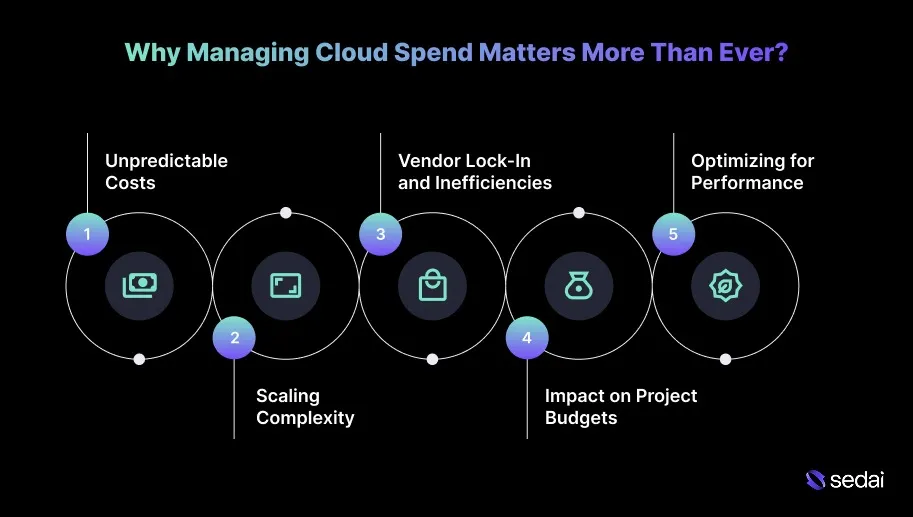
Why Managing Cloud Spend Matters More Than Ever?
Managing cloud spend is critical for you because the growing complexity of modern cloud environments makes costs escalate rapidly.
As more services, tools, and architectural components are introduced, tracking actual resource utilization becomes increasingly challenging.
Here’s why you need to manage cloud spend more than ever:
Unpredictable Costs: Usage-based pricing can lead to sudden cost spikes from traffic surges or misconfigured resources. You need clear visibility and control over consumption to avoid unexpected charges.
Scaling Complexity: As applications grow, cloud resources multiply quickly. Without continuous optimization, idle or overprovisioned resources accumulate, increasing costs.
Vendor Lock-In and Inefficiencies: Long-term commitments, such as Reserved Instances or savings plans, can become misaligned with changing workloads. Regular evaluation is needed to ensure they still provide value.
Impact on Project Budgets: Poor cost management can cause projects to exceed budgets even when technical goals are met. Infrastructure costs must be considered early in planning.
Optimizing for Performance and Cost: Cost management balances spend with performance and availability. Ongoing evaluation helps maintain reliable systems while keeping costs in check.
When cloud spend becomes a growing priority, the challenges teams face in optimizing costs become clearer.
Most cost visibility tools show you the problem. Book a demo to see how Sedai fixes it, taking autonomous action based on your actual workload behavior.
22 Common Challenges Teams Face With Cloud Cost Optimization & Solutions
Cloud cost optimization brings a distinct set of challenges for engineering teams, particularly as cloud environments become larger and more complex.
Effectively addressing these challenges requires strategic planning, continuous monitoring, and ongoing optimization to ensure resources match real-time demand while reducing unnecessary spend.
Below is a list of common challenges teams face and their effective solutions.
1.Lack of Cloud Cost Visibility and Billing Transparency
Cloud providers use complex pricing models that can be hard to interpret, leaving engineers with limited visibility into where costs are being incurred.
Without detailed billing transparency, identifying inefficiencies becomes difficult, leading to unexpected cloud spend.
How to Solve:
Use Cost Allocation Tags: Implement detailed cost allocation tags for each service, project, or team. This enables engineers to track and assign costs accurately, making it easier to spot inefficiencies and optimize resource usage.
Use Cloud Cost Management Tools: Utilize tools to gain detailed insights into cost distribution across resources. These tools provide granular visibility, helping teams identify opportunities for optimization.
Set Up Cost Alerts: Configure custom alerts to notify you when costs exceed predefined thresholds. This ensures engineers are informed before costs escalate, enabling proactive cost management.
Review Billing Reports Regularly: Schedule routine reviews of cloud billing reports to monitor usage and spending. Regular checks help catch anomalies early and adjust resources before costs accumulate.
Consolidate Billing for Multi-Cloud Environments: For organizations using multiple cloud providers, consider a consolidated billing approach. Platforms can aggregate billing data from various providers, providing a unified view that makes cost tracking simpler and more actionable.
2.Mismanagement of Cloud Resources and Over-Provisioning
Over-provisioning occurs when engineers allocate more resources than necessary, either as a safety measure or due to uncertainty about actual demand. This results in inefficiencies and unnecessary costs, as unused resources are still being paid for.
How to Solve:
Implement Auto-Scaling: Use auto-scaling to adjust resources dynamically based on real-time demand. This prevents over-provisioning by scaling up during peak periods and scaling down when demand drops.
Use Rightsizing Tools: Utilize tools to get data-driven recommendations on optimal resource sizes for workloads based on usage patterns.
Monitor Resource Utilization: Continuously track resource utilization to identify underused resources. Periodically review metrics such as CPU, memory, and storage usage to ensure resources are appropriately provisioned.
Limit Excess Provisioning: Avoid allocating excess capacity by default. Provision resources based on realistic usage expectations rather than worst-case assumptions.
Use Discounted Compute Options for Flexible Workloads: Run non-critical or interruptible workloads on lower-cost compute options to reduce spend without impacting core services.
3.Complexity of Managing Multi-Cloud Environments
Managing resources across multiple cloud providers (AWS, Azure, GCP) increases complexity in billing, governance, and integration. This often leads to fragmented data and inefficiencies in cost management.
How to Solve:
Use Multi-Cloud Management Tools: Implement platforms to provide a unified view of costs and usage across multiple clouds, simplifying monitoring and optimization efforts.
Standardize Resource Allocation Across Clouds: Provision similar resources consistently across all cloud environments. This reduces management complexity and ensures optimized performance.
Establish Centralized Governance: Define centralized policies for resource management, budgeting, and monitoring. Ensure all cloud environments adhere to consistent cost control strategies.
Consolidate Billing: Where possible, centralize billing into a single account or system to avoid fragmentation and provide clear visibility across all clouds.
Perform Cross-Cloud Cost Analysis: Regularly compare pricing models across providers to determine the most cost-efficient placement for workloads, balancing cost and performance requirements.
4.Challenges with Reservations and Savings Plans Management
Engineers may struggle with Reserved Instances (RIs) or Savings Plans due to incorrect usage patterns or over-committing resources. This can lead to missed savings or wasted spend on underutilized RIs.
How to Solve:
Analyze Usage Patterns: Review historical usage data to identify steady-state workloads that are suitable for long-term commitments.
Start with Limited Commitments: Begin with smaller reservations for predictable workloads to reduce risk while still capturing savings.
Use Flexible Commitment Options: Choose commitment models that allow changes in instance types or configurations as workload needs change.
Monitor Commitment Utilization: Track how effectively reservations and savings plans are being used and adjust commitments to avoid over- or under-utilization.
Automate Commitment Management: Use automation to manage renewals and adjustments, reducing reliance on manual tracking and minimizing errors.
5.Delayed or Missing Adoption of Automated Cloud Optimization
Relying on manual optimization or delaying automated cloud cost management tools leads to missed savings and inefficient resource usage.
How to Solve:
Adopt Cloud-Native Automation: Use built-in automation features to adjust resources automatically based on real-time demand.
Integrate Optimization Platforms: Use tools that automate rightsizing, scaling, and scheduling to reduce manual effort.
Enable Continuous Optimization: Move away from periodic optimization and adopt systems that continuously monitor usage and recommend improvements.
Implement Auto-Shutdown Policies: Automatically shut down non-production environments during idle hours to prevent unnecessary spend.
Move Beyond Automation to Autonomous Optimization: While automation reacts to predefined rules, autonomous platforms likeSedai continuously analyze workload behavior and take safe optimization actions independently. This reduces the need for constant tuning and helps teams capture savings that manual rules or static automation often miss.
6.Cultural Barriers to Cloud Cost Accountability
Cloud cost accountability is often spread across multiple teams, resulting in unclear ownership. Without clear responsibility, engineers may not prioritize controlling cloud costs, reducing the effectiveness of optimization initiatives.
How to Solve:
Assign Cloud Cost Owners: Designate teams or individuals responsible for monitoring and optimizing cloud costs, creating accountability at all levels.
Implement Chargeback/Showback Models: Introduce chargeback or showback systems to hold teams accountable for their incurred costs, fostering awareness and responsibility.
Align Engineering and Finance Teams: Facilitate collaboration between engineering and finance teams to align on cost management goals and ensure shared understanding of resource usage and its financial impact.
Embed Cost Awareness into Development: Integrate cost considerations into the development and deployment lifecycle so engineers make cost-efficient decisions from the outset.
Encourage a Cost-Conscious Culture: Promote cloud cost optimization as an organizational priority, making cost management a KPI for teams and encouraging responsible usage across the board.
7.Vendor Lock-In Risks
Relying heavily on a single cloud provider can create dependency on that provider’s pricing and services, limiting flexibility and making it difficult to optimize costs or migrate to a more cost-effective solution in the future.
How to Solve:
Adopt a Multi-Cloud Strategy: Distribute workloads across multiple cloud providers to reduce dependence on a single vendor. This improves flexibility and enables organizations to use each provider’s pricing and service strengths.
Use Open-Source and Interoperable Tools: Utilize platform-agnostic tools and services to ensure workloads can be transferred between providers without extensive rework.
Negotiate Contracts with Flexibility: When engaging with a cloud provider, secure contract terms that support scaling or migration. Avoid long-term agreements that lock you into one specific platform.
Evaluate the Cost Impact of Lock-In: Regularly assess the total cost of ownership for each provider, factoring in migration costs and long-term flexibility, to ensure lock-in remains the most cost-effective choice.
8.Security and Compliance-Related Costs
Maintaining security and compliance in cloud environments often requires additional tools, configurations, and resources, increasing costs, especially in regulated industries.
How to Solve:
Automate Security and Compliance Monitoring: Utilize tools to automatically monitor security and compliance, reducing the need for manual intervention.
Choose Cloud Services with Built-In Security: Opt for services that offer integrated security features, such as encryption, identity management, and compliance certifications, to minimize reliance on expensive third-party solutions.
Optimize Security Configurations: Periodically review and refine security settings, eliminating unnecessary layers that add cost without proportionate value.
Consolidate Security and Compliance Tools: Reduce duplication by standardizing on a smaller set of security and compliance solutions across environments.
9.Inefficient Resource Utilization
Underutilized resources, like oversized instances or idle storage, drive unnecessary cloud costs. Without regular monitoring and adjustment, inefficiencies accumulate.
How to Solve:
Implement Continuous Monitoring: Use tools to track resource utilization in real time, with alerts for underutilization or idle resources.
Rightsize Instances Regularly: Apply cloud recommendations (e.g., AWS Compute Optimizer) to identify over-provisioned instances and adjust sizes periodically to match actual workloads.
Auto-Shutdown and Scheduling: Configure automated shutdown policies for development or testing environments during off-hours to prevent wasted spend.
Use Serverless Options: Transition workloads with low or unpredictable demand to serverless architectures to reduce the risk of over-provisioning.
Cloud Cost Optimization Challenges Resolved Through Continuous Autonomous Action, Not Manual To-Do Lists
See how Sedai addresses the full spectrum of cloud cost optimization challenges by continuously acting on workload behavior rather than surfacing recommendations for engineers to prioritize.
10.Overall Cloud Environment Complexity
As organizations scale, cloud environments become increasingly complex, making it harder for engineers to monitor and manage costs across multiple services and accounts.
How to Solve:
Consolidate and Simplify Environments: Reduce the number of cloud accounts, regions, and services, and standardize configurations to simplify cost and resource management.
Adopt Infrastructure-as-Code (IaC): Use Terraform, CloudFormation, or Azure ARM templates to define infrastructure in code, ensuring repeatable, predictable, and easier-to-manage environments.
Use Centralized Monitoring and Cost Management Tools: Implement platforms like AWS Control Tower to provide a single pane of glass for monitoring and managing resources across environments.
Perform Regular Audits: Conduct routine audits of cloud configurations to identify and decommission unused or redundant services, maintaining efficiency.
11.Balancing Performance and Cost
You must optimize cloud resources to control costs while maintaining required performance, especially for latency-sensitive applications or large-scale systems.
How to Solve:
Use Performance Benchmarks: Continuously benchmark performance with tools to understand the impact of cost adjustments and optimize accordingly.
Implement Auto-Scaling for Performance: Apply auto-scaling policies to dynamically adjust resources based on performance needs, ensuring optimal operation while controlling costs.
Optimize Resource Allocation: Select instance types and storage configurations based on performance requirements and monitor utilization to prevent over-allocation.
Prioritize Workloads: Categorize workloads by priority, running critical services on high-performance instances and lower-priority workloads on cost-effective options like spot instances.
12.Weak Cloud Governance Frameworks
Without a strong governance framework, organizations struggle to enforce policies around cloud resource usage, resulting in inefficient allocation and unpredictable costs.
How to Solve:
Implement Cloud Governance Policies: Define clear policies specifying usage guidelines for instance sizes, storage limits, and security configurations.
Use Tools for Policy Enforcement: Utilize platforms to automate policy enforcement across accounts and regions.
Establish Cost Allocation Rules: Assign costs to projects, teams, or departments to ensure ownership and accountability for cloud spending.
Automate Compliance Audits: Use tools to automatically verify that resources adhere to governance and security standards.
13.Poor Cloud Architecture Design
Suboptimal cloud architecture can lead to inefficient resource use, increasing costs. This may stem from overly complex setups, improper scaling, or unevenly distributed workloads.
How to Solve:
Adopt Modular Architectures: Break applications into smaller components to improve scaling and resource allocation.
Use Managed Services Where Possible: Rely on managed services to reduce operational overhead and infrastructure management costs.
Design for Elasticity: Ensure architectures can scale automatically based on real-time demand.
Simplify System Design: Minimize the number of services and dependencies to reduce misconfigurations and waste.
14.Complex and Hard-to-Interpret Billing Models
Cloud providers’ intricate billing models can make it difficult for engineers to understand costs, potentially leading to missed optimization opportunities.
How to Solve:
Use Cost Management Tools: Utilize tools to gain detailed insights into how services and resources contribute to overall spend.
Understand Pricing Models: Learn service pricing structures, including pay-as-you-go, reserved, or spot pricing, to optimize resource choices.
Set Up Cost Allocation Tags: Tag resources by team, project, or department to provide visibility into spending and accountability.
Regularly Review Billing Reports: Conduct frequent reviews to identify discrepancies and ensure costs align with usage and operational needs.
15.Inaccurate Budget Forecasting and Cost Planning
Without accurate forecasts, predicting cloud costs is difficult, resulting in budget overruns and unexpected expenses.
How to Solve:
Use Historical Data for Forecasting: Use past usage to predict future costs and adjust budgets. Tools can provide forecasting based on historical trends.
Implement Cost Planning Models: Develop cost models considering workloads, instance usage, and data transfers, updating them as workloads evolve.
Set Up Alerts for Budget Breaches: Configure notifications to alert teams when spending approaches thresholds, enabling timely action.
Review Forecasts Regularly: Conduct monthly or quarterly evaluations of cloud spend and adjust forecasts to reflect changes in workloads, scaling, or pricing.
16.Ever-Changing Cloud Pricing Models
Cloud pricing changes continuously, making it challenging to maintain optimal cost strategies.
How to Solve:
Stay Informed About Pricing Changes: Monitor provider updates for new discounts, services, or models that could reduce costs.
Use Savings Plans and Reserved Instances Strategically: Utilize options like AWS Savings Plans, Azure Reserved Instances, or Google Committed Use Discounts, while monitoring their cost-effectiveness.
Automate Pricing Adjustments: Implement tools that dynamically switch between pricing options, such as reserved or spot instances, based on usage patterns.
Benchmark Across Providers: Compare costs across providers regularly to refine multi-cloud strategies and choose the most cost-efficient solutions.
Cost spikes may result from misconfigurations, inefficient scaling, or sudden usage increases. Quickly identifying and addressing these spikes is often challenging.
How to Solve:
Set Up Cost Anomaly Detection: Implement monitoring tools to alert teams to sudden cost increases.
Analyze Historical Cost Trends: Use AWS Cost Explorer or Google Cloud Billing Reports to identify trends and anticipate potential spikes.
Enable Resource Monitoring: Continuously track usage and set alerts for unusual activity, such as spikes in compute or data transfer.
Create a Cost Response Plan: Develop SOPs for managing cost spikes, including root cause analysis, temporary cost controls, and configuration adjustments to prevent recurrence.
18.Lack of Skilled Cloud and FinOps Talent
Managing cloud costs effectively requires expertise in both cloud architecture and financial operations, a combination that many engineering teams lack. This skills gap can limit teams’ ability to optimize resources and control spend.
How to Solve:
Invest in Training: Provide engineers and operations teams with FinOps and cloud certifications, such as AWS Certified Cloud Practitioner or Azure Fundamentals, to build foundational financial and cloud knowledge.
Build Cross-Functional Teams: Encourage collaboration between engineering, finance, and operations to create shared responsibility for cloud costs and bridge knowledge gaps.
Hire Specialized Talent: Where possible, bring in FinOps specialists or cloud financial engineers to provide expertise and directly drive cost optimization.
19.Performance Tracking and Benchmarking Challenges
Measuring cloud resource performance relative to cost is complex. Without benchmarks, it’s difficult to assess whether cost-saving measures are impacting the expected performance.
How to Solve:
Implement Key Performance Indicators (KPIs): Define metrics like latency, throughput, and response times to track cloud performance against expectations,
Benchmark Regularly: Use tools to compare current performance with industry standards and internal benchmarks.
Optimize Based on Metrics: Continuously adjust resources according to performance data, scaling or rightsizing as needed to maintain efficiency.
Conduct Load Testing: Perform load simulations during peak and off-peak periods to evaluate resource requirements and ensure cost-effective performance.
20.Real-Time Cost and Usage Decision-Making Difficulties
Making immediate decisions about resource allocation is challenging without proper tools, which can lead to over-provisioning or inefficient utilization.
How to Solve:
Adopt Real-Time Cost Optimization Tools: Use platforms for live insights and recommendations on resource adjustments.
Set Up Real-Time Dashboards: Monitor cost and usage through dashboards like AWS Cost Explorer or Google Cloud Console to enable informed, instant decisions.
Develop Cost Optimization Policies: Establish automated policies for scaling down resources when workloads are underutilized or costs exceed thresholds.
21.Cloud Rate Optimization Challenges
Frequent changes in cloud rates, new pricing models, or discounts make it difficult for engineers to consistently secure cost-effective options.
How to Solve:
Stay Updated on Pricing Changes: Regularly monitor provider updates, subscribe to newsletters, or use alerts to track pricing changes.
Use Cost Management Platforms: Utilize tools to continuously analyze pricing and generate optimized recommendations.
Automate Resource Pricing Changes: Implement automation that adjusts resource usage to the most cost-effective pricing options, such as switching to Spot or Reserved Instances when rates are favorable.
22.Organizational Misalignment Between Engineering, Finance, and Leadership
When engineering, finance, and leadership teams aren’t aligned on cloud cost objectives, optimization efforts can become fragmented, reducing overall efficiency.
How to Solve:
Establish Clear Communication Channels: Set up regular reporting and meetings to align stakeholders on cloud spend goals.
Define Shared Goals: Ensure all teams have measurable, common objectives, such as reducing cloud spend by a defined percentage or improving resource utilization.
Use Cross-Functional Teams: Form teams combining technical and financial expertise to collaboratively implement cost optimization strategies.
Incorporate Cloud Costs into Decision-Making: Embed cost considerations into organizational decision-making, ensuring leadership balances cost efficiency with performance and scalability priorities.
Recognizing these common challenges helps show how FinOps can play a key role in solving cloud cost optimization problems.
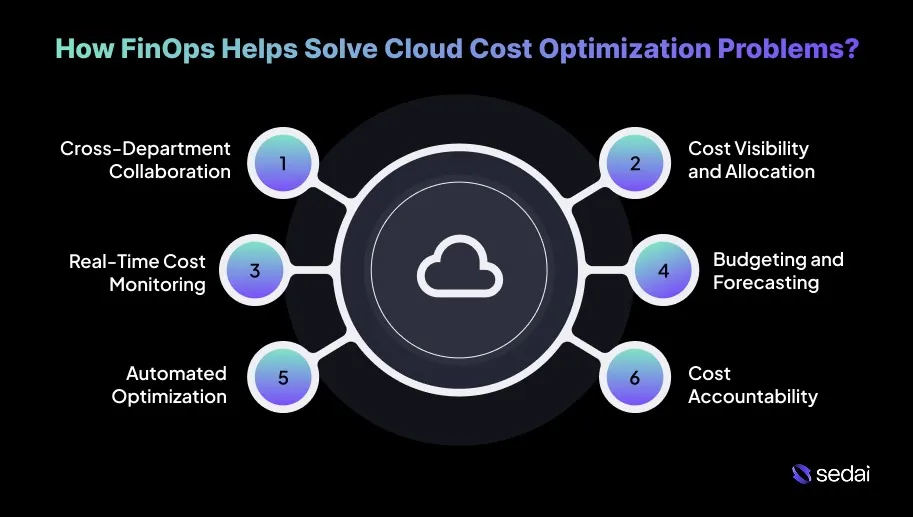
How FinOps Helps Solve Cloud Cost Optimization Problems?
FinOps (Financial Operations) provides the framework and tooling to gain real-time visibility into cloud costs, monitor spend, and make data-driven decisions to optimize resources. Here’s how it works:
1.Cross-Department Collaboration
You often lack visibility into the financial impact of their decisions, and finance teams may not fully understand the technical resources used.
FinOps promotes collaboration by integrating financial insights into engineering workflows, ensuring you’re aware of cost implications. It also provides finance teams with the technical data needed for accurate cloud spend tracking.
2.Cost Visibility and Allocation
Without granular cost visibility, you cannot effectively optimize resources. FinOps provides detailed cost-allocation tags and dashboards, enabling you to track usage at a granular level and pinpoint inefficiencies for real-time optimization.
3.Real-Time Cost Monitoring
Cloud costs can fluctuate rapidly, and you need to respond quickly to avoid overspending.
FinOps enables real-time monitoring and alerts, allowing you to detect cost anomalies or budget breaches and take immediate action. This adjusts resources or scales down underused services.
4.Budgeting and Forecasting
Cloud spend can escalate without proper forecasting. FinOps uses historical data to help engineers forecast future costs, align resource planning with budget constraints, and prevent unexpected spending spikes.
5.Automated Optimization
Manual cloud cost optimization can be tedious and error-prone. FinOps integrates with optimization tools to automatically apply cost-saving actions such as rightsizing and instance switching. This ensures resources remain optimized without constant intervention.
6.Cost Accountability
You often lack direct insight into the financial impact of their cloud decisions. FinOps ensures accountability by linking costs to specific teams, projects, or services. This encourages you to make more cost-conscious decisions when configuring or scaling cloud resources.
Twenty-two challenges means twenty-two places costs can escape undetected. Book a demo to see how Sedai addresses each one through continuous, autonomous action, not a to-do list.
How Sedai Improves Cloud Cost Optimization and Efficiency?
Many organizations struggle to manage cloud costs effectively across their infrastructure, often relying on static policies or manual adjustments that fail to adapt in real time.
Sedai differentiates itself by delivering autonomous cloud cost optimization that continuously adjusts resources and usage based on real-time workload behavior.
Unlike traditional cloud cost management tools that focus mainly on reporting inefficiencies or offering static recommendations, Sedai continuously learns from actual cloud performance metrics and automatically aligns resources with workload requirements.
Using advanced machine learning models, Sedai enables cost savings by optimizing resource utilization across a wide range of cloud services, while consistently maintaining performance and efficiency.
Sedai analyzes real workload behavior and dynamically adjusts compute and storage allocations to avoid both over- and under-provisioning. This real-time rightsizing helps reduce waste by over 30% while maintaining consistent application performance.
Intelligent Instance and Service Type Optimization
Sedai evaluates resource consumption patterns across the cloud environment to identify the most efficient service types and instance sizes. This ensures optimal resource usage, reduces idle capacity, and can improve performance, all while keeping costs under control.
Autonomous Scaling Decisions
Using machine learning-driven insights, Sedai automatically scales resources based on demand patterns. This approach reduces reliance on static thresholds and manual intervention, resulting in up to 70% fewer service degradation events and improved overall reliability.
Automated Cost and Performance Remediation
Sedai continuously detects performance degradation, resource pressure, or instability and resolves these issues before they impact workloads. This proactive remediation increases engineering productivity by up to 6x, allowing teams to focus more on innovation rather than ongoing infrastructure management.
Comprehensive Cloud Optimization (Full-Stack)
Sedai delivers full-stack optimization across compute, storage, networking, and commitment levels, ensuring autoscaling remains cost-efficient, and resource utilization stays at peak efficiency. This holistic optimization approach can drive up to 50% cost savings.
Multi-Cloud and Multi-Environment Support
Sedai operates seamlessly across AWS, Azure, Google Cloud, and on-prem environments using a unified optimization engine. This consistency enables scalable cost and resource management in complex multi-cloud architectures. Sedai has already managed$3.5 million in cloud spend, showing its ability to perform effectively at scale.
SLO-Driven Resource Scaling
Sedai aligns scaling decisions with definedService Level Objectives (SLOs) and Service Level Indicators (SLIs), ensuring performance and reliability remain prioritized during workload fluctuations. This ensures that scaling decisions support application performance rather than compromise it.
With Sedai, organizations can optimize every layer of their cloud environment, improving efficiency while reducing waste and operational complexity.
If you want to optimize cloud costs and resource usage with Sedai, tryour ROI calculator to estimate the potential return on investment from scaling efficiently, reducing waste, and improving overall performance.
Final Thoughts
Cloud cost optimization is a continuous effort that demands ongoing monitoring, regular adjustments, and close alignment between resources and actual usage.
As cloud environments scale, relying solely on manual approaches is no longer practical, making automation and intelligent systems essential for sustainable cost control. This shift shows why many organizations are adopting autonomous optimization solutions.
Platforms likeSedai enable engineering teams to automatically adjust resources, identify cloud cost trends, and apply optimizations based on real-time workload behavior.
By including intelligence directly into the optimization process, Sedai helps ensure resources are used efficiently, costs remain controlled, and engineers can focus more on building systems rather than managing infrastructure.
Q1. What are the core principles of cloud cost optimization?
A1. The core principles include visibility through comprehensive tagging and cost attribution, governance and accountability supported by a FinOps culture, and continuous optimization rather than one-time cost cuts.
Q2. What are the key success metrics and KPIs for cloud cost optimization?
A2. Key metrics include cost per workload or unit economics, waste rate or idle resource cost, percentage of spend under committed pricing, and variance against forecast or budget.
Q3. What are the future trends in cloud cost management?
A3. Future trends include AI- and ML-driven optimization recommendations that identify resource needs, autonomic or self-optimizing cloud platforms that scale and reconfigure resources automatically. It also includes integrating cost and sustainability considerations, where reducing spend also supports lower carbon emissions.
Q4. What is the implementation framework and roadmap for cloud cost optimization?
A4. The cloud cost optimization roadmap involves four key phases:
Phase 1: Assessment and Benchmarking: Audit resources, set baseline spending, and identify quick wins.
Phase 2: Pilot and Quick Wins: Apply a few high-impact, low-risk optimizations like rightsizing instances or scheduling shutdowns.
Phase 3: Full Rollout and Automation: Scale successful pilots, automate optimization, and integrate into workflows.
Phase 4: Governance and Review: Conduct regular reviews to monitor spending, adjust strategies, and optimize workload placement continuously.
Q5. How can containerization help with cloud cost optimization?
A5. Containerization helps improve resource efficiency by isolating applications into containers that can scale dynamically based on demand. Using Kubernetes or other container orchestration platforms ensures resources are allocated only when required, improving cost efficiency and minimizing waste caused by idle resources.
Top Strategies for Google Dataflow Cost Optimization in 2026
Google Dataflow is a powerful tool for processing large-scale data, but its costs can quickly add up without proper management. Optimizing Google Dataflow costs is crucial for organizations looking to maximize the value of their data processing pipelines while minimizing expenses.Cost optimization involves a combination of strategies, techniques, and best practices that help users effectively manage and reduce the costs associated with running Dataflow jobs. By understanding the factors that influence Dataflow pricing and implementing targeted optimizations, organizations can significantly improve their cost efficiency and overall return on investment.
Best Practices for Optimizing Google Persistent Disk Costs in 2026
Google Persistent Disk (PD) is a durable and high-performance block storage solution designed to support a wide range of workloads on Google Cloud Platform (GCP). As organizations increasingly rely on cloud infrastructure to power their applications and services, optimizing persistent disk performance becomes crucial for ensuring optimal efficiency and cost-effectiveness.In the rapidly evolving cloud landscape, staying informed about the latest optimization strategies is essential for businesses looking to maximize the value of their GCP investments. By understanding the nuances of persistent disk types, performance metrics, and best practices, organizations can unlock the full potential of their cloud storage infrastructure.This article explores the key aspects of Google Persistent Disk optimization in 2026, providing actionable insights and recommendations to help businesses achieve their performance and cost objectives. From choosing the right disk type to leveraging advanced features and monitoring techniques, we will delve into the best practices that can drive significant improvements in your GCP storage environment.
Top Practices for Optimizing Google Cloud Compute Costs in 2026
In 2026, cloud cost optimization remains a top priority for businesses as they navigate an increasingly complex landscape of cloud services and pricing models. Enterprises must adopt effective strategies to manage their Google Cloud expenses while ensuring optimal performance and resource utilization.As cloud computing continues to evolve, organizations face the challenge of balancing innovation with cost-efficiency. To stay competitive, businesses must leverage the latest tools and best practices to optimize their Google Cloud infrastructure and maximize their return on investment.Achieving cost optimization in Google Cloud requires a proactive approach that involves understanding pricing models, implementing automated management tools, and continuously monitoring and adjusting resources based on workload requirements. By following best practices and leveraging advanced technologies, organizations can significantly reduce their cloud expenses without compromising on performance or availability.