Cloud Cost Optimization Framework & Best Practices
What is a cloud cost optimization framework?
A cloud cost optimization framework is a structured, strategic approach to controlling and optimizing your cloud spending. It focuses on ongoing monitoring, analysis, and adjustment of cloud resources to reduce costs while maintaining performance and reliability. The framework addresses visibility, right-sizing, cost allocation, and governance to ensure efficient cloud usage.
Why is visibility important in cloud cost optimization?
Visibility is crucial because without clear insight into cloud resource usage, it's difficult to identify inefficiencies or accurately track expenses. A cloud cost optimization framework establishes consistent tracking and monitoring practices using cloud-native billing tools and third-party cost management platforms, enabling organizations to make informed optimization decisions and forecast costs accurately.
How does over-provisioning impact cloud costs?
Over-provisioning occurs when engineers allocate more resources than required, leading to avoidable cloud costs. The framework encourages right-sizing and auto-scaling to align resource usage with real demand, minimizing waste and keeping spending closely aligned with actual workload requirements.
What are the 11 steps in the cloud cost optimization framework?
The 11 steps are: 1) Analyze spending data, 2) Create a tagging policy, 3) Establish a showback or chargeback strategy, 4) Define a cloud budget, monitoring, and alerts, 5) Look for anomalies, 6) Identify underutilized resources, 7) Evaluate existing reserved instances, 8) Automate cost optimization measures, 9) Establish a culture of cloud cost optimization, 10) Right-size purchase commitments and resources, and 11) Continuously improve and optimize cloud costs.
How can I measure the impact of cloud cost optimization on my business performance?
Cloud cost optimization directly influences business performance by improving ROI and reducing wasted spend. You can measure its impact by tracking reductions in operational costs, improvements in service delivery times, and changes in overall resource efficiency.
How do I balance performance and cost in cloud environments?
Balancing performance and cost starts with understanding workload behavior and usage patterns. Techniques such as auto-scaling, reserved instances, and serverless computing help meet performance demands without overprovisioning resources.
What are common challenges in cloud cost optimization?
Common challenges include unpredictable cloud spending, over-provisioned resources, inefficient use of reserved instances, lack of cost ownership across teams, underutilized cloud services, complex pricing models, and sprawl of cloud services. Solutions involve cost forecasting, right-sizing, governance, and automation.
What metrics and KPIs should I track for cloud cost optimization?
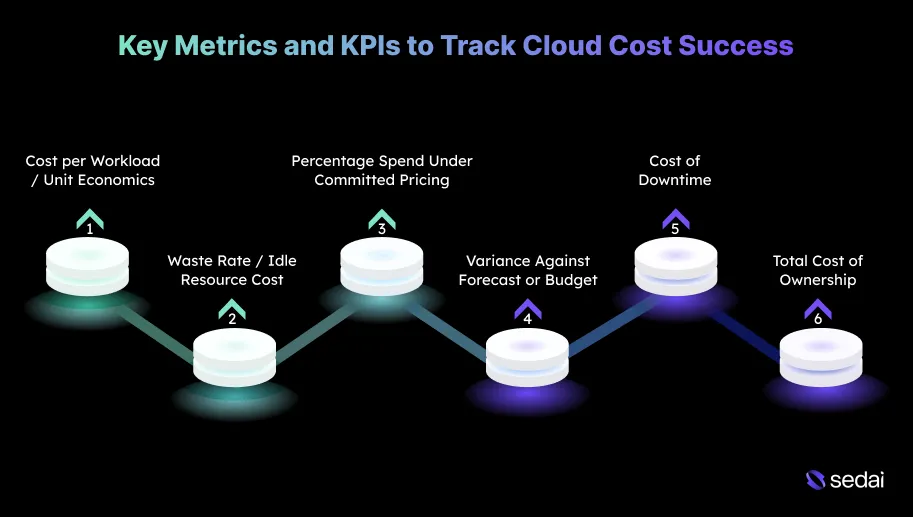
Key metrics include cost per workload/unit economics, waste rate/idle resource cost, percentage spend under committed pricing, variance against forecast or budget, cost of downtime, and total cost of ownership (TCO). Tracking these helps maintain effective cloud cost management.
What are the future trends in cloud cost optimization?
Future trends include AI-driven cloud cost management, serverless architectures, multi-cloud and hybrid optimization, containerization and Kubernetes for cost control, FinOps integration, edge computing, cost-efficient regions, and advanced automation tools.
How does Sedai improve cloud cost optimization?
Sedai delivers autonomous cloud cost optimization by continuously adjusting resources based on real-time workload behavior. It uses machine learning to optimize resource utilization, prevent over- and under-provisioning, and maintain consistent performance and efficiency. Sedai's approach can drive up to 50% cost savings and has managed $3.5 million in cloud spend at scale.
What misconceptions exist about cloud cost optimization?
A common misconception is that cloud cost optimization is only about reducing resources. In reality, it focuses on aligning resources with actual business needs, right-sizing workloads, improving resource allocation, and using flexible pricing models to maximize value.
How often should I review my cloud cost optimization strategies?
Cloud cost optimization strategies should be reviewed at least quarterly to ensure alignment with evolving workloads and business objectives. More frequent reviews may be needed during periods of rapid growth or significant changes in usage patterns.
How does AI-driven cloud optimization handle demand spikes?
AI-driven optimization tools can respond to sudden demand spikes by adjusting resource allocations in real time. These tools automatically trigger scaling actions during traffic surges and scale resources down during low-usage periods, ensuring cost efficiency and performance.
How does Sedai's autonomous optimization differ from traditional tools?
Unlike traditional tools that rely on static policies or manual adjustments, Sedai uses machine learning to autonomously optimize cloud resources in real time. It continuously learns from actual cloud performance metrics and automatically aligns resources with workload requirements, reducing waste and improving efficiency.
What is real-time resource rightsizing in Sedai?
Sedai analyzes workload behavior and dynamically adjusts compute and storage allocations to prevent over- and under-provisioning. This real-time rightsizing reduces waste by over 30% while maintaining consistent application performance.
How does Sedai support multi-cloud and hybrid environments?
Sedai operates seamlessly across AWS, Azure, Google Cloud, and on-prem environments with a unified optimization engine. This enables scalable cost and resource management in complex multi-cloud architectures.
How does Sedai use SLO-driven resource scaling?
Sedai aligns scaling decisions with Service Level Objectives (SLOs) and Service Level Indicators (SLIs), ensuring performance and reliability remain priorities during workload fluctuations.
What is the role of automation in cloud cost optimization?
Automation reduces manual effort and ensures that optimization actions are consistently and continuously applied. Implementing auto-scaling, scheduled shutdowns, and AI-driven optimization platforms helps maintain cost efficiency and reduces the risk of human error.
How does Sedai help with cost allocation and ownership?
Sedai supports structured tagging strategies and integrates with showback and chargeback models, making cost ownership clear and improving financial transparency. This enables more accurate forecasting and accountability across teams and projects.
Features & Capabilities
What features does Sedai offer for cloud cost optimization?
Sedai offers autonomous optimization, proactive issue resolution, full-stack cloud coverage, smart SLOs, release intelligence, plug-and-play implementation, multiple modes of operation (Datapilot, Copilot, Autopilot), enhanced productivity, and safety-by-design. These features help reduce costs, improve performance, and ensure reliability across AWS, Azure, GCP, and Kubernetes environments. Learn more.
Does Sedai support integration with existing cloud tools?
Yes, Sedai integrates with a wide range of tools and platforms, including Cloudwatch, Prometheus, Datadog, Azure Monitor, GitLab, GitHub, Bitbucket, Terraform, ServiceNow, Jira, Slack, Microsoft Teams, and various runbook automation platforms. This ensures seamless integration into your existing workflows. See all integrations.
What is Sedai's approach to proactive issue resolution?
Sedai detects and resolves performance and availability issues before they impact users, reducing failed customer interactions by up to 50% and ensuring seamless operations. This proactive approach minimizes downtime and enhances reliability.
How does Sedai's release intelligence feature work?
Sedai's release intelligence tracks changes in cost, latency, and errors for each deployment, ensuring smoother releases and minimizing risks. This feature helps improve release quality and reduce deployment-related incidents.
What modes of operation does Sedai provide?
Sedai offers three modes of operation: Datapilot (observability), Copilot (one-click optimizations), and Autopilot (fully autonomous execution). This flexibility allows organizations to choose the level of automation that fits their needs.
How does Sedai ensure safe and auditable changes?
Sedai integrates with Infrastructure as Code (IaC), IT Service Management (ITSM), and compliance workflows to ensure all changes are safe, auditable, and reversible. This safety-by-design approach guarantees compliance and operational integrity.
What productivity gains can Sedai deliver?
Sedai automates routine tasks like capacity tweaks, scaling policies, and configuration management, delivering up to 6X productivity gains. This allows engineering teams to focus on high-value work and innovation.
How does Sedai continuously improve its optimization models?
Sedai continuously learns from interactions and outcomes, evolving its optimization and decision models over time to deliver better results and adapt to changing environments.
What technical documentation is available for Sedai?
Sedai provides detailed technical documentation covering features, setup, and usage. Access the documentation at https://docs.sedai.io/get-started and explore additional resources, case studies, and guides at https://sedai.io/resources.
Use Cases & Business Impact
What business impact can customers expect from using Sedai?
Customers can achieve up to 50% reduction in cloud costs, 75% latency reduction, 6X productivity gains, and 50% fewer failed customer interactions. Notable results include Palo Alto Networks saving $3.5 million and KnowBe4 achieving 50% cost savings in production. See case studies.
Who can benefit from using Sedai?
Sedai is designed for platform engineers, IT/cloud operations teams, technology leaders (CTO, CIO, VP Engineering), site reliability engineers (SREs), and FinOps professionals in organizations with significant cloud operations across industries such as cybersecurity, IT, financial services, healthcare, travel, and e-commerce.
What industries are represented in Sedai's case studies?
Sedai's case studies cover cybersecurity (Palo Alto Networks), IT (HP), financial services (Experian, CapitalOne Bank), security awareness training (KnowBe4), travel and hospitality (Expedia), healthcare (GSK), car rental services (Avis), retail and e-commerce (Belcorp), SaaS (Freshworks), and digital commerce (Campspot). See all case studies.
Can you share specific customer success stories with Sedai?
Yes. KnowBe4 achieved up to 50% cost savings and saved $1.2 million on AWS bills. Palo Alto Networks saved $3.5 million, reduced Kubernetes costs by 46%, and saved 7,500 engineering hours. Belcorp reduced AWS Lambda latency by 77%. Read KnowBe4's story, Palo Alto Networks.
What pain points does Sedai address for cloud teams?
Sedai addresses pain points such as fragmentation, repetitive toil, risk vs. speed, autoscaler limits, ticket queues, config drift, hybrid complexity, capacity/cost surprises, outcome gaps, cloud spend pressure, tool sprawl, and talent bandwidth constraints. It automates optimization, aligns priorities, and reduces manual effort.
What core problems does Sedai solve?
Sedai solves cost inefficiencies, operational toil, performance and latency issues, lack of proactive issue resolution, complexity in multi-cloud/hybrid environments, and misaligned priorities between engineering and FinOps teams. It delivers autonomous optimization, actionable insights, and improved reliability.
How quickly can Sedai be implemented?
Sedai's setup process takes just 5 minutes for general use cases and up to 15 minutes for specific scenarios like AWS Lambda. For complex environments, timelines may vary. Personalized onboarding and extensive documentation are available. Get started here.
How easy is it to start using Sedai?
Sedai offers plug-and-play implementation, agentless integration via IAM, personalized onboarding sessions, a dedicated Customer Success Manager for enterprise customers, and a 30-day free trial. Extensive resources and support are available to ensure a smooth start. Start your free trial.
Competition & Differentiation
How does Sedai compare to other cloud optimization tools?
Sedai stands out with 100% autonomous optimization, proactive issue resolution, application-aware intelligence, full-stack cloud coverage, release intelligence, and rapid plug-and-play implementation. Unlike competitors that rely on static rules or manual adjustments, Sedai continuously optimizes based on real application behavior and outcomes. See feature comparison.
What unique features set Sedai apart from competitors?
Sedai's unique features include 100% autonomous optimization, proactive issue resolution, application-aware intelligence, full-stack coverage, release intelligence, and a quick setup process. These capabilities address specific use cases and provide a competitive edge in cost savings, performance, and operational efficiency.
Are there advantages for different user segments with Sedai?
Yes. Platform engineers benefit from reduced toil and IaC consistency; IT/cloud ops teams see lower ticket volumes and safe automation; technology leaders gain measurable ROI and lower cloud spend; FinOps teams align engineering and cost goals; SREs experience fewer incidents and less manual work.
Security & Compliance
What security and compliance certifications does Sedai have?
Sedai is SOC 2 certified, demonstrating adherence to stringent security requirements and industry standards for data protection and compliance. Learn more about Sedai's security.
Customer Proof & Social Validation
Who are some of Sedai's customers?
Sedai's customers include Palo Alto Networks, HP, Experian, KnowBe4, Expedia, CapitalOne Bank, GSK, and Avis. These organizations trust Sedai to optimize their cloud environments and improve operational efficiency.
What feedback have customers given about Sedai's ease of use?
Customers highlight Sedai's quick plug-and-play setup (5–15 minutes), agentless integration, personalized onboarding, dedicated Customer Success Manager for enterprise clients, and extensive support resources. The 30-day free trial allows users to experience value firsthand.
The 11-Step Cloud Cost Optimization Framework in 2026
Benjamin Thomas
CTO
February 10, 2026
Featured
10 min read
Optimizing cloud costs requires a structured approach to track, analyze, and adjust resources across compute, storage, and networking. Key challenges such as underutilized resources, misaligned cost allocation, and inefficient scaling often result in wasted spend. By implementing a cloud cost-optimization framework, you can ensure ongoing visibility, right-size resources, and use pricing models such as Reserved Instances and Spot Instances. With continuous optimization and automated tools, you can maintain long-term control, keeping cloud expenses aligned with actual usage.
As cloud environments expand, managing costs effectively becomes challenging. Inefficiencies such as over-provisioned resources, misaligned cost allocation, and a lack of continuous optimization can result in significant waste.
Studies estimate that around30% of cloud spend goes toward unused or underutilized resources, including idle compute, orphaned storage, and oversized services.
The cloud cost optimization framework provides a structured approach to gain visibility, optimize resource use, and monitor spending.
In this blog, you’ll explore the 11-step cloud cost optimization framework in three phases to help you achieve long-term cloud cost efficiency.
Most cost visibility tools show you the problem. Book a demo to see how Sedai fixes it, taking autonomous action based on your actual workload behavior.
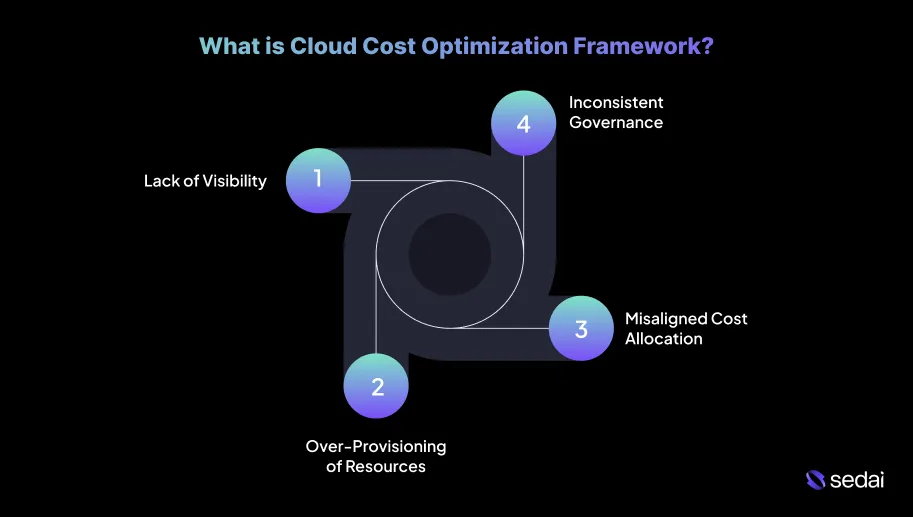
What is Cloud Cost Optimization Framework?
A cloud cost optimization framework is a structured, strategic approach to controlling and optimizing your cloud spending. It focuses on ongoing monitoring, analysis, and adjustment of cloud resources to reduce costs while maintaining performance and reliability.
Here’s why the cloud cost optimization framework matters:
1. Lack of Visibility
When teams lack clear visibility into cloud resource usage, identifying inefficiencies or accurately tracking expenses becomes difficult.
A cloud cost optimization framework addresses this by establishing consistent tracking and monitoring practices using cloud-native billing tools and third-party cost management platforms.
2. Over-Provisioning of Resources
It’s common for engineers to provision more resources than required, which leads to avoidable cloud costs. The framework encourages right-sizing and the use of auto-scaling to align resource usage with real demand.
This approach minimizes waste by ensuring resources are consumed only when needed, keeping spending closely aligned with actual workload requirements.
3. Misaligned Cost Allocation
The framework promotes a structured tagging strategy that assigns resources to specific teams, projects, or business units. This makes cost ownership clear, improves financial transparency, and enables more accurate forecasting based on real usage data.
4. Inconsistent Governance
A cloud cost optimization framework establishes clear policies for provisioning, approval workflows, and spending limits. These controls ensure resources are deployed intentionally and in line with business priorities and budget constraints.
Once you understand what a cloud cost optimization framework is, it becomes easier to break it down into the 11 practical steps that guide effective implementation.
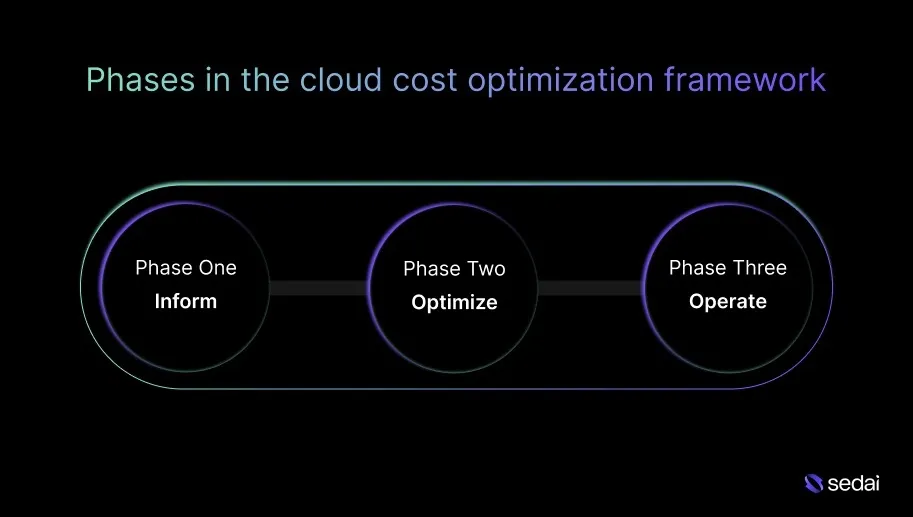
The cloud cost optimization framework is built around three key phases: Inform, Optimize, and Operate. These phases address a specific aspect of cost management, from improving visibility and understanding usage to implementing optimizations and driving continuous improvement.
Below are the 11 steps involved in these three phases in the cloud cost optimization framework.
Phase One: Inform
Cloud cost optimization starts with visibility and a clear understanding of your cloud environment. If you cannot see how resources are being used, it becomes difficult to make informed optimization decisions or forecast costs accurately.
In this phase, the focus is on tracking, analyzing, and allocating cloud costs to create transparency and accountability across the organization.
1. Analyze Spending Data
A clear analysis of spending data forms the foundation of effective cloud cost optimization. Without understanding historical usage patterns, it is difficult to build a reliable strategy for future savings.
How to Do It:
Use tools such as AWS Cost and Usage Report (CUR), Azure Cost Management, or Google Cloud Billing to gain detailed visibility into cloud spending across services, including compute, storage, reserved capacity, and data transfer.
Break down spending by department, team, application, and project to identify which resources are driving costs.
Review cost reports regularly to identify high-spend areas and uncover potential optimization opportunities.
Pitfall to Avoid: Analyzing data only at a high level can hide inefficiencies. A lack of granular insights often leads to inaccurate forecasts and missed cost optimization opportunities.
2. Create a Tagging Policy
Tagging enables accurate cost allocation across cloud resources. Without a structured tagging strategy, costs can quickly become difficult to track, reducing accountability and limiting optimization efforts.
How to Do It:
Define and enforce a consistent tagging strategy that includes business unit, environment, project, and cost center information.
Use automation to ensure resources are tagged correctly at deployment and remain compliant with tagging policies.
Perform regular audits to identify untagged or incorrectly tagged resources.
Pitfall to Avoid: Inconsistent or missing tags lead to incomplete cost visibility and inaccurate cost allocation, weakening optimization initiatives.
3. Establish a Showback or Chargeback Strategy
Showback and chargeback models introduce accountability by linking cloud costs directly to teams or projects. This encourages more responsible usage and informed decision-making.
How to Do It:
Begin with a showback model that provides visibility into usage and costs without billing teams directly.
Gradually move to a chargeback model where teams are billed based on actual consumption, reinforcing cost ownership.
Integrate chargeback reporting with internal financial systems to ensure accurate cost allocation.
Pitfall to Avoid: Without chargeback or showback mechanisms, teams may remain unaware of their cost impact, making it harder to drive meaningful savings.
4. Define a Cloud Budget, Monitoring, and Alerts
Budgets help control spending, while monitoring and alerts act as early warning systems for unexpected cost increases.
How to Do It:
Use historical usage data to create realistic budgets for applications, projects, and departments.
Configure monitoring and alerts using tools to notify teams when spending approaches defined thresholds.
Review and adjust budgets regularly to reflect changes in usage patterns and business growth.
Pitfall to Avoid: Failing to act on budget alerts can lead to unexpected cost overruns. Alerts should be configured to surface issues early, not after budgets are exceeded.
Phase Two: Optimize
The optimization phase focuses on actively identifying inefficiencies, monitoring usage in near real time, and taking corrective action to reduce waste. Cost optimization is an ongoing effort rather than a one-time exercise.
Cloud Cost Optimization Requires More Than Cost Visibility
See how Sedai automates cloud cost optimization by continuously identifying inefficiencies, rightsizing resources, and taking real-time actions to reduce spend while maintaining performance and reliability.
5. Look for Anomalies
Unexpected spikes in usage often indicate misconfigurations or inefficiencies. Identifying anomalies early helps prevent sustained cost increases.
How to Do It:
Analyze cost and usage data at an hourly level to detect unusual spending patterns.
Enable automated anomaly detection using AWS Cost Explorer, Azure Monitor, or third-party cost optimization platforms.
Pitfall to Avoid: Relying only on monthly summaries can hide short-term anomalies that gradually drive up costs over time.
6. Identify Underutilized Resources
Cloud providers charge for provisioned resources regardless of utilization. Underutilized resources are a common source of unnecessary spending.
How to Do It:
Audit compute instances, databases, and storage volumes to identify low utilization.
Use AWS Trusted Advisor or Azure Advisor to recommend downsizing or terminating idle resources.
Pitfall to Avoid: Leaving idle resources running leads to ongoing waste. Regular audits are essential to keep costs under control.
7. Evaluate Existing Reserved Instances
Reserved Instances and Savings Plans offer significant discounts but require careful planning to avoid paying for unused capacity.
How to Do It:
Review usage trends and ensure reservations align with long-term, predictable workloads.
Optimize coverage for services such as EC2 and Lambda while avoiding commitments for highly variable workloads.
Pitfall to Avoid: Overcommitting to reservations during fluctuating workloads can lead to underutilization and lost savings.
8. Automate Cost Optimization Measures
Automation reduces manual effort and ensures that optimization actions are consistently and continuously applied.
How to Do It:
Implement auto-scaling and scheduled shutdowns using AWS Lambda, Azure Automation, or native cloud tools.
Use AI-driven optimization platforms to identify and apply recommendations in real time.
Pitfall to Avoid: Manual optimization does not scale well and increases the risk of human error. Automation ensures consistent execution.
Phase Three: Operate
The final phase focuses on operationalizing cost optimization and embedding it into everyday cloud management practices.
9. Establish a Culture of Cloud Cost Optimization
A FinOps-driven culture ensures that cloud cost management becomes a shared responsibility across engineering, finance, and operations teams.
How to Do It:
Create a dedicated FinOps function to align financial and technical decision-making.
Promote cost awareness across teams so everyone understands the financial impact of their cloud usage.
Pitfall to Avoid: Excluding key stakeholders leads to misalignment and limits the effectiveness of optimization initiatives.
10. Right-size Purchase Commitments and Resources
Incorrectly sized commitments result in either wasted spend or higher on-demand costs.
How to Do It:
Regularly review Reserved Instances and Savings Plans to ensure they reflect current usage patterns.
Use real-time monitoring to align resources with actual workload demand.
Pitfall to Avoid: Failing to reassess commitments over time can lock organizations into unnecessary expenses.
11. Continuously Improve and Optimize Cloud Costs
Cloud environments evolve constantly, and without continuous optimization, inefficiencies accumulate over time.
How to Do It:
Monitor cloud usage continuously and use predictive analytics to anticipate cost trends.
Conduct regular cost reviews and performance audits to adapt optimization strategies as business needs change.
Pitfall to Avoid: Treating cost optimization as a one-time initiative rather than an ongoing process results in gradual cost increases.
After outlining the 11 steps of a cloud cost optimization framework, it’s helpful to examine common challenges and practical ways to address them.
As cloud adoption increases, managing costs becomes more complex. You are responsible for balancing performance, scalability, and cost efficiency across a growing set of cloud services.
Below are some common challenges teams face and practical solutions to address them effectively.
Challenge
Solution
Unpredictable Cloud Spending
Use cost forecasting tools and set budgets with alerts to track and predict costs.
Over-Provisioned Resources
Right-size resources regularly and use auto-scaling to match demand.
Inefficient Use of Reserved Instances
Review RIs periodically, align with actual demand, and mix on-demand and reserved resources.
Lack of Cost Ownership Across Teams
Implement showback or chargeback models to enforce accountability for cloud costs.
Underutilized Cloud Services
Audit unused services and optimize storage with lifecycle management policies.
Complex Pricing Models
Use cost calculators and understand pricing tiers to model and optimize costs.
Sprawl of Cloud Services
Enforce governance and provisioning policies using cloud management tools.
Once you understand common cloud cost challenges, it becomes easier to identify which metrics and KPIs are most important for measuring success.
Key Metrics and KPIs to Track Cloud Cost Success
To effectively manage and optimize cloud costs, you need to track specific metrics and KPIs that provide clear visibility into resource usage, performance, and cost efficiency.
Below are the key metrics and KPIs to monitor to maintain effective cloud cost management.
1. Cost per Workload / Unit Economics
Tracking the cost of running each application or service is critical for evaluating how effectively cloud spend supports business outcomes. By measuring unit economics such as cost per transaction, cost per user, or cost per API call, you can pinpoint inefficiencies and fine-tune resource allocation.
2. Waste Rate / Idle Resource Cost
The waste rate represents the portion of cloud spend tied to idle or underutilized resources, which directly contributes to unnecessary costs. Identifying unused compute instances, storage, and other services allows teams to take corrective action quickly.
3. Percentage Spend Under Committed Pricing
Monitoring how much of your compute spend is covered by Reserved Instances or Savings Plans indicates how effectively you are using discounted pricing models for predictable workloads. A higher percentage of committed spend generally translates to better cost efficiency.
4. Variance Against Forecast or Budget
Comparing actual cloud spending against forecasts and budgets helps surface issues early and keeps costs aligned with business expectations. Significant variances often point to changes in usage patterns, unexpected demand, or inaccurate forecasts.
5. Cost of Downtime
Measuring downtime costs highlights the financial impact of service disruptions, including lost revenue and operational inefficiencies. Indirect costs, such as customer trust and brand reputation, can also be significant. Monitoring tools help detect issues early and reduce the overall cost associated with outages.
6. Total Cost of Ownership (TCO)
Total Cost of Ownership includes both direct cloud expenses and indirect costs such as management effort and operational overhead. Tracking TCO provides a more complete view of the financial impact of your cloud environment.
This metric helps balance cost optimization efforts with performance and reliability, ensuring savings do not come at the expense of service quality.
Once you know which metrics and KPIs to track, it’s easier to identify the future trends shaping cloud cost optimization.
Future Trends in Cloud Cost Optimization
Cloud cost optimization is changing quickly as cloud environments grow in complexity and play a more central role in business operations. Below are key cloud cost-optimization trends that will shape the future and support more data-driven, cost-effective decision-making.
Trend
Key Details
AI-Driven Cloud Cost Management
AI tools optimize cloud spend by predicting usage patterns and automatically adjusting resources.
Serverless Architectures and Cost Efficiency
Serverless models charge only for actual usage, avoiding over-provisioning and reducing costs.
Multi-Cloud and Hybrid Cloud Cost Optimization
Multi-cloud platforms help track and optimize costs across AWS, Azure, and Google Cloud for better efficiency.
Containerization and Kubernetes for Cost Control
Kubernetes dynamically adjusts resources based on demand, reducing underutilization and optimizing costs.
FinOps Integration Across Teams
FinOps aligns finance and engineering teams for better cloud cost visibility and budgeting.
Edge Computing and Cost Distribution
Edge computing processes data closer to its source, cutting bandwidth costs and reducing the need for centralized resources.
Cost-Efficient Cloud Regions and Availability Zones
Selecting cheaper regions and zones helps reduce costs while maintaining performance.
Advanced Cost Monitoring and Automation Tools
Real-time monitoring and automation tools adjust resources automatically, keeping cloud costs efficient without manual intervention.
Many organizations struggle to manage cloud costs effectively, often relying on static policies or manual adjustments that cannot adapt in real time.Sedai stands out by delivering autonomous cloud cost optimization, continuously adjusting resources based on real-time workload behavior.
Unlike traditional tools that focus primarily on reporting inefficiencies or offering static recommendations, Sedai learns from actual cloud performance metrics and automatically aligns resources with workload requirements.
Using advanced machine learning, Sedai optimizes resource utilization across a wide range of cloud services while maintaining consistent performance and efficiency.
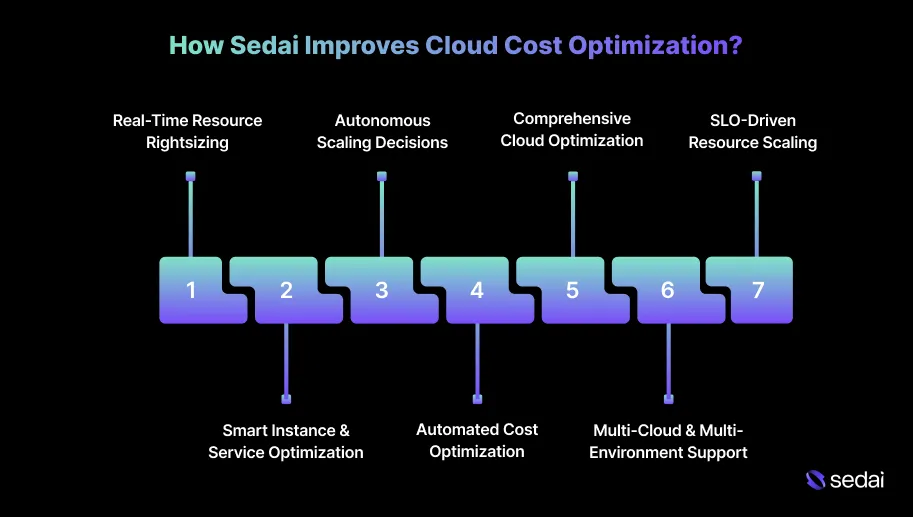
Sedai analyzes workload behavior and dynamically adjusts compute and storage allocations to prevent over- and under-provisioning. This real-time rightsizing reduces waste by over 30% while maintaining consistent application performance.
2. Intelligent Instance and Service Type Optimization
By evaluating resource consumption patterns, Sedai identifies the most efficient service types and instance sizes. This ensures optimal usage, reduces idle capacity, and improves performance while controlling costs.
3. Autonomous Scaling Decisions
Machine learning-driven insights allow Sedai to automatically scale resources based on demand patterns. This reduces reliance on static thresholds and manual intervention, resulting in up to 70% fewer service degradation events and improved reliability.
4. Automated Cost and Performance Remediation
Sedai continuously detects performance degradation, resource pressure, or instability and resolves issues before they impact workloads. This proactive remediation increases engineering productivity by up to 6x, freeing teams to focus on innovation.
5. Comprehensive Cloud Optimization (Full-Stack)
Sedai optimizes compute, storage, networking, and commitment levels holistically, ensuring autoscaling remains cost-efficient and resource utilization stays at peak performance. This approach can drive up to 50% cost savings.
6. Multi-Cloud and Multi-Environment Support
Sedai operates seamlessly across AWS, Azure, Google Cloud, and on-prem environments with a unified optimization engine. This enables scalable cost and resource management in complex multi-cloud architectures. Sedai has managed $3.5 million in cloud spend, showing its effectiveness at scale.
7. SLO-Driven Resource Scaling
Scaling decisions are aligned with Service Level Objectives (SLOs) and Service Level Indicators (SLIs), ensuring performance and reliability remain priorities during workload fluctuations.
With Sedai, you can optimize every layer of their cloud environment, improving efficiency while reducing waste and operational complexity.
Final Thoughts
Building an effective cloud cost optimization strategy is not a one-time task. It requires ongoing monitoring, adjustment, and automation of resource allocation based on real-time data.
As cloud environments become more dynamic, manual oversight is no longer practical. This is why organizations are turning to autonomous optimization.
Platforms likeSedai allow engineering teams to automatically analyze workload behavior, predict resource needs, and execute cost-saving actions without constant manual intervention.
By continuously optimizing cloud resources, Sedai ensures environments remain efficient, cost-effective, and adaptable. It takes on the heavy lifting so your teams can focus on innovation rather than managing costs.
Cloud cost frameworks are only useful if someone's executing them. Book a demo to see how Sedai runs the optimization playbook continuously across your environment.
FAQs
Q1. How can I measure the impact of cloud cost optimization on my business performance?
A1. Cloud cost optimization directly influences business performance by improving ROI and reducing wasted spend. You can measure its impact by tracking reductions in operational costs, improvements in service delivery times, and changes in overall resource efficiency.
Q2. How do I balance performance and cost in cloud environments?
A2. Balancing performance and cost starts with a clear understanding of workload behavior and usage patterns. Techniques such as auto-scaling, reserved instances, and serverless computing help meet performance demands without overprovisioning resources.
Q3. Can AI-driven cloud optimization tools adapt to sudden spikes in cloud demand?
A3. Yes, AI-driven optimization tools can respond to sudden demand spikes by adjusting resource allocations in real time. These tools automatically trigger scaling actions during traffic surges and scale resources down during low-usage periods.
Q4. What are the common misconceptions about cloud cost optimization?
A4. A common misconception is that cloud cost optimization is solely about reducing resources. In practice, it focuses on aligning resources with actual business needs. Effective optimization includes right-sizing workloads, improving resource allocation, and using flexible pricing models to maximize value.
Q5. How often should I review my cloud cost optimization strategies?
A5. Cloud cost optimization strategies should be reviewed at least quarterly to ensure they remain aligned with evolving workloads and business objectives. More frequent reviews may be required during periods of rapid growth, architectural changes, or significant shifts in usage patterns.


.webp%3Fv%3D2026-04-09T18%253A41%253A05.143Z&w=3840&q=75)