Google Cloud SQL is a fully managed relational database service from Google Cloud that supports MySQL, PostgreSQL, and SQL Server. It handles provisioning, maintenance, backups, replication, and security, allowing teams to focus on application development rather than infrastructure management.
Which database engines are supported by Google Cloud SQL?
Google Cloud SQL supports MySQL, PostgreSQL, and SQL Server, covering a wide range of application needs and ensuring flexibility for different workloads.
How does Google Cloud SQL integrate with other Google Cloud services?
Google Cloud SQL integrates natively with services like BigQuery, Kubernetes Engine, App Engine, and Compute Engine, making it easier to build, run, and scale applications without needing custom connectors.
What are the main features of Google Cloud SQL?
Key features include automated backups and recovery, high availability with automatic failover, flexible scaling of compute and storage, IAM-based access control, SSL/TLS encryption, compliance with HIPAA, PCI DSS, and GDPR, and integration with Google Cloud services.
How do you set up a new Google Cloud SQL instance?
To set up a new instance, open the SQL section in the Google Cloud Console, click 'Create Instance', choose your database engine, configure core settings (like machine type and storage), review backup and availability options, and then create the instance. The process typically takes a few minutes.
What are the best practices for securing Google Cloud SQL?
Best practices include using private IPs or the Cloud SQL Auth Proxy, enabling SSL/TLS for all connections, assigning IAM roles for access control, whitelisting only necessary networks, and regularly rotating passwords and certificates.
How does Google Cloud SQL handle backups and recovery?
Cloud SQL supports scheduled automated backups, point-in-time recovery, and allows you to store backups for up to a year. Backups can be triggered manually or run on a schedule, and all backups are encrypted by default.
What high availability options does Google Cloud SQL offer?
Google Cloud SQL offers high availability through automatic failover between zones and regional instances for disaster recovery, ensuring databases remain accessible during hardware or network disruptions.
How can you scale Google Cloud SQL resources?
You can scale compute resources (CPU and memory) and storage independently. Vertical scaling can be performed with minimal downtime, and automatic storage increase prevents running out of space unexpectedly.
What compliance standards does Google Cloud SQL meet?
Google Cloud SQL meets common compliance requirements including HIPAA, PCI DSS, and GDPR, making it suitable for regulated workloads.
Cost Optimization & Performance
What strategies can help optimize Google Cloud SQL costs?
Strategies include right-sizing instances, using committed use discounts (CUDs), controlling storage costs, optimizing queries, and shutting down idle instances. Regular reviews and using built-in tools like Query Insights and Recommender help keep costs predictable.
How does Google Cloud SQL Query Insights help with performance?
Query Insights provides visibility into query performance, highlights slow or resource-intensive queries, and integrates with Cloud Monitoring for alerts and trend tracking, helping maintain responsiveness as workloads grow.
What is the role of the Google Cloud SQL Recommender?
The Recommender uses AI to detect underused instances, suggest missing indexes, and offer cost-saving configuration changes without risking uptime, helping you optimize both performance and spending.
How can you automate Google Cloud SQL management tasks?
You can use the Google Cloud SQL Admin API and gcloud CLI to automate tasks such as starting or stopping instances, resizing compute or storage, and building custom dashboards for real-time cost and performance tracking.
How does Sedai help optimize Google Cloud SQL costs and performance?
Sedai uses AI-driven automation and optimization to reduce Google Cloud SQL costs by up to 50% and keep performance consistent. It integrates with Query Insights and the SQL Admin API to surface inefficient queries, automate resource adjustments, and provide real-time monitoring, freeing engineers from manual oversight.
What are the benefits of using Sedai with Google Cloud SQL?
Benefits include smarter cost and performance tuning, automation of repetitive tasks, real-time monitoring, and better resource utilization. Sedai helps teams avoid surprise bills and maintain high database performance with minimal manual intervention.
How much can Sedai reduce Google Cloud SQL costs?
Sedai can reduce Google Cloud SQL costs by up to 50% through autonomous optimization, rightsizing workloads, and eliminating waste, as demonstrated in customer case studies.
What types of tasks can Sedai automate for Google Cloud SQL?
Sedai can automate start/stop schedules, storage resizing, machine type adjustments, and apply AI-driven recommendations for query and resource optimization, reducing manual toil for engineering teams.
Features & Capabilities of Sedai
What is Sedai's autonomous cloud management platform?
Sedai's autonomous cloud management platform uses machine learning to optimize cloud resources for cost, performance, and availability without manual intervention. It covers compute, storage, and data across AWS, Azure, GCP, and Kubernetes environments.
What are the key features of Sedai?
Key features include autonomous optimization, proactive issue resolution, full-stack cloud coverage, smart SLOs, release intelligence, plug-and-play implementation, multiple modes of operation (Datapilot, Copilot, Autopilot), enhanced productivity, and safety-by-design for all changes.
How does Sedai's proactive issue resolution work?
Sedai detects and resolves performance and availability issues before they impact users, reducing failed customer interactions by up to 50% and ensuring seamless operations.
What integrations does Sedai support?
Sedai integrates with monitoring and APM tools (Cloudwatch, Prometheus, Datadog, Azure Monitor), Kubernetes autoscalers (HPA/VPA, Karpenter), IaC and CI/CD tools (GitLab, GitHub, Bitbucket, Terraform), ITSM tools (ServiceNow, Jira), notification tools (Slack, Microsoft Teams), and various runbook automation platforms.
What is Sedai's approach to security and compliance?
Sedai is SOC 2 certified, demonstrating adherence to stringent security requirements and industry standards for data protection and compliance. More details are available on Sedai's Security page.
How does Sedai ensure safe and auditable changes?
Sedai integrates with Infrastructure as Code (IaC), IT Service Management (ITSM), and compliance workflows to ensure all optimizations are safe, validated, reversible, and auditable.
How quickly can Sedai be implemented?
Sedai's setup process takes just 5 minutes for general use cases and up to 15 minutes for specific scenarios like AWS Lambda. The platform uses agentless integration via IAM, and offers personalized onboarding support and extensive documentation.
What technical documentation is available for Sedai?
Sedai provides detailed technical documentation covering features, setup, and usage. Access it at docs.sedai.io/get-started and explore additional resources at sedai.io/resources.
Use Cases & Business Impact
What types of companies and roles benefit most from Sedai?
Sedai is designed for platform engineering, IT/cloud operations, technology leadership, site reliability engineering (SRE), and FinOps roles in organizations with significant cloud operations across industries such as cybersecurity, IT, financial services, healthcare, travel, and e-commerce.
What business impact can Sedai deliver?
Sedai delivers up to 50% cost savings, 75% latency reduction, 6X productivity gains, and reduces failed customer interactions by up to 50%. For example, Palo Alto Networks saved $3.5 million, and KnowBe4 achieved 50% cost savings in production.
What customer success stories demonstrate Sedai's value?
KnowBe4 achieved 50% cost savings and saved $1.2 million on AWS bills. Palo Alto Networks saved $3.5 million and reduced Kubernetes costs by 46%. Belcorp reduced AWS Lambda latency by 77%. See more at sedai.io/resources.
What industries are represented in Sedai's case studies?
Industries include cybersecurity (Palo Alto Networks), IT (HP), financial services (Experian, CapitalOne Bank), security awareness training (KnowBe4), travel (Expedia), healthcare (GSK), car rental (Avis), retail/e-commerce (Belcorp), SaaS (Freshworks), and digital commerce (Campspot).
What pain points does Sedai address for cloud teams?
Sedai addresses pain points such as cost inefficiencies, operational toil, performance and latency issues, lack of proactive issue resolution, complexity in multi-cloud environments, and misaligned priorities between engineering and FinOps teams.
How does Sedai help with cloud cost optimization?
Sedai autonomously optimizes cloud resources, rightsizes workloads, eliminates waste, and aligns engineering and cost efficiency objectives, delivering up to 50% cost savings for cloud environments.
Competition & Differentiation
How does Sedai differ from other cloud optimization tools?
Sedai offers 100% autonomous optimization, proactive issue resolution, application-aware intelligence, full-stack cloud coverage, release intelligence, and a quick plug-and-play setup. Unlike competitors that rely on static rules or manual adjustments, Sedai continuously improves based on real application behavior.
What unique features set Sedai apart from competitors?
Unique features include 100% autonomous optimization, proactive issue resolution, application-aware intelligence, release intelligence, and a 5-minute plug-and-play implementation, all designed to deliver measurable business outcomes quickly.
What advantages does Sedai offer for different user segments?
Platform engineers benefit from reduced toil and IaC consistency; IT/cloud ops teams see lower ticket volumes and safer automation; technology leaders gain measurable ROI and cost savings; FinOps teams get actionable savings; SREs experience fewer SLO breaches and less pager fatigue.
Why should a customer choose Sedai over other solutions?
Customers should choose Sedai for its autonomous optimization, proactive issue resolution, application-aware intelligence, full-stack coverage, safety-by-design, quick setup, and proven results such as up to 50% cost savings and 6X productivity gains.
Google Cloud SQL is a fully managed relational database service for MySQL, PostgreSQL, and SQL Server. It handles backups, high availability, scaling, and integrates tightly with other Google Cloud services. This guide walks through setting up and connecting to an instance, managing it effectively, and applying cost‑saving strategies. Native tools like Query Insights and Recommender help improve query efficiency and resource allocation. Platforms like Sedai add AI‑driven automation and optimization, enabling teams to reduce costs and keep performance consistent without constant manual oversight.
Checking your database dashboard first thing in the morning? That’s hardly the ideal way to start the day. Yet for many engineers, the constant worry over surprise costs, slow queries, or sudden downtime has become part of the routine.
Cloud databases promised to simplify life. Instead, they’ve often replaced on‑premises complexity with a new set of challenges: unpredictable bills, scaling puzzles, and alerts that always seem to arrive at the worst possible moment.
This guide is here to help you take control. We’ll walk through how to make Google Cloud SQL work for you and not the other way around, covering setup, scaling, and practical strategies for keeping operations smooth. And yes, we’ll also touch on how Sedai can quietly help keep your costs in check while you focus on building what matters.
GCP costs shift constantly across compute, storage, and data services. Book a demo to see how Sedai keeps your Google Cloud environment continuously optimized.
What Is Google Cloud SQL?
Google Cloud SQL is Google Cloud’s managed relational database service for MySQL, PostgreSQL, and SQL Server. It’s designed to handle routine database operations such as provisioning, maintenance, backups, replication, and security, so teams can focus on application development rather than infrastructure upkeep.
Because it’s part of the Google Cloud ecosystem, Cloud SQL integrates natively with services like BigQuery, Kubernetes Engine, and Compute Engine. This makes it easier to build, run, and scale applications without having to stitch together separate systems.
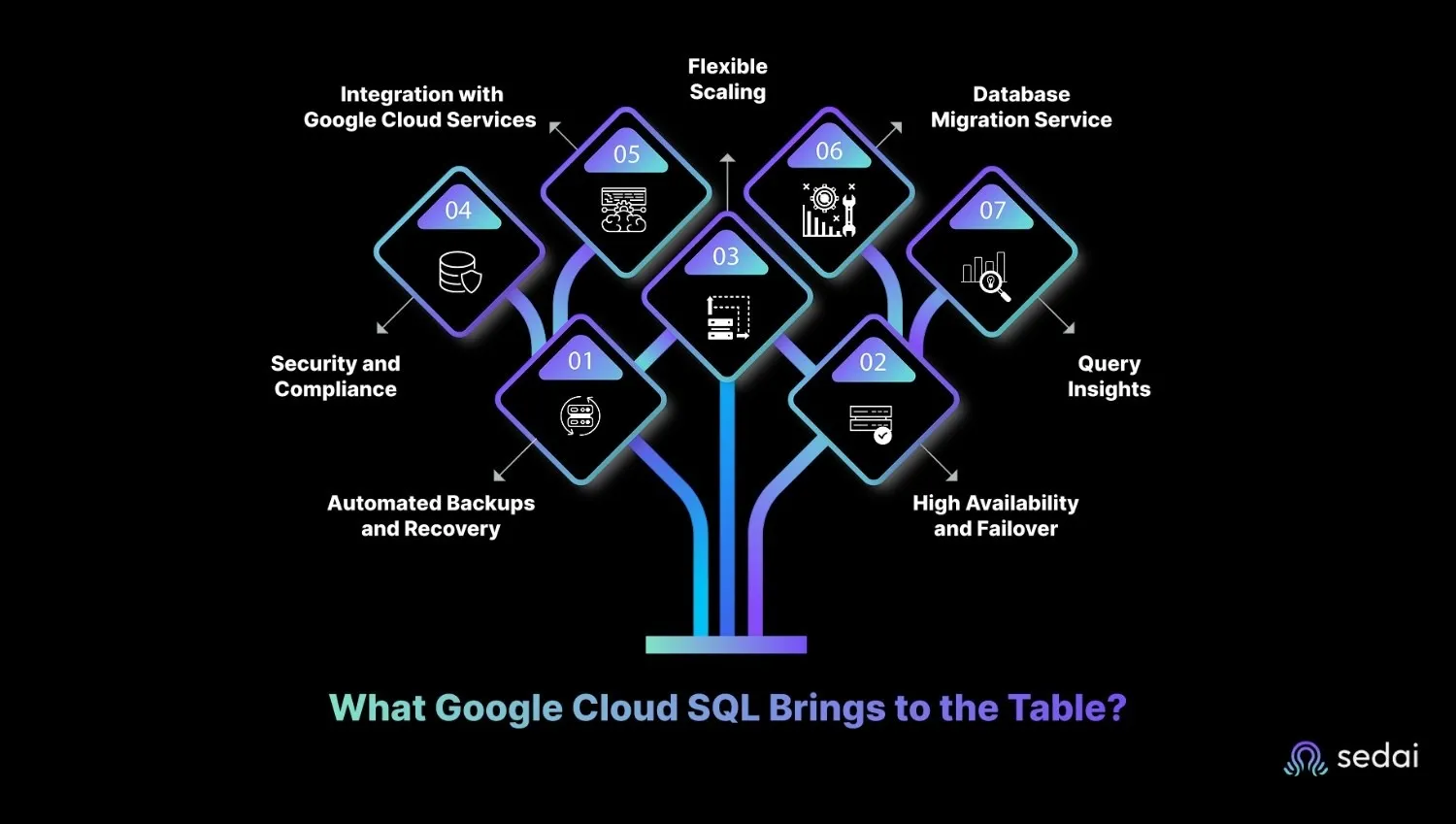
What Google Cloud SQL Brings to the Table
Cloud SQL brings together several capabilities that simplify database management and keep performance consistent. Here are the essentials to understand before you start using it.
1. Automated Backups and Recovery
Cloud SQL takes scheduled backups and supports point‑in‑time recovery. You can store backups for up to a year and restore to a specific moment when needed. Encryption is applied by default, and you can run backups on a schedule or trigger them manually if required.
2. High Availability and Failover
Instances can be configured for high availability with automatic failover between zones. This helps keep databases accessible during hardware or network disruptions. Regional instances provide additional resilience for disaster recovery.
3. Flexible Scaling
Compute resources (CPU and memory) and storage can be scaled independently. Vertical scaling can be done with minimal downtime, and automatic storage increase prevents instances from running out of space unexpectedly.
4. Security and Compliance
Cloud SQL supports IAM‑based access control, private IP connectivity, SSL/TLS encryption for data in transit, and encryption at rest. It meets common compliance requirements including HIPAA, PCI DSS, and GDPR.
5. Integration with Google Cloud Services
Cloud SQL works seamlessly with GCP products such as BigQuery, Kubernetes Engine, App Engine, and Compute Engine. This allows applications, analytics, and data pipelines to connect without additional middleware or custom connectors.
6. Database Migration Service
Google’s Database Migration Service supports continuous data replication for MySQL and PostgreSQL with minimal downtime. It’s useful for moving workloads to Cloud SQL without disrupting production systems.
7. Query Insights
Query Insights provides visibility into query performance, highlighting slow or resource‑intensive queries. It integrates with Cloud Monitoring for alerts and trend tracking, helping maintain responsiveness as workloads grow.
Next, let’s dive into the step-by-step process of creating your first Cloud SQL instance the right way.
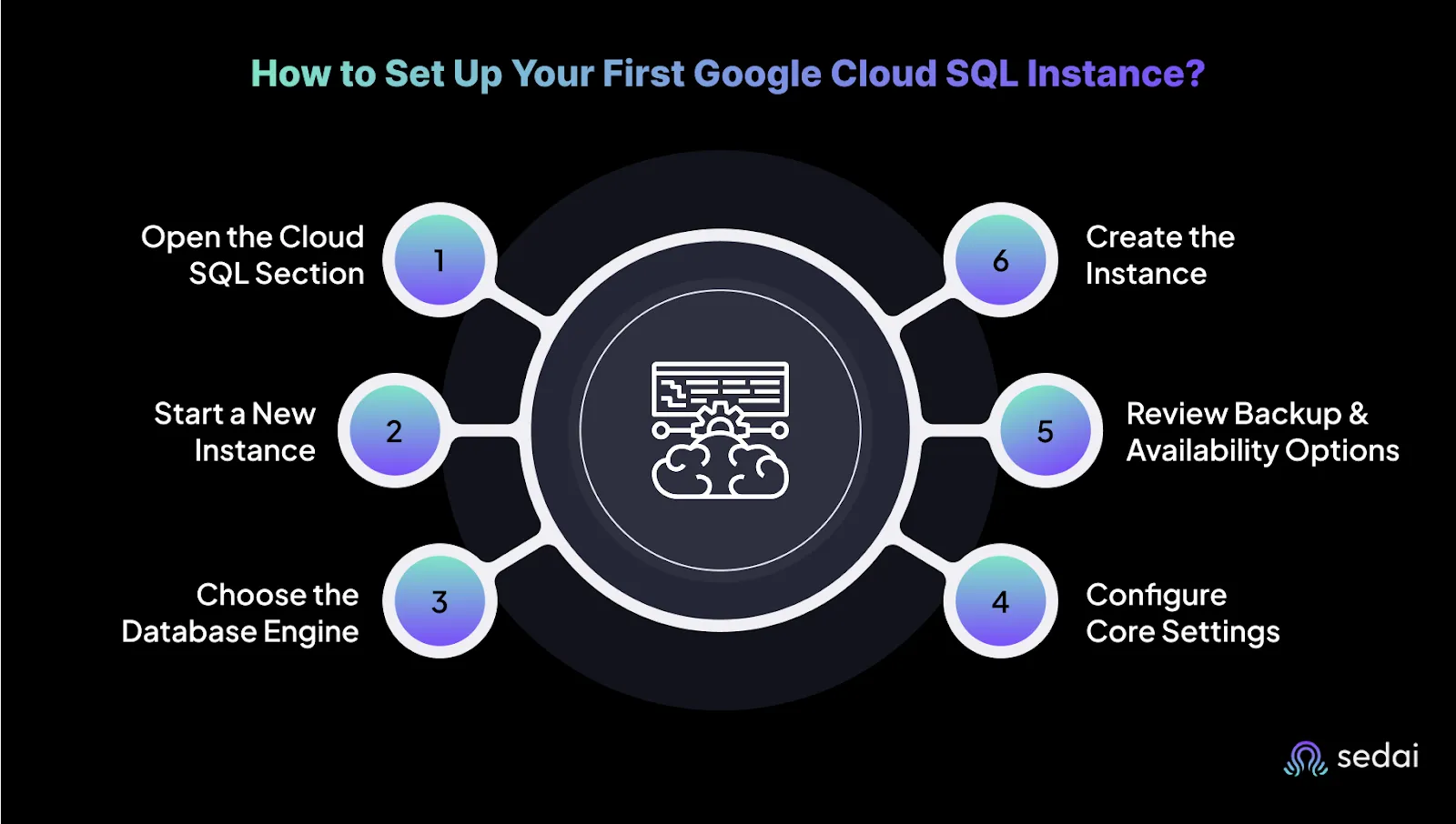
How to Set Up Your First Google Cloud SQL Instance
Getting started with Google Cloud SQL isn’t complicated, but the way you configure it will shape performance, reliability, and costs down the line. Here’s what to focus on when creating your first instance.
1. Open the Cloud SQL Section
From the Google Cloud Console, open the SQL section in the main navigation. This is your control center for creating, viewing, and managing all Cloud SQL instances.
2. Start a New Instance
Click Create Instance. This opens the configuration wizard where you’ll define the database type, resources, and security settings.
3. Choose the Database Engine
Google Cloud SQL supports three major relational database engines, each suited to different needs:
MySQL: Popular for web and application backends, easy to scale, and integrates seamlessly with GCP services like App Engine and Kubernetes Engine.
PostgreSQL: Feature‑rich, reliable, and great for complex applications that need strong data integrity and advanced capabilities.
SQL Server: Microsoft’s enterprise‑grade database, ideal if you already work with .NET applications or have an existing Microsoft‑centric environment.
4. Configure Core Settings
The default values work for testing but rarely for production. Key settings to review:
Instance ID: Use a clear, descriptive name to distinguish it from other resources.
Root Password: Generate a secure password and store it safely (e.g., in Secret Manager).
Region and Zone: Pick a location close to your users or applications to reduce latency.
Machine Type (vCPUs & Memory): Match resources to your expected workload. You can scale later, but an under‑sized instance can cause performance bottlenecks early.
Storage Type & Size: Choose SSD for low‑latency workloads or standard storage for cost‑sensitive projects. Start with enough space for your dataset plus growth.
5. Review Backup and Availability Options
Before launching:
Automated Backups: Enable daily backups with enough retention to meet your recovery needs.
High Availability (HA): Consider enabling HA for production to minimize downtime in case of failures.
Point‑in‑Time Recovery: Activate if you want the ability to restore to a specific moment.
6. Create the Instance
After configuring all details, including engine, machine type, storage, backups, and availability options, click Create. This step actually provisions the instance. Google Cloud SQL will allocate resources, set up your database environment, and apply your configuration. The process typically takes a few minutes. When it’s complete, the instance will appear in your dashboard, ready for connections..
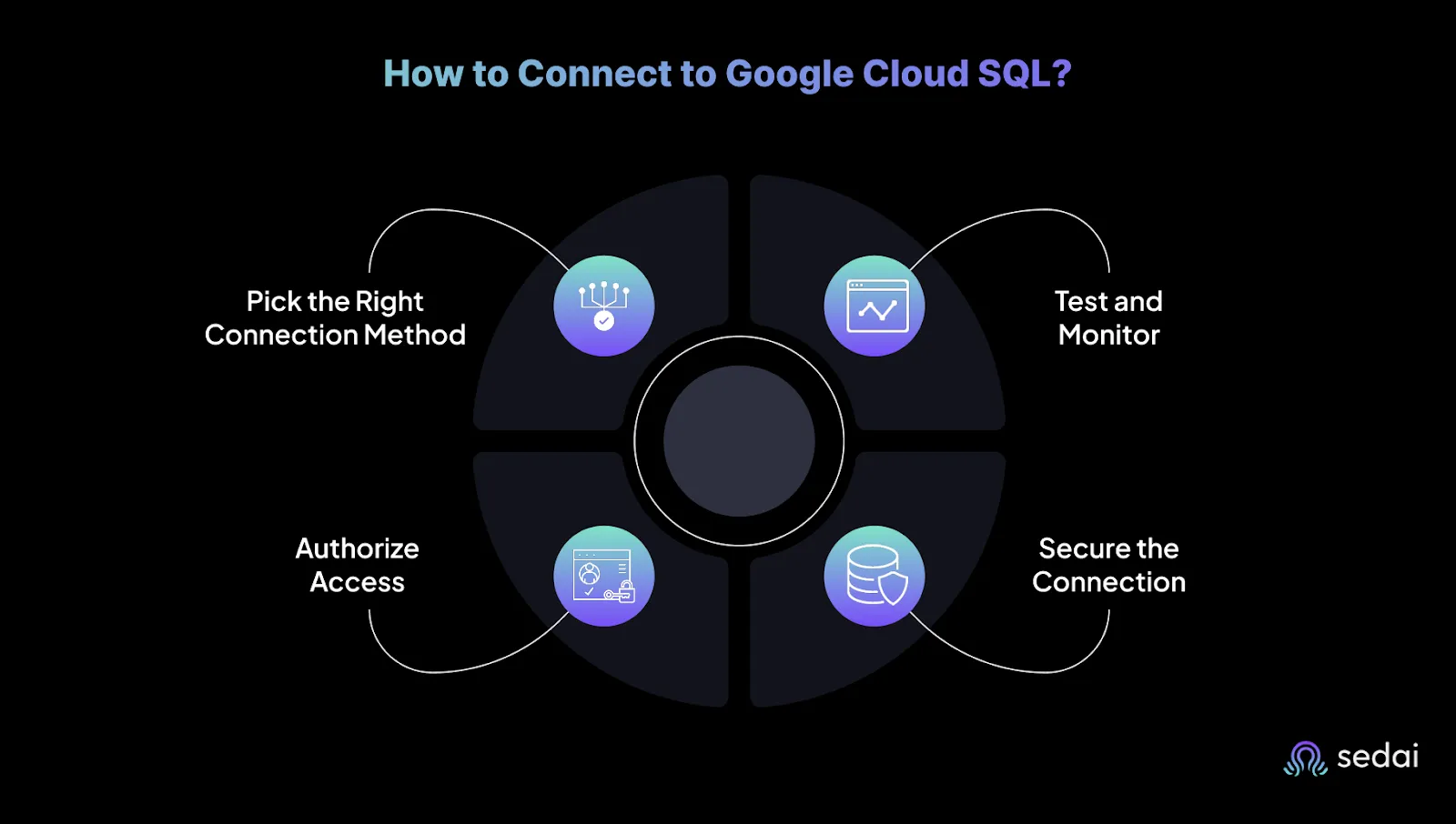
How to Connect to Google Cloud SQL
Once your Google Cloud SQL instance is ready, the next step is to connect without creating performance bottlenecks or security risks.
1. Pick the Right Connection Method
Inside Google Cloud: Use private IP for faster, more secure internal traffic.
Outside Google Cloud: Use the Cloud SQL Auth Proxy or a public IP locked down with SSL/TLS encryption.
2. Authorize Access
Grant access only to the applications, servers, or users that truly need it. In most setups, this means:
Assigning IAM roles for database administrators and application services.
Avoiding “allow all IPs” and instead whitelisting the specific networks or machines that require access.
3. Secure the Connection
Even if your database is internal, treat every connection as if it’s exposed to the internet:
Encrypt data in transit with SSL/TLS.
Rotate passwords and certificates regularly.
Disable any unused accounts or permissions.
4. Test and Monitor
Verify that your application can connect and query the database as expected.
Monitor connection performance through the Cloud SQL dashboard.
Watch for failed connection attempts, as they may signal misconfiguration or a security probe.
Ready to optimize your Cloud SQL costs?
Book a Sedai demo to improve database performance, reduce spend, and automate cloud optimization.
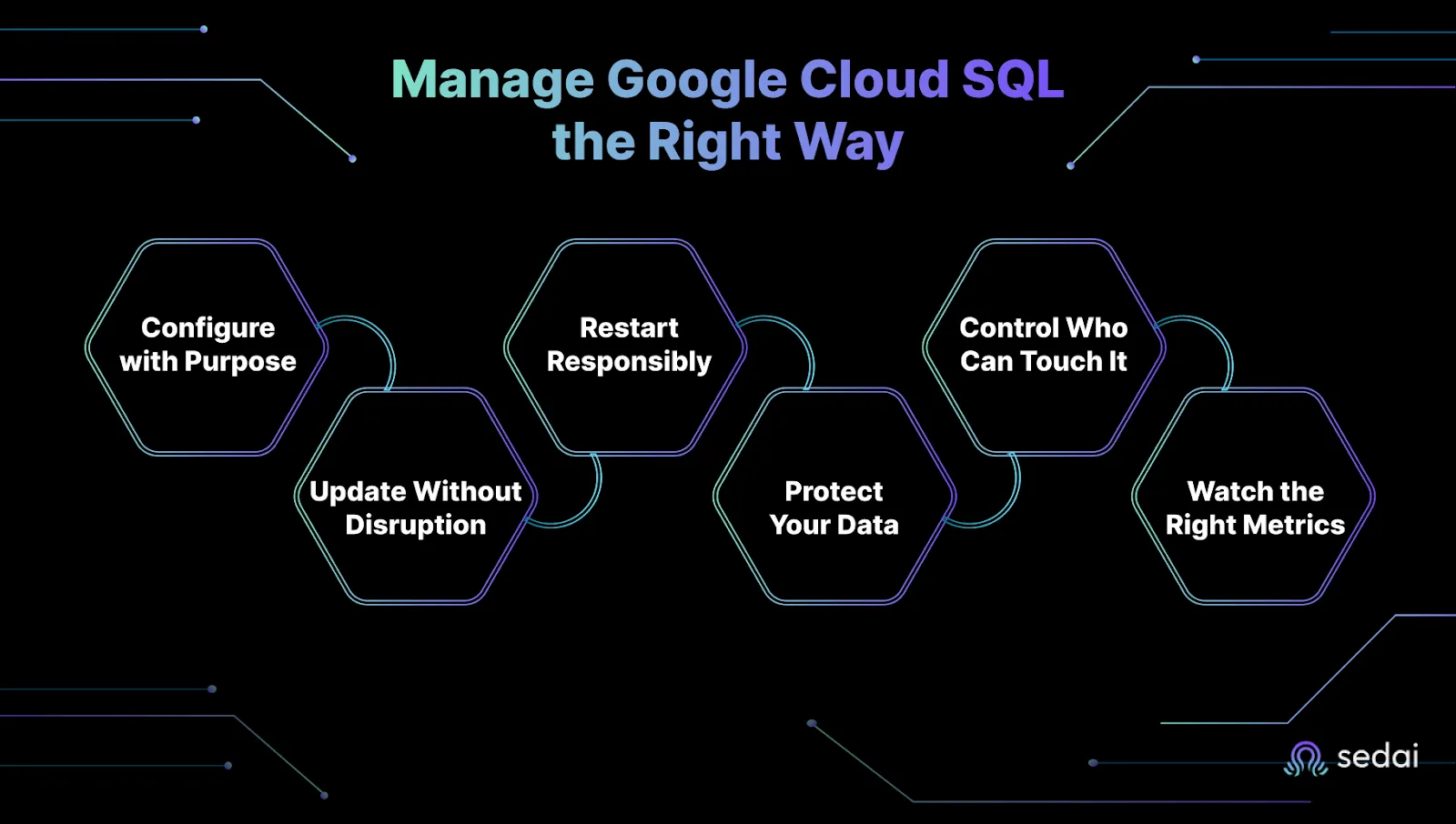
Manage Google Cloud SQL the Right Way
Running a Google Cloud SQL instance isn’t just about keeping it online. It’s about making sure it stays fast, secure, and cost‑efficient while fitting your workload’s needs.
1. Configure with Purpose
When creating or updating an instance, match machine type, storage size, and storage type to actual workload requirements. Over‑provisioning wastes money, while under‑provisioning risks slowdowns. Review and adjust these settings as usage changes.
2. Update Without Disruption
Most configuration changes apply immediately, but resizing machine types will require a restart. Plan these changes during low‑traffic windows to avoid unexpected downtime.
3. Restart Responsibly
Restarting clears active connections and temporarily stops the database. Schedule restarts intentionally, ideally during maintenance windows, so users and applications aren’t caught off guard.
4. Protect Your Data
Enable automated backups and keep recent restore points available. If you no longer need certain backups, remove them to control storage costs. Always back up before making major changes.
5. Control Who Can Touch It
Use IAM roles to manage who can view, configure, or connect to the instance. Keep permissions tight and review them regularly. Remove unnecessary accounts as team members change roles or leave.
6. Watch the Right Metrics
Monitor CPU, memory, and storage usage from the Cloud SQL dashboard. Spikes may mean you need to optimize queries, add indexes, or scale resources. Also, watch connection counts, they can indicate inefficient application handling.
What You Can Run and Build with Google Cloud SQL
Once your Google Cloud SQL instance is running, you can put it to work in ways that go far beyond just “hosting a database.”
Application backends: Power web, mobile, and SaaS apps without the hassle of maintaining your own database servers.
Analytics pipelines: Feed relational data into BigQuery or other BI tools for real‑time dashboards and reporting.
Multi‑tenant platforms: Support separate customer databases while managing everything from one control plane.
Hybrid and microservices architectures: Integrate seamlessly with Cloud Run, Kubernetes Engine, or Dataflow to handle complex, event‑driven workloads.
Pro tip: Match your use case to the database engine you chose during setup — the right fit here keeps your architecture simpler and more efficient in the long run.
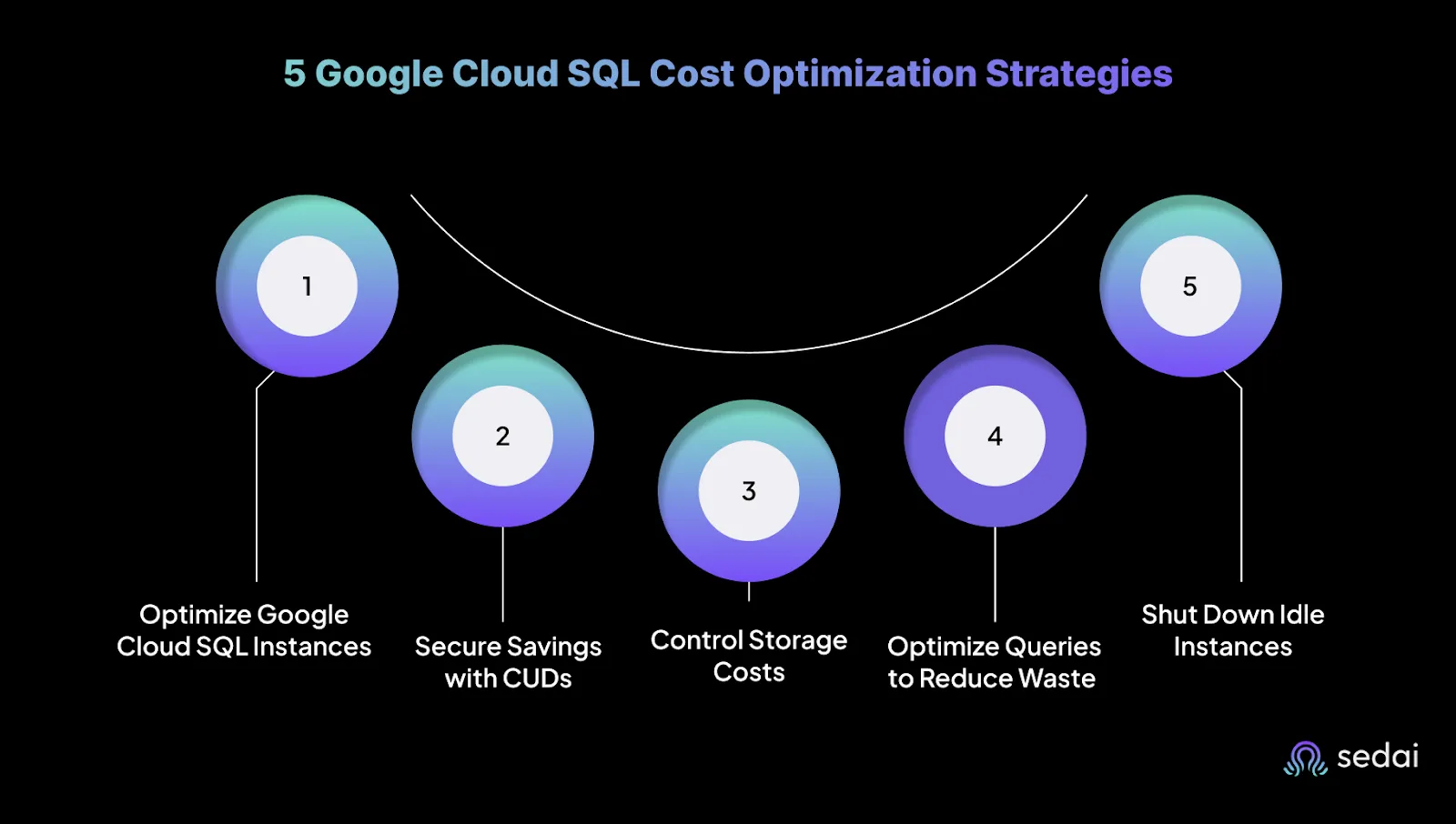
5 Google Cloud SQL Cost Optimization Strategies
Google Cloud SQL can run lean if you manage resources deliberately. Left unchecked, though, costs can creep up faster than expected. Here’s how to keep your bill predictable without sacrificing performance.
1. Right‑Size Your Google Cloud SQL Instances
Match instance size to real workload needs. Over‑provisioning burns budget; under‑provisioning risks slowdowns. Review usage regularly and adjust:
Scale down during quieter hours.
Pick machine types that fit your traffic patterns.
Avoid “just in case” oversizing.
2. Lock in Savings with Committed Use Discounts (CUDs)
If workloads are steady, CUDs can lower costs significantly — but only if commitments match actual needs.
Check historical usage before locking in.
Leave headroom for growth but avoid overcommitting.
3. Keep Storage Costs Under Control
Storage costs grow quietly.
Enable auto‑storage increase so you don’t hit limits.
Archive or delete old, unused data.
Use lower‑cost tiers for infrequently accessed data.
4. Optimize Queries to Reduce Waste
Inefficient queries waste CPU and I/O, which increases costs.
Use built‑in query analysis tools to spot slow queries.
Add or adjust indexes where it helps retrieval speed.
Refactor queries as datasets grow.
5. Shut Down Idle Instances
Development, staging, or test environments don’t need to run 24/7.
Shut them down after work hours.
Restart only when needed.
Next, let’s explore the tools that help you track and optimize Google Cloud SQL performance and spending in real time.
Best Tools to Optimize Google Cloud SQL Costs and Performance
The right tools can help you spot waste early, keep workloads fast, and avoid surprise bills. These are the most useful ones for managing Google Cloud SQL efficiently.
Google Cloud SQL Query Insights
Helps you find the slow or resource‑heavy queries that quietly drain performance and inflate costs.
Identify top queries causing CPU or memory spikes.
See execution plans to pinpoint inefficiencies.
Integrates with Cloud Monitoring for alerts before users notice problems.
Google Cloud SQL Recommender
AI‑driven suggestions based on real usage patterns.
Detects underused instances that can be downsized or stopped.
Suggests missing indexes to improve query performance.
Offers cost‑saving configuration changes without risking uptime.
Google Cloud SQL Admin API and gcloud CLI
For automating the repetitive work that eats up time and budget.
Start or stop instances based on demand.
Resize compute or storage without manual intervention.
Build custom dashboards for real‑time cost and performance tracking.
Pro tip: Use these tools together. For example, run Query Insights to find inefficient queries, apply Recommender’s tuning suggestions, then use Admin API scripts to automate the fixes.
How Sedai Can Support Google Cloud SQL Optimization
Managing Google Cloud SQL well takes time, and even experienced teams can find it hard to keep performance high and costs low without constant oversight. Many companies now use AI‑driven platforms like Sedai to tackle these challenges.
Rather than replacing your current setup, Sedai layers on automation, smart recommendations, and real‑time visibility to keep your databases lean and responsive.
Smarter cost and performance tuning: Sedai uses Google Cloud SQL Query Insights to surface inefficient queries and resource‑heavy workloads. Its AI engine then suggests targeted fixes such as adjusting indexes or rightsizing instances, to balance speed and cost.
Automation without the busywork: By integrating with the SQL Admin API and gcloud CLI, Sedai can automate start/stop schedules, handle storage resizing, or adjust machine types, freeing engineers from repetitive tasks.
Real‑time monitoring that matters: Custom dashboards in Google Cloud Monitoring make it easy to track both spend and performance, so teams can spot issues early and act before they become costly.
Better resource utilization: Sedai flags underused instances and suggests practical next steps, helping you get more out of the resources you’re already paying for.
Conclusion
Running Google Cloud SQL is about making it an asset that supports your work without constant reactive fixes. The most efficient teams treat it as a system that can be refined, automated, and measured over time.
If you’re exploring smarter ways to get there, you’re not alone. Many engineering teams are already combining Google Cloud SQL’s built‑in capabilities with intelligent platforms like Sedai to keep databases lean, fast, and cost‑effective by up to 50%.
Cloud SQL costs are easy to overlook until they compound. Book a demo to see how Sedai keeps your GCP database environment right-sized and continuously optimized.
Join us and start shaping a Google Cloud SQL strategy that runs smarter every day.
FAQs
1. What database engines does Google Cloud SQL support?
Google Cloud SQL supports MySQL, PostgreSQL, and SQL Server. These popular engines cover most application needs, ensuring flexibility for your workloads.
2. How can I secure connections to Google Cloud SQL?
You can use private IPs, Cloud SQL Auth Proxy, SSL/TLS, and IAM-based access for secure connections. Proper security setups protect your data from unauthorized access and leaks.
3. What tools help monitor Google Cloud SQL performance?
Google Cloud SQL Query Insights and Cloud Monitoring provide deep visibility into query performance and resource use. These tools help you spot bottlenecks before they impact your users.
4. How can I optimize costs for my Cloud SQL instances?
Rightsize instances, tune storage/IOPS, turn off unused instances, and use the Cloud SQL Recommender for suggestions. Regular cost reviews prevent waste and keep budgets in check.
5. How does Sedai help with Google Cloud SQL cost management?
Sedai uses AI to automate cost optimization, reducing your Cloud SQL expenses by up to 50% without manual effort. It continuously adjusts resources so you never overspend or underperform.


.webp%3Fv%3D2026-04-09T18%253A41%253A05.143Z&w=3840&q=75)