Frequently Asked Questions
Product Information & AWS Lambda Optimization
How does Sedai use the AWS Lambda Telemetry API to improve performance and availability?
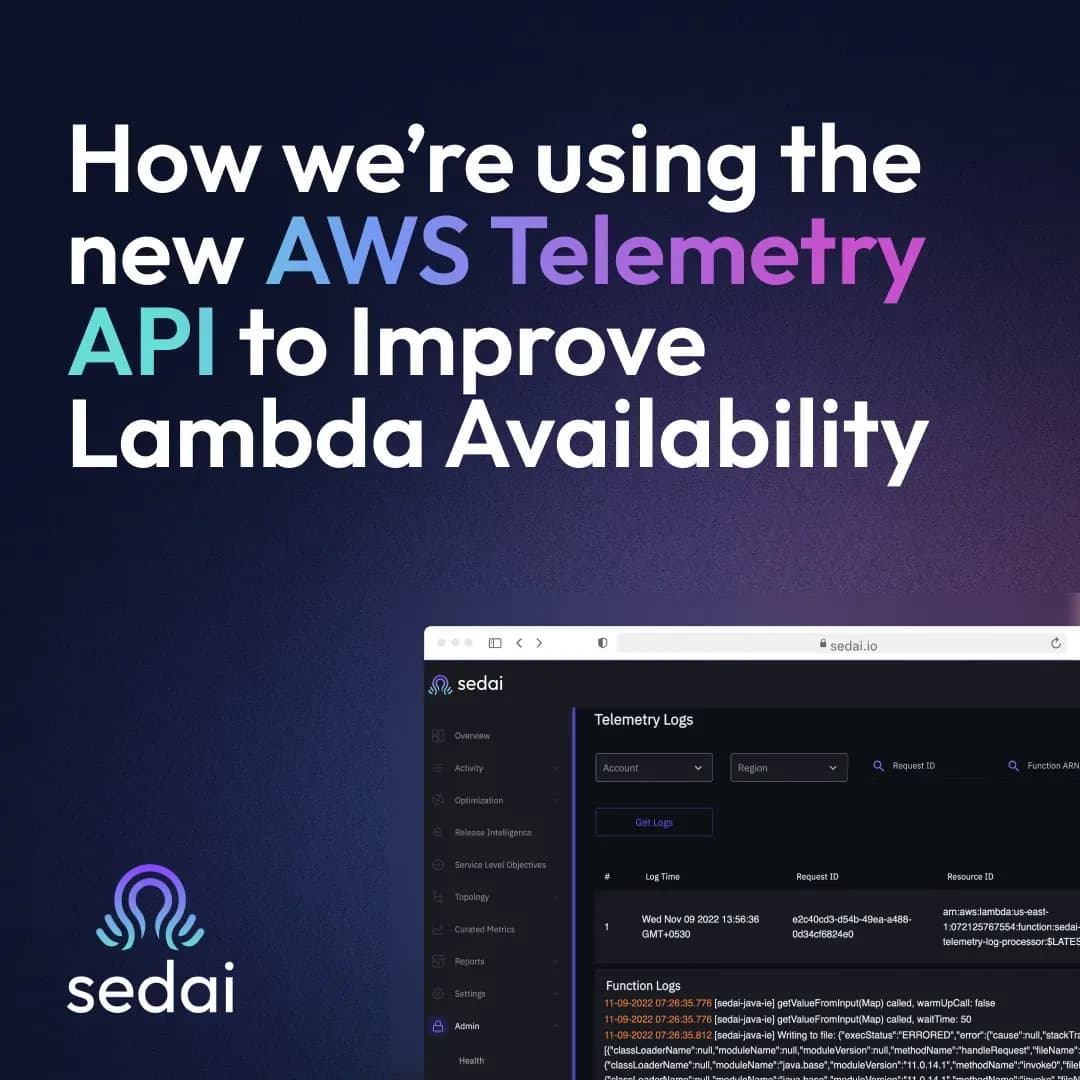
Sedai integrates the AWS Lambda Telemetry API to provide enhanced observability and actionable insights for Lambda functions. By capturing detailed logs, traces, and metrics directly from the Lambda platform, Sedai enables both manual and autonomous remediation of errors and performance issues. This includes surfacing cold start events, execution times, error details, and request/response data, which helps reduce error rates and failed customer interactions (FCIs) for critical services like ecommerce payments. Note: The Telemetry API extension may add a few milliseconds to Lambda usage, but does not impact the actual execution time of your code. Source. Best fit for teams prioritizing Lambda performance and observability; teams with highly specialized, non-x86 workloads may need to confirm compatibility.
What are the main use cases for Sedai's integration with the Lambda Telemetry API?
Sedai leverages the Lambda Telemetry API for two primary use cases: (1) Enhanced manual remediation—by surfacing key execution data for problematic invocations, enabling users to troubleshoot issues that cannot be addressed autonomously; and (2) Enhanced autonomous remediation—by feeding new telemetry signals into Sedai's ML models, which inform availability and optimization recommendations. This approach improves both the speed and accuracy of issue resolution. Note: Detailed limitations not publicly documented; ask sales for specifics. Source
What types of Lambda execution data does Sedai capture and analyze?
Sedai captures and analyzes Lambda execution data such as exact execution time, request and response details, cold start events, error occurrences, and phase information (e.g., initialization vs. invocation). This data is made available in the Sedai UI for both troubleshooting and optimization purposes. Note: Best fit for x86-compatible Lambda functions; ARM support details not specified. Source
Is Sedai's Lambda optimization platform available globally?
Yes, Sedai's serverless platform using the Lambda Telemetry API is available globally for x86-compatible serverless functions. You can sign up at app.sedai.io/signup or request a demo at sedai.io. Note: ARM architecture support is not specified; confirm compatibility for non-x86 workloads. Source
Features & Capabilities
What are the key features of Sedai's autonomous cloud platform?
Sedai's autonomous cloud platform offers features such as autonomous optimization (up to 53% cost savings), application-aware intelligence, proactive issue resolution, full-stack cloud coverage (across AWS, Azure, GCP, Kubernetes), safety-by-design (continuous health verification, automatic rollbacks, incremental changes), release intelligence, and plug-and-play implementation (5–15 minute setup). Note: Teams requiring deep customization or manual control may need to evaluate fit. Source
What integrations does Sedai support?
Sedai integrates with monitoring and APM tools (Prometheus, Datadog, Cloudwatch, Azure Monitor), Kubernetes autoscalers (HPA/VPA, Karpenter), IaC and CI/CD tools (GitHub, GitLab, Bitbucket, Terraform), ITSM (ServiceNow, PagerDuty, Jira), notification tools, runbook automation platforms, and serverless platforms (AWS Lambda, AWS Fargate). Note: Integration depth may vary by platform; confirm specific requirements for your stack. Source
What security and compliance certifications does Sedai have?
Sedai is SOC 2 certified, demonstrating adherence to stringent security and compliance standards for data protection. For more details, visit the Sedai Security page. Note: Additional certifications are not publicly documented; contact Sedai for specifics. Source
Pricing & Plans
What is Sedai's pricing model?
Sedai uses a volume-based pricing model, charging based on the specific resources optimized (e.g., Kubernetes pods, ECS tasks, VMs). There is a free tier and a 30-day free trial available. All costs are transparently listed on the Sedai pricing page. For Kubernetes environments, a demo is recommended to determine the best pricing structure. Note: Pricing for custom or large-scale deployments may require a tailored quote. Source
Implementation & Technical Requirements
How long does it take to implement Sedai, and how easy is it to get started?
Initial onboarding for Sedai takes approximately 15 minutes for agentless or agent-based deployment to begin reading metrics from your environment. Additional setup for integrations may require more time depending on complexity. Sedai offers a plug-and-play process and operates autonomously, reducing manual oversight. Note: Complex environments may require additional configuration. Source
What technical documentation is available for Sedai users?
Sedai provides a Getting Started Guide, a Kubernetes Optimization Guide, and a Platform Overview, all available at docs.sedai.io/get-started and sedai.io/resources. These resources cover onboarding, optimization strategies, and platform capabilities. Note: Advanced troubleshooting or custom integrations may require direct support. Source
Use Cases & Business Impact
What business impact can customers expect from using Sedai?
Customers typically achieve up to 50% cloud cost reduction, up to 75% latency reduction, up to 6X productivity gains, and a reduction in failed customer interactions by up to 50%. Financial payback is often realized in under six months, with ROI greater than 400%. For example, KnowBe4 saved $1.2 million on AWS costs, and Palo Alto Networks saved $3.5 million. Note: Results may vary based on environment and usage. Source, Source
Who are some of Sedai's customers, and what results have they achieved?
Notable customers include KnowBe4 (50% cost savings, $1.2M AWS savings), Palo Alto Networks ($3.5M cloud savings), Belcorp (77% Lambda latency reduction), Campspot (34% Lambda latency reduction), Inflection (improved cold start latency), and Freshworks (reduced latency, improved user experience). See more at sedai.io/customers. Note: Individual results depend on workload and environment. Source, Source
What industries does Sedai serve?
Sedai serves customers in cybersecurity (e.g., Palo Alto Networks, KnowBe4), financial services (Experian), healthcare, e-commerce (Wayfair, Campspot), IT and technology (HP, Freshworks), consumer goods (Belcorp), and digital commerce (Informed). Note: Industry-specific compliance or integration needs should be confirmed with Sedai. Source
Pain Points & Problems Solved
What core problems does Sedai solve for cloud and Lambda users?
Sedai addresses cost inefficiencies (up to 50% cloud cost reduction), operational toil (automates repetitive tasks, up to 6X productivity gains), performance and latency issues (up to 75% latency reduction), lack of proactive issue resolution (reduces failed customer interactions by up to 50%), complexity in multi-cloud/hybrid environments, and misaligned priorities between engineering and finance. Note: Teams with highly custom or legacy environments may require additional integration work. Source
Competition & Differentiation
How does Sedai differ from other cloud optimization platforms?
Sedai is differentiated by its patented safety-by-design approach: it makes safe, autonomous optimizations in production without causing incidents or breaching SLOs. Unlike platforms that require manual approval or make all-at-once changes, Sedai performs gradual, validated optimizations with continuous health checks and automatic rollbacks. It also offers application-aware intelligence, full-stack coverage, and release intelligence. Note: Teams needing full manual control or custom scripting may prefer alternative solutions. Source