Multi-cluster Kubernetes refers to the practice of managing multiple Kubernetes clusters across different regions, cloud providers, or environments. This approach improves application scalability, availability, and fault tolerance by distributing workloads across clusters, making it essential for teams operating complex, distributed systems that require consistent performance and resilience. [Source]
How does multi-cluster Kubernetes improve availability and fault tolerance?
Multi-cluster Kubernetes enables automatic failover, allowing workloads to shift smoothly to another cluster during outages. This architecture ensures high availability and fault isolation, reducing the risk of downtime from cluster-wide failures. [Source]
What are the main differences between single-cluster and multi-cluster Kubernetes?
Single-cluster Kubernetes is limited in scalability and is vulnerable to cluster-wide failures, while multi-cluster Kubernetes scales horizontally, provides high availability with automatic failover, and offers better fault isolation. Multi-cluster setups also support geographical optimization, disaster recovery, and improved security through workload isolation. [Source]
Why is multi-cluster Kubernetes important for modern applications?
Multi-cluster Kubernetes is crucial for maintaining consistent performance, uptime, and resilience in dynamic cloud environments. It allows teams to optimize resource usage, improve fault tolerance, and ensure high availability for applications that serve a global user base. [Source]
How does multi-cluster Kubernetes support compliance and security?
Multi-cluster Kubernetes allows teams to isolate sensitive workloads into dedicated clusters that align with specific compliance or security needs. This separation improves protection for critical applications while maintaining performance across the broader environment. [Source]
What are the main architecture models for multi-cluster Kubernetes?
The three main architecture models are: Replicated (same applications in multiple clusters for high availability), Split-by-Service (different services in separate clusters for isolation), and Hybrid (mix of replicated and split services for balance). Each model addresses different needs for resilience, efficiency, and compliance. [Source]
How does traffic distribution work in a multi-cluster Kubernetes setup?
Traffic is typically managed by a central load balancer or service mesh, which routes requests based on resource availability, application requirements, or failure conditions. This ensures efficient workload balancing and high availability. [Source]
What are the best practices for implementing multi-cluster Kubernetes?
Best practices include using mirrored configurations for high availability, targeted configurations for cost efficiency and compliance, centralized administration, consistent configuration management, and leveraging automation tools for deployment and upgrades. [Source]
How does multi-cluster Kubernetes help with disaster recovery?
Multi-cluster Kubernetes improves disaster recovery by replicating data and workloads across clusters. This enables automatic failover and workload migration in the event of infrastructure failures, ensuring business continuity. [Source]
What are the key challenges in managing multiple Kubernetes clusters?
Key challenges include cross-cluster service discovery, resource management and overprovisioning, consistent configuration and version control, scaling across clusters, network connectivity, and maintaining security and access control. [Source]
Tools & Automation for Multi-Cluster Management
What tools are available for managing multiple Kubernetes clusters?
Key tools include multi-cluster management platforms (e.g., Sedai, Rancher, Red Hat OpenShift), cluster federation tools, Infrastructure-as-Code (IaC) tools, GitOps platforms, and service meshes/load balancers for networking and security. [Source]
How does Sedai help with Kubernetes multi-cluster management?
Sedai continuously analyzes real-time workload behavior and applies data-driven optimizations, autonomously rightsizing container workloads, tuning scaling policies, and optimizing cluster resource usage. This reduces manual effort, improves performance, and delivers up to 50% lower cloud costs. [Source]
What is the role of a service mesh in multi-cluster Kubernetes environments?
A service mesh manages cross-cluster communication by handling traffic routing, service discovery, and security. It enforces consistent communication policies, including mutual TLS encryption, and simplifies connectivity across multiple clusters. [Source]
How can I monitor performance across multiple Kubernetes clusters?
Use a centralized monitoring solution that aggregates metrics from all environments. Tools can provide real-time visibility into resource utilization, pod health, and overall cluster performance across multiple Kubernetes deployments. [Source]
How does Sedai optimize resource utilization in Kubernetes clusters?
Sedai autonomously rightsizes container workloads, fine-tunes scaling behavior, and optimizes cluster resource usage based on actual usage patterns. This minimizes idle capacity, prevents overprovisioning, and ensures efficient performance and predictable costs. [Source]
What are the benefits of using automation in multi-cluster Kubernetes management?
Automation reduces operational overhead, ensures consistency at scale, and enables real-time adjustments to resource configurations. This leads to improved performance, lower costs, and less manual intervention for engineering teams. [Source]
How does Sedai support different Kubernetes environments?
Sedai supports Kubernetes clusters running on AWS (EKS), Azure (AKS), Google Cloud (GKE), and hybrid or self-managed environments, providing a consistent optimization approach across all deployments. [Source]
What is GitOps and how does it help with multi-cluster management?
GitOps is a declarative, version-controlled approach to managing Kubernetes configurations across clusters. It stores cluster configurations and application manifests in Git repositories, continuously reconciling the desired state with the actual state of each cluster for predictable, auditable changes. [Source]
Security, Compliance & Best Practices
What are the best practices for securing a multi-cluster Kubernetes environment?
Best practices include enforcing consistent Role-Based Access Control (RBAC) policies across clusters, securing service-to-service communication with a service mesh, encrypting all inter-cluster traffic, conducting regular access audits, and isolating sensitive workloads using network policies. [Source]
How can multi-cluster Kubernetes help with compliance and data residency requirements?
Multi-cluster Kubernetes enables workloads to be deployed in specific regions or isolated clusters to meet compliance and data residency requirements, helping organizations align with regulatory needs while maintaining centralized control. [Source]
How do I handle network latency in a multi-cluster Kubernetes setup?
To reduce network latency, deploy clusters closer to end users across multiple regions. Global load balancers can route traffic based on proximity or cluster health, maintaining low latency and consistent application performance. [Source]
How can I ensure consistent configuration across multiple Kubernetes clusters?
Use tools to manage consistent deployments across clusters and adopt a GitOps approach with platforms like Argo CD or Flux to version-control configurations and automatically synchronize desired state across all clusters. [Source]
What are the main pain points in Kubernetes multi-cluster management?
Pain points include operational complexity, configuration drift, resource inefficiency, network and security challenges, and the need for consistent monitoring and automation across clusters. [Source]
How does Sedai address the pain points of Kubernetes multi-cluster management?
Sedai automates routine tasks, continuously optimizes resource allocation, and provides unified visibility and control across clusters. This reduces operational overhead, prevents overprovisioning, and ensures consistent performance and cost efficiency. [Source]
Sedai Platform Features & Capabilities
What is Sedai's autonomous cloud management platform?
Sedai offers an autonomous cloud management platform that optimizes cloud operations for cost, performance, and availability using machine learning. It eliminates manual intervention and covers compute, storage, and data across AWS, Azure, GCP, and Kubernetes environments. [Source]
What are the key features of Sedai for Kubernetes environments?
How does Sedai integrate with existing tools and platforms?
Sedai integrates with monitoring and APM tools (Cloudwatch, Prometheus, Datadog, Azure Monitor), Kubernetes autoscalers (HPA/VPA, Karpenter), IaC and CI/CD tools (GitLab, GitHub, Bitbucket, Terraform), ITSM tools (ServiceNow, Jira), notification tools (Slack, Microsoft Teams), and supports various runbook automation platforms. [Source]
What security and compliance certifications does Sedai have?
Sedai is SOC 2 certified, demonstrating adherence to stringent security requirements and industry standards for data protection and compliance. [Source]
How easy is it to implement Sedai for Kubernetes optimization?
Sedai offers a plug-and-play implementation that takes just 5 minutes for general use cases and up to 15 minutes for specific scenarios like AWS Lambda. It connects securely to cloud accounts using IAM, with no need for complex installations or agents. [Source]
What kind of support and resources does Sedai provide?
Sedai provides detailed technical documentation, personalized onboarding sessions, a dedicated Customer Success Manager for enterprise customers, a community Slack channel, and email/phone support. Extensive resources, including case studies and datasheets, are available on the Sedai website. [Source]
What business impact can customers expect from using Sedai for Kubernetes optimization?
Customers can achieve up to 50% cost savings, 75% latency reduction, 6X productivity gains, and reduced failed customer interactions by up to 50%. Case studies include Palo Alto Networks saving $3.5 million and KnowBe4 achieving 50% cost savings. [Source]
Who are some of Sedai's customers in the Kubernetes optimization space?
Sedai's customers include Palo Alto Networks, HP, Experian, KnowBe4, Expedia, CapitalOne Bank, GSK, and Avis, representing industries such as cybersecurity, IT, financial services, healthcare, travel, and e-commerce. [Source]
What industries benefit from Sedai's Kubernetes optimization?
Industries benefiting from Sedai include cybersecurity, IT, financial services, healthcare, travel, car rental, retail, e-commerce, SaaS, and digital commerce. [Source]
What is the primary purpose of Sedai's product for Kubernetes users?
The primary purpose is to eliminate toil for engineers by automating routine tasks, optimizing resource allocation, and enabling teams to focus on impactful work rather than manual optimizations. [Source]
How does Sedai compare to other Kubernetes optimization tools?
Sedai differentiates itself with 100% autonomous optimization, proactive issue resolution, application-aware intelligence, full-stack cloud coverage, release intelligence, and rapid plug-and-play implementation. Unlike competitors that rely on static rules or manual adjustments, Sedai operates autonomously and holistically. [Source]
What are the modes of operation available in Sedai?
Sedai offers three modes: Datapilot (observability), Copilot (one-click optimizations), and Autopilot (fully autonomous execution), providing flexibility to match different operational needs. [Source]
What kind of productivity gains can engineering teams expect with Sedai?
Engineering teams can experience up to 6X productivity gains by automating routine tasks like capacity tweaks, scaling policies, and configuration management, allowing them to focus on high-value work. [Source]
How does Sedai ensure safe and auditable changes in Kubernetes environments?
Sedai integrates with Infrastructure as Code (IaC), IT Service Management (ITSM), and compliance workflows to ensure all changes are safe, validated, reversible, and auditable, supporting enterprise-grade governance. [Source]
Where can I find technical documentation for Sedai?
Technical documentation for Sedai is available at https://docs.sedai.io/get-started, covering platform features, setup, and usage. Additional resources, including case studies and datasheets, are available at https://sedai.io/resources.
KO THE CLOUD TO ENTER OUR GIVEAWAYKO THE CLOUD TO ENTER OUR GIVEAWAY
How to Manage Kubernetes Multi-Cluster for Better Efficiency?
Benjamin Thomas
CTO
May 29, 2026
Featured
10 min read
Key takeaways
Use multi-cluster Kubernetes management to improve scalability, availability, and workload distribution across environments.
Centralize cluster visibility to simplify Kubernetes operations and reduce management complexity.
Optimize workload placement across clusters to improve resource efficiency and application reliability.
Automate multi-cluster operations to reduce manual overhead and infrastructure inconsistencies.
Managing multi-cloud Kubernetes environments requires understanding the complexities of scaling, resource allocation, and fault tolerance across clusters. Effective multi-cluster management involves balancing workloads, ensuring high availability, and optimizing performance across AWS, Azure, and Google Cloud. By adopting strategies like automated scaling, disaster recovery setups, and consistent configuration management, you can avoid inefficiencies and reduce costs. Tools like Sedai help simplify the process, ensuring resources are optimized in real time while minimizing manual oversight.
Managing multiple Kubernetes clusters across different environments and cloud providers can quickly become complex, leading to increased operational overhead and inefficiencies.
Over55% of deployed workloads are now containerized, showing the widespread adoption of Kubernetes for running modern applications. Managing these clusters individually often leads to resource bottlenecks, fragmented monitoring, and slower response times.
This is where multi-cluster management becomes essential. By managing Kubernetes clusters strategically across environments, your team can optimize resource usage, improve fault tolerance, and ensure high availability.
In this blog, you’ll find the best techniques and tools to manage Kubernetes multi-clusters efficiently, keeping infrastructure scalable, responsive, and cost-effective.
Kubernetes management gets easier when optimization runs itself. Book a demo to see how Sedai reduces toil across your clusters without adding operational overhead.
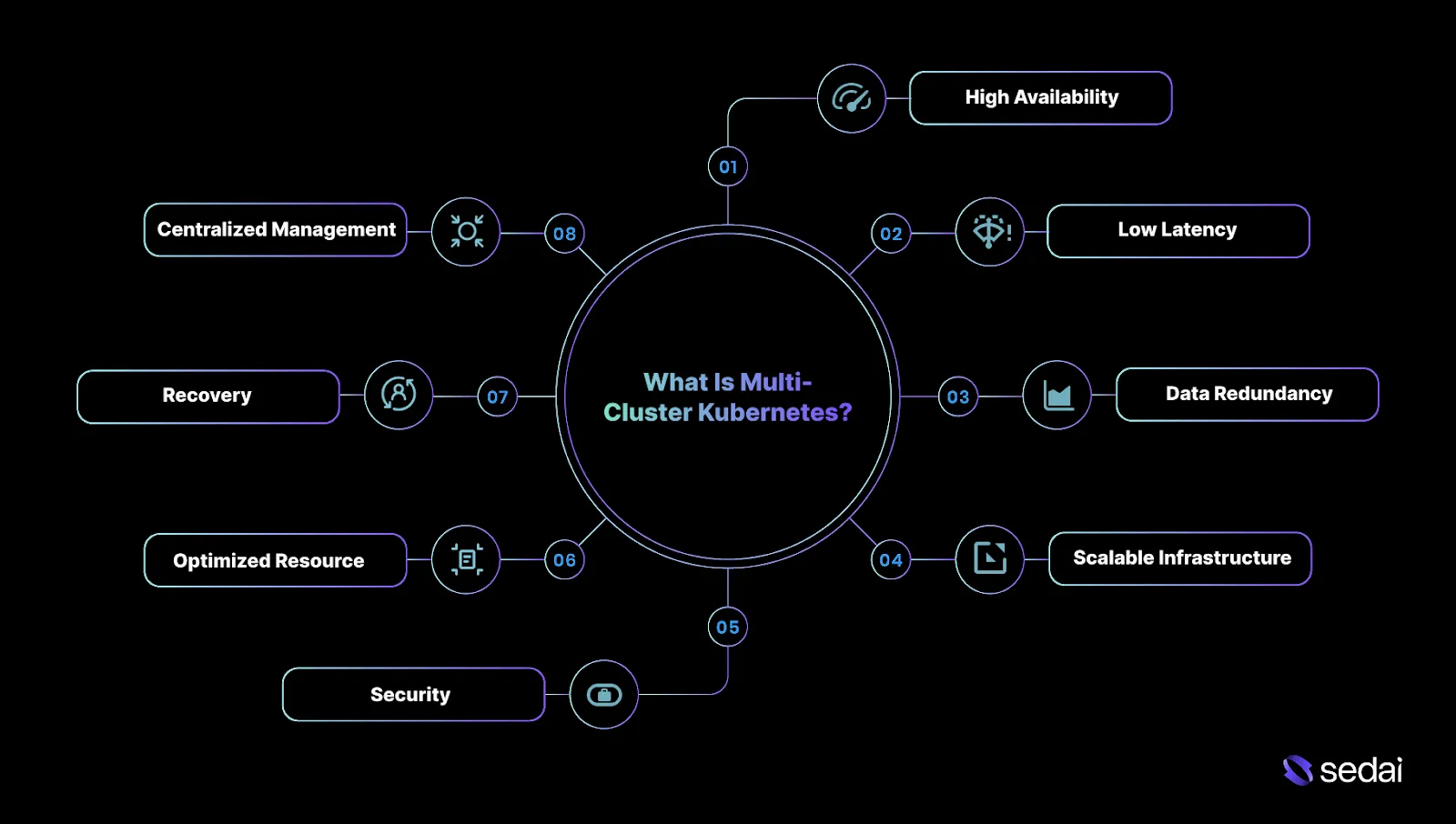
What Is Multi-Cluster Kubernetes?
Multi-Cluster Kubernetes refers to the practice of managing multiple Kubernetes clusters across different regions, cloud providers, or environments.
This architecture improves application scalability, availability, and fault tolerance by distributing workloads across multiple clusters.
It is crucial for teams operating complex, distributed systems that must maintain consistent performance, uptime, and resilience in dynamic cloud environments.
Here’s why multi-cluster Kubernetes matters
1.High Availability and Fault Tolerance
Maintaining application uptime during unexpected failures is a persistent challenge, particularly when infrastructure issues occur without warning. Multi-cluster Kubernetes addresses this by enabling automatic failover, allowing workloads to shift smoothly to another cluster during outages.
2. Geographical Optimization and Low Latency
Latency can significantly impact user experience, especially when workloads are hosted in centralized clusters far from end users. By deploying clusters across multiple regions, multi-cluster Kubernetes allows workloads to run closer to users, reducing latency.
This is especially important for applications that require real-time responsiveness and consistent performance for a global user base.
3. Disaster Recovery and Data Redundancy
Recovering quickly and preserving data integrity can be difficult in single-cluster environments during infrastructure failures. Multi-cluster Kubernetes improves disaster recovery by replicating data and workloads across clusters.
4.Scalable Infrastructure Management
As application demand grows, scaling within a single cluster can introduce resource blockages or inefficiencies. Multi-cluster Kubernetes enables horizontal scaling by adding new clusters to handle increased workloads.
This approach distributes demand more evenly, keeps clusters balanced, and helps avoid unnecessary over-provisioning.
5.Isolation for Compliance and Security
Meeting security and compliance requirements can be challenging in shared or mixed-use clusters. Multi-cluster Kubernetes allows teams to isolate sensitive workloads into dedicated clusters that align with specific compliance or security needs.
This separation improves protection for critical applications while maintaining performance across the broader environment.
6.Optimized Resource Utilization
Efficient resource allocation within a single cluster often becomes difficult as workloads grow and diversify. Multi-cluster Kubernetes distributes workloads across multiple clusters, improving resource utilization and preventing any single cluster from becoming overloaded.
This approach supports consistent performance and more effective capacity usage across the infrastructure.
7.Improved Fault Detection and Recovery
Manually identifying and resolving cluster failures can extend downtime and complicate recovery. Multi-cluster Kubernetes enhances fault detection through automated monitoring and failover mechanisms, enabling faster recovery when issues arise.
8.Centralized Management Across Diverse Environments
Operating multiple clusters across regions or cloud providers can lead to fragmented visibility and operational complexity. Multi-cluster Kubernetes simplifies management through centralized control and consistent monitoring, alerting, and logging.
This unified view improves observability, simplifies operations, and enables faster issue resolution across diverse environments.
Once the idea of multi-cluster Kubernetes is clear, the differences between single-cluster and multi-cluster approaches become more apparent.
Single-Cluster vs. Multi-Cluster Kubernetes: What's the Difference?
When choosing between single-cluster and multi-cluster Kubernetes, the primary differences center on scalability, availability, and fault tolerance. Understanding these distinctions is essential to designing cloud-native applications that reliably support complex, high-demand workloads.
Feature
Single-Cluster Kubernetes
Multi-Cluster Kubernetes
Scalability
Limited; blockages at high load
Scales horizontally across clusters
Availability
Single point of failure
High availability with automatic failover
Fault Tolerance
Vulnerable to cluster-wide failures
Fault isolation across clusters
Geographical Optimization
Limited to one region
Distributes workloads across multiple regions
Disaster Recovery
Manual intervention required
Automatic failover and workload replication
Complexity
Simple to manage
More complex, requires cross-cluster management
Resource Management
Limited to cluster resources
Optimized across clusters
Networking
Simple internal communication
Requires advanced service discovery and networking setup
Cost
Lower cost, but less efficient at scale
Higher cost due to multiple clusters
Security and Isolation
Lower isolation between workloads
Better isolation for sensitive workloads
After comparing single-cluster and multi-cluster Kubernetes, the next step is seeing how multi-cluster architectures function in real environments.
Kubernetes multi-cluster architectures allow multiple independent Kubernetes clusters to operate together, improving scalability, availability, and fault tolerance.
Traffic across clusters is typically managed by a central load balancer or service mesh, which routes requests based on resource availability, application requirements, or failure conditions.
1.Traffic Distribution Between Clusters
In a multi-cluster setup, each cluster runs its own control plane and worker nodes. A central load balancer or service mesh handles traffic routing between clusters. For example:
When a user request is received, the load balancer may route it to the cluster with the most available CPU and memory at that point in time.
A similar request from another user may be sent to a different cluster if it has greater available capacity.
This dynamic traffic distribution ensures workloads are balanced efficiently, reducing the risk of resource bottlenecks and maintaining consistent application performance.
If a cluster becomes unavailable, the load balancer or service mesh can automatically redirect traffic to healthy clusters, helping maintain high availability without manual intervention.
2.Cluster Architecture Models
When designing a multi-cluster Kubernetes environment, teams typically choose from three architectural models based on availability, resource optimization, and security requirements.
Architecture
Description
Benefit
Use Case
Replicated
Same applications run in multiple clusters.
High availability and failover.
Mission-critical workloads.
Split-by-Service
Different services run in separate clusters.
Better isolation and resource use.
Compliance or security-sensitive services.
Hybrid
Mix of replicated and split services.
Balance of resilience and efficiency.
Core services need uptime; others need optimization.
3. Cluster Management Approaches
Multi-cluster Kubernetes environments are typically managed using one of two approaches.
Approach
Description
Pros
Cons
Use Case
Kubernetes-Centric
Uses Kubernetes-native tools like Federation to manage clusters.
Centralized control.
Limited features; Federation is no longer actively developed.
Teams needing basic centralized management with native tooling.
Network-Centric
Manages clusters via service meshes and load balancers.
Advanced traffic control and security.
Higher operational complexity.
Large, multi-region or multi-cloud deployments.
Ready to optimize your multi-cluster Kubernetes?
Book a Sedai demo to improve cluster efficiency, reduce costs, and automate resource optimization.
While multi-cluster architectures offer flexibility and scale, they also introduce operational challenges that teams must manage.
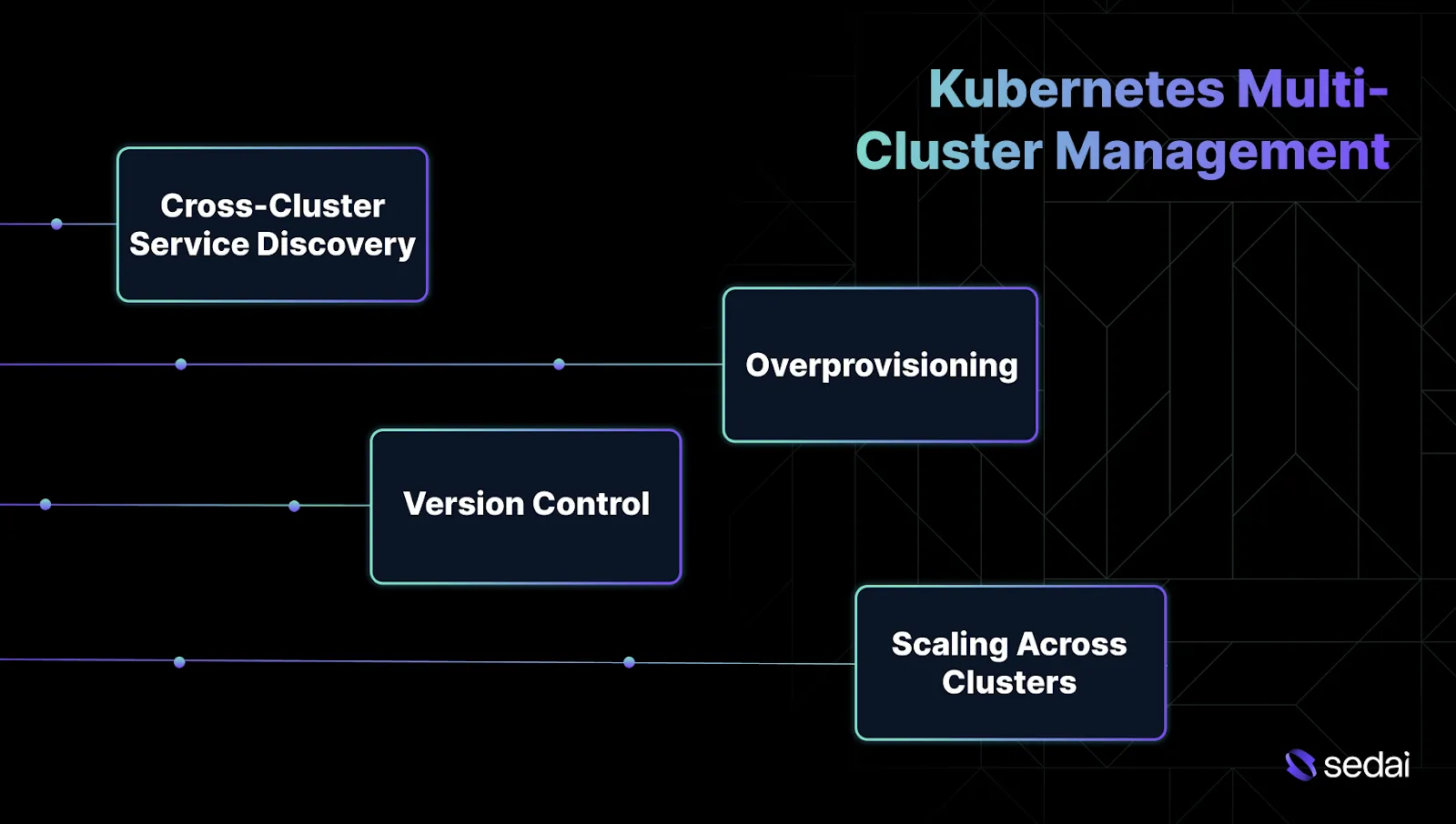
Key Challenges in Kubernetes Multi-Cluster Management
Managing multiple Kubernetes clusters introduces a range of complexities that require careful planning and disciplined execution.
Understanding these challenges is essential for designing and operating a reliable, scalable, and secure multi-cluster architecture. Below are the key challenges along with practical solutions.
1. Cross-Cluster Service Discovery
In multi-cluster environments, services must reliably discover and communicate with each other across cluster boundaries. Misconfigured DNS or inconsistent service discovery mechanisms can result in failed requests and fragmented application behavior.
Solution:
Use service meshes to manage service discovery and traffic routing across clusters. Tools can further support reliable cross-cluster DNS resolution across regions and providers.
Tip: Cross-cluster service discovery should be treated as a reliability concern with consistent resolution behavior validated under partial failures.
2.Resource Management and Overprovisioning
Distributing workloads evenly across clusters with different resource profiles can be difficult. Without careful planning, some clusters may be overprovisioned while others remain underutilized, driving unnecessary cost and inefficiency.
Solution:
Apply resource quotas, autoscaling, and horizontal scaling to balance workloads across clusters. Use cluster affinity rules along with taints and tolerations to ensure workloads are scheduled to clusters that best match their resource requirements.
Tip: Multi-cluster resource efficiency improves only when workload placement reflects actual resource shape rather than equal distribution assumptions.
3.Consistent Configuration and Version Control
Configuration drift, where clusters run different versions or configurations, can lead to inconsistent behavior, deployment failures, and operational risk.
Solution:
Use tools to manage consistent deployments across clusters. Adopt a GitOps approach with platforms like Argo CD or Flux to version-control configurations and automatically synchronize desired state across all clusters.
Tip: Configuration consistency at scale depends on treating cluster state as code and enforcing reconciliation continuously.
4.Scaling Across Clusters
Inconsistent scaling configurations can result in uneven workload distribution, causing some clusters to become overloaded while others remain underutilized.
Solution:
Use cluster autoscalers to scale infrastructure based on workload demand. Combine Horizontal Pod Autoscaling (HPA) and Vertical Pod Autoscaling (VPA) within each cluster to ensure workloads scale efficiently based on real-time resource usage.
Platforms likeSedai continuously tune scaling parameters and resource settings based on observed workload behavior.
Tip: Cross-cluster scaling remains predictable only when infrastructure scaling and pod-level scaling are aligned to the same demand signals.
Once these challenges are clear, teams can start applying practical approaches to manage multiple Kubernetes clusters more effectively.
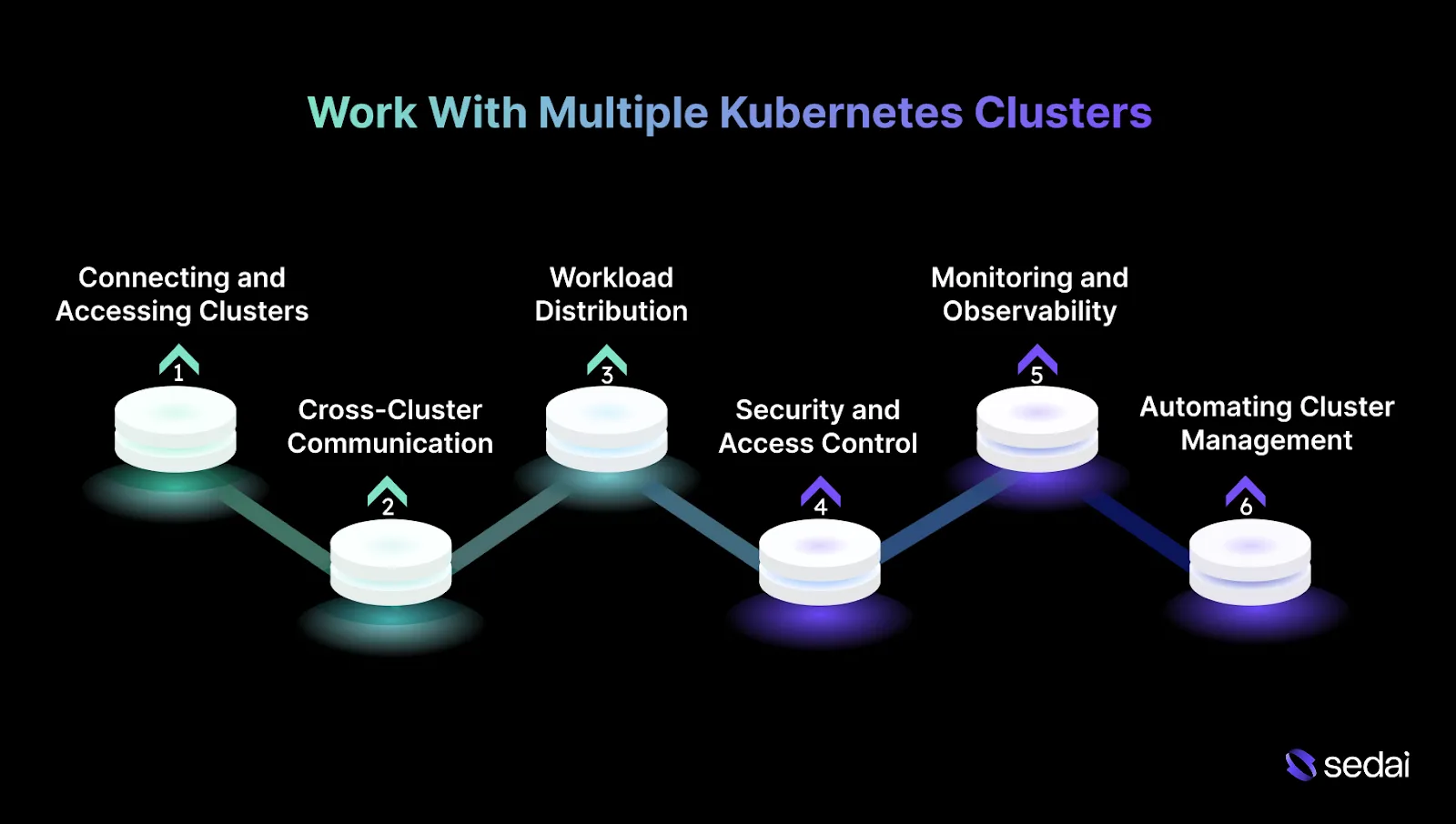
Managing multiple Kubernetes clusters introduces added complexity around network connectivity, workload distribution, resource allocation, and security. You need structured approaches and the right tooling to operate these environments effectively at scale.
1.Connecting and Accessing Clusters
Reliable access to multiple clusters is foundational for multi-cluster operations.
Kubeconfig Files: Using separate kubeconfig files for each cluster allows you to switch contexts with kubectl. This approach works well for smaller environments, but becomes harder to manage as the number of clusters grows.
Multi-Cluster Management Tools: Platforms likeSedai provide a centralized interface for managing multiple clusters. These tools simplify access management and remove the need for frequent manual context switching.
VPNs or Private Network Links: For clusters spread across different cloud providers or on-prem environments, VPNs or private connectivity options enable secure communication. Service meshes such as Istio can further simplify secure, cross-cluster connectivity.
2.Cross-Cluster Communication
Reliable communication between clusters is critical for distributed workloads.
Service Mesh: Service meshes cross-cluster communication by providing traffic routing, service discovery, and consistent security policies across clusters.
DNS Configuration: Proper DNS configuration is required for seamless service discovery. Tools can ensure services are discoverable across clusters without extensive manual setup.
3.Workload Distribution and Resource Allocation
Efficient workload placement depends on intelligent resource management across clusters.
Cluster Affinity: Affinity rules, taints, and tolerations help ensure workloads are scheduled to the appropriate clusters based on resource availability, geography, or workload characteristics.
Global Load Balancing: Load balancers such as NGINX or HAProxy distribute traffic across clusters, routing requests to regions or clusters with sufficient capacity or lower latency.
Resource Limits and Autoscaling: Resource quotas and limits help prevent cluster overload. Horizontal Pod Autoscaling (HPA) and Vertical Pod Autoscaling (VPA) enable workloads to scale dynamically across clusters based on demand.
4.Security and Access Control
Security across multiple clusters requires consistent, centralized control.
RBAC (Role-Based Access Control): RBAC policies should be defined and enforced consistently across clusters, following the principle of least privilege for users and services.
IAM Integration: In multi-cloud or hybrid environments, centralized IAM systems such as OIDC or LDAP simplify authentication and authorization across clusters.
Encryption: End-to-end encryption for inter-cluster communication protects data integrity, especially when clusters communicate over public or untrusted networks.
5.Monitoring and Observability
Unified visibility is essential for maintaining performance and reliability across clusters.
Centralized Logging: Tools like the ELK Stack or Fluentd aggregate logs from all clusters into a single location, simplifying troubleshooting and analysis.
Unified Metrics Collection: Tools can provide consistent metrics collection and visualization across clusters, enabling teams to monitor CPU usage, memory consumption, and pod health.
Distributed Tracing: Tracing tools can help track requests across clusters, making it easier to identify obstacles and optimize application workflows.
6.Automating Cluster Management
Automation reduces operational overhead and ensures consistency at scale.
CI/CD Pipelines: Tools can automate application deployments across multiple clusters, maintaining configuration consistency through a declarative, Git-driven approach.
Cluster Upgrades: Automated upgrade tools help apply patches and updates across clusters with minimal disruption, keeping environments secure and up to date.
Once multiple clusters are in place, best practices play a key role in keeping operations efficient and predictable.
Best Practices for Kubernetes Multi-Cluster Implementation
There are two common strategies for implementing multi-cluster Kubernetes: mirrored and targeted configurations. Each approach addresses different priorities such as disaster recovery, tenant isolation, performance optimization, and cost control.
1.Mirrored Kubernetes Multi-Cluster Configuration
In a mirrored configuration, Kubernetes resources are fully duplicated across all clusters. Each cluster runs the same set of Namespaces, Deployments, Services, and supporting resources.
How It Works:
For example, in a three-cluster setup, each cluster hosts identical namespaces containing the same Deployment and Service definitions. This ensures that every cluster represents a complete and consistent copy of the application environment.
Centralized Administration
Typically, one cluster acts as the primary management plane. Configuration changes are applied centrally and then synchronized across all other clusters, ensuring uniformity in application and infrastructure state.
Traffic Management
Traffic routing strategies vary based on operational goals:
Active-active: Traffic is distributed across clusters based on demand or proximity.
Hot standby: One cluster handles live traffic, while the other remains idle and is activated only during failures. In this model, the standby cluster mirrors the live environment exactly.
Geographic Flexibility
Clusters can be deployed close together for tenant isolation or distributed across regions for disaster recovery. Regardless of location, all resources remain synchronized to maintain consistency.
Benefits:
High availability through fully replicated environments
Fast and predictable failover
Simplified operational model with centralized control
Drawbacks:
Resource-intensive due to full duplication
Higher infrastructure and operational costs
Tip: Mirrored configurations work best when operational simplicity and predictable failover matter more than minimizing baseline infrastructure cost.
2.Targeted Kubernetes Multi-Cluster Configuration
The targeted strategy provides more granular control by synchronizing only selected resources across clusters rather than replicating everything.
How It Works:
A primary control point manages synchronization, but only specific resources, such as critical Deployments, shared services, or entire namespaces, are mirrored. Other workloads remain isolated within their respective clusters.
Flexibility
This approach works well for performance-driven architectures and tenant isolation scenarios. Teams can decide exactly which workloads run in which clusters, allowing fine-grained control over placement and scaling.
Cost Efficiency
Because clusters do not need to be identical, secondary clusters can run with smaller footprints or specialized configurations. This significantly reduces infrastructure costs, especially in uneven or region-specific workloads.
Compliance and Governance
Targeted configurations are beneficial for environments with regulatory or data residency requirements. Administrators can restrict sensitive workloads to specific clusters while still sharing common services where appropriate.
Benefits:
Greater flexibility in workload placement
Lower infrastructure costs
Strong fit for tenant isolation and compliance-driven architectures
Drawbacks:
Higher operational complexity
Requires careful planning to avoid configuration drift or missing dependencies
Tip: Targeted configurations deliver the most value when workload placement decisions are explicitly tied to performance, compliance, or tenancy requirements.
Choosing the Right Strategy:
Use a mirrored configuration when high availability and disaster recovery are top priorities and the cost of full duplication is acceptable.
Use a targeted configuration when flexibility, cost efficiency, tenant isolation, or compliance requirements drive architectural decisions.
Applying these best practices is much easier when the right tools are in place to support multi-cluster operations.
Tools for Kubernetes Multi-Cluster Management
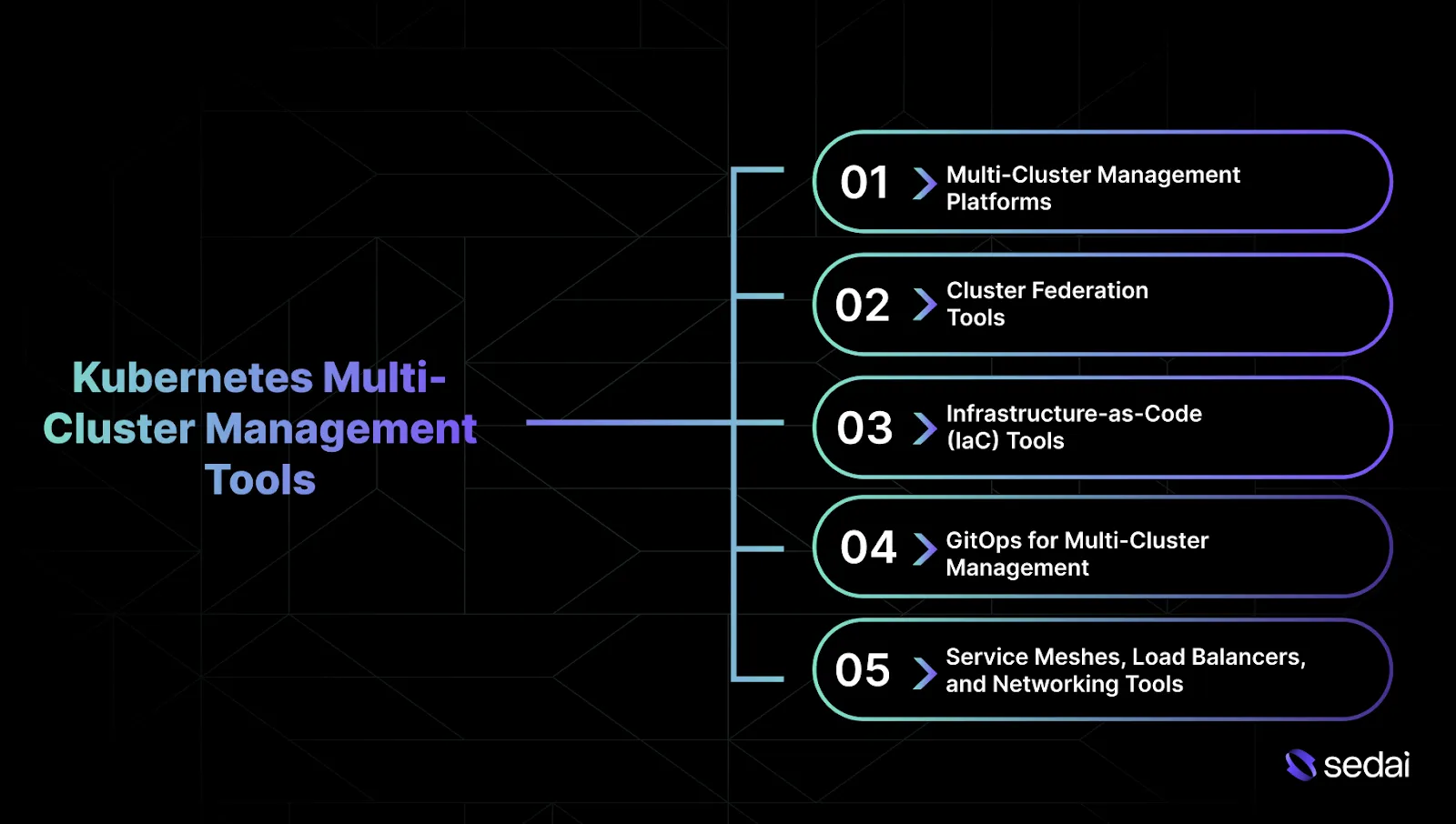
While no single tool can handle every aspect of multi-cluster Kubernetes management, a combination of complementary tools enables effective deployment, operation, and scaling of multiple clusters.
Below are the key tool categories required to manage a multi-cluster Kubernetes environment and how they fit together.
1.Multi-Cluster Management Platforms
Multi-cluster management platforms provide a centralized way to connect to, monitor, and administer multiple Kubernetes clusters from a single interface.
What They Do: These platforms simplify core administrative tasks, including managing cluster access, replicating RBAC policies, handling cluster configurations, and monitoring cluster health and status across environments.
Limitations: They primarily focus on cluster administration. Capabilities like global traffic routing, cross-cluster service discovery, or advanced networking still require additional tools such as load balancers or service meshes.
Why They’re Valuable: They reduce operational complexity by giving platform teams a unified control plane for basic cluster management and visibility.
2.Cluster Federation Tools
Cluster federation tools support a Kubernetes-centric approach where multiple clusters are managed under a single logical control plane.
What They Do: Federation tools synchronize Kubernetes resources such as namespaces, deployments, and services across clusters, enabling consistent configuration and basic cross-cluster coordination.
Drawbacks: Kubernetes federation is no longer actively developed and has seen declining adoption. As a result, it is not considered a long-term strategy for most production-grade multi-cluster environments.
Why They’re Valuable (in limited cases): Federation can still be useful for teams that want Kubernetes-native resource synchronization, but most modern architectures favor network-centric or GitOps-based approaches instead.
3.Infrastructure-as-Code (IaC) Tools
Infrastructure-as-Code tools allow teams to define Kubernetes clusters and supporting cloud infrastructure using code.
What They Do: IaC tools automate the provisioning and configuration of clusters, networking, and cloud resources. The same code can be reused across multiple clusters, ensuring consistency across environments.
Why They’re Valuable: IaC is essential for scalability and repeatability. It reduces manual effort, minimizes configuration drift, and ensures that multi-cluster environments are built and maintained predictably.
4.GitOps for Multi-Cluster Management
GitOps introduces a declarative, version-controlled approach to managing Kubernetes configurations across clusters.
What It Does: Cluster configurations and application manifests are stored in Git repositories. GitOps tools continuously reconcile the desired state defined in Git with the actual state of each cluster.
Why It’s Valuable: GitOps provides a centralized and auditable way to manage changes across multiple clusters. Updates become predictable, traceable, and easy to roll back, which is especially important at scale.
Best Use Case: Ideal for managing application deployments and shared infrastructure components that must remain consistent across clusters.
5.Service Meshes, Load Balancers, and Networking Tools
Networking tools are critical for enabling communication, traffic management, and security across clusters.
What They Do: These tools handle cross-cluster traffic routing, service discovery, load balancing, and security features such as mTLS. Service meshes provide fine-grained control over how traffic flows between services running in different clusters.
Why They’re Valuable: They are essential for multi-cluster architectures that rely on network-level integration. Without them, reliable and secure cross-cluster communication becomes challenging to manage at scale.
How Sedai Improves Kubernetes Multi-Cluster Management and Efficiency?
Managing multiple Kubernetes clusters across regions and cloud environments introduces operational complexity. Static autoscaling and manual configurations often fail to adapt to changing workload patterns, making it difficult to maintain consistent performance and cost control without automation.
Sedai addresses these challenges by continuously analyzing real-time workload behavior and applying data-driven optimizations rather than relying on predefined rules.
It autonomously rightsizes container workloads, fine-tunes scaling behavior, and optimizes cluster resource usage to maintain efficient performance and predictable costs.
Here’s how Sedai helps:
Autonomous Kubernetes Optimization: Sedai analyzes actual usage patterns and dynamically adjusts CPU, memory, and replica configurations. This minimizes idle capacity while improving application performance, without requiring manual tuning.
Smart Scaling Configuration: Instead of depending solely on static autoscaling thresholds, Sedai continuously tunes horizontal and vertical scaling policies based on workload behavior. This enables Kubernetes clusters to scale more accurately under changing demand.
Cluster-Level Resource Efficiency: Sedai evaluates cluster utilization and recommends optimal node group sizes and configurations. This helps prevent overprovisioning and reduces unnecessary cloud spend.
Proactive Cost and Performance Gains: By continuously optimizing workloads and scaling behavior, Sedai delivers measurable efficiency gains. Customers have achieved up to 50% lower cloud costs and meaningful performance gains without compromising reliability.
Unified Optimization Across Environments: Sedai supports Kubernetes clusters running on AWS (EKS), Azure (AKS), Google Cloud (GKE), and hybrid or self-managed environments, providing a consistent optimization approach across all deployments.
With Sedai, Kubernetes resource configurations are continuously optimized in production, reducing manual effort and helping teams maintain efficient, high-performing multi-cluster operations without constant oversight.
Namespace and workload-level cost attribution across multiple clusters is where most teams lose visibility. Book a demo to see how Sedai tracks spend at that granularity and acts on inefficiencies across your fleet.
Final Thoughts
Effective multi-cluster Kubernetes management is essential for maintaining scalability, availability, and performance across cloud environments. As workloads grow, manual intervention and static configurations struggle to keep pace with dynamic infrastructure needs.
As a result, engineering teams are increasingly adopting automated approaches. By continuously analyzing cluster behavior, forecasting resource demand, and executing optimization actions, platforms likeSedai help simplify multi-cluster operations.
Sedai enables real-time adjustments across clusters, maintaining consistent performance while reducing waste and manual effort. The outcome is a self-optimizing multi-cluster environment where clusters operate efficiently, and costs remain predictable.
How can I monitor performance across multiple Kubernetes clusters?
To monitor performance across multiple clusters, use a centralized monitoring solution that aggregates metrics from all environments. Tools can provide real-time visibility into resource utilization, pod health, and overall cluster performance across multiple Kubernetes deployments.
What are the best practices for securing a multi-cluster Kubernetes environment?
Securing a multi-cluster environment requires consistent Role-Based Access Control (RBAC) policies across clusters, secure service-to-service communication through a service mesh, and encryption of all inter-cluster traffic. Regular access audits and isolating sensitive workloads using network policies further strengthen security.
How do I handle network latency in a multi-cluster Kubernetes setup?
To reduce network latency, deploy clusters closer to end users across multiple regions. Global load balancers can route traffic based on proximity or cluster health, helping maintain low latency and consistent application performance.
Can Kubernetes multi-cluster management help with compliance and data residency requirements?
Yes, multi-cluster Kubernetes enables workloads to be deployed in specific regions or isolated clusters to meet compliance and data residency requirements. This approach helps organizations align with regulatory needs while maintaining centralized control.
What is the role of a service mesh in multi-cluster Kubernetes environments?
A service mesh manages cross-cluster communication by handling traffic routing, service discovery, and security. It enforces consistent communication policies, including mutual TLS encryption, and simplifies connectivity across multiple clusters.
Similar Resources
Introducing the Sedai Karpenter Migration Assistant: Move to Karpenter Without the Risk
Karpenter is the better way to provision EKS nodes, but migrating safely is hard. Sedai's new Migration Assistant automates the cutover, with a pre-flight compatibility check and automatic rollback if anything goes wrong.
Introducing Kubernetes Pod Interceptor: Optimize Without Fighting Your Pipeline
Sedai is introducing Pod Interceptor and Smart Scheduler — two changes to how Sedai executes and schedules on Kubernetes, so the optimization you've already identified actually lands, without fighting your GitOps pipeline or waiting on a manual consolidation step.
HPA scales the number of pods, VPA scales the size of each pod. See how the two Kubernetes autoscalers differ, when to use each, and how to run them together safely.
Kubernetes Pricing 2026: EKS vs AKS vs GKE Comparison Guide
Detailed 2026 cost analysis for EKS, AKS and GKE. Explore pricing components, hidden charges and rightsizing tips to optimize your Kubernetes clusters.
.webp%3Fv%3D2026-04-09T18%253A41%253A05.143Z&w=3840&q=75)


.webp%3Fv%3D2026-09-09T13%253A03%253A46.445Z&w=3840&q=75)