Cloud Cost Optimization Strategies & Best Practices
Why is cloud cost optimization important for scaling startups?
Cloud cost optimization is crucial for scaling startups because it ensures resources are aligned with actual workload demands, preventing unnecessary expenses from over-provisioning or misconfiguration. As startups grow, cloud spend can quickly become an engineering constraint, impacting decisions on reliability, performance, and innovation. Optimizing costs early helps maintain engineering headroom and avoids disruptive late-stage corrections. [Source]
What are the main components that drive cloud costs?
The main components driving cloud costs include compute (EC2, containers, Lambda), storage (S3, EBS, backups), data transfer, databases and managed data services, networking components (load balancers, NAT, VPC), licensing and marketplace services, and management/monitoring tools. Understanding how each component scales is essential for effective cost management. [Source]
How can startups implement cloud cost optimization without risking reliability?
Startups can implement cloud cost optimization by sequencing changes: anchor cost to workloads, establish a steady-state baseline, classify workloads by tolerance, audit scaling signals, correct configuration drift, define guardrails tied to SLOs, introduce optimizations incrementally, and continuously re-evaluate as traffic changes. This approach ensures cost controls adapt to workload behavior while preserving reliability and performance. [Source]
What are the top strategies for cloud cost optimization for startups?
Top strategies include attributing cost at the workload/request-path level, baselining steady-state behavior, right-sizing using percentile-based utilization, correcting configuration drift, separating workloads by latency/failure tolerance, aggressive scheduling outside production, designing spot/preemptible workloads to fail cleanly, applying commitments to steady-state usage, controlling logging volume, reviewing managed service capacity, minimizing cross-region traffic, optimizing storage, eliminating orphaned resources, tracking cost deltas after deploys, defining rollback criteria, integrating cost checks into CI/CD, treating retries as cost multipliers, and reviewing cost impact during postmortems. [Source]
How can you track and optimize cloud costs across multi-cloud environments?
Use a unified cost management tool to consolidate all cloud billing into a single view. Apply consistent tagging so every resource ties back to a team, service, or workload. Regular spend audits help surface inefficiencies early, while aligning scaling policies with real demand ensures you are not paying for unused capacity. [Source]
How do you integrate cloud cost optimization into DevOps pipelines?
Integrate cost checks directly into your CI/CD pipelines via infrastructure-as-code (IaC). Use automation to apply approved resource changes, so optimization continues without relying on manual effort. This ensures cost control starts before changes reach production. [Source]
What are the best strategies for reducing cloud data transfer costs across regions?
To reduce cloud data transfer costs, keep data in the same region whenever possible, use CDNs or AWS Direct Connect for large transfers, and design service placement to minimize unnecessary network hops. [Source]
What are common mistakes that cause cloud cost optimization to fail?
Common mistakes include skipping usage baselines, neglecting cost attribution, overcommitting to Reserved Instances without enough visibility, and failing to conduct regular reviews and audits. These errors can turn one-time savings into recurring inefficiencies. [Source]
How do you balance cloud cost optimization with high service availability?
Balance cost optimization with availability by applying optimizations gradually, monitoring latency and error rates closely, and defining rollback thresholds in advance. This approach allows you to reduce spend while protecting uptime and user experience. [Source]
How does Sedai help startups automate cloud cost optimization?
Sedai provides an AI-driven cloud cost optimization platform that acts as a behavior-aware optimization layer. It uses real production signals to evaluate cost-efficiency tradeoffs and safely execute actions within engineer-defined guardrails, automating resource rightsizing, scaling, and cost-aware decisions. [Source]
What metrics demonstrate Sedai's impact on cloud cost optimization?
Sedai delivers over 30% reduced cloud costs, 75% improved app performance, 70% fewer failed customer interactions, and 6X greater engineering productivity. The platform manages over $3 billion in cloud spend for clients like Palo Alto Networks. [Source]
Who benefits most from using Sedai for cloud cost optimization?
Senior engineers and platform teams operating cloud-native or Kubernetes-based environments benefit most from Sedai. The platform is best for those seeking AI-driven cost optimization that respects performance constraints and preserves architectural control. [Source]
How does Sedai compare to other cloud cost optimization companies?
Sedai stands out by providing AI-driven, behavior-based optimization, ML-informed scaling, guardrail-driven autonomous actions, and continuous performance validation. Unlike some competitors, Sedai focuses on real production signals and adapts as workloads evolve, ensuring cost savings without sacrificing reliability. [Source]
What should you look for when choosing a cloud cost optimization company?
Look for coverage of your actual stack (AWS, Azure, GCP, Kubernetes), depth of cost intelligence, experience with your workload profile, real-time observability, continuous adaptation, and automation with production safety (guardrails, rollback, blast-radius limits). [Source]
How does Sedai ensure cost optimization actions are safe?
Sedai executes optimizations only when confidence thresholds and safety policies are met, preserving reliability. The platform uses guardrails, continuous performance validation, and rollback criteria to ensure that cost reductions do not degrade application performance. [Source]
How does Sedai's machine learning adapt to changing workloads?
Sedai's adaptive optimization models update automatically as workloads, traffic patterns, and deployments evolve, ensuring ongoing cost efficiency and performance improvements without manual intervention. [Source]
How can Sedai help startups move beyond reactive cost control?
Sedai uses real-time production signals to automatically optimize cloud resources based on actual demand, integrating cost management directly into workflows. This keeps infrastructure efficient and scalable without distracting teams from product development. [Source]
Features & Capabilities
What features does Sedai offer for cloud cost optimization?
Does Sedai support multi-cloud and Kubernetes environments?
Yes, Sedai provides full-stack coverage, optimizing compute, storage, and data across AWS, Azure, GCP, and Kubernetes environments. [Source]
What integrations does Sedai offer?
Sedai integrates with monitoring and APM tools (Cloudwatch, Prometheus, Datadog, Azure Monitor), Kubernetes autoscalers (HPA/VPA, Karpenter), IaC and CI/CD tools (GitLab, GitHub, Bitbucket, Terraform), ITSM (ServiceNow, Jira), notification tools (Slack, Microsoft Teams), and various runbook automation platforms. [Source]
What are Sedai's modes of operation?
Sedai offers three modes: Datapilot (observability), Copilot (one-click optimizations), and Autopilot (fully autonomous execution), providing flexibility for different operational needs. [Source]
How does Sedai's Release Intelligence feature work?
Sedai's Release Intelligence tracks changes in cost, latency, and errors for each deployment, improving release quality and minimizing risks during deployments. [Source]
What security and compliance certifications does Sedai have?
Sedai is SOC 2 certified, demonstrating adherence to stringent security requirements and industry standards for data protection and compliance. [Source]
Where can I find technical documentation for Sedai?
Detailed technical documentation is available at docs.sedai.io/get-started, covering features, setup, and usage. Additional resources, including case studies and datasheets, are available at sedai.io/resources.
Use Cases & Business Impact
What business impact can customers expect from using Sedai?
Customers can expect up to 50% reduction in cloud costs, 75% improvement in application performance, 6X productivity gains, and up to 50% reduction in failed customer interactions. Notable outcomes include Palo Alto Networks saving $3.5 million and KnowBe4 achieving 50% cost savings in production. [Source]
Can you share specific case studies or success stories with Sedai?
Yes. KnowBe4 achieved up to 50% cost savings and saved $1.2 million on AWS bills. Palo Alto Networks saved $3.5 million and reduced Kubernetes costs by 46%. Belcorp reduced AWS Lambda latency by 77%. More case studies are available at sedai.io/resources.
What industries does Sedai serve?
Sedai serves industries including cybersecurity, IT, financial services, healthcare, travel, e-commerce, SaaS, and digital commerce. Customers include Palo Alto Networks, HP, Experian, KnowBe4, Expedia, CapitalOne Bank, GSK, and Avis. [Source]
Who is the target audience for Sedai?
Sedai is designed for platform engineering, IT/cloud ops, technology leadership, site reliability engineering (SRE), and FinOps professionals in organizations with significant cloud operations, especially those using multi-cloud environments. [Source]
What pain points does Sedai address for its customers?
Sedai addresses pain points such as cost inefficiencies, operational toil, performance and latency issues, lack of proactive issue resolution, complexity in multi-cloud/hybrid environments, and misaligned priorities between engineering and FinOps teams. [Source]
How does Sedai help with operational efficiency?
Sedai automates routine tasks like capacity tweaks, scaling policies, and configuration management, delivering up to 6X productivity gains and allowing engineering teams to focus on high-value work. [Source]
How does Sedai improve release quality?
Sedai's Release Intelligence tracks changes in cost, latency, and errors for each deployment, ensuring smoother releases and minimizing risks. Companies like Freshworks have benefited from this feature. [Source]
Implementation & Support
How long does it take to implement Sedai?
Sedai's setup process takes just 5 minutes for general use cases and up to 15 minutes for specific scenarios like AWS Lambda. For complex environments, timelines may vary. [Source]
How easy is it to get started with Sedai?
Getting started is simple: Sedai offers plug-and-play implementation, agentless integration via IAM, personalized onboarding sessions, detailed documentation, community Slack, and a 30-day free trial. [Source]
What support resources are available for Sedai customers?
Sedai provides personalized onboarding, a dedicated Customer Success Manager for enterprise customers, detailed documentation, a community Slack channel, and email/phone support. [Source]
What feedback have customers given about Sedai's ease of use?
Customers highlight Sedai's quick setup (5–15 minutes), agentless integration, comprehensive onboarding, and extensive support resources as key factors making the platform easy to use. [Source]
18 Cloud Cost Optimization Strategies for Scaling Startups
Benjamin Thomas
CTO
February 12, 2026
Featured
10 min read
Cloud cost optimization for growth-stage startups revolves around aligning resources with actual workload demands. Hidden cost issues arise when systems are over-provisioned or misconfigured, leading to unnecessary expenses. Startups must focus on real-time cost tracking, resource rightsizing, and separating latency-sensitive from non-critical workloads. Implementing clear cost signals and automating scaling ensures sustainable, efficient growth without compromising system reliability.
Managing cloud costs is one of the biggest challenges startups face as they scale. Global cloud spending is expected to surpassUSD 840 billion this year, showing just how quickly cloud bills can rise as usage grows.
What starts as a manageable expense can quickly spiral out of control due to inefficiencies, over-provisioning, and unpredictable usage patterns. As cloud environments expand, costs often accumulate quietly, especially when resources are allocated based on assumptions instead of real-time data.
For many startups, the core issue is limited visibility into how cloud resources are actually being used. Without active cost optimization, unnecessary resources continue running, and small inefficiencies compound over time, creating significant financial pressure.
In this blog, you’ll explore essential strategies to optimize your cloud spend. You’ll learn how to align resources with actual demand, avoid common cost traps, and keep your cloud infrastructure efficient as your startup grows.
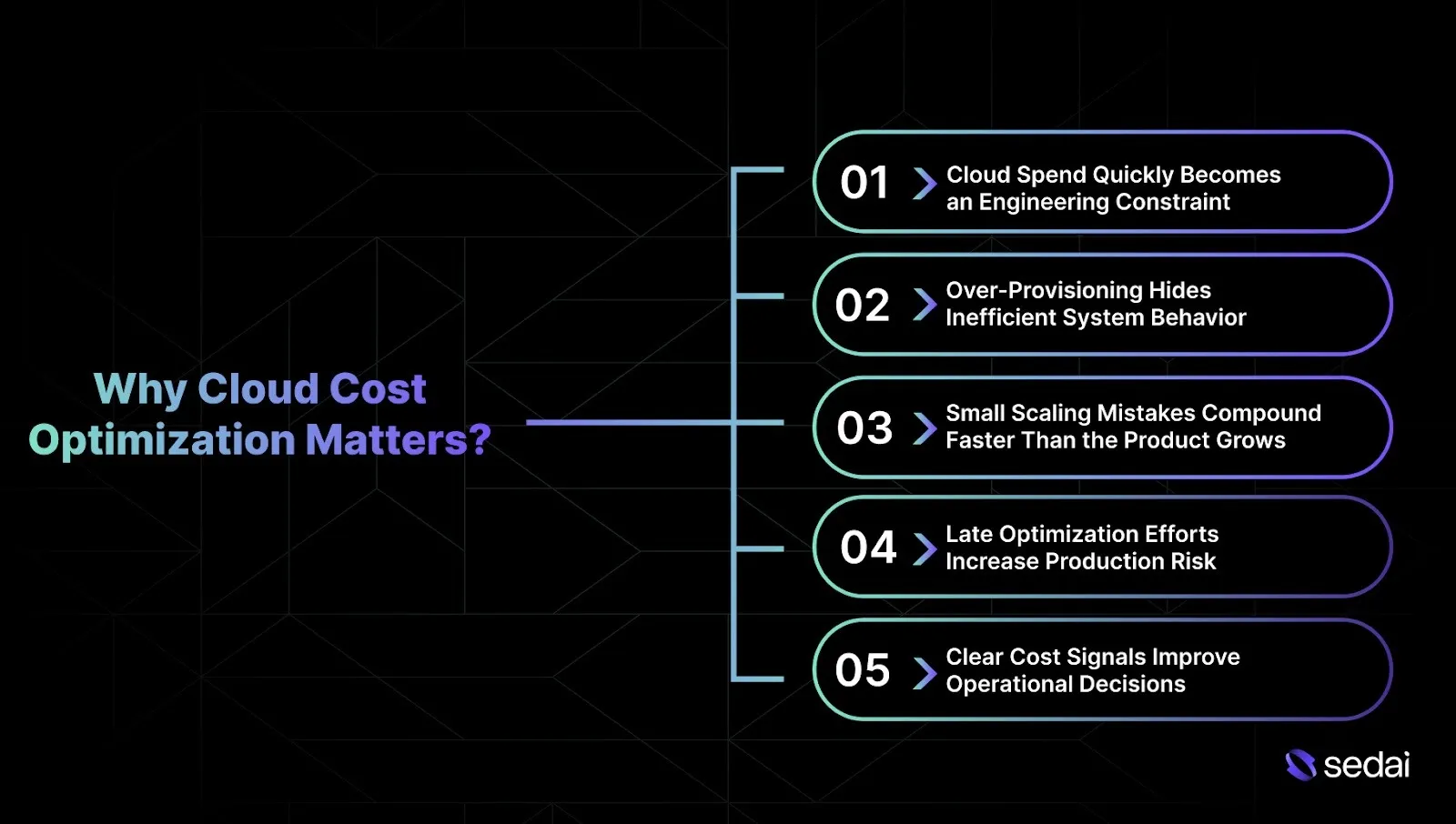
Why Cloud Cost Optimization Matters for Scaling Startups?
Cloud cost optimization is the practice of continuously aligning cloud resources with actual workload behavior so systems run reliably without paying for unused or misallocated capacity.
For scaling startups, this matters because cloud spend directly shapes engineering decisions on scale, resilience, and the risk the platform can tolerate as usage grows. Here’s why cloud cost optimization is important for startups:
1. Cloud Spend Quickly Becomes an Engineering Constraint
Rising cloud bills start limiting redundancy, load testing, and architectural experiments long before they trigger financial scrutiny. Cloud cost optimization keeps resource usage proportional to real demand, preserving engineering headroom as traffic grows.
This allows you to make reliability and performance decisions without trading safety margins for budget relief.
2. Over-Provisioning Hides Inefficient System Behavior
Excess capacity masks autoscaling misconfigurations, retry storms, and uneven traffic patterns until they surface as incidents. Cloud cost optimization removes unnecessary buffers, making system behavior observable rather than buried under idle resources.
When capacity reflects reality, you can identify scaling and performance issues earlier and with less noise.
3. Small Scaling Mistakes Compound Faster Than the Product Grows
Minor misconfigurations in Kubernetes, EC2 instance sizing, or managed service limits accumulate quietly as traffic increases. Cloud cost optimization continuously corrects these inefficiencies. This prevents gradual cost inflation that would otherwise require risky, late-stage corrections.
4. Late Optimization Efforts Increase Production Risk
Once services assume excess capacity, reducing spend feels like a direct threat to uptime and latency. Early cloud cost optimization prevents systems from becoming dependent on waste. You can adjust resources incrementally rather than attempting disruptive changes under pressure.
When spending rises, teams often cannot tell whether the cause is legitimate growth or inefficient infrastructure behavior. Cloud cost optimization ties cost changes directly to workload activity, making them easier to interpret alongside latency, error rates, and throughput.
Understanding why cloud cost optimization matters makes it easier to break down the core cloud cost components that drive those savings.
Cloud cost components are the individual services and usage dimensions that directly determine your cloud bill. Understanding how each component scales is essential for reasoning about cost changes in production environments.
1. Compute (EC2, Containers, Lambda)
Costs are driven by instance type, size, runtime, and concurrency.
For EC2 and Kubernetes, charges accrue as long as instances or nodes are running, regardless of utilization.
Serverless costs scale with execution time and memory allocation, making configuration choices as important as request volume.
2. Storage (S3, EBS, Backups, Snapshots)
Costs depend on data volume, storage tier, retention period, and access frequency.
Block storage and snapshots grow steadily as environments change.
Object storage costs increase with retained data and lifecycle policy decisions.
Many of these charges accumulate independently of application traffic.
3. Data Transfer
Applies to traffic between availability zones, regions, and the internet.
Intra-region traffic is typically cheaper than cross-zone or cross-region transfers.
Architectural placement directly influences cost, and data-heavy services amplify charges as scale increases.
4. Databases and Managed Data Services (RDS, DynamoDB, etc.)
Costs include provisioned capacity, storage, and request volume.
Spend often rises due to retained capacity rather than actual usage.
These services generally scale independently of application compute.
Includes load balancers, NAT gateways, private endpoints, and internal routing.
Charges are tied to uptime, data processed, and connection counts.
Costs are shared across services, making attribution more challenging as environments grow.
6. Licensing and Marketplace Services
Introduce fixed and usage-based fees linked to instance count, throughput, or environment size.
Costs persist while services remain enabled, regardless of workload efficiency.
They tend to scale with infrastructure footprint rather than traffic.
7. Management and Monitoring (Third-Party Tools like Sedai)
Driven by metric volume, log ingestion, retention, and query frequency.
Individually small charges compound across environments.
High-cardinality metrics and verbose logging are common drivers of unexpected cost growth.
Once you understand the components of cloud costs, it becomes easier to optimize cloud costs for startups.
Most cost visibility tools show you the problem. Book a demo to see how Sedai fixes it, taking autonomous action based on your actual workload behavior.
How to Implement Cloud Cost Optimization for Startups?
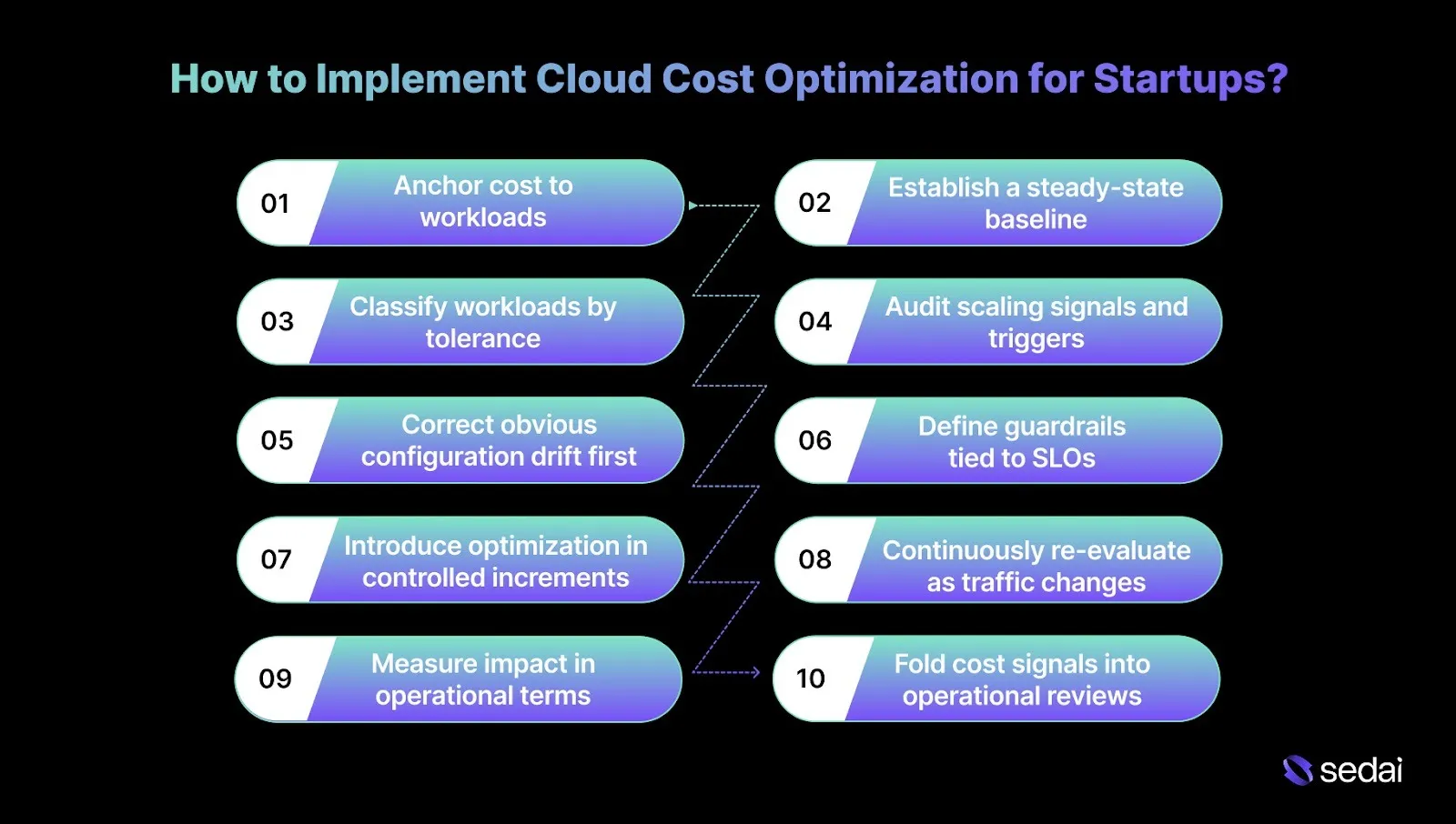
Implementing cloud cost optimization in a startup environment requires sequencing changes to improve cost efficiency without destabilizing production systems. The goal is to introduce cost controls that change with workload behavior while preserving reliability, performance, and delivery velocity.
Below is a step-by-step approach to implementing cloud cost optimization for startups.
Anchor cost to workloads: Break down spending by service, environment, and request path so cost changes can be traced to specific system behavior instead of aggregated cloud invoices.
Establish a steady-state baseline: Measure cost, utilization, latency, and error rates during normal traffic to understand what “healthy and efficient” looks like before making changes.
Classify workloads by tolerance: Separate latency-sensitive services from interruptible, delay-tolerant, and batch workloads so pricing models and scaling strategies reflect actual requirements.
Audit scaling signals and triggers: Ensure autoscaling responds to user demand, background jobs, or infrastructure noise that inflates capacity without improving throughput.
Correct obvious configuration drift first: Fix oversized instances, stale node pools, excessive retention, and forgotten resources before touching architecture or introducing new tools.
Define guardrails tied to SLOs: Set clear boundaries for acceptable cost changes and rollback conditions so optimization actions cannot silently degrade reliability or latency.
Introduce optimization in controlled increments: Start with recommendation and validation workflows, then allow limited automated actions with a small blast radius before expanding the scope.
Continuously re-evaluate as traffic changes: Revisit sizing, scaling, and retention decisions as usage patterns change to prevent regressions caused by growth or seasonality.
Measure impact in operational terms: Track cost deltas alongside latency, error rates, and capacity headroom to confirm that savings arise from efficiency gains.
Fold cost signals into operational reviews: Include cost changes in deploy reviews, incident postmortems, and capacity planning so spend becomes a first-class operational metric.
Once you understand how to implement cloud cost optimization, it becomes easier to apply practical strategies that help startups reduce expenses and improve efficiency.
18 Best Strategies for Cloud Cost Optimization for Startups
Cloud cost optimization strategies focus on controlling cloud spend by shaping how systems scale and consume resources under real traffic. They emphasize durable approaches that hold up as workloads change.
Below are the 18 best practices for cloud cost optimization for startups.
1. Attribute Cost at the Workload and Request-Path Level
Start by breaking cloud spend down by service, environment, and traffic path using tagging, labeling, and usage metadata at deploy time. Tie this data directly to deploys and traffic changes so you can see exactly what made the difference.
2. Baseline Steady-State Behavior Before Making Changes
Before optimizing anything, capture utilization, latency, error rates, and cost during normal traffic across multiple cycles. This gives you a reliable baseline to separate real inefficiency from intentional headroom.
3. Right-Size Using Percentile-Based Utilization
Once you understand steady-state behavior, shift your focus from averages to P90–P99 metrics for CPU, memory, and saturation. Averages hide spikes and uneven traffic patterns, which is why downsizing based on them often fails in production. So, always validate changes with load tests or historical peak replays before rolling them out broadly.
4. Continuously Correct Configuration Drift
Even well-sized systems drift over time as teams ship fixes and scale reactively. Instance sizes creep up, retention periods expand, and limits get loosened. That is why configuration reviews need to be conducted regularly. Treat drift correction as routine maintenance.
5. Separate Workloads by Latency and Failure Tolerance
Not every workload needs the same guarantees. Explicitly classify services as latency-sensitive, interruptible, or delay-tolerant, then align pricing models, scaling policies, and instance types accordingly. When these tolerances get mixed, non-critical work ends up riding on premium infrastructure.
6. Use Scheduling Aggressively Outside Production
Shut down dev, test, and internal systems when they are idle, and automate schedules so this does not rely on manual discipline. If an environment does not serve customers continuously, it should not run continuously.
7. Design Spot and Preemptible Workloads to Fail Cleanly
Spot instances only deliver value when interruptions are expected and handled gracefully. Build in retries, checkpoints, or job resumption, then monitor interruption rates and proactively rebalance capacity. Without interruption-aware design, Spot savings disappear quickly.
8. Apply Commitments Only to Proven Steady-State Usage
Commitments work best when they cover usage you already know is stable. Base Reserved Instances or Savings Plans on observed minimums. As traffic patterns change, revisit the coverage. Over-commitment simply locks in waste.
9. Control Logging Volume and Metric Cardinality
Observability costs grow silently when logs are verbose, and labels scale with the diversity of requests. Reduce high-cardinality metrics and set retention policies based on operational needs. Observability should help you find problems.
10. Review Managed Service Capacity Independently of Traffic
Databases, queues, and monitoring systems scale based on configuration. Regularly reassess capacity, throughput, and retention, because these services often become top spenders without obvious warning signs.
11. Minimize Cross-Zone and Cross-Region Traffic by Design
Service placement matters more than most teams realize. Avoid unnecessary network hops and track data transfer as a first-class metric. Network costs grow quietly and compound at scale, especially when no one is watching.
12. Optimize Storage Through Access Patterns
Storage optimization starts with understanding how data is accessed. Apply lifecycle policies based on read frequency and recovery needs, then move cold data to cheaper tiers automatically. In most cases, storage waste comes from outdated policies, not oversized volumes.
13. Eliminate Orphaned and Idle Resources Continuously
Unused instances, volumes, snapshots, and load balancers accumulate faster than expected. Detect them continuously and automate cleanup wherever it is safe. Idle infrastructure represents some of the most reliable cost savings available.
14. Track Cost Deltas After Every Major Deploy
Deployments often change scaling behavior in subtle ways. Compare pre- and post-deploy cost alongside performance metrics, and investigate increases even when latency and errors look stable. Waiting for invoices means missing early signals.
15. Define Rollback Criteria for Cost Optimizations
Every optimization should come with clear rollback thresholds for latency, error rate, and capacity regression. Automate rollback where possible. Optimization without a recovery path quickly turns into operational debt.
16. Integrate Cost Checks Into CI/CD Workflows
Increase cost awareness earlier in the process by surfacing the projected impact of infrastructure changes. Flag or block changes that exceed predefined thresholds. This shifts the cost responsibility from before production absorbs it.
17. Treat Retries and Timeouts as Cost Multipliers
Retries may keep SLOs green, but they still burn resources. Measure retry rates and downstream amplification, then fix retry storms even when things appear stable.
18. Review Cost Impact During Incident Postmortems
Incidents leave behind emergency capacity and temporary configuration changes. Once stability returns, remove those mitigations. Postmortems should clean up costs alongside reliability.
Implementing effective cost optimization strategies is just the first step. The next step is identifying companies that can effectively implement these strategies.
Cloud Cost Optimization Strategies That Help Startups Scale Efficiently
See how Sedai applies workload-aware rightsizing, automated scaling, and continuous optimization across cloud environments to eliminate hidden waste, align resources with real demand, and reduce costs as startups scale.
Top 8 Cloud Cost Optimization Companies in 2026
The leading cloud cost optimization companies in 2026 help engineering teams control spend without compromising performance or reliability across multi-cloud and Kubernetes environments.
Below are the top 8 cloud cost optimization companies in 2026.
1. Sedai
Sedai is a company that provides an AI-driven cloud cost-optimization platform designed to reduce spend while maintaining performance and reliability across AWS, Azure, Google Cloud, and Kubernetes environments.
Its platform acts as a behavior-aware optimization layer, using real production signals to evaluate cost-efficiency tradeoffs and safely execute actions within engineer-defined guardrails.
Platform Features:
Behavior-Based Resource Rightsizing: Sedai analyzes actual workload usage patterns to recommend or apply compute and memory adjustments, avoiding static sizing assumptions.
ML-Informed Scaling Optimization: The platform uses historical and live signals to improve autoscaling behavior, reducing over-provisioning while protecting your service objectives.
Guardrail-Driven Autonomous Actions: Optimizations are executed only when confidence thresholds and safety policies are met, thereby preserving reliability.
Cost-Aware Optimization Decisions: Consider cloud pricing models and workload characteristics without hard-coding trade-offs into the architecture.
Continuous Performance Validation: Latency, error rates, and utilization are monitored to confirm that cost reductions do not degrade application performance.
Kubernetes and Cloud-Native Support: Sedai optimizes containerized workloads and cloud resources across supported services and configurations.
Adaptive Optimization Models: Machine learning models update automatically as workloads, traffic patterns, and deployments evolve over time.
How Sedai Delivers Value:
Metric
Key Details
30%+ Reduced Cloud Costs
Sedai reduces cloud costs by optimizing resources based on real-time usage data.
75% Improved App Performance
By adjusting resource allocations, Sedai improves latency, throughput, and overall user experience.
70% Fewer Failed Customer Interactions (FCIs)
Proactive issue detection and remediation ensure services remain available and reduce downtime.
6X Greater Productivity
Automating cloud optimizations frees up engineering teams to focus on high-priority tasks.
$3B+ Cloud Spend Managed
Sedai manages over $3 billion in cloud spend, driving optimization and savings for clients like Palo Alto Networks.
Best For: Senior engineers and platform teams operating cloud-native or Kubernetes-based environments who want AI-driven cost optimization that respects performance constraints and preserves architectural control.
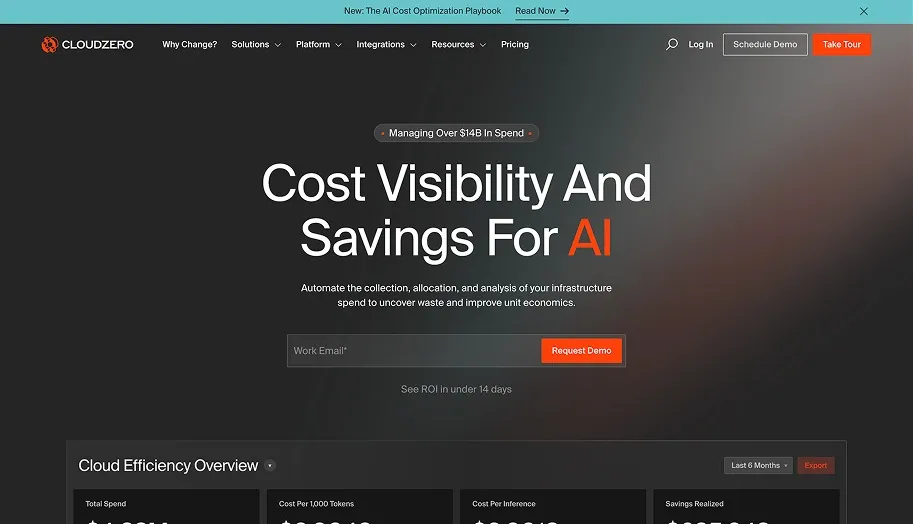
CloudZero provides real-time cloud cost visibility and insights that tie spend to technical dimensions such as product features, teams, and services. It emphasizes cost allocation and anomaly detection so you can act on cost drivers rather than raw billing data.
Platform Features:
Real-Time Cloud Cost Visibility and Allocation: Delivers continuous cost overviews with hourly insights, allowing you to track spend at fine granularity instead of relying on monthly summaries.
Granular Cost Breakdown by Business Metrics: Maps cost to product features, deployments, or teams, helping engineering decisions reflect real cost impact.
Anomaly Detection and Alerts: Uses machine-learning-powered alerts to flag unusual cost behavior early, helping you avoid surprise spend.
Best For: Engineering teams who need real-time cost visibility tied to business metrics like product features and deployments.
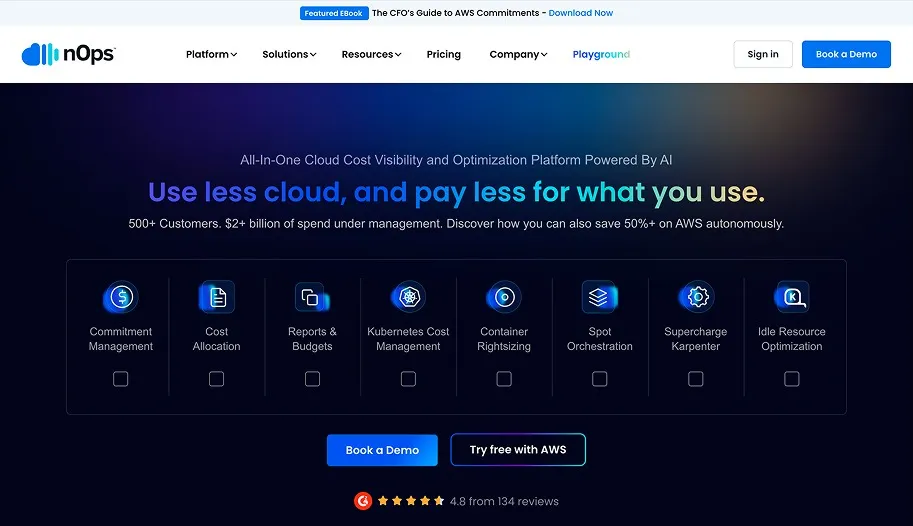
nOps delivers automated cloud cost management with visibility, allocation, and optimization recommendations. It focuses on helping you understand where spending is happening and automating parts of the optimization process.
Platform Features:
Automated Cost Allocation and Visibility: Provides real-time budget and cost tracking across resources, with anomaly detection built in.
Rightsizing and Optimization Recommendations: Suggests cost reduction opportunities based on utilization and usage patterns.
Root Cause Analysis for Anomalies: Helps you trace unexpected cost changes back to specific services or events.
Best For: Teams looking for automated cost optimization and governance with strong support for multi-cloud environments.
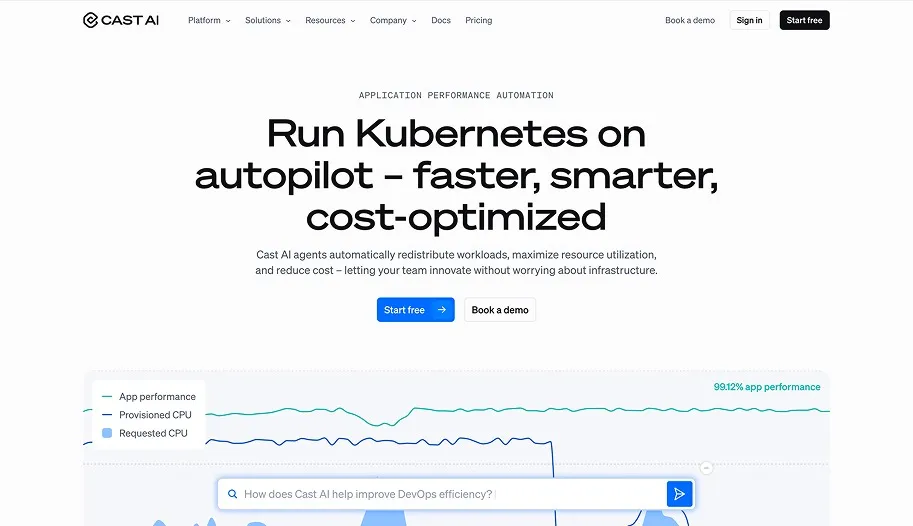
CAST AI uses automation and machine intelligence to optimize Kubernetes clusters and cloud infrastructure costs. Its platform focuses on real-time resource scaling, rightsizing, and selecting the most cost-efficient compute options across cloud providers.
Platform Features:
Automated Kubernetes Autoscaling and Resource Allocation: Dynamically adjusts node and workload allocations based on real utilization to reduce waste.
Cost-Efficient Instance Integration (Spot/Preemptible): Places workloads on cost-efficient instance types, such as Spot or preemptible, where appropriate.
Multi-Cloud Resource Optimization: Supports AWS, Azure, and GCP, letting you manage clusters across clouds with consistent tooling.
Best For: Kubernetes-centric teams that want cost optimization for their containerized workloads and multi-cloud environments.
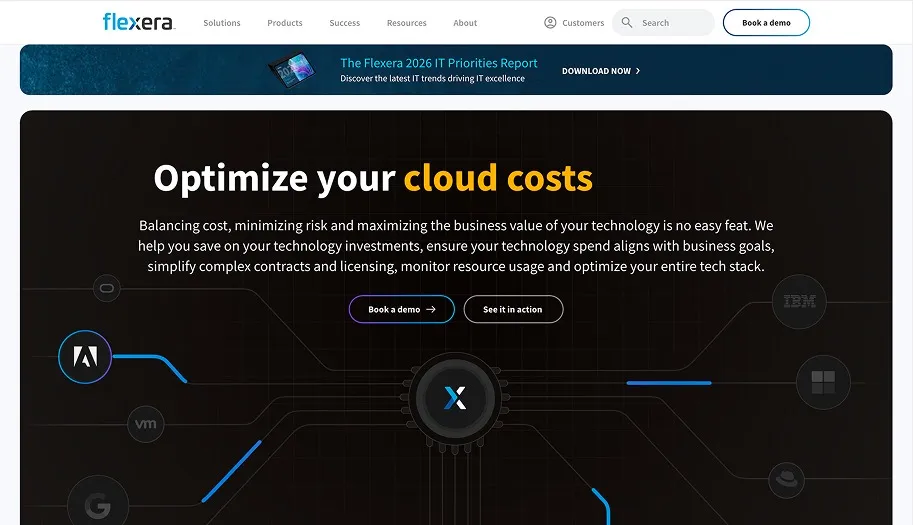
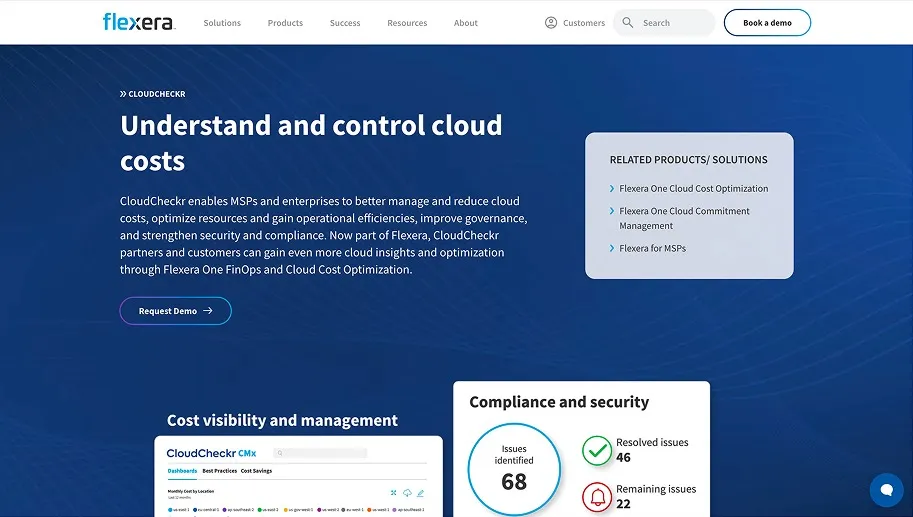
Flexera offers an enterprise-grade cloud cost and asset management platform covering cost visibility, governance, and software asset optimization. The platform is widely used in large environments with hybrid and multi-cloud deployments.
Platform Features:
Multi-Cloud Cost Visibility and Governance: Consolidates cost data across cloud providers and enforces policies to help you maintain cost controls.
Policy Automation for Cost and Compliance: Automates governance and budgeting policies to reduce drift.
IT Asset and Licensing Optimization: Aligns cloud spend with software license usage and broader asset strategy.
Best For: Large teams operating hybrid and multi-cloud environments, requiring governance and compliance alongside cost optimization.
CloudCheckr offers a cloud management platform providing cost optimization, compliance, and governance capabilities. The platform combines cost analytics with security and configuration insights for multi-cloud environments.
Platform Features:
Detailed Multi-Cloud Cost and Usage Analytics: Offers granular reporting across AWS, Azure, GCP, and more.
Automated Governance and Compliance Controls: Helps you apply security and cost policies consistently across environments.
Resource Optimization Insights: Highlights opportunities to eliminate waste and improve resource utilization.
Best For: Organizations seeking a comprehensive platform for cost management, compliance, and security across multi-cloud estates.
For startups, cloud waste compounds into runway loss faster than any other operational cost. Book a demo to see how Sedai applies all 18 optimization strategies continuously so your engineering team can focus on product, not cloud bills.
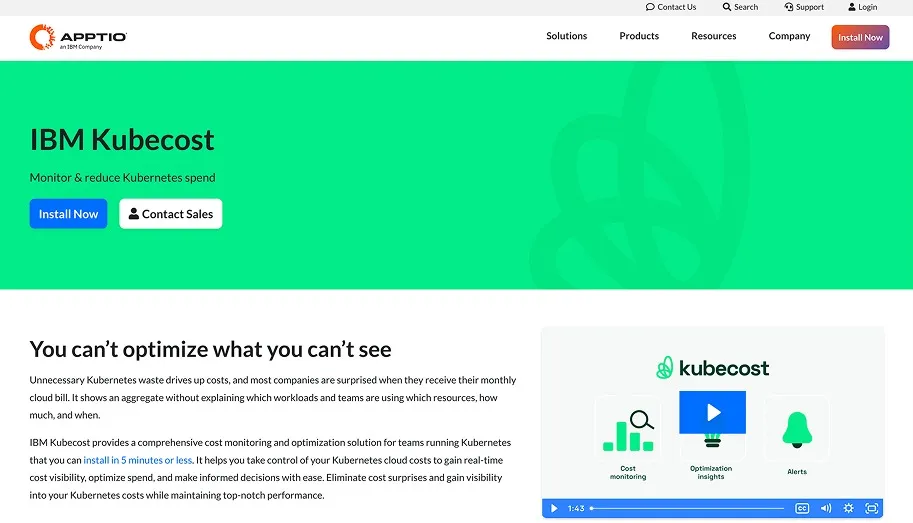
Kubecost focuses on cost visibility and optimization for Kubernetes environments. It helps you break down spending by cluster components and improve container efficiency.
Platform Features:
Cost Breakdown by Namespace, Pod, and Deployment: Provides granular Kubernetes cost visibility so you can pinpoint expensive components.
Real-Time Utilization Monitoring: Tracks CPU, memory, and other resource usage to support efficient capacity planning.
Multi-Cloud Kubernetes Support: Maintains cost visibility across clusters running in different clouds.
Best For: Engineering teams that need granular Kubernetes cost insights and optimization for containerized environments.
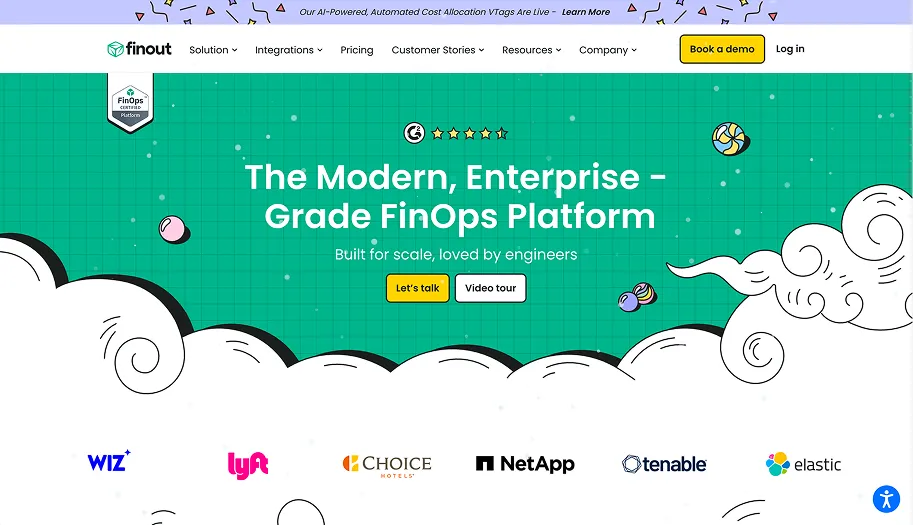
Finout unifies cloud cost data across providers into a single view and provides tools for detailed allocation and anomaly detection. It simplifies multi-cloud spend analysis and helps you understand cost patterns more clearly.
Platform Features:
Unified Multi-Cloud Billing and Cost View: Consolidates AWS, Azure, and GCP spend into one dashboard for easier analysis.
Virtual Tagging for Accurate Allocation: Applies virtual tags to categorize spend where native tagging falls short.
Anomaly Detection and Trend Tracking: Identifies unusual spend patterns and delivers near-real-time insights.
Best For: Teams operating across multiple cloud providers who need a unified view of costs with the flexibility of virtual tagging.
Knowing which companies lead in cloud cost optimization makes it easier to make an informed decision when choosing the right one for your business.
How to Choose the Right Cloud Cost Optimization Company?
Choosing the right cloud cost optimization company means validating that it can operate safely in production and help you deliver efficiency without compromising reliability.
The focus is on workload-level insight, automated actions with guardrails, and continuous adaptation as traffic and system behavior change.
Here's how you can select the right cloud cost optimization company:
Cloud Platform and Service Coverage: Verify support for your actual stack. AWS, Azure, or GCP is table stakes. What matters is coverage across EC2, Kubernetes, managed databases, serverless, and the networking services you run in production.
Depth of Cost Intelligence: Determine whether their platform understands cost drivers tied to scaling behavior, retries, and configuration drift, or if it only surfaces savings opportunities after the fact.
Experience with Your Workload Profile: Ask whether they have optimized environments with traffic patterns, failure tolerance, and scaling dynamics similar to those of SaaS platforms, data-heavy pipelines, or AI workloads.
Real-Time Observability Versus Static Analysis: Favor platforms that operate on near-real-time signals and correlate cost with deploys and scaling events, not tools that rely on periodic audits or monthly reports.
Operating Model Over Engagement Model: One-time audits deliver short-lived value. Continuous systems that adapt as workloads change help you prevent regression and reduce ongoing engineering effort.
Automation With Production Safety: Evaluate whether optimizations can be applied incrementally with guardrails, rollback conditions, and blast-radius limits.
Final Thoughts
Cloud cost optimization for growing startups is about building a sustainable, scalable infrastructure that grows with your business. By continuously adjusting resources and scaling policies, you keep your cloud environment efficient without compromising performance.
As your startup grows, manual cost management quickly becomes harder to maintain, which is where automation starts to matter. Platforms likeSedai help you move beyond reactive cost control. By using real-time production signals, Sedai automatically optimizes cloud resources based on actual demand, while protecting application performance.
With Sedai, you can integrate cost management directly into your workflows, keep infrastructure lean, efficient, and ready to scale, without pulling your team away from building products.
Start optimizing today and set your startup up for predictable cloud costs and uninterrupted growth.
FAQs
Q1. How can you track and optimize cloud costs across multi-cloud environments?
A1. Start by using a unified cost management tool to consolidate all cloud billing into a single view. From there, apply consistent tagging so every resource ties back to a team, service, or workload. Regular spend audits help surface inefficiencies early, while aligning scaling policies with real demand ensures you are not paying for unused capacity.
Q2. How do you integrate cloud cost optimization into DevOps pipelines?
A2. Cost control works best when it starts before changes reach production. Integrate cost checks directly into your CI/CD pipelines via infrastructure-as-code (IaC). Then use automation to apply approved resource changes, so optimization continues without relying on manual effort.
Q3. What are the best strategies for reducing cloud data transfer costs across regions?
A3. Network costs drop quickly when services are placed thoughtfully. Keep data in the same region whenever possible, and use CDNs or AWS Direct Connect for large transfers.
Q4. What are the common mistakes that cause cloud cost optimization to fail?
A4. Most failures come from skipping the basics. Teams often miss usage baselines, neglect cost attribution, or overcommit to Reserved Instances without enough visibility. Regular reviews and ongoing audits turn one-time savings into lasting results.
Q5. How do you balance cloud cost optimization with high service availability?
A5. The key is gradual change with clear guardrails. Apply optimizations step by step, watch latency and error rates closely, and define rollback thresholds in advance. This lets you reduce spend while protecting uptime and user experience.


.webp%3Fv%3D2026-04-09T18%253A41%253A05.143Z&w=3840&q=75)