What is cloud cost optimization and why does it matter?
Cloud cost optimization is the process of managing compute, storage, and network resources to use them efficiently and avoid unnecessary costs. It ensures resources are dynamically allocated to match real-time application demands, reducing waste and maintaining performance. This is crucial because studies show that 78% of companies waste 21–50% of their cloud spend each year, mostly due to over-provisioned, idle, or misaligned resources. Optimization helps cut these costs, improves scalability, and makes cloud management more predictable.
How does cloud optimization work in practice?
Cloud optimization works by continuously monitoring resource usage, scaling resources based on demand, rightsizing resources for optimal performance, implementing cost management and forecasting, and automating issue remediation. This ensures your cloud infrastructure runs efficiently, scales with workload fluctuations, and controls costs while maintaining performance.
What are the main benefits of cloud optimization?
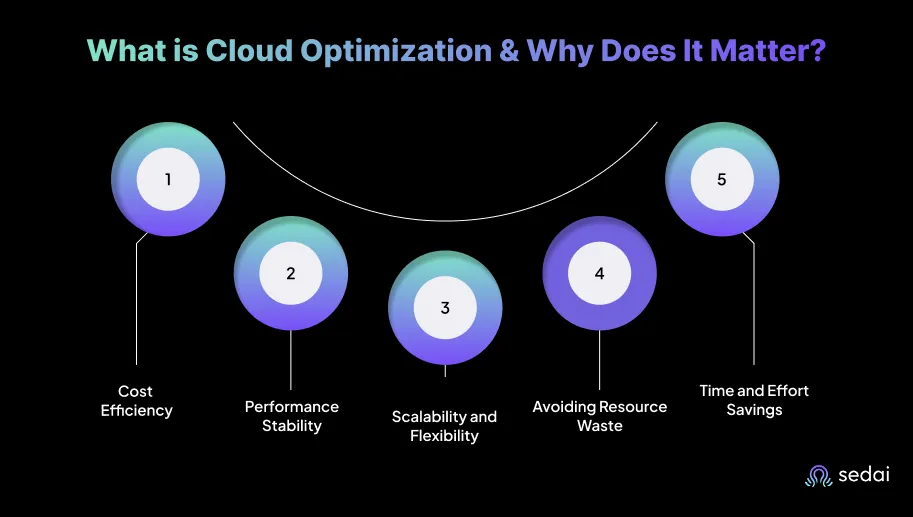
The main benefits include cost efficiency by reducing unnecessary spend, performance stability during traffic spikes, scalability and flexibility as applications grow, avoidance of resource waste, and significant time and effort savings through automation of critical tasks like scaling and rightsizing.
How can I prevent cloud cost overruns in unpredictable workloads?
You can avoid unexpected cloud costs by using dynamic scaling and predictive analytics to understand workload behavior. These tools automatically adjust resources based on real-time demand, ensuring you’re not over-provisioning and keeping costs under control.
What are the best practices for optimizing cloud networking costs?
Best practices include reducing unnecessary inter-region data movement, establishing private connections like AWS Direct Connect, and using CDNs to bring content closer to users. These steps help lower latency, simplify traffic flow, and avoid hidden data transfer charges.
How does multi-cloud optimization improve cost management?
Multi-cloud optimization allows you to run workloads on the cloud provider that offers the best balance of cost and performance for each use case. Tools like Kubernetes simplify multi-cloud deployments, enabling strategic workload distribution, cost control, and consistent performance across environments.
What role does cost tagging play in cloud optimization?
Cost tagging provides visibility into where cloud spend originates, whether by team, project, or department. This clarity makes it easier to identify optimization opportunities and ensures cost accountability across the organization.
How can cloud optimization tools integrate with existing monitoring systems?
Cloud optimization tools typically integrate with platforms such as Prometheus, Datadog, and CloudWatch. By connecting resource utilization data from your monitoring system, these tools can provide recommendations or even apply optimizations automatically.
What are some actionable strategies for cloud cost optimization in 2026?
Key strategies include using multi-cloud architectures, automating rightsizing, optimizing storage with tiered solutions, leveraging serverless computing, implementing cost allocation tags, dynamic resource scheduling, cloud-managed networking, reserved instances, automation tools, hybrid cloud, cloud-native monitoring, load balancing, cost forecasting, security configuration optimization, AI for resource optimization, Infrastructure-as-Code, and data transfer management.
How is AI shaping the future of cloud optimization?
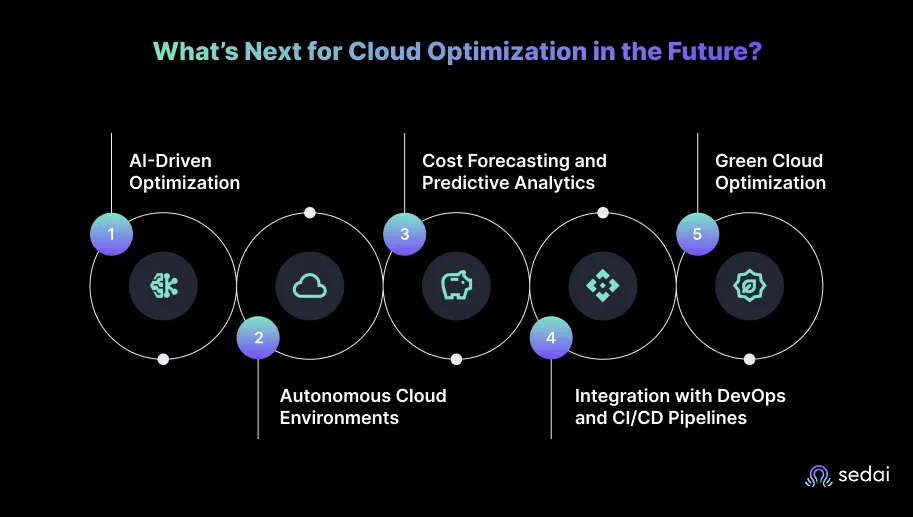
AI is increasingly used to monitor workloads, predict demand, and optimize resources in real-time, reducing manual intervention. AI-driven optimization, autonomous cloud environments, predictive analytics, and integration with DevOps pipelines are key trends shaping the future of cloud optimization.
About Sedai's Autonomous Cloud Optimization Platform
What is Sedai and what does it do?
Sedai is an autonomous cloud management platform that optimizes cloud operations for cost, performance, and availability. It uses machine learning to eliminate manual intervention, continuously adjusting resources to match real-time demand and proactively resolving issues before they impact users.
What are the key features of Sedai's platform?
Sedai offers autonomous optimization, proactive issue resolution, full-stack cloud coverage (compute, storage, data across AWS, Azure, GCP, Kubernetes), release intelligence, plug-and-play implementation, enterprise-grade governance, and multiple modes of operation (Datapilot, Copilot, Autopilot).
How does Sedai help reduce cloud costs?
Sedai reduces cloud costs by up to 50% through autonomous optimization, rightsizing workloads, and eliminating waste. It continuously analyzes real-time usage patterns and predicts future resource needs, adjusting configurations to prevent over-provisioning and reduce unnecessary spend.
What performance improvements can Sedai deliver?
Sedai can reduce latency by up to 75%, as demonstrated by customers like Belcorp, and proactively resolves performance and availability issues before they impact users. This ensures seamless operations and improved user experience.
How does Sedai improve engineering productivity?
Sedai automates routine tasks such as capacity tweaks, scaling policies, and configuration management, delivering up to 6X productivity gains. This allows engineering teams to focus on high-value work and innovation instead of manual cloud management.
What is Sedai for S3 and how does it work?
Sedai for S3 optimizes Amazon S3 costs by managing Intelligent-Tiering and Archive Access Tier selection. It achieves up to 30% cost efficiency gain and 3X productivity gain by reducing manual effort in S3 management.
What is Release Intelligence in Sedai?
Release Intelligence tracks changes in cost, latency, and errors for each deployment, improving release quality and minimizing risks during deployments. This feature ensures smoother releases and reduces the likelihood of errors impacting production.
What modes of operation does Sedai offer?
Sedai offers three modes of operation: Datapilot (observability), Copilot (one-click optimizations), and Autopilot (fully autonomous execution of optimizations). This provides flexibility to match different operational needs and risk tolerances.
How does Sedai ensure safe and auditable changes?
Sedai integrates with Infrastructure as Code (IaC), IT Service Management (ITSM), and compliance workflows to ensure all changes are safe, validated, and auditable. Every optimization is constrained, validated, and reversible, guaranteeing safe operations.
Implementation, Integrations & Support
How long does it take to implement Sedai?
Sedai’s setup process is designed to be quick and efficient. For general use cases, setup takes just 5 minutes, and for specific scenarios like AWS Lambda, it may take up to 15 minutes. More complex environments may require additional time, and personalized onboarding is available.
How easy is it to get started with Sedai?
Getting started with Sedai is simple due to its plug-and-play implementation. It connects securely to your cloud accounts using IAM, requires no agents, and offers comprehensive onboarding support, detailed documentation, and a 30-day free trial.
What integrations does Sedai support?
Sedai integrates with a wide range of tools, including monitoring/APM platforms (Cloudwatch, Prometheus, Datadog, Azure Monitor), Kubernetes autoscalers (HPA/VPA, Karpenter), IaC & CI/CD tools (GitLab, GitHub, Bitbucket, Terraform), ITSM (ServiceNow, Jira), notification tools (Slack, Microsoft Teams), and various runbook automation platforms.
What technical documentation is available for Sedai?
Sedai provides detailed technical documentation covering features, setup, and usage. Access it at docs.sedai.io/get-started. Additional resources, including case studies and datasheets, are available at sedai.io/resources.
What support options does Sedai offer?
Sedai offers personalized onboarding sessions, a dedicated Customer Success Manager for enterprise customers, a community Slack channel, and email/phone support. Extensive documentation and a 30-day free trial are also available to assist new users.
Use Cases, Industries & Customer Success
Who can benefit from using Sedai?
Sedai is designed for platform engineering, IT/cloud operations, technology leadership, site reliability engineering (SRE), and FinOps professionals. It is ideal for organizations with significant cloud operations across industries such as cybersecurity, IT, financial services, healthcare, travel, e-commerce, SaaS, and more.
What industries are represented in Sedai's case studies?
Sedai's case studies cover cybersecurity (Palo Alto Networks), IT (HP), financial services (Experian, CapitalOne Bank), security awareness training (KnowBe4), travel/hospitality (Expedia), healthcare (GSK), car rental (Avis), retail/e-commerce (Belcorp), SaaS (Freshworks), and digital commerce (Campspot).
Can you share specific customer success stories with Sedai?
Yes. KnowBe4 achieved up to 50% cost savings and saved $1.2 million on AWS. Palo Alto Networks saved $3.5 million, reduced Kubernetes costs by 46%, and saved 7,500 engineering hours. Belcorp reduced AWS Lambda latency by 77%. More case studies are available on the Sedai resources page.
Who are some of Sedai's notable customers?
Notable customers include Palo Alto Networks, HP, Experian, KnowBe4, Expedia, CapitalOne Bank, GSK, and Avis. These organizations trust Sedai to optimize their cloud environments and improve operational efficiency.
What business impact can customers expect from using Sedai?
Customers can expect up to 50% cost savings, 75% latency reduction, 6X productivity gains, and up to 50% fewer failed customer interactions. For example, Palo Alto Networks saved $3.5 million and KnowBe4 achieved 50% cost savings in production.
Security, Compliance & Trust
What security and compliance certifications does Sedai have?
Sedai is SOC 2 certified, demonstrating adherence to stringent security requirements and industry standards for data protection and compliance. More details are available on the Sedai Security page.
How does Sedai ensure safe automation and compliance?
Sedai ensures safe automation by constraining, validating, and making every optimization reversible. It integrates with compliance workflows and provides enterprise-grade governance, ensuring all changes are safe and auditable.
Competitive Differentiation & Comparison
How does Sedai differ from other cloud optimization tools?
Sedai stands out with 100% autonomous optimization, proactive issue resolution, application-aware intelligence, full-stack cloud coverage, release intelligence, and a quick plug-and-play setup. Unlike competitors that rely on static rules or manual adjustments, Sedai operates autonomously and holistically.
What unique features put Sedai ahead of competitors?
Unique features include 100% autonomous optimization, proactive issue resolution before downtime, application-aware intelligence, full-stack coverage across major clouds and Kubernetes, release intelligence, and a 5–15 minute setup process. These features address specific use cases and provide a competitive edge.
Why should a customer choose Sedai over other solutions?
Customers should choose Sedai for its autonomous optimization, proactive issue resolution, application-aware intelligence, comprehensive cloud coverage, safety-by-design, quick setup, and proven results such as up to 50% cost savings and 6X productivity gains. Real-world success stories from companies like Palo Alto Networks and KnowBe4 support these claims.
What advantages does Sedai offer for different user segments?
Platform engineers benefit from reduced toil and IaC consistency; IT/cloud ops teams see lower ticket volumes and safe automation; technology leaders get measurable ROI and reduced cloud spend; FinOps teams align engineering and cost efficiency; SREs experience fewer alerts and automated scaling. Sedai tailors its value to each role.
Pain Points & Problem Solving
What common pain points does Sedai address for cloud teams?
Sedai addresses pain points such as cost inefficiencies, operational toil, performance and latency issues, lack of proactive issue resolution, complexity in multi-cloud/hybrid environments, and misaligned priorities between engineering and FinOps teams.
How does Sedai help with operational toil and ticket queues?
Sedai automates repetitive tasks like capacity tweaks, scaling policies, and configuration management, reducing ticket queues and freeing up engineering teams to focus on higher-value work.
How does Sedai address performance and latency issues?
Sedai enhances application performance by reducing latency by up to 75% and proactively resolving performance and availability issues before they impact users, ensuring seamless operations and improved user experience.
How does Sedai help align engineering and cost efficiency objectives?
Sedai provides actionable insights and autonomous optimization that align engineering goals (performance, reliability) with cost efficiency objectives, bridging the gap between technical and financial priorities.
KO THE CLOUD TO ENTER OUR GIVEAWAYKO THE CLOUD TO ENTER OUR GIVEAWAY
17 Best Cloud Cost Optimization Strategies for 2026
Benjamin Thomas
CTO
June 1, 2026
Featured
19 min read
Cloud cost optimization is essential for managing the growing complexity of cloud environments. By focusing on key strategies like dynamic scaling, right-sizing, and automating resource adjustments, you can significantly reduce cloud spend while maintaining performance. Tools such as Sedai help automate these optimizations, analyzing real-time data to prevent waste and ensure resources align with actual demand. These strategies improve cost efficiency while ensuring scalability, flexibility, and long-term savings, making cloud management more predictable and less resource-intensive.
Cloud costs used to be something you checked once a month. Today, they shift by the hour. As apps scale, teams deploy faster, and architectures become more distributed, it’s easy for your cloud bill to drift far from what you originally planned. In fact, studies show that companies waste 30% of their total cloud spend.
Cloud teams are expected to keep everything optimized while also delivering features, improving reliability, and responding to incidents. Even with dashboards and alerts, the sheer volume of signals makes it hard to understand what actually needs attention and what’s just noise.
That’s why 2026 is becoming the year of smarter optimization: not more tools, but simpler, more predictable ways to control spend without slowing engineering down. This guide covers 17 cost-saving strategies that you can apply right away.
What is Cloud Optimization & Why Does It Matter?
Cloud optimization is the process of managing compute, storage, and network resources to use them efficiently and avoid unnecessary costs. You dynamically allocate resources to match real-time application demands without affecting performance.
Cloud optimization monitors usage patterns and applies automated changes like resizing VMs, scaling storage, or updating network configurations so every resource serves a real purpose.
A recent survey found that 78% of companies waste 21–50% of their cloud spend each year, mostly due to over-provisioned, idle, or misaligned resources.
Ready to maximize your cloud ROI?
Book a Sedai demo to see how intelligent optimization can lower costs and boost performance.
Cloud optimization tackles these issues directly by cutting unnecessary costs and keeping your environment responsive and scalable as demand changes.
Here’s why it matters for you:
1. Cost Efficiency
Cloud optimization directly reduces costs by ensuring resources are aligned with actual demand rather than being over-provisioned. You avoid running excess capacity during low-usage periods, preventing unnecessary cloud spending.
2. Performance Stability
Unoptimized cloud environments often face performance bottlenecks during traffic spikes or peak load. Cloud optimization ensures resources scale in line with workload fluctuations, keeping performance consistent and avoiding downtime.
3. Scalability and Flexibility
As applications expand, managing cloud infrastructure becomes increasingly complex. Cloud optimization allows your environment to scale smoothly as demand changes, without requiring manual intervention. Automated adjustments based on usage patterns ensure the infrastructure adapts smoothly, preventing overprovisioning and preserving availability.
4. Avoiding Resource Waste
Cloud setups frequently accumulate unused or idle resources, such as VMs or storage volumes, that continue to generate costs. Cloud optimization continuously tracks utilization and de-provisions resources that are no longer needed.
5. Time and Effort Savings
Managing cloud resources manually can be time-intensive and error-prone. Cloud optimization automates critical tasks such as scaling, rightsizing, and configuration tuning. For your team, this reduces the operational workload and frees up time for higher-value initiatives, while the system maintains performance and cost efficiency in the background.
Once you understand why cloud optimization matters, it becomes easier to see how the overall process works behind the scenes.
How Does Cloud Optimization Work?
Cloud optimization ensures that your cloud infrastructure runs efficiently by automatically adjusting resources to meet real-time application needs. This involves a series of actions that help manage resources, scale infrastructure, and control costs while maintaining performance. Here’s how the process works:
1. Monitor Cloud Resource Usage
You need to continuously track cloud resource utilization across compute, storage, and networking components. Monitoring key metrics such as CPU, memory, I/O, and network traffic provides insights into workload behavior. These insights help identify inefficiencies and anticipate resource requirements before they affect performance.
2. Scale Resources Based on Demand
Using real-time usage data, the system automatically adjusts resources to match workload demand. During periods of high traffic, additional instances or storage are provisioned to maintain performance. When demand decreases, resources scale down to prevent waste and reduce unnecessary costs.
3. Rightsize Resources for Optimal Performance
After scaling, your next priority should be rightsizing. Cloud optimization tools analyze usage patterns and recommend adjustments such as resizing VMs or switching to more suitable storage tiers. This ensures resources remain aligned with actual workload needs, helping you avoid both underutilization and over-allocation.
4. Implement Cost Management and Forecasting
With workloads properly sized and scaled, cost management becomes a core part of the optimization process. Tools track spending trends and highlight cost-saving opportunities, including reserved instances, committed-use discounts, and spot instances for non-critical workloads.
5. Automate Issue Remediation
Cloud optimization also includes automated detection and remediation of performance issues. If a resource becomes underperforming or a configuration error arises, the system can adjust settings or reallocate resources automatically.
Once you understand how cloud optimization functions, it becomes easier to apply practical strategies that can increase efficiency across your entire cloud environment.
17 Smart Strategies for Cloud Optimization in 2026
In 2026, cloud optimization will push engineers to rely on smarter, data-driven strategies to manage environments that are growing more complex and dynamic. Most cost visibility tools show you the problem. Book a demo to see how Sedai fixes it, taking autonomous action based on your actual workload behavior. These strategies will ensure that you can scale efficiently, manage costs, and maintain high performance.
Below are some smart and actionable strategies for cloud optimization.
1. Use Multi-Cloud Architectures
Multi-cloud environments distribute workloads across AWS, Azure, and GCP, optimizing each workload for cost, performance, or availability.
Actionable steps include:
You can assess workloads based on performance, cost, and availability needs to determine which provider offers the best fit for each component.
Use multi-cloud management platforms like Kubernetes to simplify deployment and resource management across multiple clouds.
Adopt cost monitoring tools that operate across cloud providers to simplify spend visibility and ensure consistent optimization.
2. Automate Rightsizing of Cloud Resources
Automated rightsizing continuously evaluates your cloud resources and adjusts them according to actual utilization. This reduces the risk of over-provisioning, prevents performance issues tied to under-provisioning, and helps maintain cost efficiency as workloads scale.
Actionable steps include:
You need to enable tools like AWS Compute Optimizer or Azure Advisor to automatically deliver rightsizing recommendations based on real-time usage.
Use auto-scaling policies driven by performance metrics such as CPU, memory, or throughput to dynamically adjust compute resources.
Integrate rightsizing automation into your CI/CD pipeline to ensure resource adjustments are applied during deployments without requiring manual review.
Revisit rightsizing recommendations regularly and refine scaling rules so they continue to reflect evolving workload patterns.
3. Optimize Storage with Tiered Solutions
Tiered storage helps keep costs under control by placing data in the most appropriate tier based on access frequency. High-performance workloads stay fast with SSD-backed storage, while infrequently accessed data moves to low-cost archival tiers.
Actionable steps include:
You can categorize data by how frequently it’s accessed and migrate low-touch data to cost-effective tiers like AWS Glacier or Azure Archive Storage.
Automate data movement using lifecycle policies to avoid manual intervention when transitioning files between tiers.
Keep SSD-based storage reserved for high-performance or latency-sensitive workloads, shifting non-critical data to inexpensive options.
Track storage usage regularly to identify over-allocated volumes and move them to more budget-friendly storage classes.
4. Use Serverless Computing for Event-Driven Workloads
Serverless computing eliminates the need to manage servers, allowing you to pay only for actual usage. This makes it ideal for event-driven workloads and tasks that don’t need constant compute capacity, helping you reduce operational costs while improving elasticity.
Actionable steps include:
You need to migrate stateless and event-driven processes to serverless platforms like AWS Lambda or Azure Functions to benefit from automatic scaling.
Use serverless for data processing, notifications, and microservices so resources scale precisely with incoming events or requests.
Set execution limits and memory allocations to avoid unnecessary resource consumption and keep costs in check.
Pair serverless functions with API Gateway to ensure seamless service communication and scale workloads efficiently.
5. Implement Cost Allocation Tags
A strong tagging strategy helps teams understand exactly where cloud costs originate. Tagging resources by team, project, or environment creates clear cost ownership and simplifies optimization efforts across distributed infrastructures.
Actionable steps include:
You can define a consistent tagging framework that categorizes every resource by team, project, or department for accurate cost distribution.
Enforce tagging compliance using cloud governance tools to ensure new and existing resources follow established tag policies.
Use cost allocation features in AWS Cost Explorer or Azure Cost Management to analyze spending by tag and identify inefficiencies.
Conduct periodic tag audits to validate accuracy and make updates as resource ownership evolves.
6. Optimize Cloud Cost with Dynamic Resource Scheduling
Dynamic resource scheduling helps you manage cloud costs more intelligently by adjusting resources based on peak and off-peak usage patterns. When resources scale with real demand, workloads get the capacity they need during busy hours while preventing waste during slow periods.
Actionable steps include:
Start with setting automated schedules to power resources on and off during specific time windows, such as business hours or post-testing cycles.
Use tools like AWS Instance Scheduler or Azure Automation to dynamically control when resources are active.
Apply policies for non-production environments so dev and test instances automatically shut down after working hours.
Review usage patterns regularly and update scheduling rules to match actual workload behavior and improve cost savings.
7. Implement Cloud-Managed Networking Solutions
Cloud-managed networking services help you simplify network operations by automating routing, optimizing traffic distribution, and managing private connections. These services also reduce inter-region data transfer costs and improve application performance by directing traffic more efficiently.
Actionable steps include:
Use cloud-native networking tools such as AWS Transit Gateway, Azure Virtual WAN, or Google Cloud Interconnect to automate routing and reduce cross-region traffic costs.
Set up secure and cost-effective VPN connections to support connectivity between on-premises environments and the cloud.
Use edge locations and CDNs like AWS CloudFront or Azure CDN to cache content closer to users and reduce bandwidth costs.
Continuously monitor network performance and adjust configurations based on live data to maintain both efficiency and performance.
8. Take Advantage of Reserved Instances and Savings Plans
Reserved Instances and Savings Plans offer significant discounts for predictable workloads, making them essential for long-term cost control. Committing to usage upfront provides stability, helping you plan and budget more accurately.
Actionable steps include:
You need to analyze workload behavior to identify which services and instances can benefit from long-term commitments such as RIs or Savings Plans.
Choose appropriate term lengths, typically one or three years, based on how predictable your resource usage is.
Monitor utilization regularly to ensure your reservations continue to align with actual workloads and adjust them when patterns shift.
Combine Reserved Instances with spot instances for additional flexibility and cost savings across fluctuating workloads.
9. Automate Cost Optimization with Cloud Management Tools
Manual optimization can introduce delays and gaps. Automating these tasks ensures continuous improvement and reduces the burden on your team while keeping cloud environments cost-efficient.
Actionable steps include:
Use automation tools like AWS Lambda, Azure Automation, or Google Cloud Functions to handle scaling, rightsizing, and cleanup tasks.
Configure automated cost alerts to notify you when spending exceeds thresholds so you can act quickly and prevent overspending.
Apply policy-based automation to enforce best practices, such as turning off idle resources outside business hours.
10. Use Hybrid Cloud for Flexible Cost Optimization
Hybrid cloud strategies let organizations distribute workloads between on-premises and cloud systems, giving you the flexibility to optimize costs while meeting performance and compliance requirements.
Actionable steps include:
You can adopt hybrid cloud platforms like Azure Arc or AWS Outposts to manage applications across on-prem and cloud environments from a unified interface.
Run less critical or flexible workloads in the public cloud while retaining sensitive or mission-critical workloads on-premises.
Ensure smooth integration between both environments using hybrid management tools that optimize performance and control costs.
Review workload placement regularly to determine the most cost-effective environment based on performance, regulatory, and financial needs.
11. Utilize Cloud-Native Monitoring and Optimization Tools
Every major cloud provider offers monitoring and optimization tools that give you real-time visibility into performance and resource consumption. When used well, these tools help surface inefficiencies quickly so you can take action sooner.
Actionable steps include:
You can monitor performance with AWS CloudWatch, Azure Monitor, or Google Operations Suite to spot abnormalities early.
Build dashboards and alerts for ongoing visibility into usage patterns.
Configure automated remediation to fix common issues as soon as thresholds are breached.
Integrate monitoring into DevOps pipelines to keep optimization aligned with development cycles.
12. Optimize Application Load Balancing
Effective load balancing spreads incoming traffic across systems, improving availability and preventing bottlenecks. When configured properly, it becomes a key part of keeping cloud resources efficient and responsive.
Actionable steps include:
Implement load balancing policies that distribute requests intelligently across instances or services.
Use health checks so traffic only reaches healthy targets.
Consider global load balancing solutions like AWS Global Accelerator for lower latency across regions.
Pair load balancing with autoscaling to adjust instance counts as traffic patterns change.
13. Implement Cost Forecasting and Budgeting Tools
Cost forecasting enables you to plan more accurately by using historical data to anticipate upcoming cloud spend. This helps avoid unplanned cost spikes and supports long-term budgeting.
Actionable steps include:
Use AWS Cost Explorer or Azure Cost Management to model future spend based on usage patterns.
Set up budgets and alerts to know when costs approach or exceed expected thresholds.
Analyze trends in historical data and tune resource allocation to prevent waste.
Compare forecasted and actual spending regularly to refine accuracy.
14. Optimize Cloud Security Configurations for Efficiency
Security plays a major role in both performance and cost. Poorly configured security settings can create unnecessary overhead, so continuously fine-tuning them is essential.
Actionable steps include:
Use tools like AWS IAM Access Analyzer or Azure Security Center to identify and resolve gaps.
Maintain least-privilege access to ensure only necessary users and systems can reach sensitive resources.
Review security groups and policies to avoid excessive permissions.
Rely on managed security services like AWS GuardDuty or Azure Sentinel for automated threat detection.
15. Use AI for Resource Optimization and Anomaly Detection
AI is becoming an essential layer in cloud optimization, helping you stay ahead of demand and performance issues. By continuously analyzing workloads, AI systems can predict resource needs, detect anomalies, and recommend adjustments before inefficiencies turn into bigger problems.
Actionable steps include:
Implement AI-driven optimization tools like AWS AI Services or Azure AI to monitor workloads and predict how resources will be used over time.
Set up anomaly detection to catch unusual spikes in consumption and automatically trigger resource adjustments when needed.
Use machine learning models to identify traffic patterns and refine auto-scaling thresholds proactively.
Regularly retrain your machine learning models using the latest usage data so predictions stay accurate and reliable.
16. Centralize Resource Management with Infrastructure-as-Code (IaC)
Infrastructure-as-Code helps you manage cloud environments in a structured, predictable, and scalable way. By defining resources as code, teams can provision infrastructure consistently, reduce manual errors, and enforce standards across environments.
Actionable steps include:
Use Terraform or AWS CloudFormation to define and deploy cloud resources as code, ensuring everything is automated and version-controlled.
Build policies into your IaC templates for naming, tagging, and security settings to maintain uniformity across deployments.
Automate pipelines so infrastructure provisioning is triggered by code changes, reducing manual work and keeping environments optimized.
Review and update IaC templates regularly to adopt new cloud features or cost-saving enhancements introduced by vendors.
17. Optimize Cloud Costs through Data Transfer Management
Data transfer often brings hidden costs, especially when traffic flows between regions or services. By fine-tuning how workloads communicate, you can cut unnecessary data movement, lower egress charges, and improve performance at the same time.
Actionable steps include:
Reduce cross-region traffic by deploying communicating resources within the same region whenever possible.
Use VPC peering or PrivateLink for internal data transfers to avoid charges associated with public routing.
Implement CDNs like Amazon CloudFront or Azure CDN to cache frequently accessed content closer to users and minimize transfer volume.
Audit data transfer patterns using AWS Cost Explorer or Azure Cost Management to identify inefficiencies and refine routing where needed.
While these strategies can significantly improve efficiency, you also need to look ahead and see how cloud optimization is evolving.
What’s Next for Cloud Optimization in the Future?
As cloud environments evolve, optimization will become more automated, intelligent, and closely integrated with broader systems. You will be able to manage resources with minimal manual effort while maintaining performance and controlling costs. Here’s what to expect moving forward:
AI-Driven Optimization: Cloud optimization will use AI and machine learning to monitor workloads, predict demand, and optimize resources in real-time, reducing the need for manual intervention.
Autonomous Cloud Environments: Cloud platforms will automatically resize instances, optimize storage, and adjust networking based on real-time needs, allowing you to focus on innovation.
Cost Forecasting and Predictive Analytics: Predictive tools will improve cost forecasting by analyzing historical data and using machine learning models to anticipate future usage and spending.
Integration with DevOps and CI/CD Pipelines: Cloud optimization will be integrated into CI/CD pipelines, ensuring that infrastructure is aligned with workloads from the moment code is deployed.
Sustainability and Green Cloud Optimization: Future cloud platforms will focus on energy-efficient workloads, greener data centers, and integrating sustainability metrics to track environmental impact.
Cloud cost reduction strategies mean nothing if they're not implemented continuously. Book a demo to see how Sedai acts on those strategies around the clock.
We have seen engineering teams struggle with cloud cost management, especially as they scale resources to meet changing demands. Balancing performance, efficiency, and cost becomes difficult when resources are either over-provisioned or underutilized.
This is exactly where Sedai helps teams stay in control, ensuring that workloads run efficiently while keeping cloud spend in check.
By continuously analyzing real-time usage patterns and predicting future resource needs, Sedai autonomously adjusts cloud configurations, ensuring optimal performance while reducing unnecessary cloud spend.
Here's what Sedai offers:
Autonomous Resource Adjustment: Continuously analyzes real-time workload data (CPU, memory, traffic) to autonomously adjust resources, ensuring optimal performance without over-provisioning or underutilization.
Proactive Scaling: Automatically scales resources based on predicted demand, ensuring capacity during peak loads and avoiding waste during off-peak periods.
Cost-Effective Resource Selection: Uses machine learning to recommend the most cost-effective resources (e.g., on-demand, reserved, or spot instances) based on real-time usage and historical patterns.
Continuous Performance Monitoring & Remediation: Monitors application performance and cloud health in real-time. Automatically adjusts configurations or remediates issues like latency or resource bottlenecks before they affect users.
Reduced Engineering Toil: Eliminates the need for manual scaling, tuning, or monitoring, giving engineers more time to focus on high-value tasks like innovation rather than cloud resource management.
Here’s what Sedai has continuously achieved:
30%+ Reduced Cloud Costs: Automatically adjusts resources based on real-time demand, preventing over-provisioning and reducing waste.
75% Improved Performance: Aligns resources with actual workload needs, improving responsiveness and reducing latency.
70% Fewer Failed Customer Interactions (FCIs): Detects and resolves performance bottlenecks before they affect users.
6x Greater Engineering Productivity: Eliminates manual cloud resource management, allowing teams to focus on innovation.
$3B+ Cloud Spend Managed: Trusted by organizations to ensure cloud environments are optimized for both performance and cost.
Instead of manually adjusting resources or analyzing spending, Sedai continuously optimizes cloud environments in real-time, ensuring efficiency without adding operational overhead.
If you’re looking to understand the potential return on your investment in Sedai, use our ROI calculator to estimate the impact on cloud cost savings, performance improvements, and overall efficiency through Sedai’s automated optimization.
Final Thoughts
Optimizing cloud costs is a continuous effort that needs regular evaluation and smart adjustments. Manual optimization might work initially, but it quickly becomes unsustainable as environments expand and workloads upgrade. The most effective engineering teams treat cloud optimization as an ongoing discipline, using automation and intelligence to balance utilization and spending with precision.
This is where platforms like Sedai make a real difference. Sedai continuously studies real-time workload behavior, predicts future resource needs, and autonomously adjusts configurations before waste occurs.
Handling the heavy lifting behind the scenes reduces operational overhead and ensures your cloud stays efficient without constant manual tuning.
Q1. How can I prevent cloud cost overruns in unpredictable workloads?
A1. You can avoid unexpected cloud costs by using dynamic scaling along with predictive analytics to understand how your workloads behave. These tools help you adjust resources automatically based on real-time demand, ensuring you’re not over-provisioning.
Q2. How can cloud optimization tools integrate with existing monitoring systems?
A2. Cloud optimization tools typically integrate smoothly with platforms such as Prometheus, Datadog, and CloudWatch. By connecting resource utilization data from your monitoring system, these tools can provide recommendations or even apply optimizations automatically.
Q3. What role does cloud cost tagging play in effective optimization?
A3. Cost tagging provides the clarity engineers need by showing exactly where cloud spend is coming from, whether it’s tied to a team, project, or department. This level of visibility makes it easier to identify which areas require optimization and ensures that cost accountability is clear across the organization.
Q4. What are the best practices for optimizing cloud networking costs?
A4. You can optimize networking spend by reducing unnecessary inter-region data movement, establishing private connections like AWS Direct Connect for stable and cost-effective transfers, and using CDNs to bring content closer to users. These steps help simplify traffic flow, lower latency, and avoid hidden data transfer charges.
Q5. How does multi-cloud optimization improve cost management?
A5. Multi-cloud optimization gives you the flexibility to run workloads on the cloud provider that offers the best balance of cost and performance for each use case. With tools like Kubernetes simplifying multi-cloud deployments, you can distribute workloads strategically while keeping costs in check and ensuring consistent performance across environments.
Similar Resources
Should You Build Your Own Cloud Optimization Tool?
Building your own cloud optimization tool can seem like a good idea at first. Here's where the real costs hide, and when buying makes more sense.
CPU & memory limits are the floor of Kubernetes performance, not the ceiling. Learn HPA tuning, node affinity, Karpenter, golden signals, & application-aware optimization for production K8s.
12 Top FinOps Tools for Engineering Leaders in 2026
Get our 2026 comparison of top FinOps tools. Review cost allocation, forecasting, anomaly detection and automation features to choose the best platform.
What Is Data Egress? A Practitioner’s Guide to the Cloud Cost That Hides in Plain Sight
Data egress is the charge cloud providers apply when data leaves a network boundary. Learn where egress costs come from, why they compound, & how workload-level attribution makes them actionable.
.webp%3Fv%3D2026-04-09T18%253A41%253A05.143Z&w=3840&q=75)