How did Sedai perform in the GigaOm Radar for Kubernetes Resource Management?
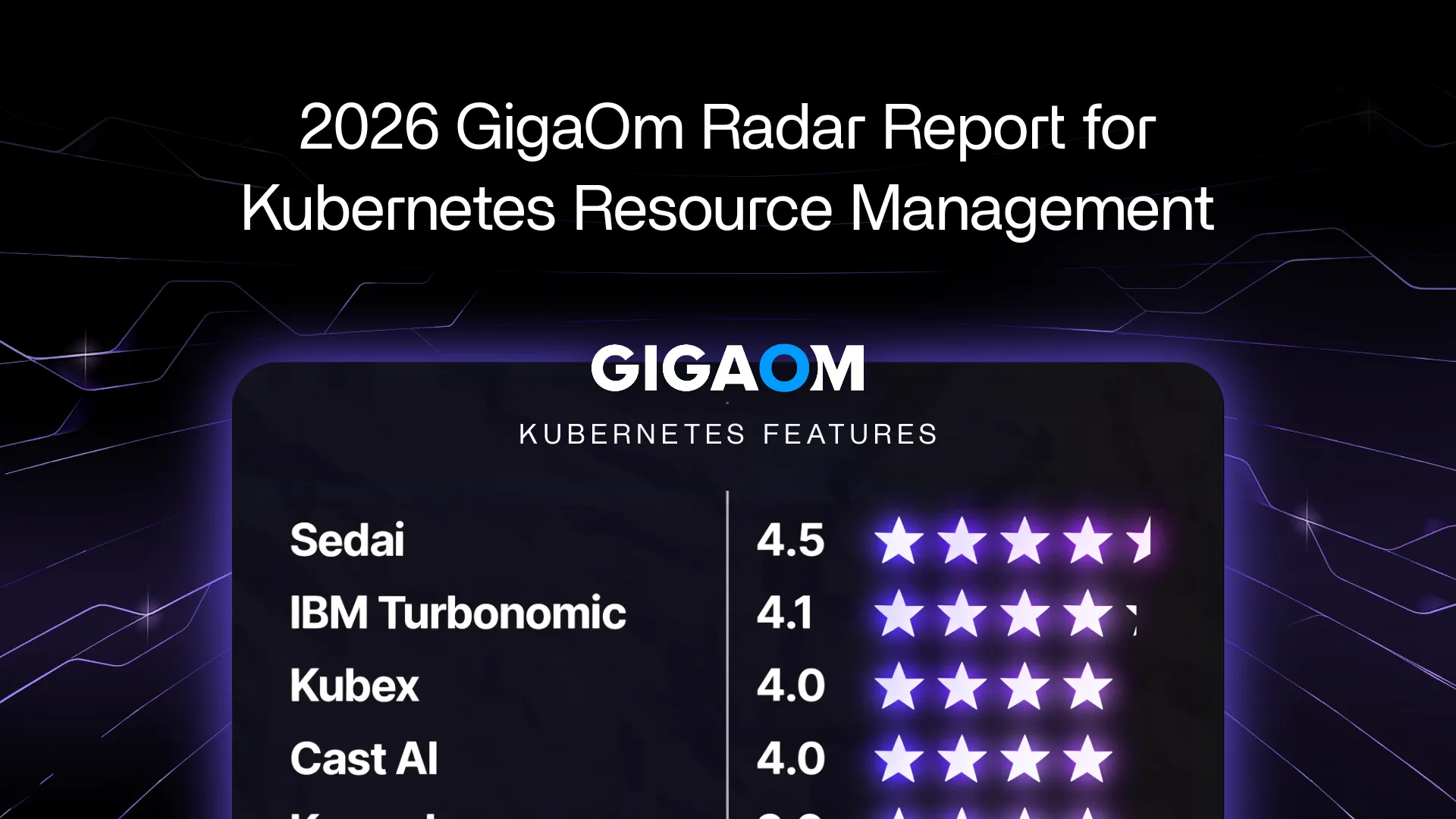
Sedai was named a Leader and Outperformer in the GigaOm Radar for Kubernetes Resource Management, earning the top spot in GigaOm's Key Features Comparison with an average score of 4.5 stars—0.4 stars ahead of the second-ranked competitor. This recognition highlights Sedai's innovation and leadership in autonomous Kubernetes optimization. Read the full GigaOm Radar report (March 2026).
What does it mean to be positioned in the Innovation/Platform Play quadrant by GigaOm?
Being positioned in the Innovation/Platform Play quadrant by GigaOm means Sedai is recognized for its innovative, platform-centric approach to Kubernetes resource management. This designation is reserved for vendors who are moving faster than the market and delivering advanced features that set new standards for the industry.
What key features did GigaOm highlight about Sedai's Kubernetes optimization?
GigaOm highlighted Sedai's autonomous engine, which uses reinforcement learning to safely execute rightsizing and scaling actions in production. Every action is validated against safety guardrails such as error rates and latency, ensuring hands-free optimization without sacrificing reliability. GigaOm also praised Sedai's ability to dynamically tune Kubernetes autoscalers (HPA/VPA) and its deep ITSM integration for enterprise governance.
Why did GigaOm name Sedai an Outperformer?
GigaOm named Sedai an Outperformer because of its autonomous-first approach, rapid feature delivery, and unique capabilities such as tuning the autoscaler itself and integrating availability goals (SLOs) directly into rightsizing decisions. These features enable cost savings without compromising reliability.
What did GigaOm say about Sedai's approach to SRE and automation?
GigaOm analysts noted that Sedai's autonomous SRE approach continuously learns from application behavior in production by analyzing metrics, traces, and events, and makes proactive decisions. This sets Sedai apart from rule-based tools by enabling hands-free, intelligent optimization.
How does Sedai's GigaOm ranking compare to other Kubernetes resource management platforms?
Sedai ranked #1 in GigaOm's Key Features Comparison for Kubernetes Resource Management, with an average score of 4.5 stars—0.4 stars higher than the next competitor. This demonstrates Sedai's leadership in feature set and innovation among Kubernetes optimization solutions. (Source: GigaOm Radar, March 2026)
Where can I read the full GigaOm Radar report on Kubernetes Resource Management?
You can read the full GigaOm Radar for Kubernetes Resource Management by visiting this page on Sedai's website.
What customer feedback did GigaOm include about Sedai?
GigaOm included feedback from Palo Alto Networks, whose Senior Vice President of Engineering stated, "Sedai has helped us save millions of dollars by optimizing and managing our own back-end services. But most importantly, what Sedai has done very well is allow us to respond in real time when anomalies are detected."
How does Sedai's autonomous optimization differ from rule-based tools according to GigaOm?
According to GigaOm, Sedai's autonomous optimization continuously learns from live application behavior and makes proactive decisions, unlike rule-based tools that rely on static thresholds. This enables Sedai to optimize resources safely and efficiently in production environments.
What enterprise features did GigaOm recognize in Sedai's platform?
GigaOm recognized Sedai's deep integration with ITSM workflows, including automatic change ticket creation in ServiceNow and Jira for every optimization action. Sedai also supports full audit trails and can pause execution for manual approval in sensitive environments, ensuring enterprise-grade governance and control.
Features & Capabilities
What is Sedai's autonomous cloud management platform?
Sedai's autonomous cloud management platform uses machine learning to optimize cloud resources for cost, performance, and availability without manual intervention. It covers compute, storage, and data across AWS, Azure, GCP, and Kubernetes environments. (Source: Sedai Solution Briefs)
How does Sedai optimize Kubernetes autoscalers?
Sedai dynamically tunes the thresholds and configurations of native Kubernetes autoscalers (HPA and VPA) based on real-time traffic patterns and learned seasonality. This allows autoscalers to react faster to demand spikes and scale down efficiently during quiet periods, improving both performance and cost efficiency. (Source: GigaOm Radar, March 2026)
What are the main benefits of using Sedai for Kubernetes resource management?
Sedai reduces manual effort, optimizes resource usage, and ensures reliability by validating every action against live safety guardrails. It also integrates with ITSM tools for governance and provides full audit trails, making it suitable for enterprise environments. (Source: GigaOm Radar, March 2026)
Does Sedai support integration with ITSM tools like ServiceNow and Jira?
Yes, Sedai integrates with ITSM tools such as ServiceNow and Jira. Every optimization action can automatically create a change ticket, and execution can be paused for manual approval in sensitive environments, ensuring compliance and governance. (Source: GigaOm Radar, March 2026)
What modes of operation does Sedai offer?
Sedai offers three modes of operation: Datapilot (observability), Copilot (one-click optimizations), and Autopilot (fully autonomous execution). This provides flexibility for different operational needs. (Source: Sedai Solution Briefs)
How does Sedai ensure safe and reliable optimization in production?
Sedai validates every optimization action against defined safety guardrails, such as error rates and latency, before execution. This ensures that optimizations do not compromise reliability or user experience. (Source: GigaOm Radar, March 2026)
What is the primary purpose of Sedai's platform?
The primary purpose of Sedai's platform is to eliminate toil for engineers by automating cloud resource optimization, allowing teams to focus on impactful work instead of manual tuning. (Source: Sedai Company Page)
How does Sedai use machine learning in cloud optimization?
Sedai uses machine learning to analyze application behavior, traffic patterns, and dependencies, enabling autonomous optimization of cloud resources for cost, performance, and availability. (Source: Sedai Solution Briefs)
Competition & Comparison
How does Sedai compare to other Kubernetes optimization tools?
Sedai stands out by offering 100% autonomous optimization, proactive issue resolution, and application-aware intelligence. Unlike competitors that rely on static rules or manual adjustments, Sedai continuously learns from live data and optimizes resources without manual intervention. (Source: GigaOm Radar, March 2026; Sedai Solution Briefs)
What makes Sedai's approach to Kubernetes resource management unique?
Sedai's approach is unique because it combines autonomous optimization, dynamic autoscaler tuning, and integration of SLOs into rightsizing decisions. This ensures cost savings and reliability, setting Sedai apart from traditional, rule-based tools. (Source: GigaOm Radar, March 2026)
How does Sedai's autonomous-first approach benefit enterprises compared to competitors?
Sedai's autonomous-first approach reduces manual effort, accelerates optimization, and ensures safe, reliable operations. Enterprises benefit from rapid feature delivery, ITSM integration, and full audit trails, which are not always available in competing solutions. (Source: GigaOm Radar, March 2026)
What competitive advantages does Sedai offer for Kubernetes resource management?
Sedai offers competitive advantages such as hands-free optimization, dynamic autoscaler tuning, SLO-driven rightsizing, and deep ITSM integration. These features enable enterprises to achieve cost savings and reliability without manual intervention. (Source: GigaOm Radar, March 2026)
Use Cases & Benefits
Who can benefit from using Sedai for Kubernetes resource management?
Platform engineers, SREs, IT/cloud operations teams, technology leaders, and FinOps professionals in organizations running Kubernetes at scale can benefit from Sedai's autonomous optimization, cost savings, and reliability improvements. (Source: Sedai Buyer Personas)
What business impact can Sedai deliver for Kubernetes environments?
Sedai can reduce cloud costs by up to 50%, improve application performance by reducing latency up to 75%, and deliver up to 6X productivity gains by automating routine tasks. These outcomes are validated by customer case studies and analyst reports. (Source: Sedai Solution Briefs, GigaOm Radar)
What pain points does Sedai address for Kubernetes users?
Sedai addresses pain points such as manual resource tuning, risk of overprovisioning, lack of proactive issue resolution, and the need for enterprise governance. It automates optimization, reduces toil, and ensures compliance with safety guardrails. (Source: Sedai Buyer Personas, GigaOm Radar)
Can you share a customer success story related to Kubernetes optimization?
Palo Alto Networks reported saving millions of dollars and improving real-time anomaly response using Sedai for Kubernetes optimization. Their Senior Vice President of Engineering highlighted Sedai's impact on both cost and operational agility. (Source: GigaOm Radar, March 2026)
What industries have benefited from Sedai's Kubernetes optimization?
Industries such as cybersecurity, information technology, financial services, travel, healthcare, car rental, retail, SaaS, and digital commerce have benefited from Sedai's Kubernetes optimization, as demonstrated in customer case studies. (Source: Sedai Case Studies)
Technical Requirements & Implementation
How long does it take to implement Sedai for Kubernetes optimization?
Sedai's setup process typically takes just 5 minutes for general use cases and up to 15 minutes for specific scenarios like AWS Lambda. The platform is designed for quick, plug-and-play implementation. (Source: Sedai Get Started)
What integrations does Sedai support for Kubernetes environments?
Sedai integrates with monitoring tools (Cloudwatch, Prometheus, Datadog, Azure Monitor), Kubernetes autoscalers (HPA/VPA, Karpenter), IaC and CI/CD tools (GitLab, GitHub, Bitbucket, Terraform), ITSM (ServiceNow, Jira), notification tools (Slack, Microsoft Teams), and runbook automation platforms. (Source: Sedai Technology Overview)
Is technical documentation available for Sedai's Kubernetes optimization features?
Yes, detailed technical documentation is available to help users get started with Sedai's Kubernetes optimization features. Access the documentation at docs.sedai.io/get-started.
What support resources are available for onboarding and troubleshooting?
Sedai provides personalized onboarding sessions, a dedicated Customer Success Manager for enterprise customers, detailed documentation, a community Slack channel, and email/phone support. (Source: Sedai Get Started)
Is there a free trial available for Sedai's Kubernetes optimization?
Yes, Sedai offers a 30-day free trial, allowing users to experience the platform's value firsthand before making a commitment. (Source: Sedai Free Trial)
Security & Compliance
Is Sedai SOC 2 certified?
Yes, Sedai is SOC 2 certified, demonstrating adherence to stringent security and compliance standards for data protection. For more details, visit the Sedai Security page.
How does Sedai ensure compliance and auditability for Kubernetes optimization?
Sedai integrates with ITSM workflows for automatic change ticket creation, supports full audit trails for every optimization action, and allows for manual approval in sensitive environments, ensuring compliance and auditability. (Source: GigaOm Radar, March 2026)
KO THE CLOUD TO ENTER OUR GIVEAWAYKO THE CLOUD TO ENTER OUR GIVEAWAY
GigaOm: Sedai Ranks #1 for Key Features in Kubernetes Resource Management
Benjamin Thomas
CTO
May 29, 2026
Featured
10 min read
Key takeaways
Compare Kubernetes optimization platforms based on automation, scalability, and operational efficiency capabilities.
Use AI-driven optimization to improve Kubernetes performance and reduce infrastructure waste.
Continuously optimize workload allocation and scaling behavior across Kubernetes environments.
Improve Kubernetes visibility with real-time monitoring and autonomous infrastructure management.
The results are in, and they confirm what our customers already know: Sedai is setting the pace for intelligent Kubernetes resource management.
GigaOm, one of the most respected analyst firms in enterprise technology, has released its latest Radar for Kubernetes Resource Management, and Sedai has earned top honors: named a Leader and Outperformer, positioned in the Innovation/Platform Play quadrant.
On top of that, Sedai took the #1 spot in GigaOm's Key Features Comparison, scoring an average of 4.5 stars — a full 0.4 stars ahead of the second-ranked competitor.
Cloud costs and performance do not manage themselves. Book a demo to see how Sedai takes continuous autonomous action across your entire environment.
This isn't just a badge. It's validation of a fundamentally different approach to managing and optimizing Kubernetes at scale.
What GigaOm's Analysis Found
Hands-Free Optimization With Confidence
GigaOm highlighted Sedai's autonomous engine as a standout strength, noting that we use reinforcement learning to safely execute rightsizing and scaling actions in production. Critically, every action is validated against defined safety guardrails — error rates, latency, and other live signals — so organizations can run on autopilot without sacrificing reliability.
The result: dramatically less manual effort, and optimization that never comes at the expense of user experience.
Autoscaling That Scales the Autoscaler
Most platforms stop at standard autoscaling. Sedai goes further. GigaOm called out Sedai's ability to dynamically tune the thresholds and configurations of native Kubernetes scalers (HPA and VPA) based on real-time traffic patterns and learned seasonality.
This means autoscalers react faster to demand spikes and scale down faster during quiet periods, without risking instability.
Built for the Enterprise: ITSM Integration and Full Audit Trails
Autonomous action and enterprise governance don't have to be at odds. GigaOm recognized Sedai's deep integration with ITSM workflows, including automatic change ticket creation in ServiceNow and Jira for every optimization action. For sensitive environments, Sedai can even pause execution until a ticket receives manual approval, giving teams full control without giving up automation.
"Unlike rule-based tools, Sedai's autonomous SRE approach continuously learns from application behavior in production by analyzing metrics, traces, and events, and makes proactive decisions."
— Chris Nelson, GigaOm Analyst
See Sedai For Yourself
We'll show you all the features that GigaOm ranked #1 for Kubernetes optimization.
Why GigaOm Named Sedai an Outperformer
GigaOm's Outperformer designation isn't handed out lightly. It signals that a vendor is moving faster than the market, in other words innovating ahead of the curve. In Sedai's case, GigaOm specifically cited our autonomous-first approach, rapid feature delivery, and two capabilities that represent a genuine leap beyond standard optimization techniques:
The ability to tune the autoscaler itself, and
The integration of availability goals (SLOs) directly into rightsizing decisions. Cost savings that respect reliability instead of risking it.
Don't Just Take Our Word For It
"Sedai has helped us save millions of dollars by optimizing and managing our own back-end services. But most importantly, what Sedai has done very well is allow us to respond in real time when anomalies are detected."
— Suresh Sangia, Senior Vice President of Engineering, Palo Alto Networks
GigaOm's recognition as a leader and outperformer validates that Sedai's autonomous approach to Kubernetes optimization delivers measurable, differentiated results. Book a demo to see those results applied to your specific cluster environment.
The Future of Kubernetes Management Is Autonomous
Engineering teams shouldn't be spending their best hours chasing resource inefficiencies. Sedai exists to change that: an autonomous platform that continuously learns, adapts, and acts, so your team can focus on building, not tuning.
We're proud of this recognition, and we're just getting started.
Want to see what a leader in Kubernetes resource management looks like in action?
The GigaOm Kubernetes Radar report evaluates Kubernetes management and optimization platforms based on features, innovation, scalability, and operational capabilities. It helps teams compare leading Kubernetes solutions.
Which is best for Kubernetes optimization: traditional management tools or AI-driven platforms?
Traditional management tools provide visibility and manual controls for Kubernetes operations. AI-driven platforms continuously optimize infrastructure automatically to improve efficiency and reduce operational overhead.
How do Kubernetes optimization platforms work?
Kubernetes optimization platforms analyze workload telemetry, scaling behavior, and infrastructure utilization to improve resource allocation dynamically. Many platforms also automate scaling, workload placement, and cost optimization.
How does Sedai help optimize Kubernetes environments?
Sedai autonomously optimizes Kubernetes workloads using AI-driven analysis and real-time infrastructure tuning. It helps teams achieve up to 30% cloud savings with a 5-minute agentless setup while improving performance and scalability.
Similar Resources
Introducing the Sedai Karpenter Migration Assistant: Move to Karpenter Without the Risk
Karpenter is the better way to provision EKS nodes, but migrating safely is hard. Sedai's new Migration Assistant automates the cutover, with a pre-flight compatibility check and automatic rollback if anything goes wrong.
Introducing Kubernetes Pod Interceptor: Optimize Without Fighting Your Pipeline
Sedai is introducing Pod Interceptor and Smart Scheduler — two changes to how Sedai executes and schedules on Kubernetes, so the optimization you've already identified actually lands, without fighting your GitOps pipeline or waiting on a manual consolidation step.
HPA scales the number of pods, VPA scales the size of each pod. See how the two Kubernetes autoscalers differ, when to use each, and how to run them together safely.
See the Full Picture: Introducing the Resource Lifecycle Dashboard
Sedai already gives you deep visibility into individual resources, opportunities, and savings. Now we're providing a single place to step back and understand your entire environment at a glance.
.webp%3Fv%3D2026-04-09T18%253A41%253A05.143Z&w=3840&q=75)
.webp&w=3840&q=75)


.webp%3Fv%3D2026-09-09T13%253A03%253A46.445Z&w=3840&q=75)