What are cloud optimization services and why do they matter for engineering leaders?
Cloud optimization services help engineering leaders cut waste, improve performance, and increase ROI by efficiently managing cloud resources. These services focus on rightsizing, auto-scaling, and smart cost management, integrating strategies like continuous monitoring and performance optimization. They are essential because teams often waste up to 50% of their cloud spend on inefficiencies, and optimization ensures every resource is used efficiently and cost-effectively. (Source: Original Webpage)
How much cloud spend is typically wasted due to inefficiencies?
According to BCG, up to 30% of cloud spending is wasted due to inefficient usage and a lack of proper cost controls. Some organizations see waste as high as 50% from unused storage, over-provisioned instances, and idle resources. (Source: Original Webpage, BCG)
What are the main functions of cloud optimization services?
Cloud optimization services cover three main functions: resource management (analyzing CPU, memory, and storage to consolidate workloads and remove unused resources), performance and reliability (automating scaling and scheduling for responsiveness), and cost and procurement (choosing the right mix of capacity and making costs transparent). (Source: Original Webpage)
How do cloud optimization services support sustainability goals?
Cloud optimization supports sustainability by reducing environmental impact. For example, Accenture’s Green Cloud research shows that migrating to public cloud can reduce carbon emissions by over 84% and deliver 30–40% total cost of ownership savings. (Source: Original Webpage, Accenture)
What are the key benefits of cloud optimization for organizations?
Key benefits include immediate cost reduction (up to 14% in wasted spend), maximized ROI, simplified management, improved focus for engineering teams, strengthened security and compliance, operational agility, and alignment with sustainability goals. (Source: Original Webpage)
What strategies are most effective for cloud optimization?
Effective strategies include rightsizing resources, auto-scaling for dynamic needs, utilizing spot and reserved instances, consolidating and eliminating unused resources, optimizing data transfer costs, performance optimization techniques (like load balancing and caching), continuous monitoring, and strengthening security and compliance through governance. (Source: Original Webpage)
How do engineering teams implement cloud optimization as an ongoing practice?
Teams should treat optimization as a continuous discipline, not a one-off project. Steps include discovering and tagging resources, automating rightsizing, optimizing purchasing, modernizing architecture, integrating FinOps and sustainability, and measuring and iterating using key metrics like cost per transaction and resource utilization rates. (Source: Original Webpage)
What metrics should engineering teams track to measure cloud ROI?
Key metrics include effective savings rate (actual savings divided by on-demand equivalent spend), unit cost (cost per customer or transaction), utilization rates, and change lead time. These metrics should be aligned with business outcomes such as revenue growth or customer satisfaction. (Source: Original Webpage)
Will cloud optimization hurt performance?
No. Effective optimization improves both cost and performance. Autoscaling, rightsizing, and modern architectures match capacity to demand, providing enough headroom during peaks and reducing waste during quiet periods. (Source: Original Webpage)
How do AI workloads influence cloud optimization strategies?
Generative-AI and machine-learning workloads consume much more compute and energy than traditional applications. Optimization for these workloads involves using dedicated accelerators, sizing models appropriately, scheduling training jobs, and monitoring energy use. Combining cost and carbon metrics helps make balanced decisions. (Source: Original Webpage)
Features & Capabilities
What is Sedai and how does it help with cloud optimization?
Sedai is an autonomous cloud management platform that optimizes cloud resources for cost, performance, and availability using machine learning. It eliminates manual intervention, reduces cloud costs by up to 50%, improves performance by reducing latency by up to 75%, and enhances reliability by proactively resolving issues. (Source: Knowledge Base)
What are the key features of Sedai's autonomous cloud optimization platform?
Sedai uses machine learning to optimize cloud resources based on real application behavior, eliminating the need for manual intervention. It continuously learns from interactions and outcomes to improve optimization and decision models over time. (Source: Knowledge Base)
What is Sedai for S3 and what does it do?
Sedai for S3 optimizes Amazon S3 costs by managing Intelligent-Tiering and Archive Access Tier selection. It achieves up to 30% cost efficiency gain and 3X productivity gain by reducing manual effort in S3 management. (Source: Knowledge Base)
What is Release Intelligence in Sedai?
Release Intelligence tracks changes in cost, latency, and errors for each deployment, improving release quality and minimizing risks during deployments. (Source: Knowledge Base)
What modes of operation does Sedai offer?
Sedai offers three modes: Datapilot (observability), Copilot (one-click optimizations), and Autopilot (fully autonomous execution of optimizations). (Source: Knowledge Base)
What integrations does Sedai support?
Sedai integrates with monitoring and APM tools (Cloudwatch, Prometheus, Datadog, Azure Monitor), Kubernetes autoscalers (HPA/VPA, Karpenter), IaC & CI/CD tools (GitLab, GitHub, Bitbucket, Terraform), ITSM tools (ServiceNow, Jira), notification tools (Slack, Microsoft Teams), and various runbook automation platforms. (Source: Knowledge Base)
What security and compliance certifications does Sedai have?
Sedai is SOC 2 certified, demonstrating adherence to stringent security requirements and industry standards for data protection and compliance. (Source: Knowledge Base, Security page)
Where can I find technical documentation for Sedai?
Sedai’s setup process takes just 5 minutes for general use cases and up to 15 minutes for specific scenarios like AWS Lambda. For more complex environments, timelines may vary. (Source: Knowledge Base)
How easy is it to get started with Sedai?
Sedai offers plug-and-play implementation, connecting securely to cloud accounts using IAM without complex installations or agents. Customers can access personalized onboarding, detailed documentation, and a 30-day free trial. (Source: Knowledge Base)
What feedback have customers given about Sedai's ease of use?
Customers highlight Sedai’s quick setup (5–15 minutes), agentless integration, personalized onboarding, comprehensive support resources, and a risk-free 30-day trial as key factors making the platform easy to use. (Source: Knowledge Base)
What support resources are available for Sedai users?
Sedai provides detailed documentation, a community Slack channel, email/phone support, and personalized onboarding sessions with the engineering team. (Source: Knowledge Base)
Use Cases & Business Impact
What business impact can customers expect from using Sedai?
Customers can achieve up to 50% cloud cost reduction, 75% latency reduction, 6X productivity gains, and 50% fewer failed customer interactions. For example, Palo Alto Networks saved $3.5 million, and KnowBe4 achieved 50% cost savings in production. (Source: Knowledge Base)
Can you share specific case studies or success stories of Sedai customers?
Yes. KnowBe4 achieved 50% cost savings and saved $1.2 million on AWS. Palo Alto Networks saved $3.5 million and reduced Kubernetes costs by 46%. Belcorp reduced AWS Lambda latency by 77%. (Source: Knowledge Base, KnowBe4, Palo Alto Networks)
What industries does Sedai serve?
Sedai serves industries including cybersecurity, IT, financial services, healthcare, travel, e-commerce, SaaS, digital commerce, and car rental services. (Source: Knowledge Base)
Who are some of Sedai's customers?
Notable customers include Palo Alto Networks, HP, Experian, KnowBe4, Expedia, CapitalOne Bank, GSK, and Avis. (Source: Knowledge Base)
Who is the target audience for Sedai?
Sedai is designed for platform engineering, IT/cloud ops, technology leadership, site reliability engineering (SRE), and FinOps professionals in organizations with significant cloud operations. (Source: Knowledge Base)
Pain Points & Problem Solving
What core problems does Sedai solve for engineering teams?
Sedai addresses cost inefficiencies, operational toil, performance and latency issues, lack of proactive issue resolution, complexity in multi-cloud/hybrid environments, and misaligned priorities between engineering and FinOps teams. (Source: Knowledge Base)
What pain points do Sedai's customers commonly express?
Customers often face fragmentation, repetitive toil, risk vs. speed trade-offs, autoscaler limits, ticket volume, config drift, hybrid complexity, cost surprises, outcome gaps, cloud spend pressure, tool sprawl, talent bandwidth issues, release risk, pager fatigue, brittle automation, and slow response to anomalies. (Source: Knowledge Base)
How does Sedai help with cost optimization?
Sedai reduces cloud costs by up to 50% through autonomous optimization, rightsizing workloads, and eliminating waste. It also aligns engineering and cost efficiency objectives through actionable insights. (Source: Knowledge Base)
How does Sedai improve performance and reliability?
Sedai enhances application performance by reducing latency by up to 75% and proactively resolving issues before they impact users, reducing failed customer interactions by up to 50%. (Source: Knowledge Base)
How does Sedai address operational toil for engineering teams?
Sedai automates routine tasks like capacity tweaks, scaling policies, and configuration management, delivering up to 6X productivity gains and freeing up teams to focus on innovation. (Source: Knowledge Base)
Competition & Differentiation
How does Sedai differ from other cloud optimization tools?
Sedai offers 100% autonomous optimization, proactive issue resolution, application-aware intelligence, full-stack cloud coverage, release intelligence, and plug-and-play implementation. Unlike competitors that rely on static rules or manual adjustments, Sedai operates autonomously and holistically. (Source: Knowledge Base)
What unique features set Sedai apart from competitors?
Unique features include 100% autonomous optimization, proactive issue resolution, application-aware intelligence, full-stack cloud coverage, release intelligence, and a quick setup process (5–15 minutes). (Source: Knowledge Base)
What advantages does Sedai provide for different user segments?
Platform engineers benefit from automation and reduced toil; IT/cloud ops teams see reduced ticket volumes and safe automation; technology leaders gain measurable ROI and cost reduction; FinOps teams get actionable savings and multi-cloud simplicity; SREs benefit from proactive issue resolution and reduced pager fatigue. (Source: Knowledge Base)
Why should a customer choose Sedai over other solutions?
Sedai provides always-on autonomous optimization, proactive issue resolution, application-aware intelligence, comprehensive cloud coverage, safety-by-design, quick setup, and proven results such as $3.5 million in savings for Palo Alto Networks and 50% cost savings for KnowBe4. (Source: Knowledge Base)
KO THE CLOUD TO ENTER OUR GIVEAWAYKO THE CLOUD TO ENTER OUR GIVEAWAY
Cloud optimization services help engineering leaders cut waste, improve performance, and increase ROI by efficiently managing cloud resources. Teams often waste up to 50% of their cloud spend on inefficiencies. These services focus on rightsizing, auto-scaling, and smart cost management, integrating strategies like continuous monitoring and performance optimization. Cloud optimization also supports sustainability goals, reducing environmental impact. AI-driven platforms like Sedai automate cost management and performance enhancements, freeing teams to focus on high-impact work.
Public cloud adoption has exploded in the US, with Gartner forecasting $723.4 billion in worldwide spending on cloud services in 2025. Yet alongside this growth comes a reality: engineering teams frequently overspend on infrastructure that doesn’t deliver proportional value.
According to BCG, up to 30% of cloud spending is wasted due to inefficient usage and a lack of proper cost controls.
For engineering leaders, the challenge is not just cost containment but aligning technology investments with business impact. That’s why we’ve created this guide to help you quickly understand what cloud optimization services entail, why they matter right now, and how to implement them.
What Exactly Are Cloud Optimization Services?
As an engineering leader, you're likely already aware that cloud costs are spiraling out of control. We have seen organizations waste 30-50% of their cloud spend on inefficiencies such as unused storage, over-provisioned instances, and idle resources that aren’t being leveraged.
Cloud optimization services eliminate this waste and help you get the most out of your cloud investments by making sure every resource is used efficiently and cost-effectively.
Rather than just trimming costs, these services enhance application speed, improve transparency into usage and spending, and address issues like over-provisioning and cloud sprawl.
With cloud optimization, you get access to certified experts who perform audits, right-size workloads, and provide actionable recommendations, allowing your team to focus on high-priority work instead of managing inefficiencies.
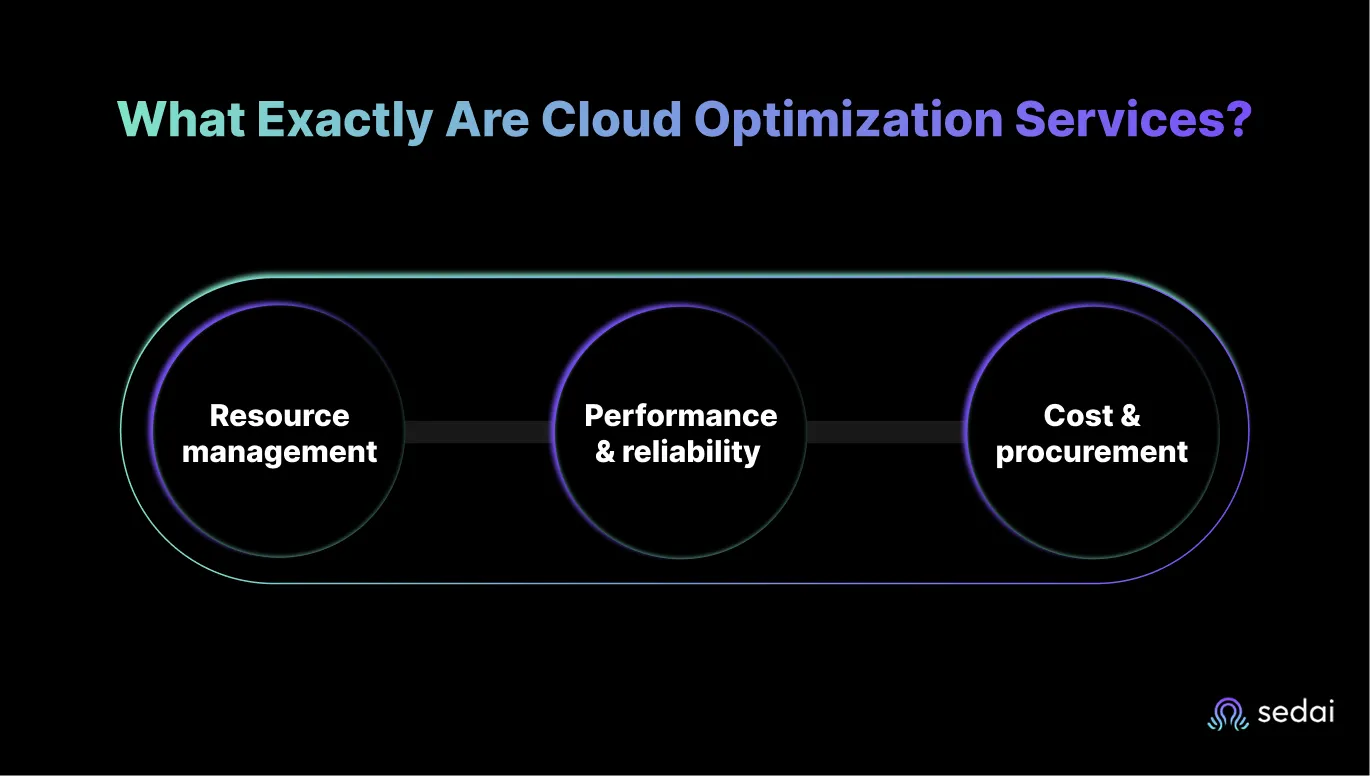
Effective optimization covers three functions:
Resource management
Analyze CPU, memory, and storage consumption to consolidate workloads and remove unused resources. A 2024 survey highlights that over-provisioning (40%) and idle resources (35%) are major drivers of cloud waste.
Performance and reliability
Automate scaling and scheduling so that applications remain responsive without paying for unneeded headroom. This includes serverless services, event‑driven architectures, and autoscaling groups that grow and shrink resources on demand.
Cost and procurement
Pick the right mix of on‑demand, reserved, and spot capacity, make use of discount plans, and employ tagging and showback to map spend to services. These measures make costs transparent and align consumption with business value.
Whether run by internal FinOps teams or provided by a vendor, optimization is a continuous practice that uses unit metrics like cost per API call to balance cost, performance, and sustainability.
Most cost visibility tools show you the problem. Book a demo to see how Sedai fixes it, taking autonomous action based on your actual workload behavior.
Why Cloud Optimization Services Matter?
Engineering leaders know the drill. Budgets expand every year, yet when the CFO asks for a clear return, the answers rarely satisfy.
Gartner’s recent reports put it bluntly: 69% of IT leaders overspent on cloud budgets, and 68 % intend to grow budgets to fund generative‑AI projects. The problem is not that we are spending, but that we are spending without enough control.
Cloud optimization services help bridge this gap by reducing inefficiencies and enabling better management of cloud resources.
The key benefits of cloud optimization include:
1. Immediate Cost Reduction
By addressing inefficiencies such as idle resources, misaligned instances, and excessive data transfers, these services can quickly help organizations eliminate waste. On average, enterprises can achieve reductions of up to14%in wasted cloud spend through quick optimization efforts.
2. Maximized Return on Investment
While many move to the cloud for agility, quantifying value remains difficult. As per McKinsey’s research, companies that integrate cloud with business objectives and adopt a product-oriented operating model can achieve 180% ROIin business benefits. Generative AI can add 75–110 percentage points of incremental ROI by unlocking new use cases and accelerating migration.
However, migrating legacy workloads without optimization often produces an unexciting ROI, with most organizations seeing payback only after 12–18 months when containerization and optimization are applied.
Optimization is the difference between the cloud being a growth driver and it being a long-term expense.
3. Simplified Management and Improved Focus
As cloud environments grow more complex, managing them becomes increasingly challenging. Cloud optimization services simplify the process by automating resource management and ensuring that infrastructure adapts to changing business needs.
This reduces the time and effort required from engineering teams, allowing them to focus on core activities such as performance optimization rather than dealing with inefficiencies.
4. Strengthened Security and Compliance
By ensuring that resources are appropriately provisioned and efficiently utilized, cloud optimization services help reduce risks associated with over-provisioning and misconfigurations. This protects the enterprise from potential vulnerabilities and costly regulatory breaches.
5. Operational Agility
With optimized cloud environments, engineering teams can quickly adapt to new business needs, whether it’s launching a new application or expanding into new markets. The ability to adjust cloud resources quickly ensures that businesses can remain agile, responding to both planned and unplanned changes with minimal disruption.
6. Sustainability as a strategic driver
Cloud optimization is not just about cost, but it also includes sustainability and regulatory requirements. Accenture’s Green Cloud research shows that migrating to public cloud can reduce carbon emissions by over 84% and deliver 30–40% total cost of ownership savings.
Combining new cooling technologies and high server utilization, hyperscalers operate at power‑usage‑effectiveness (PUE) levels as low as 1.1–1.2, meaning up to 90 % of energy directly powers workloads. For engineering teams pursuing net‑zero goals, cloud optimization aligns with both cost savings and environmental responsibility.
We should not think of optimization as just cost trimming. It is proof that engineering teams can run the cloud with discipline, protect the business from unnecessary risk, and deliver measurable returns.
The companies that take it seriously show their leadership that the cloud is not just an expense line, but rather a decisive competitive advantage.
Cloud Optimization Strategies That You Should Know
According to BCG, quick wins in cloud optimization can reduce addressable waste by 6-14%, and more targeted efforts can lead to savings of 8-20%. At scale, those percentages translate into millions of dollars annually.
For a large-scale environment, that isn’t optional savings. It’s the difference between budget predictability and CFO panic.
The mistake many teams make is treating optimization as a one-off project. You shut down a few idle instances, pat yourselves on the back, and six months later, the bloat is back.
Cloud Optimization Service Evaluation Criteria That Prioritize Autonomous Action, Compounding ROI, and Observability Integration
See how Sedai meets engineering leadership priorities by operating continuously without review cycles and integrating with existing observability and incident management tooling.
To truly take control of your cloud spend and performance, it's crucial to implement strategies that go beyond the basics. Here are the strategies we’ve seen actually move the needle.
1. Rightsizing Cloud Resources
Rightsizing matches capacity to real demand. Many teams over‑provision to avoid performance issues, creating idle resources. Continuous rightsizing analyzes utilization patterns, changes instance types or sizes, and shuts down non‑production environments after hours.
Adjust compute, storage, and network resources to avoid overprovisioning.
Regularly monitor usage patterns to identify when changes are needed.
2. Auto-Scaling for Dynamic Needs
Auto-scaling is essential for adapting to fluctuations in workload demand. Instead of manually adjusting resources, auto-scaling automatically adds or reduces capacity based on real-time requirements.
Automatically scale up during peak demand and down during off-peak periods.
Ensure that cloud costs correlate directly with actual usage, not idle resources.
3. Utilizing Spot Instances and Reserved Instances
Both spot and reserved instances provide significant cost savings, but each has its ideal use case. Spot instances are great for non-critical, flexible workloads, while reserved instances can save costs for predictable, steady workloads.
Spot Instances: Take advantage of unused capacity at a discounted rate, ideal for workloads that can tolerate interruptions.
Reserved Instances: Commit to a set resource usage for a longer period to secure lower rates, ideal for predictable needs.
4. Consolidating and Eliminating Unused Resources
Cloud environments become cluttered with unused or underutilized resources. A regular review of resources can help consolidate or eliminate these inefficiencies, cutting unnecessary costs.
Identify idle instances and services that no longer serve a purpose.
Consolidate workloads into fewer instances or servers to improve efficiency and reduce cost.
5. Optimizing Data Transfer Costs
Data transfer between cloud regions or services can quickly drive up expenses. Minimizing unnecessary transfers and optimizing data movement is key to controlling these costs.
Use compression and data deduplication to minimize the volume of data being transferred.
Use content delivery networks (CDNs) to reduce latency and lower transfer costs.
6. Performance Optimization Techniques
Performance is equally important in cloud optimization. Ensuring your cloud services run efficiently can be as crucial as reducing costs.
Load balancing: Distribute traffic evenly or direct it to the most efficient servers to prevent bottlenecks and improve application performance, especially during peak usage.
Caching: Storing frequently accessed data temporarily in cache minimizes retrieval time, reduces computing resources, and speeds up service delivery.
7. Continuous Monitoring and Reporting
Gartner predicts that by 2027, 70% of enterprises will leverage cloud platforms to optimize their business processes, representing a 55% increase from 2023. This trend highlights the growing importance of real-time visibility into cloud infrastructure for understanding and optimizing performance.
Set up automated monitoring tools to track performance, cost, and resource utilization.
Use reporting to gain insights into trends and forecast future cloud usage more accurately.
8. Strengthened Security and Compliance
Proactively securing cloud environments is critical for preventing data breaches and service disruptions. Proper provisioning ensures that services are appropriately configured, which helps prevent misconfigurations that could lead to vulnerabilities.
The FinOps Foundation emphasizes governance and policy at scale as a top priority for the next 12 months. This entails including cost policies into CI/CD pipelines, using policy‑as‑code to enforce standards, and building a culture of accountability where each team understands its spend. Integrating infrastructure-as-code ensures security and compliance measures are automated alongside cost governance.
By applying these governance practices, you can align optimization efforts with both financial and security goals.
Emerging Trends & Future Outlook
Several trends will shape cloud optimization over the next two years. Generative‑AI projects are exploding, but many leaders still lack metrics to evaluate value, prompting focus on cost control and measurement (BCG).
We are also seeing FinOps practices mature. What started as basic showback and chargeback has grown into teams tracking SaaS and AI spend with the same rigor as infrastructure.
Sustainability pressures are driving carbon‑aware scheduling and region selection, and collaboration between FinOps and sustainability teams is set to grow.
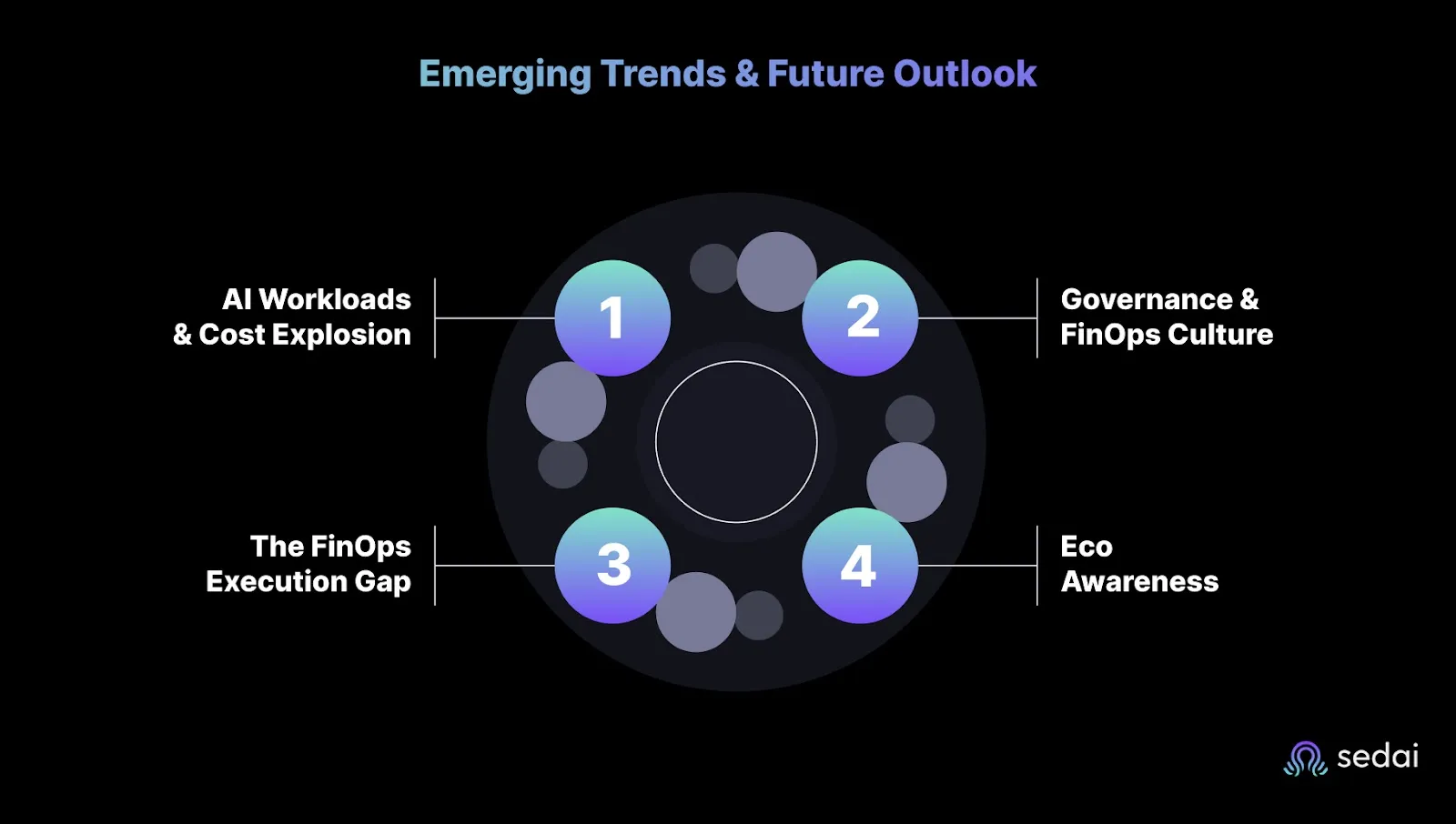
As cloud spend grows, optimization is about to get a lot more complicated. The convergence of AI workloads, governance gaps, and sustainability pressures will require targeted focus on each of these factors.
AI Workloads and Cost Explosion
Generative AI and large language models (LLMs) demand massive amounts of compute and storage, and it’s only going to get worse. Gartner predicts AI workloads will account for over half of cloud compute by 2028. Without optimization, these workloads amplify carbon footprints and erode margins.
Harness’s survey shows that 71% of developers do not orchestrate spot instances, 61% do not rightsize, and 58% do not use reserved instances. This under‑utilization of cost‑saving mechanisms is particularly concerning as AI adoption accelerates.
Governance & FinOps Culture
Optimization succeeds when finance and engineering work together. FinOps brings financial accountability to variable cloud spending through showback and chargeback. The FinOps Foundation notes that workload optimization and waste reduction remain top priorities for enterprises.
Build a FinOps culture by forming a cross‑functional group that sets budgets, guardrails, and cost policies. Training on cloud economics helps everyone interpret bills and spot anomalies.
The FinOps Execution Gap
CloudBolt’s CII report highlights a gap between perceived and actual FinOps maturity. While organizations claim high automation, 78% struggle to demonstrate ROI, 66% report automated environments, yet 58% need weeks or months to remediate waste, and 91% struggle to optimize Kubernetes. Barriers include difficulty linking spend to outcomes, organisational silos, and inefficient resource management.
To close this gap, engineering teams must integrate cost data into developer workflows, adopt continuous optimisation rather than quarterly reviews, and collaborate closely with finance.
Sustainability & Carbon Awareness
Optimization improves sustainability, too. Choose regions with renewable energy, schedule non‑urgent tasks when renewable availability is high, and combine these strategies with rightsizing and automation to align financial and environmental goals.
Add carbon metrics to dashboards. The FinOps Foundation notes that few teams currently collaborate with sustainability groups, but many plan to. This shows that carbon‑aware optimization is gaining traction.
Implementing Cloud Optimization: Steps for Engineering Teams
Most engineering teams don’t struggle because they lack ideas for optimization. They struggle because optimization keeps slipping down the priority list.
What actually works is treating optimization as you would testing or observability: not an afterthought, but a continuous discipline built into the way systems are run. Here’s how we approach it when we want results that last.
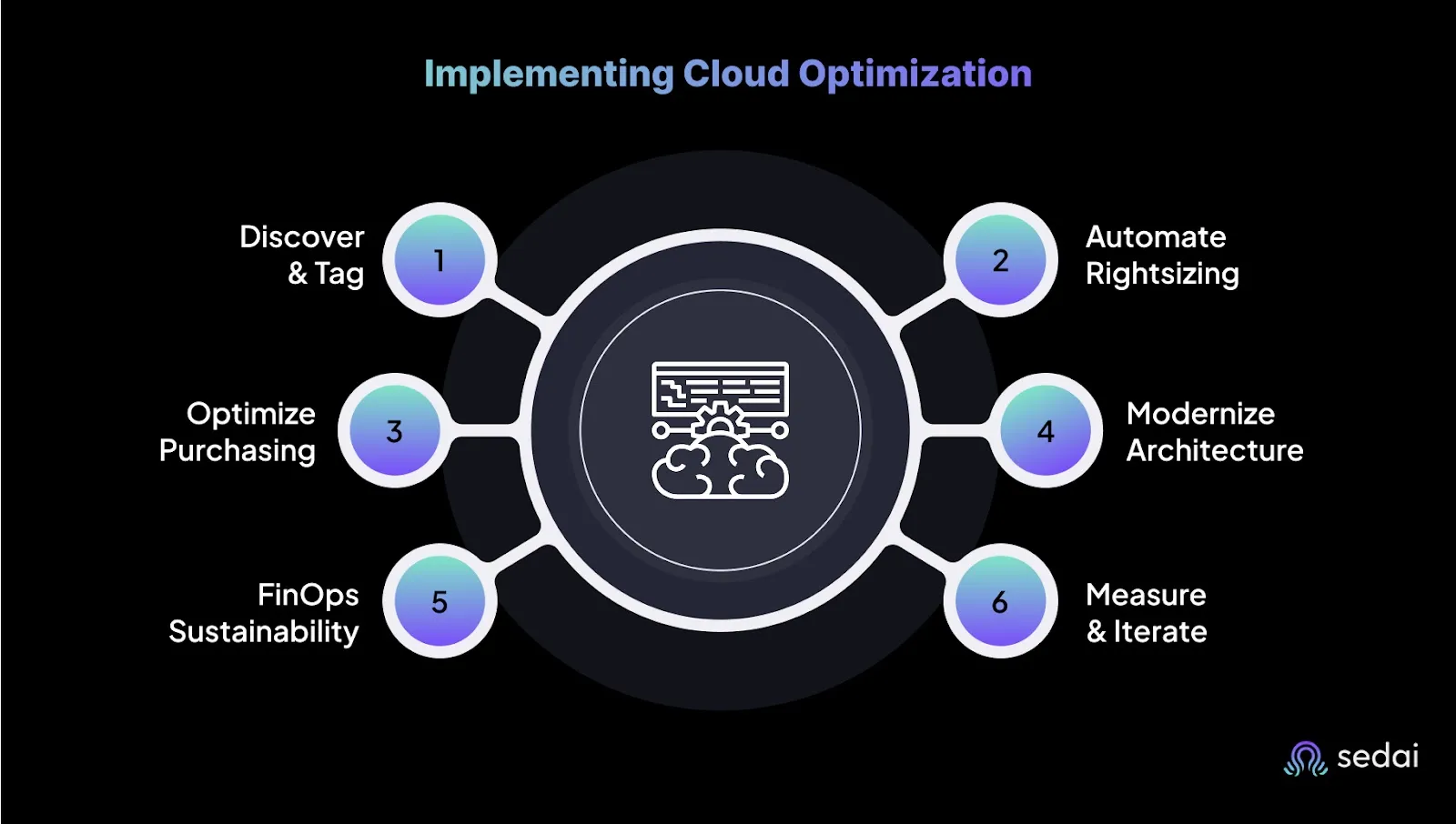
Discover and Tag
Inventory resources, tag them by application and owner, and map costs to services. Without tagging, waste remains hidden.
Automate Rightsizing
Use monitoring data to adjust instance sizes, schedule autoscaling, and shut down non‑production resources outside business hours.
Optimize Purchasing
Classify workloads by stability and pick the appropriate mix of on‑demand, reserved, and spot capacity. Use discount plans to reduce spend.
Modernize Architecture
Refactor heavy monolithic services into microservices or serverless functions. Adopt managed databases and event‑driven architectures where they deliver real savings.
Integrate FinOps and Sustainability
The hardest part is cultural. If optimization is “someone else’s job,” it will always lose to product deadlines. You need to form a cross‑functional group to set budgets and guardrails. Include carbon and cost metrics in dashboards and train teams on cloud economics and AI cost management.
6. Measure and Iterate
Track cloud ROI metrics to validate improvements and inform ongoing adjustments. Key metrics to monitor include:
Cost per Transaction or Request: Assesses the cost-efficiency of workloads, aligning with product and business unit cost structures.
Resource Utilization Rates: Compares actual usage against provisioned capacity, identifying over- or under-provisioning.
Savings Against Budget: Measures the variance between actual spend and budgeted amounts, highlighting areas of over- or under-spending.
By establishing a baseline for these metrics, engineering teams can continuously track performance, validate optimizations, and ensure alignment with business objectives.
Engineering leaders need cloud optimization that compounds ROI continuously not services that require separate review cycles. Book a demo to see how Sedai integrates autonomous optimization into your existing observability stack.
Why Engineering Teams Trust Sedai for Smarter Cloud Optimization?
As your cloud costs increase and infrastructure becomes more complex, you're likely facing the challenge of optimizing performance without blowing your budget. The challenge isn’t that the solutions are unknown. It’s difficult because engineering teams rarely have the cycles to manage it consistently.
That’s why a growing number of engineering teams are now using AI platforms like Sedai. With its AI-powered platform, Sedai automates cloud optimization, making it easier for your team to stay agile and cost-effective.
1. Autonomous Cloud Operations
Whether it's allocating compute power during traffic spikes or scaling back during quieter periods, Sedai does it seamlessly. With over100,000production operations executed flawlessly, Sedai helps you optimize performance, reducing latency by up to 75%.
2. Proactive Uptime Automation
By monitoring early indicators like memory anomalies or unusual behavior, Sedai reduces failed customer interactions by up to 50%and improves performance by up to 6x, helping you stay ahead of issues before they affect your users.
3. Smarter Cost Management
Controlling cloud costs is a persistent challenge. Sedai’s AI-driven approach to cost optimization helps you achieve 30–50% savings. For example, Palo Alto Networks saved $3.5 million by using Sedai to manage tens of thousands of safe production changes.
With Sedai, you can reduce waste, optimize resource allocation, and ultimately lower your cloud spend, freeing up budget for more strategic initiatives.
Conclusion
Cloud optimization has become a necessity rather than a nice-to-have. Research highlights the widespread issues of overspending and waste, even as cloud budgets continue to grow.
For engineering teams, cloud optimization services provide a clear path forward. By rightsizing resources, adopting modern architectures, and integrating FinOps practices, teams can reduce waste, enhance performance, and maximize ROI.
With Sedai, this vision comes to life. We take the complexity out of cloud optimization with AI-powered solutions that provide real-time insights, autonomous scaling, and proactive cost management. This means your teams can focus on creating value, while Sedai ensures your cloud environment is optimized for cost and performance.
1. How do cloud optimization services differ from basic cloud cost tools?
Basic tools provide visibility and spending reports, but cloud optimization services combine continuous analysis, automated actions, and multi‑objective tuning (cost, performance, and reliability).
2. What metrics should engineering teams track to measure cloud ROI?
Key metrics include effective savings rate (actual savings divided by on‑demand equivalent spend), unit cost (cost per customer or transaction), utilization rates, and change lead time. Align these metrics with business outcomes such as revenue growth or customer satisfaction.
3. Will optimization hurt performance?
No. Effective optimization improves both cost and performance. Autoscaling, rightsizing, and modern architectures match capacity to demand, providing enough headroom during peaks and reducing waste during quiet periods.
4. How do AI workloads influence cloud optimization?
Generative‑AI and machine‑learning workloads consume much more compute and energy than traditional applications. Optimize these workloads by using dedicated accelerators, sizing models appropriately, scheduling training jobs, and monitoring energy use. Combine cost and carbon metrics to make balanced decisions.
Explore the best cloud storage options for 2026, comparing AWS S3, Azure Blob, Google Cloud Storage, and key features to help you choose the right solution.
Sedai Expands Its Self-Driving Cloud to Power Autonomous Enterprise Infrastructure with $20M Series B
Sedai raises $20 million in Series B funding for its self-driving cloud. Fortune 500 companies use Sedai's patented AI to manage and optimize the cloud.