What is enterprise Kubernetes management and why is it important?
Enterprise Kubernetes management is the practice of running multiple Kubernetes clusters as a unified, governed platform rather than isolated systems. It covers provisioning, securing, updating, monitoring, and optimizing clusters across AWS EKS, Azure AKS, and Google GKE. This approach is critical because it brings consistency to upgrades, access control, automation, and visibility, helping organizations control reliability and cloud spend as their Kubernetes fleets grow.
What are the main challenges of managing Kubernetes at enterprise scale?
Key challenges include configuration drift, inconsistent security controls, fragmented visibility, unclear cost attribution, and operational risk from manual changes. As clusters multiply across clouds and teams, these issues can lead to increased costs, reliability problems, and governance gaps. Enterprise Kubernetes management platforms like Sedai address these by automating guardrails, enforcing policies, and providing fleet-wide visibility.
How does Sedai help automate enterprise Kubernetes management?
Sedai automates Kubernetes management by continuously analyzing workload behavior, enforcing safety guardrails, and applying optimizations based on real-time and historical signals. It supports autonomous rightsizing, behavior-based scaling, anomaly detection, and cost attribution, reducing manual intervention and operational risk for platform teams.
What are the core components of enterprise Kubernetes management?
Core components include upstream hardening, container runtime compatibility, scalable networking, platform-controlled ingress, centralized identity and access management, logical cluster grouping, and consistent policy enforcement. These ensure reliability, security, and cost control as Kubernetes environments scale.
How do enterprises manage Kubernetes across multiple clusters and hybrid clouds?
Enterprises manage Kubernetes at scale by separating global control from local autonomy, grouping clusters logically, normalizing differences between cloud providers, centralizing identity and access, standardizing network policies, centralizing visibility, and aligning cost and capacity decisions across the fleet.
How can enterprises ensure Kubernetes security, compliance, and governance at scale?
They enforce security and policy at admission, centralize identity, standardize security baselines, treat compliance as a continuous process, govern changes with guardrails, and audit all actions affecting runtime behavior. This approach ensures consistent enforcement and reduces risk as clusters multiply.
What role do automation and GitOps play in enterprise Kubernetes consistency?
Automation and GitOps make the desired state enforceable by validating live cluster state against declared intent, automating baselines and policies, encoding constraints into automation, and applying changes incrementally with validation and rollback. This reduces configuration drift and manual errors.
What are the key features of enterprise Kubernetes management platforms like Sedai?
Key features include centralized multi-cluster control, drift detection and reconciliation, policy enforcement at admission, guardrailed automation with rollback, workload-aware cost visibility, controlled lifecycle management, scalable identity and access management, network and traffic visibility, and platform abstractions that preserve team autonomy.
How does Sedai optimize Kubernetes workloads?
Sedai optimizes Kubernetes workloads by evaluating container-level metrics, workload utilization, traffic patterns, and latency signals to build behavior models. It recommends or applies rightsizing, scaling, and optimization actions based on observed behavior, reducing overprovisioning and improving performance.
What measurable outcomes can Sedai deliver for Kubernetes environments?
Sedai delivers outcomes such as 30%+ reduced cloud costs, 75% improved application performance, 70% fewer failed customer interactions, 6X greater engineering productivity, and management of over $3 billion in annual cloud spend for customers like Palo Alto Networks.
How does Sedai support multi-cluster and multi-cloud Kubernetes environments?
Sedai supports Kubernetes environments running on AWS EKS, Azure AKS, Google GKE, self-managed clusters, and hybrid deployments. It applies consistent optimization logic and policy enforcement across all clusters, regardless of cloud provider or environment.
How does Sedai handle deployment and release impact visibility?
Sedai surfaces changes in performance and resource behavior before and after deployments, helping teams assess the impact of releases and minimize risks associated with changes in production environments.
What are the main differences between Sedai and other Kubernetes management platforms?
Sedai focuses on autonomous, behavior-driven optimization, while other platforms like Red Hat OpenShift, VMware Tanzu, Google Anthos, SUSE Rancher, and Platform9 emphasize managed lifecycle, policy enforcement, or control plane operations. Sedai's unique strengths are in workload rightsizing, behavior-based scaling, and proactive anomaly detection for large, production Kubernetes environments.
Who is Sedai best suited for?
Sedai is best for enterprise engineering and platform teams operating business-critical Kubernetes workloads who want to replace ongoing manual tuning with behavior-driven automation and measurable outcomes in cost, performance, and reliability.
How does Sedai ensure safe and reversible optimizations?
Sedai uses configurable safety guardrails and confidence thresholds to determine when changes are safe. It supports recommendation-only and autonomous execution modes, and automatically rolls back actions if performance regressions or unexpected outcomes are detected.
How does Sedai attribute Kubernetes costs to engineering teams?
Sedai maps infrastructure costs across namespaces, workloads, GPUs, storage, and networking, providing engineering-level cost visibility. This helps teams connect resource decisions to financial outcomes in near real time.
What is the implementation process for Sedai in Kubernetes environments?
Sedai offers a plug-and-play implementation that typically takes 5 minutes for general use cases and up to 15 minutes for specific scenarios like AWS Lambda. The platform connects securely to cloud accounts using IAM, with agentless integration and comprehensive onboarding support, including documentation and a 30-day free trial.
What customer outcomes have been achieved with Sedai?
Customers like Palo Alto Networks saved $3.5 million and performed over 2 million autonomous remediations in one year. KnowBe4 achieved 50% cost savings in production, and Belcorp reduced AWS Lambda latency by 77%. These outcomes demonstrate Sedai's impact on cost, performance, and operational efficiency. Read the Palo Alto Networks case study.
Features & Capabilities
What features does Sedai offer for Kubernetes management?
Sedai offers autonomous workload rightsizing, behavior-based scaling, anomaly detection, cost attribution, multi-cluster and multi-cloud support, deployment impact visibility, and continuously updated workload models. It also provides guardrail-based execution modes and integrates with existing monitoring and CI/CD tools.
Does Sedai support integration with monitoring and CI/CD tools?
Yes, Sedai integrates with monitoring and APM tools such as Cloudwatch, Prometheus, Datadog, and Azure Monitor, as well as CI/CD and Infrastructure as Code tools like GitLab, GitHub, Bitbucket, and Terraform. It also supports ITSM tools (ServiceNow, Jira) and notification platforms (Slack, Microsoft Teams).
What modes of operation does Sedai provide?
Sedai offers three modes: Datapilot (observability), Copilot (one-click optimizations), and Autopilot (fully autonomous execution). This allows teams to choose the level of automation and control that fits their risk tolerance and operational needs.
How does Sedai handle security and compliance?
Sedai is SOC 2 certified, demonstrating adherence to stringent security and compliance standards. The platform integrates with Infrastructure as Code (IaC), IT Service Management (ITSM), and compliance workflows to ensure safe, auditable changes. Learn more about Sedai's security.
What technical documentation is available for Sedai?
Sedai provides detailed technical documentation covering platform features, setup, and usage. Access the documentation at docs.sedai.io/get-started and explore additional resources, case studies, and guides at sedai.io/resources.
Use Cases & Benefits
What problems does Sedai solve for Kubernetes platform teams?
Sedai addresses cost inefficiencies, operational toil, performance and latency issues, lack of proactive issue resolution, complexity in multi-cloud environments, and misaligned priorities between engineering and FinOps teams. It automates optimization, reduces manual work, and aligns cost and performance objectives.
Who can benefit from using Sedai?
Sedai is designed for platform engineering, IT/cloud operations, technology leadership, site reliability engineering (SRE), and FinOps professionals in organizations with significant cloud operations across industries such as cybersecurity, IT, financial services, healthcare, travel, and e-commerce.
What industries use Sedai for Kubernetes optimization?
Industries represented in Sedai's case studies include cybersecurity (Palo Alto Networks), IT (HP), financial services (Experian, CapitalOne Bank), security awareness training (KnowBe4), travel and hospitality (Expedia), healthcare (GSK), car rental services (Avis), retail and e-commerce (Belcorp), SaaS (Freshworks), and digital commerce (Campspot).
What business impact can customers expect from using Sedai?
Customers can expect up to 50% reduction in cloud costs, 75% improvement in application performance, 6X productivity gains, 50% fewer failed customer interactions, and enhanced reliability. These outcomes are supported by case studies from companies like Palo Alto Networks, KnowBe4, and Belcorp.
How does Sedai help with cost optimization in Kubernetes environments?
Sedai reduces cloud costs by up to 50% through autonomous optimization, rightsizing workloads, and eliminating waste. It provides real-time cost attribution and actionable insights to help teams make efficient resource decisions.
How does Sedai improve application performance in Kubernetes?
Sedai enhances application performance by reducing latency by up to 75%, optimizing CPU and memory needs, and proactively resolving performance bottlenecks before they impact users. For example, Belcorp achieved a 77% reduction in AWS Lambda latency using Sedai.
How does Sedai reduce operational toil for engineering teams?
Sedai automates routine tasks such as capacity tweaks, scaling policies, and configuration management, delivering up to 6X productivity gains and allowing engineering teams to focus on high-value work instead of manual optimizations.
How does Sedai proactively resolve issues in Kubernetes environments?
Sedai detects and resolves performance and availability issues before they impact users, reducing failed customer interactions by up to 50% and ensuring seamless operations. It uses anomaly detection and continuous monitoring to identify and remediate problems early.
What feedback have customers given about Sedai's ease of use?
Customers highlight Sedai's quick setup (5–15 minutes), agentless integration, comprehensive onboarding support, detailed documentation, and risk-free 30-day trial. These features make adoption smooth and accessible for engineering teams. Learn more about getting started with Sedai.
Competition & Comparison
How does Sedai compare to Red Hat OpenShift for Kubernetes management?
Sedai focuses on autonomous, behavior-driven optimization and workload rightsizing, while Red Hat OpenShift emphasizes managed lifecycle, security defaults, and compliance for regulated enterprises. OpenShift provides a supported, opinionated Kubernetes platform, whereas Sedai delivers continuous optimization for production workloads.
How does Sedai differ from VMware Tanzu?
VMware Tanzu is designed for enterprises heavily invested in VMware infrastructure, aligning Kubernetes operations with vSphere and NSX. Sedai, on the other hand, is cloud-agnostic and specializes in autonomous optimization, behavior-based scaling, and cost attribution across multi-cloud and hybrid Kubernetes environments.
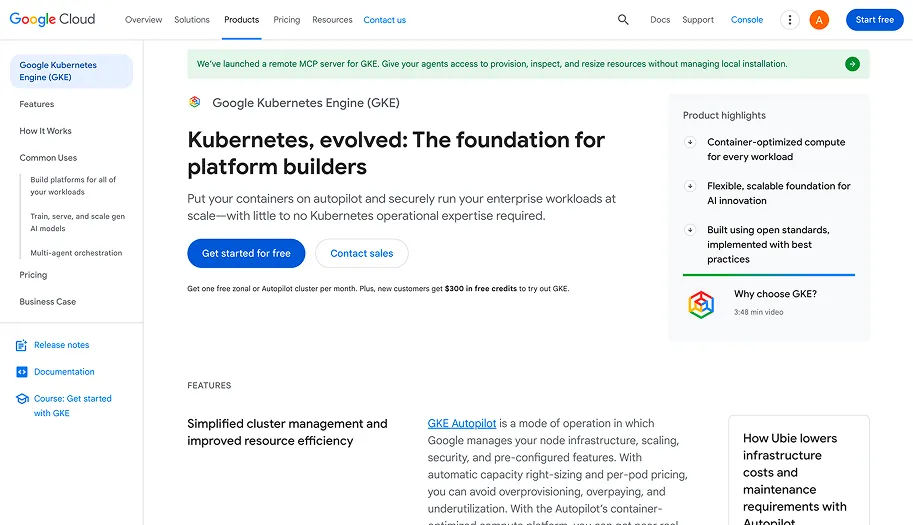
How does Sedai compare to Google Anthos?
Google Anthos focuses on centralized policy and configuration enforcement across hybrid and multi-cloud Kubernetes environments, with strong integration into Google Cloud's security and service mesh. Sedai complements this by providing autonomous workload optimization, cost attribution, and behavior-driven scaling for production workloads.
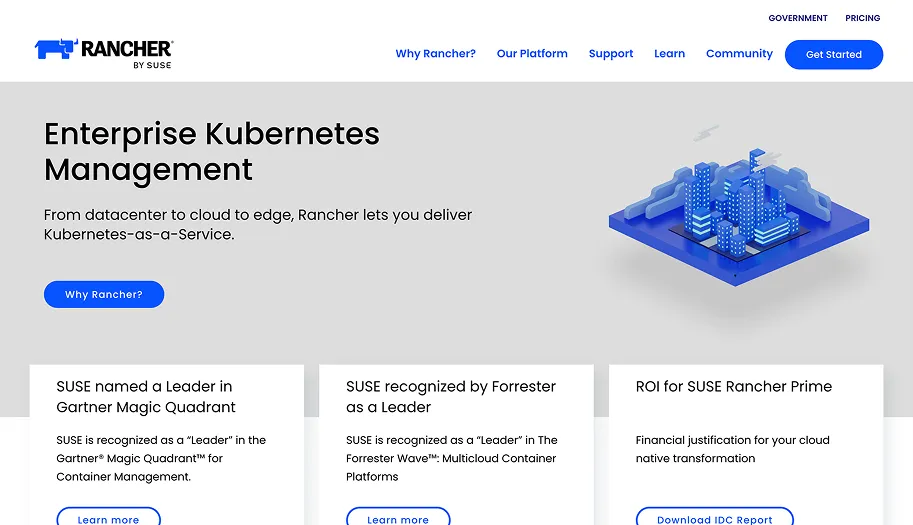
How does Sedai differ from SUSE Rancher?
SUSE Rancher centralizes cluster management and governance without altering workload behavior, making it ideal for large cluster fleets. Sedai adds value by automating workload optimization, rightsizing, and cost attribution, focusing on improving engineering outcomes and reducing operational overhead.
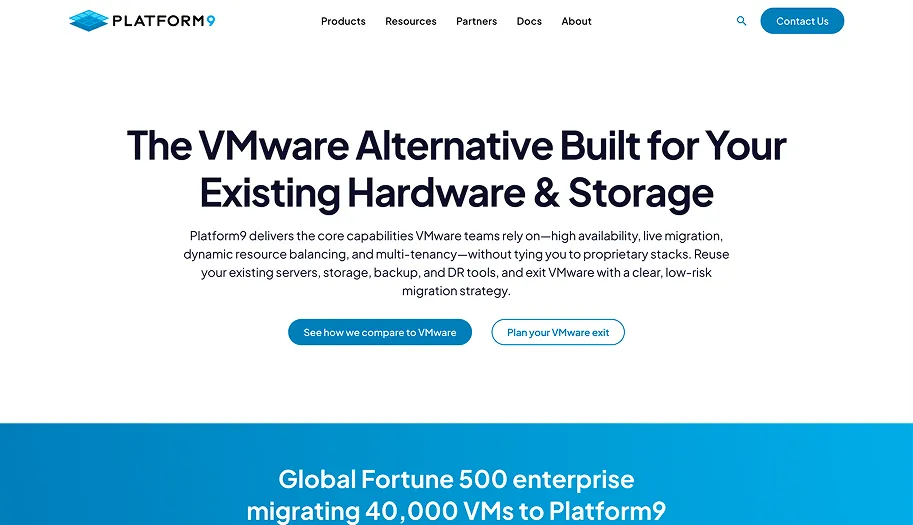
How does Sedai compare to Platform9 for Kubernetes management?
Platform9 delivers managed Kubernetes control plane operations, upgrades, and patching, especially for hybrid and on-prem deployments. Sedai focuses on autonomous, behavior-driven optimization, cost savings, and performance improvements for production workloads across any environment.
Enterprise Kubernetes Management Guide With 6 Leading Tools
Benjamin Thomas
CTO
May 29, 2026
Featured
10 min read
Key takeaways
Use enterprise Kubernetes management platforms to simplify large-scale cluster operations and governance.
Automate Kubernetes optimization to improve scalability, reliability, and infrastructure efficiency.
Centralize monitoring and workload visibility across multi-cluster Kubernetes environments.
Continuously optimize resource allocation to reduce cloud waste and operational overhead.
Enterprise Kubernetes management requires a clear approach to running clusters as a governed platform rather than isolated environments. As fleets grow across EKS, AKS, and GKE, challenges like configuration drift, inconsistent security controls, and fragmented visibility become unavoidable. Managing core drivers such as cluster baselines, access control, upgrades, and cost attribution is critical to keeping reliability and spend under control. Platforms like Sedai help automate this complexity by continuously analyzing workload behavior, enforcing guardrails, and applying safe optimizations.
Running Kubernetes at enterprise scale exposes challenges that never appear in smaller clusters. As fleets expand across EKS, AKS, and GKE, configuration drift accelerates, security controls fragment, and cost attribution to real workloads becomes increasingly difficult.
Around28–35% of overall cloud spend is wasted, largely due to idle or under-utilized resources, inconsistent configurations, and limited visibility across large Kubernetes fleets.
Enterprise Kubernetes management addresses this by treating clusters as a governed platform rather than isolated systems. It brings consistency to upgrades, access control, automation, and visibility without slowing delivery.
In this blog, you’ll learn what enterprise Kubernetes management requires and how leading platforms help teams operate large Kubernetes fleets reliably and at scale.
What Is Enterprise Kubernetes Management & Why Does It Matter?
Enterprise Kubernetes management involves running multiple Kubernetes clusters as a unified, governed platform rather than as separate, independent systems. It covers provisioning, securing, updating, monitoring, and optimizing clusters across AWS EKS, Azure AKS, and Google GKE.
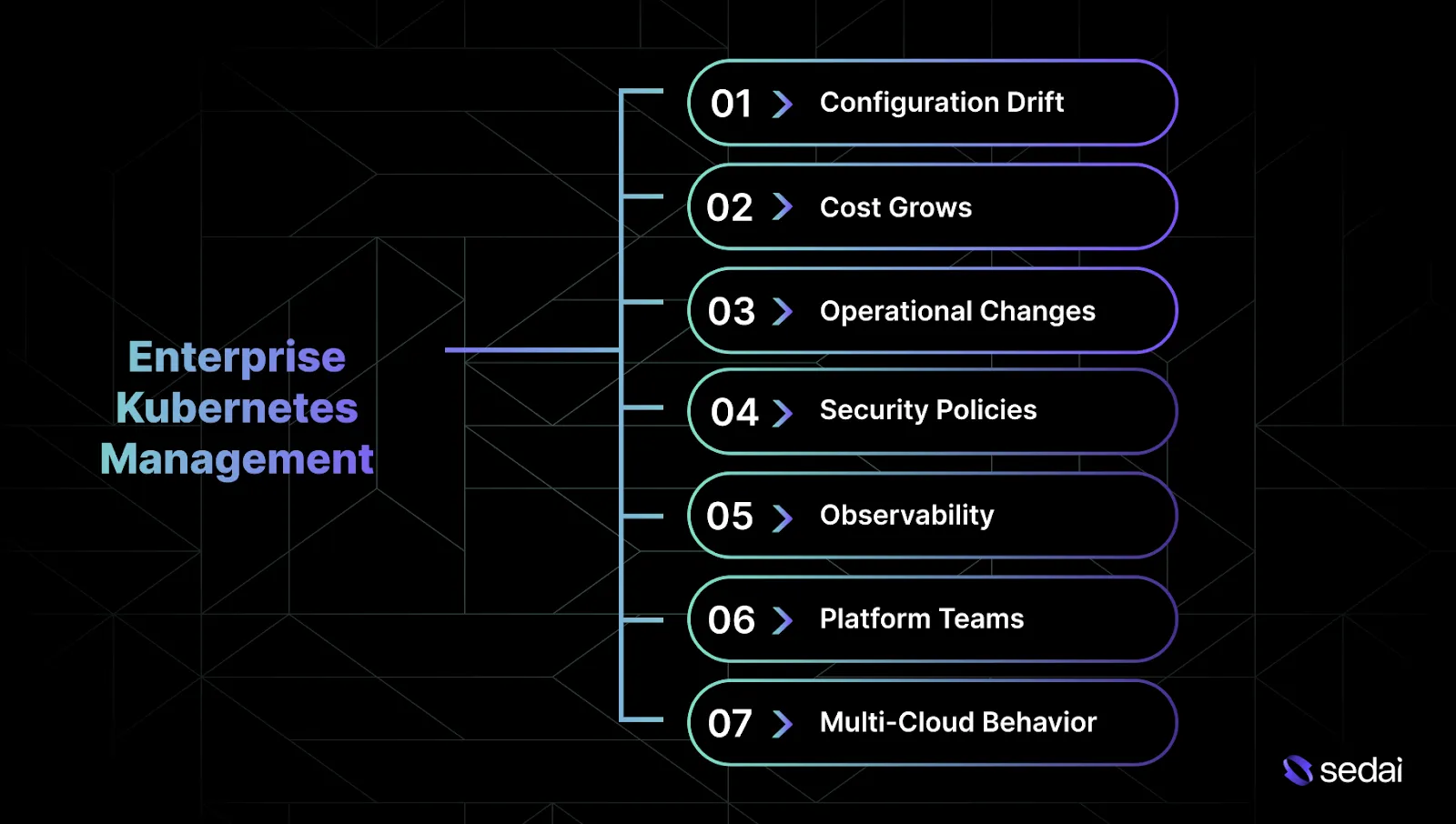
At enterprise scale, Kubernetes functions as shared infrastructure, with cost, reliability, and security implications that reach far beyond a single team. Here’s why it matters:
A single misconfigured HPA or resource request can destabilize shared nodes and affect unrelated workloads.
Enterprise Kubernetes management enforces guardrails that limit how far local changes can propagate. This reduces the risk that one team’s tuning decisions will impact platform-wide stability.
2.Security Policies Drift Faster Than Code
Manually applied security controls rarely stay consistent across clusters. Enterprise Kubernetes management integrates security and compliance checks into the cluster and workload lifecycle, ensuring policies are enforced by default rather than audited reactively.
3.Observability Stops at the Cluster Boundary
Cluster-local dashboards often hide patterns that only emerge across regions, environments, and clouds. Enterprise Kubernetes management aggregates signals from multiple clusters, giving engineers a systemic view.
This allows reasoning about platform-level behavior rather than isolated per-cluster snapshots.
4.Platform Teams Become Reactive
Without a unified management strategy, platform teams spend most of their time correcting inconsistencies caused by scale. Enterprise Kubernetes management standardizes cluster and workload behavior, allowing teams to focus on improving reliability and efficiency.
5.Multi-Cloud Behavior Is Inconsistent by Default
EKS, AKS, and GKE differ in scaling behavior, defaults, and operational semantics. Enterprise Kubernetes management abstracts these differences to provide consistent operating expectations, allowing you to reason about workloads uniformly regardless of the underlying cloud.
Once the value of enterprise Kubernetes management is clear, it’s easier to explore its essential components.
Core Components of Enterprise Kubernetes
Enterprise Kubernetes doesn’t fail due to missing features. Failures occur when the supporting systems around Kubernetes can’t scale with the number of clusters, team size, or workload diversity.
Below are the components that ultimately determine whether Kubernetes remains reliable and operable at enterprise scale.
1.Upstream Hardening Without Lock-In
Kubernetes changes faster than most enterprises can safely upgrade, exposing clusters to bugs, CVEs, and deprecated APIs. Running close to upstream without support creates operational debt. Enterprise Kubernetes must stabilize this without locking teams behind proprietary layers.
Key practices:
Curated Kubernetes versions with backported fixes and extended support.
Hardening at the distribution level.
Avoid proprietary APIs or control planes that block upstream compatibility.
No artificial constraints on OS, infrastructure, or cloud provider.
Clean upgrade paths without workload or tooling refactors.
2.Container Runtime: Compatibility First, Security Where It Belongs
The container runtime is critical for security and reliability. Deviating from Docker-compatible workflows adds friction. Enterprise runtime choices should reduce risk.
Minimum requirements:
Full support for Docker-built images and CI/CD pipelines.
Linux and Windows node support on the same platform.
Stable GPU and hardware accelerator support.
Runtime enforcement for image signing and execution policies.
FIPS 140-2–compliant encryption for regulated environments.
Minimal abstraction to avoid interfering with Kubernetes scheduling.
3.Container Networking That Scales Without Surprises
Networking issues may be invisible in small clusters but become critical at scale. Enterprise networking must behave predictably under load.
Key requirements:
Proven scalability under high east-west traffic.
Support for mixed Linux and Windows nodes.
Compatibility with production-grade ingress and service meshes.
Default enforcement of least-privilege network policies.
At scale, ingress becomes shared infrastructure rather than a team-level concern. Native Kubernetes Ingress is minimal, so enterprise deployments require managed controllers and tooling.
Platform requirements:
Advanced routing, rewrites, and conditional traffic rules.
Centralized TLS termination and certificate management.
Visibility into traffic patterns and failure modes.
Integration with monitoring and alerting pipelines.
Controlled rollout and rollback of routing changes.
Clear separation between application ownership and ingress behavior.
Once the key components are clear, it becomes easier to see how enterprises manage Kubernetes across complex environments.
Kubernetes management gets easier when optimization runs itself. Book a demo to see how Sedai reduces toil across your clusters without adding operational overhead.
How Do Enterprises Manage Kubernetes Across Multiple Clusters and Hybrid Clouds?
Enterprises rarely operate a single Kubernetes cluster for long. As teams, regions, and compliance requirements expand, clusters multiply across AWS EKS, Azure AKS, Google GKE, and on-prem environments.
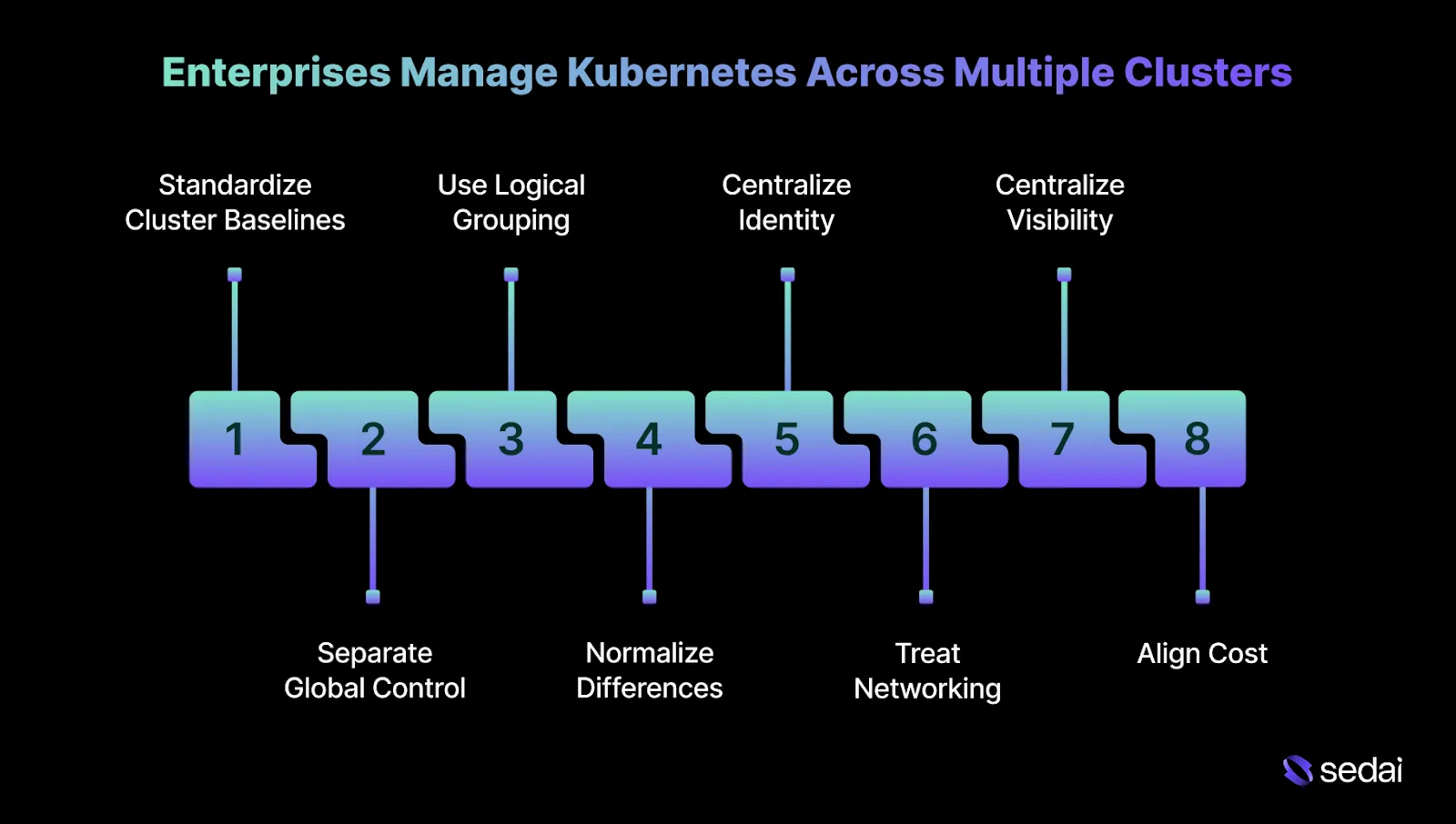
The challenge shifts from simply running Kubernetes to managing multiple clusters with consistent behavior, controlled risk, and predictable cost. The following practices are proven to hold up at enterprise scale:
1.Separate Global Control From Local Autonomy
Centralized control can slow delivery, while fully decentralized control scales chaos just as fast. Multi-cluster management works best when responsibility is balanced:
Platform teams own cluster lifecycle, security baselines, and shared services
Application teams manage namespaces, deployments, and scaling within guardrails
Global policies limit blast radius without dictating application design
2.Use Logical Grouping Instead of Managing Clusters Individually
Treating each cluster as a unique snowflake fails at scale. Enterprises manage clusters in logical groups based on purpose rather than location:
Group clusters by environment, criticality, or compliance requirements
Apply policies and updates at the group level rather than individually
Handle regional or cloud-specific differences as exceptions
3.Normalize Differences Between Cloud Providers
EKS, AKS, and GKE differ in autoscaling behavior, networking defaults, and upgrade mechanics. Ignoring these differences leads to inconsistent workloads.
Validating workload behavior across clouds before rolling out changes
Avoiding reliance on cloud-specific defaults that compromise portability
4.Centralize Identity and Access Without Breaking Team Boundaries
IAM and RBAC complexity grow nonlinearly with cluster count. Applying access rules individually is error-prone.
At scale, this requires:
Central identity sources consistently mapped across all clusters
Standardized role definitions tied to job function
Auditable access changes with clear ownership and expiration
5.Treat Networking as a Cross-Cluster Concern
Networking challenges intensify in hybrid and multi-cloud setups, especially when services span clusters. Ad hoc networking decisions create fragile dependencies.
Enterprises reduce risk by:
Standardizing network policy models across clusters
Enforcing encryption and authentication for service-to-service traffic
Designing connectivity with failure isolation in mind
6.Centralize Visibility While Preserving Local Signal
Per-cluster dashboards hide systemic issues like uneven utilization or cascading failures. Fully centralized dashboards can lose local context.
Effective visibility requires:
Global views for capacity, cost, and risk trends
Cluster- and namespace-level views for debugging and tuning
Consistent metrics and labels so signals have the same meaning everywhere
7.Align Cost and Capacity Decisions Across the Fleet
Local autoscaling often fails to account for fleet-wide efficiency, inflating shared capacity and hiding waste.
Enterprises manage this by:
Linking workload demand to node and cluster-level capacity planning
Comparing utilization patterns across clusters to detect inefficiencies
Preventing local optimizations from driving fleet-wide cost growth.
Once enterprises understand how to manage Kubernetes across clusters and hybrid clouds, the next focus is ensuring security, compliance, and governance at scale.
How Can Enterprises Ensure Kubernetes Security, Compliance, & Governance at Scale?
At enterprise scale, Kubernetes security failures rarely stem from a lack of tools. They arise from inconsistent enforcement, unclear ownership, and controls that break down as clusters multiply.
Security, compliance, and governance have to be embedded into how clusters and workloads operate. Here’s how enterprises apply these controls consistently across Kubernetes environments.
1.Enforce security and policy at admission
Catching violations after workloads are running is too late. Misconfigured pods, excessive privileges, or unsafe images should never make it into the cluster.
Enterprises address this by:
Enforcing security, resource, and compliance policies at admission time
Blocking non-compliant workloads before they affect runtime behavior
Treating policy violations as deployment failures rather than audit findings
2.Centralize identity while preserving team boundaries
Managing RBAC separately for each cluster does not scale and quickly leads to privilege sprawl. At the same time, heavy-handed centralization slows teams down.
Effective governance relies on:
A single identity source applied consistently across all clusters
Role definitions based on job function
Time-bound, auditable access changes with clear ownership
3.Standardize baselines without freezing innovation
Clusters drift when security and compliance controls are applied manually or inconsistently. Over-standardization, however, blocks legitimate variation.
The balance comes from:
Defining mandatory security baselines for all clusters
Allowing controlled deviations based on workload criticality
Continuously detecting and correcting drift from approved baselines
4.Treat compliance as a continuous process
Point-in-time audits rarely reflect the real cluster state. In fast-moving environments, compliance gaps appear between audits.
Enterprises manage this by:
Continuously validating cluster and workload state against requirements
Producing compliance evidence directly from live systems
Aligning compliance checks with operational controls rather than documentation
5.Govern changes
Most incidents are triggered by changes. Governance that ignores how changes propagate breaks down under real conditions.
Strong governance includes:
Guardrails on who can change what and where
Clear separation between platform-level and application-level changes
Visibility into change impact across clusters before rollout
6.Audit everything that affects runtime behavior
As clusters and teams scale, logs alone are not enough. Enterprises need a clear lineage from intent to action.
This requires:
Auditable records of access, configuration changes, and automated actions
Correlation between policy decisions and runtime outcomes
Retention policies aligned with regulatory and operational needs.
After establishing strong security and compliance practices, enterprises can use automation and GitOps to maintain Kubernetes consistency.
Driving Enterprise Kubernetes Consistency with Automation and GitOps
In large Kubernetes environments, inconsistency is not a process failure. It is a consequence of scale. Manual operations, ad hoc fixes, and per-cluster tuning introduce variance faster than teams can manage.
Automation and GitOps exist to make the desired state enforceable in practice. Here’s how enterprises apply them effectively:
Challenge
Solutions
Git reflects intent
Validate live cluster state continuously against declared intent and correct drift explicitly.
Over-automation increases blast radius
Automate cluster baselines and policies centrally while keeping workload changes team-owned.
Manual reviews do not scale
Encode non-negotiable constraints into admission-time automation instead of human approval.
Blind reconciliation amplifies incidents
Separate reconciliation from execution and gate changes based on runtime context.
Configuration drift goes unnoticed
Track drift as a signal and feed it back into platform controls and ownership models.
YAML duplication creates false consistency
Use shared abstractions with minimal, explicit environment overrides.
Global automation fails globally
Apply changes incrementally across cluster groups with validation and rollback.
Tool adoption hides real outcomes
Measure reduction in variance, manual fixes, and rollout failures instead of tool usage.
After implementing automation and GitOps for consistency, the next step is ensuring enterprise-scale monitoring, visibility, and cost optimization for Kubernetes.
Enterprise Kubernetes Management Strategies That Unify Multi-Cluster Operations
See how Sedai applies autonomous workload optimization, guardrail-based automation, and continuous multi-cluster analysis across EKS, AKS, and GKE to reduce configuration drift, improve visibility, and optimize cost and performance at enterprise scale.
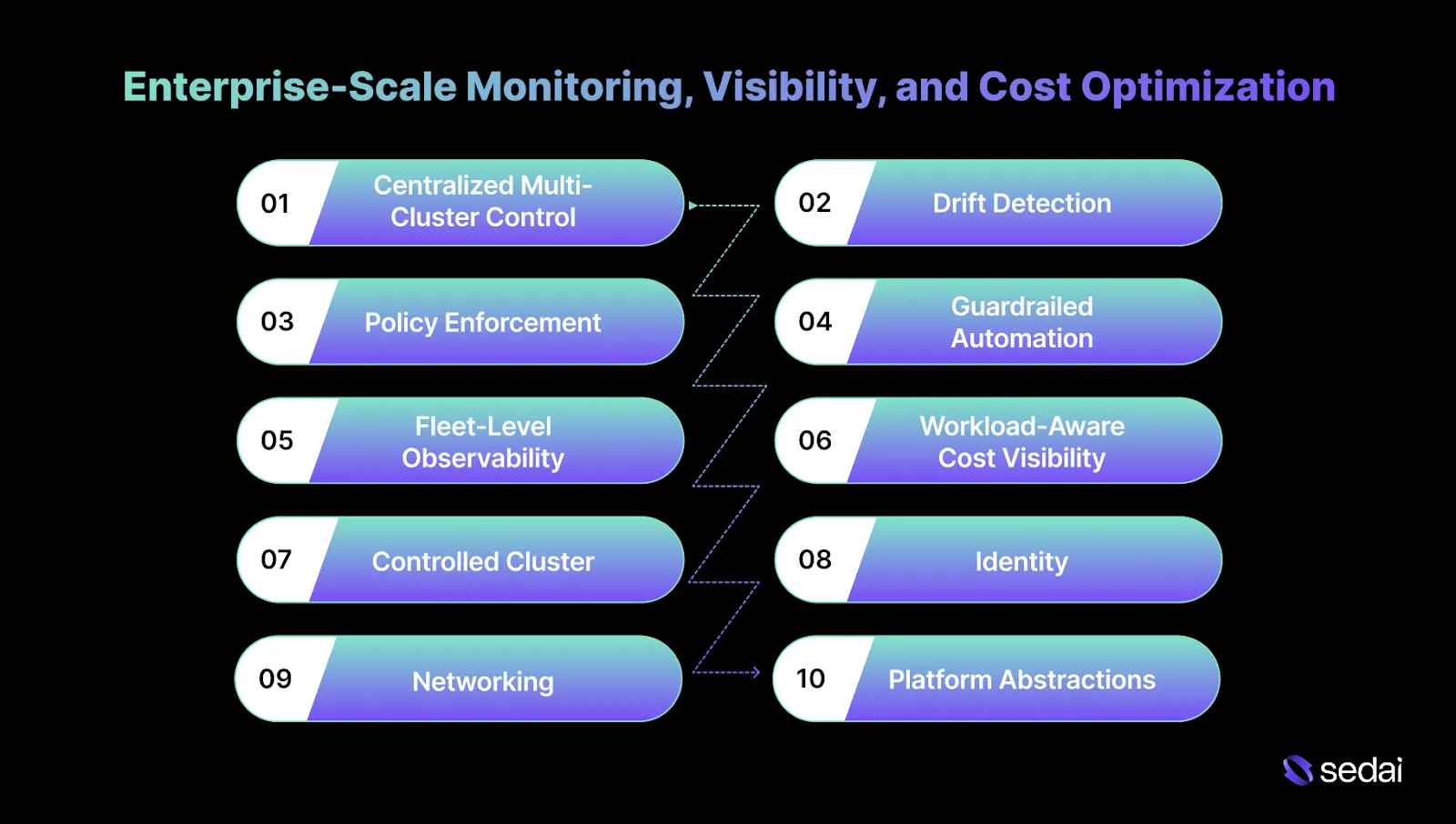
Enterprise-Scale Monitoring, Visibility, and Cost Optimization for Kubernetes
At enterprise scale, Kubernetes breaks down because signals are fragmented, cost feedback arrives too late, and decisions are made without fleet-level context.
Monitoring, visibility, and cost optimization have to work together. When they operate in isolation, none of them scale.
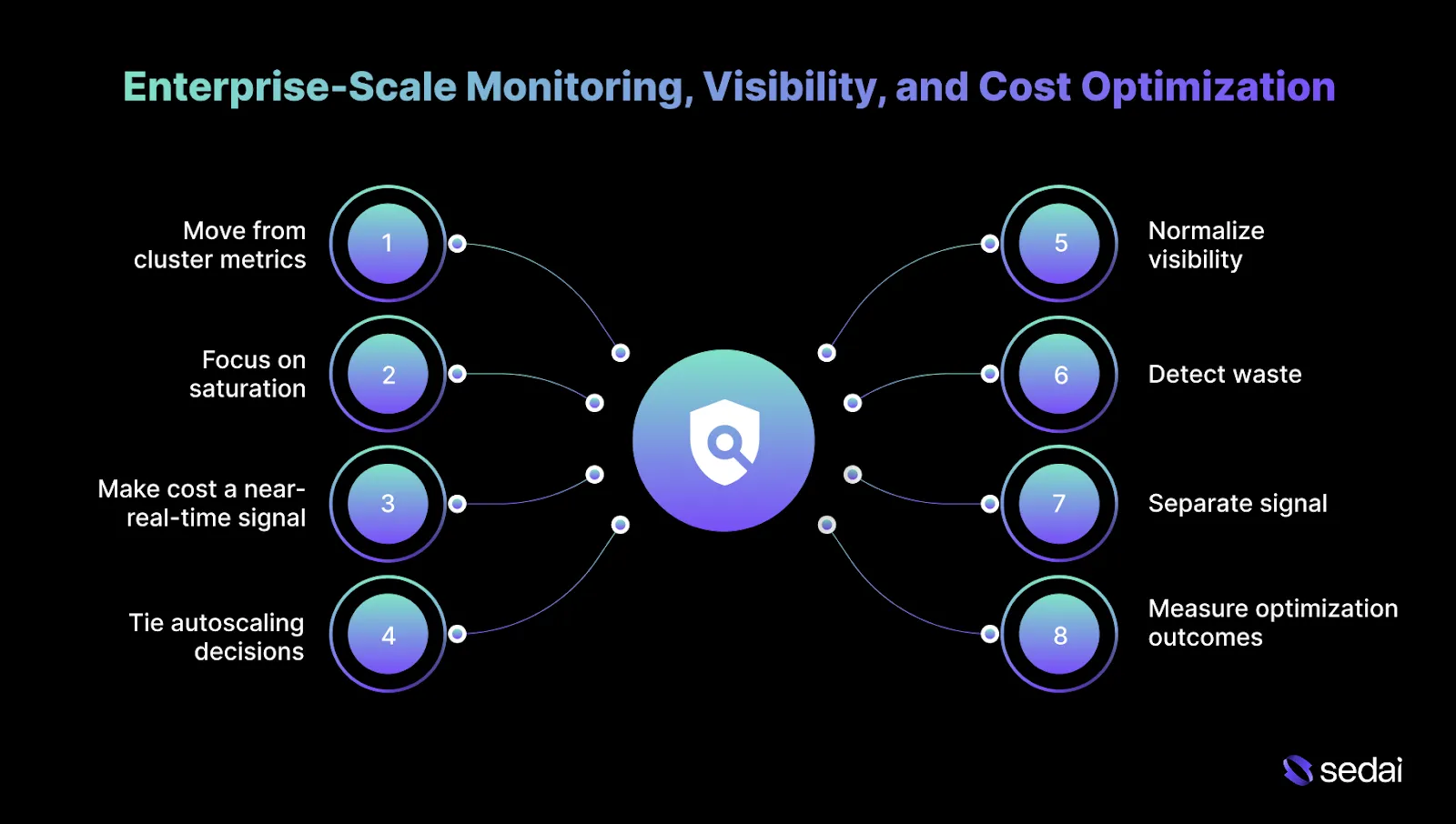
1.Move from cluster metrics to fleet signals
Per-cluster dashboards hide systemic issues like uneven utilization, cascading failures, and duplicated capacity. Engineers need visibility that spans clusters, environments, and cloud providers.
In practice, this means:
Using consistent metrics and labels across EKS, AKS, and GKE
Providing aggregated views for capacity, saturation, and error trends
Allowing drill-down without losing global context
2.Focus on saturation and behavior
Average CPU and memory usage rarely explain real incidents. Spikes, throttling, and contention matter more than steady-state numbers.
Effective monitoring emphasizes:
CPU throttling, memory pressure, and eviction signals
Latency and error rates correlated with resource pressure
Leading indicators that surface risk before SLOs are breached
3.Make cost a near-real-time signal
Monthly cloud bills arrive too late to influence engineering behavior. Cost has to be visible close to when resource decisions are made.
Enterprises do this by:
Mapping node, storage, and network spend back to workloads and namespaces
Showing cost trends alongside performance and scaling metrics
Detecting cost drift early
4.Tie autoscaling decisions to actual demand
Autoscaling without feedback loops often increases cost without improving reliability. Scaling needs to reflect real workload behavior.
At scale, teams:
Validate autoscaling decisions against latency and error signals
Detect over-scaling caused by mis-sized requests or bursty traffic
Constrain scaling behavior to prevent fleet-level capacity inflation
5.Normalize visibility across clouds and environments
Differences between AWS, Azure, and Google Cloud complicate monitoring and cost attribution. Inconsistent semantics make comparisons unreliable.
Enterprises address this by:
Normalizing metrics and cost data across providers
Avoiding provider-specific dashboards for cross-cluster decisions
Using consistent definitions for capacity, utilization, and waste
6.Detect waste where Kubernetes hides it
Kubernetes abstracts infrastructure in ways that quietly conceal inefficiency. Idle nodes, inflated requests, and underutilized storage persist without obvious symptoms.
Effective visibility surfaces:
Persistent gaps between requests and actual usage
Node pools with low sustained utilization
Workloads that never justify their allocated capacity
7.Separate signal from noise at scale
As environments grow, alert volume increases faster than insight. Too many alerts erode trust in monitoring systems.
Senior teams prioritize:
Alerts tied to actionable risk
Fleet-level anomaly detection instead of static thresholds
Clear ownership for responding to cost and performance signals
8.Measure optimization outcomes
Cost tools that only generate reports do not change behavior. Optimization has to close the loop between action and result.
At enterprise scale, teams track:
Reduction in persistent idle capacity
Improved utilization without increased error rates
Fewer manual interventions are required to control spend.
While monitoring, visibility, and cost optimization are crucial, enterprises still face several challenges in managing Kubernetes at scale.
Challenges in Enterprise Kubernetes Management
Enterprise Kubernetes rarely fails due to missing tools. Failures occur because small decisions amplify at scale, creating systemic issues. The challenges below consistently emerge as clusters, teams, and environments expand.
Challenges
Solutions
Configuration drift across clusters
Enforce baseline cluster profiles with continuous drift detection and corrective reconciliation.
Autoscaling decisions inflate fleet-level cost
Constrain workload autoscaling with node and cluster-level capacity guardrails.
Cost ownership is unclear in Kubernetes
Map infrastructure spend directly to workloads, namespaces, and teams.
Security and policy enforcement diverges
Apply admission-time policy enforcement consistently across all clusters.
Cluster upgrades carry high blast radius
Standardize upgrade paths and limit version skew across clusters and add-ons.
Platform teams become approval bottlenecks
Separate platform guardrails from application-level autonomy.
Networking failures span clusters and clouds
Standardize network policy models and isolate failure domains explicitly.
Operational knowledge concentrates in a few engineers
Encode decisions and constraints into the platform instead of tribal knowledge.
Once the challenges are clear, it’s easier to see how enterprise Kubernetes management platforms address them with essential features.
Key Features of Enterprise Kubernetes Management Platforms
Enterprise Kubernetes platforms prove their value when they reduce operational risk, control costs, and enable consistent decision-making across multiple clusters. The features below depend on environments that expand beyond a handful of clusters.
1.Centralized Multi-Cluster Control Without Single Points of Failure
Enterprise platforms provide a global control layer that coordinates policy and visibility across AWS EKS, Azure AKS, and Google GKE, ensuring cluster health isn’t tied to a single control plane.
Tip: Coordinate policies and visibility across clusters while avoiding dependence on a single control plane.
2.Drift Detection and Continuous Reconciliation
Effective platforms continuously detect differences in cluster configuration, add-ons, and policies, then reconcile or flag them before they become upgrade or security risks.
Tip: Continuously detect and correct configuration drift to prevent security or upgrade issues.
3.Policy Enforcement at Admission
Enterprise platforms enforce security, compliance, and resource policies at admission, preventing misconfigured workloads from entering the cluster while keeping deployment pipelines smooth.
Tip: Block misconfigured workloads at deployment to maintain compliance without slowing pipelines.
4.Guardrailed Automation With Rollback
Enterprise platforms execute automation behind guardrails, validate changes against live signals, and automatically roll back actions if outcomes deviate from expectations.
Tip: Automate safely and roll back changes automatically when results deviate from expectations.
5.Workload-Aware Cost Visibility
Enterprise platforms map costs back to pods, namespaces, services, and teams, helping engineers connect resource decisions to cost outcomes in near real time.
Tip: Map costs to workloads to connect engineering decisions with financial impact in near real time.
6.Controlled Cluster and Add-On Lifecycle Management
Enterprise platforms standardize Kubernetes and add-on upgrade paths, prevent unsupported combinations, and reduce the operational burden of maintaining supported versions across EKS, AKS, and GKE.
Tip: Standardize upgrade paths to reduce version skew and operational overhead across clusters.
7.Identity and Access Management at Scale
Enterprise platforms integrate with centralized identity providers, enforce consistent access models across clusters, and ensure changes are auditable with clear ownership.
Tip: Centralize RBAC with identity providers for consistent and auditable access control.
8.Networking and Traffic Management Visibility
Enterprise platforms provide visibility into ingress, service-to-service traffic, and policy enforcement, making it easier to isolate failures without cross-team guesswork.
Tip: Monitor cross-cluster traffic to quickly isolate failures and optimize network policies.
9.Platform Abstractions That Preserve Team Autonomy
Enterprise Kubernetes platforms expose stable interfaces that let application teams operate independently while platform teams retain control over safety, cost, and compliance.
Tip: Expose stable interfaces that enforce safety constraints without limiting team innovation.
With these key features in mind, it’s helpful to look at the top enterprise Kubernetes management platforms that bring them to life.
Top 6 Enterprise Kubernetes Management Platforms
Engineers prioritize platforms that can enforce policy consistently across fleets, manage upgrades without disruption, and maintain compliance across hybrid and multi-cloud environments.
Below is a list of Kubernetes management platforms designed to operate at that level.
1.Sedai
Sedai is an enterprise Kubernetes management platform designed for autonomous, behavior-driven optimization of production workloads. It focuses on understanding how applications actually behave in live environments and using those signals to guide resource sizing, scaling, and optimization decisions.
The platform evaluates container-level metrics, workload utilization, traffic patterns, and latency signals to build workload behavior models over time.
Using configurable safety guardrails and confidence thresholds, Sedai can surface recommendations or apply changes automatically, allowing teams to control the level of autonomy based on risk tolerance.
Key Features
Workload rightsizing based on observed behavior: Evaluates pod and container CPU and memory usage to recommend or apply rightsizing actions, reducing dependence on static requests and limits.
Behavior-based scaling adjustments: Uses historical and real-time workload signals to inform scaling decisions beyond reactive, threshold-based autoscaling.
Guardrail-based execution modes: Supports recommendation-only and autonomous execution modes, applying changes only when safety and confidence criteria are satisfied.
Anomaly detection using workload baselines: Identifies deviations such as sustained memory growth, performance regressions, or repeated restarts by comparing runtime behavior against learned norms.
Kubernetes-level cost attribution: Maps infrastructure cost across namespaces, workloads, GPUs, storage, and networking to provide engineering-level cost visibility.
Multi-cluster and multi-cloud support: Supports Kubernetes environments running on EKS, AKS, GKE, self-managed clusters, and hybrid deployments using consistent optimization logic.
Deployment and release impact visibility: Surface changes in performance and resource behavior before and after deployments to help teams assess release impact.
Continuously updated workload models: Adapts optimization insights as traffic patterns, infrastructure conditions, and application behavior change over time.
Enterprise Kubernetes environments need multi-cluster visibility, cost attribution, and governance that single-cluster tools cannot provide. Book a demo to see how Sedai manages all of it autonomously across your enterprise Kubernetes estate.
Measured Outcomes:
Metrics
Key Details
30%+ Reduced Cloud Costs
Sedai uses ML models to find the ideal cloud configuration without compromising performance.
75% Improved App Performance
It optimizes CPU and memory needs, lowering latency and reducing error rates.
70% Fewer Failed Customer Interactions (FCIs)
Sedai proactively detects and remediates issues before impacting end users.
6X Greater Productivity
It automates optimizations, freeing engineers to focus on high-priority tasks.
$3B+ Cloud Spend Managed
Sedai manages over $3 billion in annual cloud spend for companies like Palo Alto Networks.
Best For: Enterprise engineering and platform teams operating business-critical Kubernetes workloads who want to replace ongoing manual tuning with behavior-driven automation.
Red Hat OpenShift is a full-stack enterprise Kubernetes platform that standardizes how clusters are built, secured, upgraded, and operated across hybrid and multi-cloud environments.
It delivers Kubernetes as a managed product through opinionated defaults, Operators, and controlled lifecycle workflows. The platform emphasizes consistency, security, and long-term support over low-level customization.
Key Features:
Automated cluster installation and upgrades: Manages Kubernetes lifecycle operations through supported, versioned upgrade paths.
Operator Lifecycle Management: Automates deployment and lifecycle management of platform services and add-ons.
Platform-level security controls: Applies RBAC, image policies, and security defaults consistently across clusters.
Integrated observability stack: Provides standardized monitoring and logging using supported components.
Best For: Large enterprises that require a supported, compliance-ready Kubernetes platform with predictable operations at scale.
VMware Tanzu is an enterprise Kubernetes platform portfolio designed to run and manage Kubernetes consistently across on-prem, cloud, and VMware-based infrastructure.
Its value lies in aligning Kubernetes operations with existing enterprise infrastructure, governance models, and security practices, particularly in VMware-centric environments.
Key Features
Centralized cluster lifecycle management: Provisions, upgrades, and manages Kubernetes clusters across environments.
Policy-driven governance: Enforces security and operational policies consistently.
Deep VMware integration: Aligns Kubernetes operations with vSphere and NSX.
Enterprise identity integration: Integrates Kubernetes access with existing IAM systems.
Best For: Enterprises heavily invested in VMware that want Kubernetes operations aligned with existing infrastructure and governance models.
Google Anthos is a hybrid and multi-cloud Kubernetes management platform focused on enforcing consistency across distributed environments.
It extends Google Cloud’s operational and security model to Kubernetes clusters running on GCP, on-prem, and other clouds, with centralized policy and configuration control.
Key Features
Centralized multi-cluster management: Manages Kubernetes clusters across cloud and on-prem environments.
Declarative policy and configuration enforcement: Applies consistent configuration and security policies across fleets.
Service mesh integration: Provides traffic management and observability across clusters.
Unified identity and security model: Extends Google Cloud security practices to hybrid deployments.
Best For: Organizations running Kubernetes across multiple environments that need centralized policy, configuration, and service management.
SUSE Rancher is a Kubernetes fleet management platform that centralizes control over large numbers of clusters.
It focuses on cluster lifecycle, access control, and governance while leaving application behavior unchanged. Rancher operates as a management layer over existing Kubernetes distributions.
Key Features
Centralized multi-cluster management: Operates Kubernetes clusters across clouds, data centers, and edge environments.
Unified authentication and RBAC: Applies consistent access control across clusters.
Cluster provisioning and upgrade automation: Manages lifecycle operations at fleet scale.
Policy-based governance: Enforces standards without altering workload behavior.
Best For: Enterprises managing large Kubernetes fleets that need centralized governance without replacing existing platforms.
Platform9 Managed Kubernetes delivers Kubernetes as a managed service across cloud, on-prem, and hybrid environments.
It removes control plane ownership from internal teams by handling upgrades, patching, and availability. The focus is on operational stability rather than workload-level optimization.
Key Features
Managed control plane operations: Handles Kubernetes upgrades, patching, and availability.
Enterprise Kubernetes management becomes essential once clusters span teams, regions, and cloud providers. As environments expand, teams move beyond one-time standardization.
Automation becomes the tool for correcting drift, validating changes, and maintaining reliability across EKS, AKS, and GKE. Intelligence and guardrails are mandatory to prevent small deviations from escalating into major issues.
Autonomous optimization addresses this challenge directly.Sedai observes real production workloads, learning patterns across CPU, memory, latency, error rates, and saturation signals rather than relying on static thresholds. It decides when changes are safe, applies them gradually, and enforces guardrails to prevent unintended impact.
Sedai coordinates optimizations across pods, nodes, and clusters, ensuring actions don’t conflict. Every scaling or rightsizing decision is validated against SLO signals, and any performance regression triggers an automatic rollback.
How does enterprise Kubernetes management change incident ownership during outages?
In large environments, ownership moves away from individual clusters and toward clearly defined platform domains. Platform teams take responsibility for cluster health, networking, and upgrades, while application teams own workload behavior within enforced guardrails.
How do enterprises test Kubernetes management changes safely before global rollout?
Most enterprises rely on staged rollouts across cluster groups. Changes are introduced in non-critical environments first, then rolled out to a limited slice of production, and expanded only after stability, performance, and rollback behavior are validated under real traffic conditions.
Can enterprise Kubernetes management coexist with team-specific tooling?
Yes, as long as responsibilities are clearly separated. Platform tooling governs cluster lifecycle, security baselines, and automation limits. Application teams can continue using their preferred tools for debugging, tracing, and deployment, provided those tools operate within platform-defined constraints.
How do enterprises handle Kubernetes upgrades when workloads cannot restart easily?
For stateful or tightly coupled workloads, upgrades are deliberately decoupled from application restarts. Platform teams plan upgrades during controlled windows, add surge capacity where needed, and validate workload readiness in advance to avoid forced restarts or cascading failures.
What is the role of contracts or SLOs between platform teams and application teams?
Many enterprises formalize expectations through internal SLOs. Platform teams commit to cluster availability, upgrade behavior, and guardrail enforcement. Application teams commit to correct resource definitions, health checks, and dependency clarity.
Similar Resources
Introducing the Sedai Karpenter Migration Assistant: Move to Karpenter Without the Risk
Karpenter is the better way to provision EKS nodes, but migrating safely is hard. Sedai's new Migration Assistant automates the cutover, with a pre-flight compatibility check and automatic rollback if anything goes wrong.
Introducing Kubernetes Pod Interceptor: Optimize Without Fighting Your Pipeline
Sedai is introducing Pod Interceptor and Smart Scheduler — two changes to how Sedai executes and schedules on Kubernetes, so the optimization you've already identified actually lands, without fighting your GitOps pipeline or waiting on a manual consolidation step.
HPA scales the number of pods, VPA scales the size of each pod. See how the two Kubernetes autoscalers differ, when to use each, and how to run them together safely.
Kubernetes Pricing 2026: EKS vs AKS vs GKE Comparison Guide
Detailed 2026 cost analysis for EKS, AKS and GKE. Explore pricing components, hidden charges and rightsizing tips to optimize your Kubernetes clusters.
.webp%3Fv%3D2026-04-09T18%253A41%253A05.143Z&w=3840&q=75)


.webp%3Fv%3D2026-09-09T13%253A03%253A46.445Z&w=3840&q=75)