What is FinOps and how does it help with cloud cost management?
FinOps (Financial Operations) is a collaborative approach to cloud financial management that brings together finance, engineering, and operations teams to optimize and manage cloud costs. It focuses on real-time cost visibility, automation, and cross-functional accountability, ensuring cloud spending aligns with business goals without sacrificing performance.
How does FinOps differ from traditional cloud cost management?
FinOps is dynamic and real-time, emphasizing continuous optimization, cross-functional collaboration, and automation. Traditional cost management is typically static, relies on delayed reports, and often separates finance and engineering, leading to reactive decisions and limited flexibility. FinOps enables adaptive scaling, automated rightsizing, and shared accountability for cloud spend.
What are the key benefits of adopting FinOps practices?
Key benefits include real-time cost visibility, engineering–finance alignment, automated cost optimization, improved forecasting and budgeting, and clear accountability through cost allocation and tagging. These practices help teams proactively manage cloud costs and foster a culture of financial responsibility.
What are the main components of an effective FinOps practice?
Core components include cost allocation and tagging, cloud usage monitoring, budgeting and forecasting, cost optimization, automated remediation, cross-functional collaboration, real-time alerts and notifications, and governance and compliance. These elements support real-time cost control and ongoing optimization.
What challenges do teams face when implementing FinOps?
Common challenges include aligning engineering and finance teams, enforcing consistent cost allocation, scaling across multiple cloud providers, handling complex forecasting, ensuring real-time cost control, managing resource sprawl, balancing cost optimization with performance, and reducing manual overhead through automation.
How can organizations build a FinOps-first culture?
Organizations can build a FinOps-first culture by running education sessions, offering role-specific training, tracking optimization progress, holding cross-functional reviews, and defining KPIs for cost efficiency. Continuous engagement, open communication, and shared accountability are essential for success.
How can engineering teams be encouraged to embrace FinOps?
Engineering teams are more likely to embrace FinOps when cost awareness is integrated into their culture through role-specific training, shared ownership with finance, regular cross-functional reviews, and clear cost dashboards that keep teams aligned and accountable.
How does FinOps impact cloud architecture design?
FinOps encourages engineers to factor cost efficiency into architecture decisions from the design stage, leading to better right-sizing, smarter service selection, and architectures that scale efficiently without unnecessary spend.
How can the success of a FinOps program be measured?
Success is measured using KPIs such as Effective Savings Rate, cost per user, cost per transaction, and overall resource utilization. Improvements in forecasting accuracy, budget adherence, and optimization consistency also indicate strong FinOps maturity.
What role does automation play in FinOps?
Automation enables continuous right-sizing, cost monitoring, and policy enforcement without manual intervention. It reduces operational effort while ensuring cost optimization happens in real time and at scale.
FinOps Best Practices & Strategies
What are the top strategies for optimizing cloud costs with FinOps?
Top strategies include centralizing cost visibility, right-sizing and auto-scaling resources, automated resource scheduling, optimizing commitment purchases, leveraging spot/preemptible instances, implementing storage lifecycle management, real-time cost monitoring, and embedding automation into daily operations.
How can teams centralize cloud cost visibility?
Teams can centralize cost visibility by consolidating cloud spending data using unified platforms, building real-time dashboards, and assigning clear ownership to cost centers. This enables earlier anomaly detection and more informed optimization decisions.
Why is right-sizing and auto-scaling important for cloud cost optimization?
Right-sizing and auto-scaling ensure resources are aligned with actual workload demand, preventing over-provisioning and inflated costs. Regular utilization reviews and dynamic scaling policies help maintain efficiency and cost control.
How can automated resource scheduling reduce cloud costs?
Automated resource scheduling shuts down non-production environments when not in use, eliminating avoidable and recurring costs. Standardized scheduling policies and automation scripts ensure consistency and cost savings across all non-production resources.
What is the value of using spot and preemptible instances?
Spot and preemptible instances offer substantial discounts for workloads that can tolerate interruptions, such as batch processing and testing. They help reduce costs for non-critical workloads by leveraging excess cloud capacity at lower prices.
How does lifecycle management for storage contribute to cost savings?
Lifecycle management automates the transition of data between storage tiers based on access patterns, ensuring infrequently accessed data is moved to lower-cost storage. Regular cleanup of unused volumes and snapshots further reduces unnecessary spend.
Why are real-time cost monitoring and alerts critical in FinOps?
Real-time monitoring and alerts help teams detect unexpected cost spikes early, enabling immediate action to prevent budget overruns. Automated responses, such as scaling down resources, can be triggered when thresholds are breached.
How does integrating FinOps with CI/CD pipelines improve cost control?
Integrating cost checks into CI/CD pipelines prevents inefficient deployments by identifying oversized or unnecessary resources before production. Automated guardrails and cost policies ensure deployments stay within defined cost thresholds.
What are the best practices for managing cloud cost debt?
Best practices include performing regular cost audits, detecting underutilized or idle resources, and using automated cleanup policies to eliminate recurring waste. This prevents long-term cost drag and maintains financial efficiency.
Sedai Platform & Autonomous Cloud Optimization
What is Sedai and how does it support FinOps cloud optimization?
Sedai is an autonomous cloud management platform that optimizes cloud resources for cost, performance, and availability using machine learning. It eliminates manual intervention, reduces cloud costs by up to 50%, and improves performance by reducing latency by up to 75%. Sedai supports AWS, Azure, GCP, and Kubernetes environments, making it ideal for FinOps-driven organizations.
How does Sedai's autonomous optimization work?
Sedai uses machine learning to analyze real-time workload behavior and autonomously optimizes compute, storage, and data resources. It continuously rightsizes workloads, eliminates waste, and proactively resolves performance issues, ensuring cost efficiency and high availability without manual effort.
What are the key features of the Sedai platform?
Key features include autonomous optimization, proactive issue resolution, full-stack cloud coverage, smart SLOs, release intelligence, plug-and-play implementation, multiple modes of operation (Datapilot, Copilot, Autopilot), enhanced productivity, and safety-by-design for all optimizations.
How does Sedai help reduce cloud costs?
Sedai reduces cloud costs by up to 50% through autonomous optimization, rightsizing workloads, eliminating overprovisioning, and optimizing resource utilization. Customers like Palo Alto Networks saved $3.5 million, and KnowBe4 achieved 50% cost savings in production using Sedai.
What business impact can customers expect from using Sedai?
Customers can expect significant cost savings (up to 50%), performance improvements (up to 75% latency reduction), operational efficiency (up to 6X productivity gains), reduced failed customer interactions (up to 50%), and enhanced reliability. These outcomes are supported by real-world case studies from companies like Palo Alto Networks, KnowBe4, and Belcorp.
How quickly can Sedai be implemented?
Sedai offers a plug-and-play implementation that typically takes just 5 minutes for general use cases and up to 15 minutes for specific scenarios like AWS Lambda. The platform connects securely to cloud accounts using IAM, requiring no complex installations or agents.
What integrations does Sedai support?
Sedai integrates with monitoring and APM tools (Cloudwatch, Prometheus, Datadog, Azure Monitor), Kubernetes autoscalers (HPA/VPA, Karpenter), IaC and CI/CD tools (GitLab, GitHub, Bitbucket, Terraform), ITSM platforms (ServiceNow, Jira), notification tools (Slack, Microsoft Teams), and various runbook automation platforms.
What security and compliance certifications does Sedai have?
Sedai is SOC 2 certified, demonstrating adherence to stringent security requirements and industry standards for data protection and compliance. For more details, visit the Sedai Security page.
What technical documentation is available for Sedai?
Sedai provides detailed technical documentation covering platform features, setup, and usage. Access the documentation at docs.sedai.io/get-started and explore additional resources, case studies, and guides at sedai.io/resources.
Use Cases, Success Stories & Industry Coverage
Who can benefit from using Sedai?
Sedai is designed for platform engineering, IT/cloud operations, technology leadership, site reliability engineering (SRE), and FinOps professionals. It is ideal for organizations with significant cloud operations across industries such as cybersecurity, IT, financial services, healthcare, travel, and e-commerce.
What industries are represented in Sedai's case studies?
Industries include cybersecurity (Palo Alto Networks), information technology (HP), financial services (Experian, CapitalOne Bank), security awareness training (KnowBe4), travel and hospitality (Expedia), healthcare (GSK), car rental services (Avis), retail and e-commerce (Belcorp), SaaS (Freshworks), and digital commerce (Campspot).
Can you share specific customer success stories with Sedai?
Yes. KnowBe4 achieved up to 50% cost savings and saved $1.2 million on AWS bills. Palo Alto Networks saved $3.5 million, reduced Kubernetes costs by 46%, and saved 7,500 engineering hours. Belcorp reduced AWS Lambda latency by 77%. See more at sedai.io/resources.
Who are some of Sedai's notable customers?
Notable customers include Palo Alto Networks, HP, Experian, KnowBe4, Expedia, CapitalOne Bank, GSK, and Avis. These organizations trust Sedai to optimize their cloud environments and improve operational efficiency.
What feedback have customers given about Sedai's ease of use?
Customers highlight Sedai's quick setup (5–15 minutes), agentless integration, personalized onboarding, detailed documentation, and risk-free 30-day trial as key factors for its ease of use. The platform's plug-and-play nature ensures minimal disruption during onboarding.
What pain points does Sedai address for cloud teams?
Sedai addresses pain points such as fragmented cloud stacks, repetitive manual tasks, balancing risk and speed, autoscaler limits, ticket volume, change risk, config drift, hybrid complexity, cost surprises, tool sprawl, and misaligned priorities between engineering and finance.
What core problems does Sedai solve?
Sedai solves cost inefficiencies, operational toil, performance and latency issues, lack of proactive issue resolution, complexity in multi-cloud/hybrid environments, and misaligned priorities between engineering and FinOps teams. It delivers up to 50% cost savings, 6X productivity gains, and 75% latency reduction.
How does Sedai compare to other cloud optimization tools?
Sedai stands out with 100% autonomous optimization, proactive issue resolution, application-aware intelligence, full-stack cloud coverage, release intelligence, and rapid plug-and-play implementation. Unlike competitors that rely on static rules or manual adjustments, Sedai continuously optimizes based on real application behavior and outcomes.
What makes Sedai unique for FinOps teams?
Sedai's autonomous, always-on optimization, proactive issue resolution, application-aware intelligence, and full-stack coverage make it uniquely suited for FinOps teams seeking continuous cost control, performance improvement, and operational efficiency across multi-cloud environments.
Top 17 FinOps Cloud Optimization Strategies for 2026
Benjamin Thomas
CTO
January 8, 2026
Featured
19 min read
Effectively managing FinOps in 2026 requires understanding key strategies such as cost allocation, real-time monitoring, and resource rightsizing. Properly setting up cost visibility and automated optimization tools can uncover hidden inefficiencies, like underutilized resources or unused commitments. By integrating FinOps into your CI/CD pipeline and maintaining cross-functional collaboration, you can proactively manage cloud costs. Automation plays a crucial role in continuously adjusting resources and aligning spending with actual demand, ensuring long-term financial efficiency.
Managing cloud costs without a clear strategy can quickly throw budgets off track. Cloud spending can account for as much as 17% of total IT budgets, making inefficiencies and waste a significant drain on overall technology investment.
Many teams face fragmented cost data, limited cross-functional collaboration, and reactive cost management, resulting in idle resources and overspending.
This problem is common across cloud environments, where idle resources and manual cost tracking create hidden inefficiencies. At the same time, these inefficiencies reveal clear opportunities to optimize and save.
FinOps provides a structured approach to bridge engineering, finance, and operations, ensuring cloud spending aligns with business goals.
In this blog, you’ll explore 17 FinOps cloud optimization strategies to help your team take control of cloud costs, foster collaboration, and improve financial accountability.
Most FinOps tools tell you what to fix. Book a demo to see how Sedai fixes it, taking real-time autonomous action so your team spends time on strategy, not tickets.
What is FinOps?
FinOps (Financial Operations) is a collaborative approach to cloud financial management that brings together finance, engineering, and operations teams to optimize and manage cloud costs.
It connects engineering decision-making with financial accountability, helping ensure cloud infrastructure remains cost-efficient without compromising performance.
At its core, FinOps focuses on continuous monitoring, real-time cost visibility, and automation to control cloud spending, while promoting a culture of financial accountability within engineering teams.
Key Benefits of FinOps
FinOps helps teams gain better control over cloud costs by combining visibility, collaboration, and accountability across engineering and finance. Here are its key benefits:
Real-time cost visibility: Engineers gain clear, up-to-date insights into cloud usage and spend, enabling proactive resource management and more informed scaling decisions.
Engineering–finance alignment: FinOps aligns finance and engineering teams, ensuring cloud usage supports both technical requirements and broader business objectives.
Automated cost optimization: Routine activities such as rightsizing, removing unused resources, and configuring cost alerts are automated, reducing manual effort and improving operational efficiency.
Better forecasting and budgeting: By using historical usage data, teams can more accurately forecast cloud spend and reduce the risk of unexpected cost overruns.
Clear accountability: Cost allocation and tagging provide visibility into ownership, showing exactly which teams or services are consuming resources and encouraging responsible spending.
Understanding the key benefits of FinOps makes it easier to see how it differs from traditional cost management.
FinOps vs Traditional Cost Management: What’s the Difference?
While traditional cost management methods tend to be static and centered on historical reporting, FinOps takes a more dynamic, real-time approach to managing cloud costs. Here’s how the two differ:
Aspect
FinOps
Traditional Cost Management
Cost Visibility
Real-time, continuous visibility.
Historical, delayed reports.
Collaboration
Cross-functional teamwork (finance, engineering).
Separate finance and engineering teams.
Flexibility
Adaptive, dynamic scaling and optimization.
Fixed budgets, limited flexibility.
Automation
Automated rightsizing and cost alerts.
Manual tracking and interventions.
Focus
Balance cost control with performance.
Primarily cost-cutting, sometimes sacrificing performance.
Decision Making
Data-driven, real-time decisions.
Reactive decisions based on past data.
Resource Management
Automated allocation and tagging.
Limited automation, manual management.
Forecasting
Accurate, dynamic forecasts.
Static, often inaccurate forecasts.
Seeing how FinOps differs from traditional cost management makes the structure of the FinOps framework easier to understand.
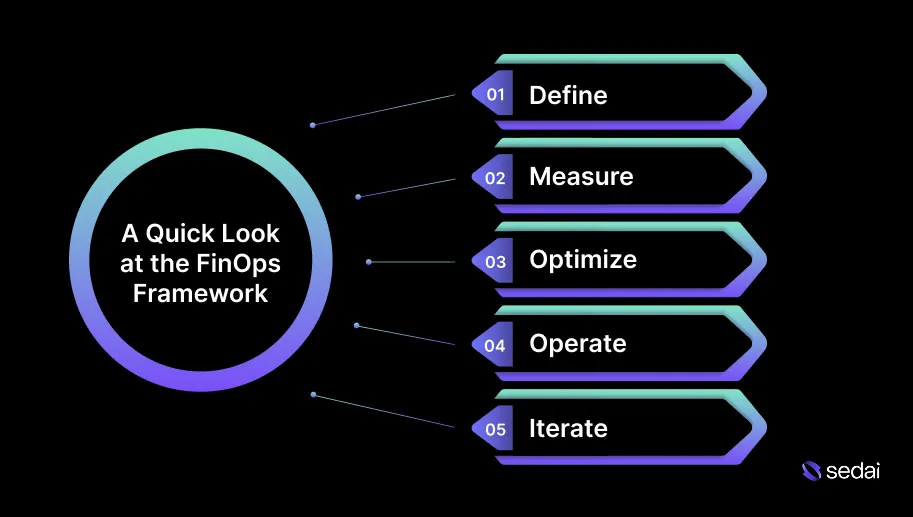
A Quick Look at the FinOps Framework
The FinOps Framework helps teams embed cloud financial management into everyday operations. It provides a structured set of practices that support continuous optimization, clear cost visibility, and strong alignment between engineering and finance.
Below is how senior engineers should approach the framework and apply it in practice:
1. Define
Set Financial Goals: Define clear, measurable financial objectives for the cloud environment, such as reducing cloud spend by 20% in the next quarter. Ensure these goals align closely with engineering priorities and delivery plans.
Cloud Cost Allocation: Determine how cloud costs are assigned across services, projects, or teams. Use consistent tagging and cost allocation models to ensure accuracy and transparency.
2. Measure
Track Usage and Spending: Use cloud-native tools such as AWS Cost Explorer or Azure Cost Management to monitor cloud usage and spending in real time.
Use Dashboards: Build real-time dashboards that surface key metrics, including cost by service, instance type, and team. This gives engineers clear visibility into how their resource usage impacts budgets.
Key Metrics: Focus on unit economics by tracking costs per transaction, per user, or per workload to understand cost efficiency at a detailed level.
3. Optimize
Rightsize Resources: Continuously adjust compute, storage, and network resources based on real usage data. For example, if a VM consistently runs at 30% utilization, scaling it down can reduce unnecessary spend.
Auto-Scaling: Apply auto-scaling policies that align resource allocation with actual demand. This is especially important in dynamic environments such as Kubernetes, where over-provisioning is common.
Spot Instances & Reserved Instances: Use Spot Instances for non-critical workloads and Reserved Instances for predictable, steady-state workloads to maximize cost savings.
4. Operate
Automate Governance: Enforce financial controls through automation, such as shutting down unused resources or triggering alerts when spending exceeds defined thresholds.
Continuous Feedback: Maintain bi-directional feedback loops between engineering and finance teams to keep cloud costs aligned with both technical requirements and financial targets.
5. Iterate
Review and Improve: Treat FinOps as an ongoing process. Regularly review cloud usage against defined goals and refine processes to drive further optimization.
Cloud FinOps Teams: Enable engineering teams to own cloud cost management while finance teams provide strategic oversight and guidance.
Once the FinOps framework is clear, applying best practices for effective cloud financial management becomes more straightforward.
Book a Sedai demo to automate cloud cost optimization, improve efficiency, and maximize FinOps outcomes.
17 FinOps Best Practices For Effective Cloud Financial Management
Managing cloud costs goes well beyond setting a few alerts or relying on default provider tools. To keep spending under control without sacrificing performance, teams need more advanced, FinOps-driven practices that match the realities of large, complex cloud environments.
Below are some best practices that reflect the challenges engineers face at scale.
1. Centralize Cloud Cost Visibility
Fragmented cost data spread across teams, subscriptions, and accounts often results in inefficiencies and unnecessary overspending. Centralizing cost visibility enables teams to detect anomalies earlier, improve accountability, and make informed optimization decisions.
How to Apply It:
Unified Cost Platform: Consolidate cloud spending data using tools such as Azure Cost Management or AWS Cost Explorer to gain a consistent view of costs.
Real-Time Dashboards: Monitor spending across services, accounts, and teams through a single, centralized dashboard.
Cost Ownership: Assign clear ownership to cost centers to ensure accountability and encourage responsible usage.
2. Use Right-Sizing and Auto-Scaling
Cloud environments are commonly over-provisioned, which leads to inflated costs without corresponding performance benefits. Right-sizing and auto-scaling ensure resources are aligned with actual workload demand.
How to Apply It:
Utilization Reviews: Regularly analyze resource utilization metrics to identify underused or over-allocated resources.
Instance Right-Sizing: Adjust compute and storage configurations based on real consumption patterns rather than peak assumptions.
Optimization Tools: Use recommendations from Azure Advisor or AWS Compute Optimizer to guide optimization efforts.
3. Implement Automated Resource Scheduling
Non-production environments frequently remain active even when not in use, creating avoidable and recurring costs.
How to Apply It:
Scheduled Shutdowns: Automatically shut down development and QA environments outside of standard working hours.
Automation Scripts: Use schedulers or serverless functions to manage start and stop schedules reliably.
Policy Enforcement: Apply standardized scheduling policies across all non-production resources to ensure consistency.
4. Optimize Commitment Purchases
Reserved Instances and Savings Plans can deliver significant cost savings when aligned with predictable workloads.
How to Apply It:
Recommendation Tools: Use cost optimization tools to guide commitment sizing and duration.
Ongoing Reviews: Reassess commitments periodically to avoid overcommitment as workloads change.
5. Take Advantage of Spot and Preemptible Instances
Spot and preemptible instances offer substantial discounts for workloads that can tolerate interruptions.
How to Apply It:
Workload Selection: Use these instances for batch processing, testing, and other non-critical or fault-tolerant workloads.
Capacity Management: Utilize Spot Fleets or equivalent services to manage capacity efficiently.
Resilience Planning: Implement retry mechanisms and failover strategies to handle interruptions gracefully.
6. Implement Lifecycle Management for Storage
Inefficient storage management can significantly increase costs, particularly for data that is rarely accessed.
How to Apply It:
Data Classification: Categorize data based on access patterns, such as hot, cold, or archival.
Tiered Storage: Move aging or infrequently accessed data to lower-cost storage tiers.
Lifecycle Policies: Automate data transitions between tiers using lifecycle management rules.
Storage Cleanup: Regularly remove unused volumes, snapshots, and orphaned resources.
7. Real-Time Cost Monitoring with Alerts
Without timely visibility, unexpected cost spikes may go unnoticed until budgets are exceeded.
How to Apply It:
Cost Alerts: Configure alerts for specific services, projects, or environments.
Threshold Limits: Define spending thresholds and trigger notifications when limits are approached or exceeded.
Native Monitoring: Use tools like Azure Monitor or AWS Budgets for real-time tracking.
Automated Actions: Trigger automated responses such as scaling down or shutting off resources when thresholds are breached.
8. Continuous Cost Optimization via Automation
As cloud environments scale, manual cost optimization becomes increasingly unsustainable.
How to Apply It:
Cost-Based Scaling: Initiate scaling actions using cost or utilization thresholds rather than static rules.
Optimization Rules: Apply standardized optimization policies consistently across all environments.
Reduced Manual Effort: Minimize reliance on periodic manual reviews by embedding automation into daily operations.
9. Create a FinOps-Centric Culture
Sustainable cost optimization depends on shared accountability across engineering, finance, and operations teams.
How to Apply It:
Shared Responsibility: Align engineering and finance teams around clear ownership of cloud costs.
Cost-Aware DevOps: Incorporate cost metrics into sprint planning, design decisions, and deployment workflows.
Transparent Reporting: Use shared dashboards to maintain visibility and foster informed decision-making.
10. Conduct Well-Architected Reviews
Ongoing architecture reviews help surface inefficiencies and uncover opportunities for cost optimization.
How to Apply It:
Framework Reviews: Evaluate architectures against established well-architected frameworks.
Cost Focus: Make cost efficiency a core consideration during architectural assessments.
Design Improvements: Identify changes that reduce cost while preserving performance and reliability.
Scheduled Assessments: Review architectures periodically to ensure they remain optimized as workloads change.
11. Forecast Usage for Dynamic Workloads
Cloud costs fluctuate significantly for workloads that scale unpredictably. Accurate forecasting helps teams anticipate demand spikes, stay within budget, and avoid unexpected overruns.
How to Apply It:
Historical Analysis: Review historical usage data to identify recurring demand patterns and trends.
Predictive Forecasting: Use machine learning or advanced analytics tools to estimate future usage more accurately.
Continuous Updates: Refine forecasts continuously using real-time workload signals and changing usage behavior.
Budget Planning: Factor in burst traffic, peak periods, and seasonal demand when planning budgets.
12. Optimize Network Costs
Network-related charges, including data egress and inter-region traffic, can quietly become a major contributor to cloud spend if left unmanaged.
How to Apply It:
Traffic Monitoring: Regularly track data transfer volumes and associated egress costs.
Data Movement Reduction: Minimize unnecessary cross-region and inter-cloud data transfers.
CDN Usage: Deliver static and frequently accessed content through content delivery networks to reduce egress charges.
Network Peering: Use peering options to lower intra-region and intra-cloud data transfer costs.
13. Track and Optimize Software Licensing Costs
Software licensing expenses can escalate quickly without visibility into actual usage patterns.
How to Apply It:
License Tracking: Monitor consumption of operating system, database, and third-party software licenses.
Usage Optimization: Identify licenses that are unused or consistently underutilized.
Tier Optimization: Move workloads to lower-cost licensing tiers where appropriate.
License Mobility: Take advantage of bring-your-own-license (BYOL) and license mobility programs to reduce costs.
14. Consolidate and Optimize Reserved Instance Purchases
Reserved Instances deliver value only when utilization is actively monitored and managed.
How to Apply It:
Centralized Purchasing: Consolidate Reserved Instance purchases across teams to improve utilization.
Utilization Monitoring: Track usage rates regularly to ensure reservations are being fully consumed.
Commitment Adjustments: Modify commitments as workload patterns change.
Overcommitment Control: Avoid paying for unused reserved capacity by aligning purchases with actual demand.
15. Integrate FinOps with CI/CD Pipelines
Embedding cost controls early in the delivery process helps prevent inefficient deployments.
How to Apply It:
Pipeline Cost Checks: Introduce cost validation steps within CI/CD workflows.
Pre-Deploy Detection: Identify oversized or unnecessary resources before they reach production.
IaC Enforcement: Apply cost policies through infrastructure-as-code templates.
Automated Guardrails: Prevent deployments that violate defined cost thresholds or policies.
16. Optimize for Cost Efficiency in Multi-Cloud Environments
Multi-cloud strategies increase flexibility but require consistent cost governance and visibility.
How to Apply It:
Unified Visibility: Centralize cost tracking and reporting across all cloud providers.
Pricing Comparison: Regularly evaluate pricing models across providers to identify savings opportunities.
Standardized Tagging: Apply consistent tagging strategies across clouds to ensure accurate cost tracking.
17. Manage Cloud Cost Debt
Unaddressed inefficiencies accumulate over time, creating long-term cost drag across cloud environments.
How to Apply It:
Cost Audits: Perform regular audits to review cloud spending and identify inefficiencies.
Waste Identification: Detect underutilized, idle, or over-provisioned resources.
Automated Cleanup: Eliminate recurring waste through automated rightsizing, shutdowns, and cleanup policies.
Knowing the best practices helps highlight the key components that form an effective FinOps practice.
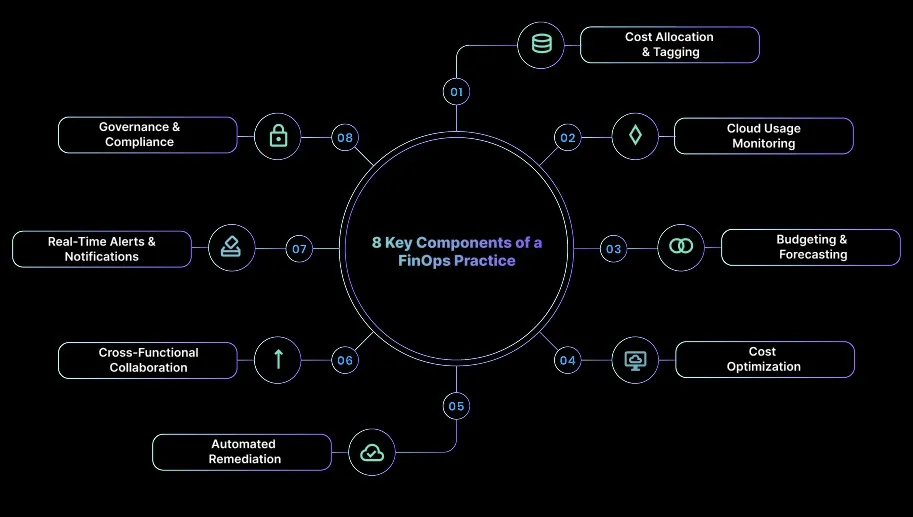
8 Key Components of a FinOps Practice
A strong FinOps practice is built on a few core components that support real-time cost control, ongoing optimization, and close collaboration across teams. Understanding these elements and applying them consistently is key to running scalable, cost-efficient cloud environments.
1. Cost Allocation & Tagging
Purpose: Ensure cloud expenses are accurately tracked and mapped to the correct teams, projects, or environments.
How to Implement: Apply consistent tagging across all resources, such as VMs, databases, and storage. Use standard tags for team, project, and environment (for example, dev or prod) so costs can be clearly attributed and analyzed.
2. Cloud Usage Monitoring
Purpose: Continuously monitor resource consumption to identify inefficiencies early.
How to Implement: Use cloud-native tools like AWS Cost Explorer, Azure Cost Management, or Google Cloud Billing Reports to track usage across compute, storage, and networking.
Key Metrics: Focus on unit economics by measuring cost per transaction, per user, or per workload to understand efficiency at a detailed level.
3. Budgeting & Forecasting
Purpose: Set financial targets and anticipate future cloud spend using historical trends.
How to Implement: Build forecasts based on past usage and define budgets for teams, projects, or services. Use tools like AWS Budgets or Azure Cost Management to trigger alerts as spending approaches limits.
4. Cost Optimization
Purpose: Reduce waste by continuously aligning resources with actual demand.
How to Implement: Perform regular rightsizing of VMs, databases, and storage. Use auto-scaling to adjust capacity dynamically. Apply reserved instances for predictable workloads and spot instances for flexible or non-critical workloads.
5. Automated Remediation
Purpose: Automatically resolve cost inefficiencies and anomalies.
How to Implement: Use automation through scripts or tools like Terraform and CloudFormation to shut down unused resources, scale down over-provisioned instances, or adjust instance types based on real-time usage.
6. Cross-Functional Collaboration
Purpose: Ensure cloud financial decisions are shared, transparent, and aligned across teams.
How to Implement: Hold regular reviews involving engineering, finance, and operations to assess cloud spend, identify optimization opportunities, and align on budget goals.
7. Real-Time Alerts & Notifications
Purpose: Prevent unexpected cost spikes by notifying teams early.
How to Implement: Configure automated alerts using AWS CloudWatch, Azure Monitor, or Google Cloud monitoring tools to trigger when usage or costs exceed defined thresholds.
8. Governance & Compliance
Purpose: Maintain financial accountability and enforce efficient resource usage.
How to Implement: Define cloud cost governance policies that align provisioning with business and financial goals. Use controls such as AWS Organizations, Azure Management Groups, or Google Cloud Organization Policies to enforce compliance consistently.
Knowing the key components of a FinOps practice helps highlight the common challenges teams face when starting.
Common Challenges When Getting Started with FinOps
Implementing FinOps can significantly change how cloud costs are managed, but it often introduces practical challenges, especially for senior engineers responsible for implementing the strategy.
Below is an overview of the key hurdles teams face and how engineers can work through them effectively.
Challenge
Solution
Aligning Engineering and Finance Teams
Hold regular cross-functional meetings and set shared KPIs.
Implementing Consistent Cost Allocation
Enforce strict tagging policies and automate tagging for accuracy.
Scaling FinOps Across Multiple Cloud Providers
Use tools like CloudHealth or CloudCheckr for unified cost visibility across platforms.
Handling Complex Cost Forecasting
Use historical data and cost modeling tools for better forecasts.
Ensuring Real-Time Cost Control
Set up real-time alerts and integrate them into CI/CD pipelines for immediate action.
Managing Resource Sprawl and Idle Resources
Automate idle resource shutdown and regularly review usage patterns.
Balancing Cost Optimization with Performance Needs
Implement right-sizing and dynamic scaling, monitoring performance impact.
Lack of Automation and Manual Overhead
Use automation tools for cost monitoring and resource management.
Recognizing the common challenges of getting started with FinOps shows why building a FinOps-first culture across teams is so important.
How to Build a FinOps-First Culture Across Teams?
Building a FinOps-first culture means integrating cost awareness into every stage of the technology lifecycle, ensuring engineering, finance, and product teams work together toward shared efficiency goals.
Here’s how you can help establish and sustain a FinOps-first culture:
1. Education and Awareness
A FinOps-first culture begins with a clear understanding of how cloud costs work. For teams to make cost-aware decisions consistently, they need visibility into cloud pricing models and how everyday engineering choices affect overall spend.
How to Build It:
Run FinOps Education Sessions: Conduct regular workshops explaining concepts like Effective Savings Rate (ESR), unit economics, and commitment utilization
Keep Cost Conversations Visible: Use Slack channels, internal newsletters, or monthly updates to keep cost optimization top of mind
Build Shared Cost Context: Simplify complex pricing topics so all teams understand the financial impact of their decisions
2. Training and Skill Development
Awareness alone is not enough. Teams need practical skills to translate FinOps principles into daily execution. Both engineering and finance teams must understand how to apply cost optimization techniques within their respective workflows.
How to Build It:
Offer Role-Specific Training: Help engineers identify idle resources and scaling issues while enabling finance teams to forecast spend accurately
Use Real Cost Data: Train teams using actual organizational data to show the real impact of decisions
Encourage Continuous Learning: Promote FinOps certifications or internal micro-learning programs to reinforce skills over time
3. Ongoing Engagement and Motivation
Cloud cost optimization is an ongoing discipline, not a one-time initiative. Sustaining momentum requires continuous engagement and visible progress.
How to Build It:
Track Optimization Progress: Use dashboards to show savings, cost per feature, and unit economics
Make Results Visible: Share progress openly so teams can see the impact of their efforts
Recognize Cost Wins: Highlight teams or services that improve cost efficiency to reinforce positive behavior
4. Collaboration and Communication
A FinOps-first culture relies on strong collaboration across engineering, finance, and product teams. Alignment improves when cost discussions are transparent and ongoing.
How to Build It:
Hold Cross-Functional Reviews: Schedule regular FinOps discussions around cost trends and risks
Encourage Open Trade-Off Discussions: Create space to evaluate cost, performance, and reliability together
Standardize Cost Communication: Ensure all teams follow shared practices for discussing cloud spend
5. KPI Tracking and Benchmarking
Defining and tracking meaningful KPIs keeps FinOps grounded in measurable outcomes. Benchmarks provide clarity on what success looks like and where improvement is needed.
How to Build It:
Define Cost Efficiency KPIs: Track metrics like cost per user, unit economics, and resource utilization
Benchmark Performance: Compare results against historical data or industry standards
Refine Continuously: Use KPI insights to improve forecasting, optimization, and decision-making.
Many tools promise cloud cost optimization, but they often rely on basic reporting or manual scaling adjustments. These static approaches can’t keep up with workload changes, leading to inefficiencies and hidden costs over time.
Sedai stands out by delivering autonomous cloud cost optimization powered by a reinforcement learning framework. It continuously analyzes real-time workload behavior and optimizes both cost and performance without manual intervention.
Pod-Level Rightsizing (CPU & Memory): Sedai dynamically adjusts pod requests and limits based on actual workload usage, preventing over- or under-provisioning. This continuous rightsizing reduces cloud costs by 30%.
Node Pool and Instance-Type Optimization: Sedai evaluates cluster-wide patterns to select the most efficient node types for GKE node pools. This reduces idle resources, enhances application performance, and cuts inefficiencies.
Autonomous Scaling Decisions: Sedai makes scaling decisions in real time, based on workload behavior rather than static thresholds. This dynamic autoscaling reduces failed customer interactions and avoids resource over-provisioning.
Automatic Remediation: Sedai proactively detects performance degradation or resource pressure and resolves issues before they impact workloads. This increases engineering productivity by 6 times, as teams no longer need to intervene manually.
Full-Stack Cost and Performance Optimization: Sedai optimizes compute, storage, networking, and commitment levels, delivering up to 50% cost savings while boosting cloud performance.
Multi-Cluster and Multi-Cloud Support: Sedai supports AWS, Azure, Google Cloud, and multiple Kubernetes clusters, providing consistent optimization across platforms. With over $3.5 million in cloud spend managed, it scales smoothly for complex multi-cloud setups.
SLO-Driven Scaling: Sedai aligns scaling actions with Service Level Objectives (SLOs) and Service Level Indicators (SLIs), ensuring cloud resources meet performance requirements during demand fluctuations.
With Sedai, cloud cost optimization becomes a continuous, autonomous process that adapts in real-time.
To see how much you could save by automating cloud optimization, reducing waste, and improving performance across your cloud infrastructure with Sedai, try our ROI calculator and estimate your potential cloud cost savings today.
Final Thoughts
FinOps cloud optimization is all about building a culture of financial efficiency and operational excellence across teams. As cloud environments scale, manual oversight quickly becomes impractical. That’s where automation and real-time insights make the difference.
Platforms like Sedai help engineering teams by automatically adjusting resources, analyzing usage patterns, and predicting future needs, keeping your cloud environment running efficiently at all times.
With Sedai’s autonomous optimization, you can eliminate waste, maintain performance, and stay within budget, while freeing engineers to focus on innovation rather than infrastructure management.
FinOps strategies work best when engineering teams don't have to execute them manually. Book a demo to see how Sedai acts on FinOps insights autonomously, closing the loop in real time.
Q1. How can we ensure that our engineering team fully embraces FinOps practices?
A1. FinOps adoption improves when cost awareness is built directly into the engineering culture through role-specific training and shared ownership with finance. Regular cross-functional reviews and clear cost dashboards help keep teams aligned, accountable, and consistently engaged.
Q2. What are the key differences between FinOps and Cloud Cost Management tools?
A2. Cloud Cost Management tools focus on tracking and reporting cloud usage and spend. FinOps is a collaborative operating model that uses this data to drive shared decision-making and continuous optimization across engineering, finance, and operations.
Q3. How does FinOps impact our cloud architecture design?
A3. FinOps encourages engineers to factor cost efficiency into architecture decisions from the design stage itself. This leads to better right-sizing, smarter service selection, and architectures that scale efficiently without unnecessary spend.
Q4. How can we measure the success of our FinOps program?
A4. FinOps success is measured using KPIs such as Effective Savings Rate, cost per user, cost per transaction, and overall resource utilization. Improvements in forecasting accuracy, budget adherence, and optimization consistency also indicate strong FinOps maturity.
Q5. What role does automation play in FinOps?
A5. Automation enables continuous right-sizing, cost monitoring, and policy enforcement without manual intervention. It reduces operational effort while ensuring cost optimization happens in real time and at scale.


.webp%3Fv%3D2026-04-09T18%253A41%253A05.143Z&w=3840&q=75)