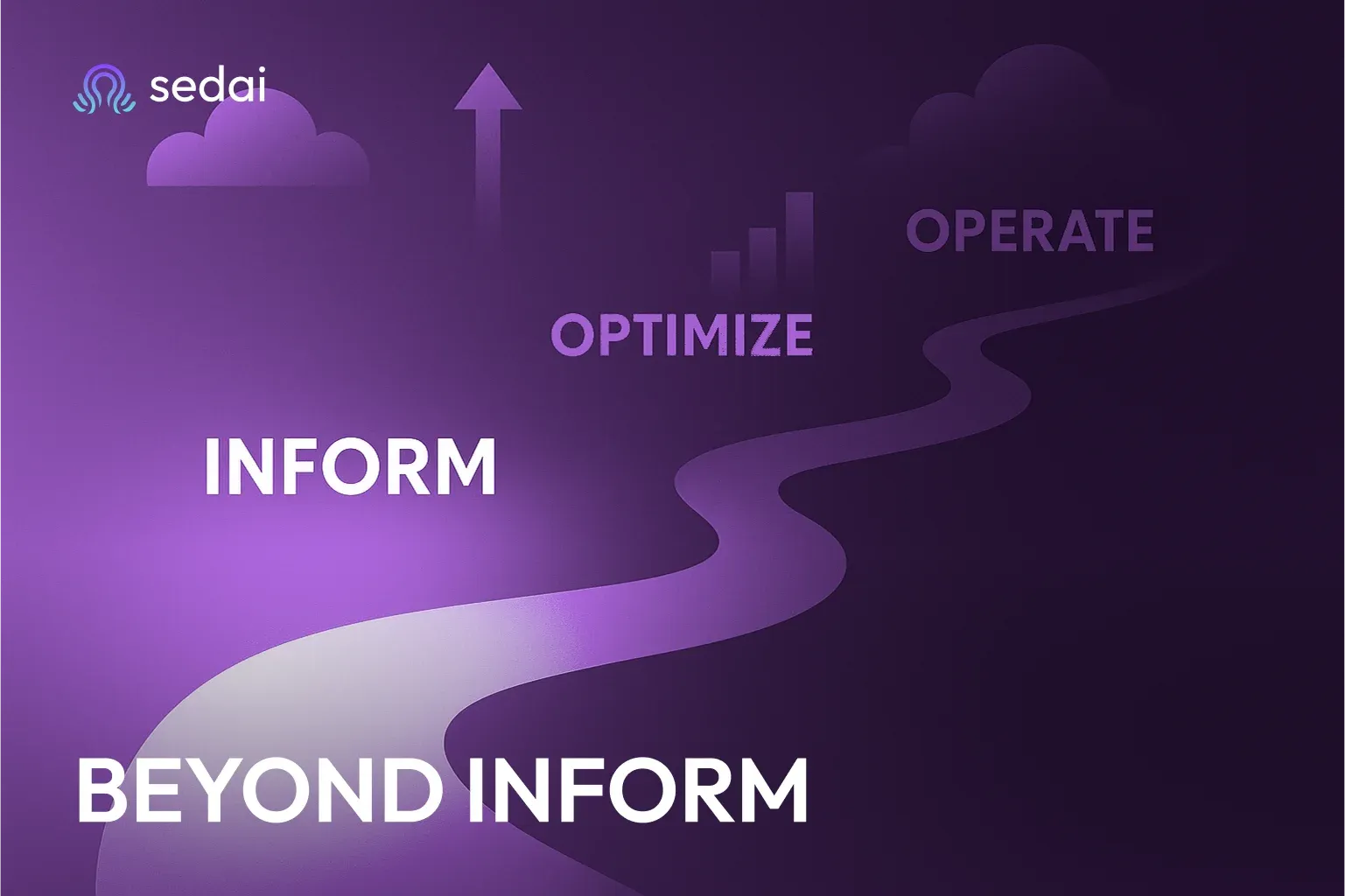
The FinOps lifecycle consists of three main phases: Inform, Optimize, and Operate. The Inform phase focuses on establishing visibility into cloud spend through allocation, tagging, and reporting. The Optimize phase identifies and implements opportunities to reduce waste and improve efficiency, such as rightsizing and scaling adjustments. The Operate phase embeds FinOps into daily processes, aligning engineering, finance, and business teams to continuously balance cost, performance, and speed. (Source: Sedai Blog, FinOps Foundation)
Why do teams often stall at the Inform phase of FinOps?
Teams often stall at the Inform phase because moving to Optimize and Operate is more complex and time-consuming. Optimization requires engineering input, prioritization, and cross-team coordination. The volume of opportunities can be overwhelming, and cultural misalignment between finance, engineering, and operations can slow progress. Additionally, dynamic cloud environments make point-in-time recommendations quickly outdated, and fear of unintended consequences can lead to inaction. (Source: Sedai Blog)
What challenges do organizations face when trying to move beyond visibility in FinOps?
Organizations face several challenges, including the complexity and time required for optimizations, cultural misalignment between teams, rapidly changing cloud environments, and concerns about the safety of changes. Governance, policy enforcement, and compliance monitoring are also difficult to implement consistently, making it hard to progress beyond visibility into continuous optimization and operation. (Source: Sedai Blog)
How does Sedai help organizations move from Inform to Optimize and Operate in FinOps?
Sedai enables organizations to move beyond visibility by providing autonomous cloud management that acts on insights in real time. Sedai's platform continuously rightsizes resources, tunes scaling parameters, and adjusts policies safely and gradually, with continuous validation checks. This approach builds trust, aligns teams, and enables continuous execution, unlocking the full value of FinOps. (Source: Sedai Blog, Sedai Knowledge Base)
Why is trust important for FinOps optimization?
Trust is crucial because engineers must be confident that optimizations will not jeopardize application performance, reliability, or availability. Without assurance of safety, teams are hesitant to implement recommendations at scale. Sedai addresses this by making safe, gradual optimizations with continuous validation, ensuring no incidents or SLO breaches occur. (Source: Sedai Blog, Sedai Knowledge Base)
How does Sedai ensure safe cloud optimizations?
Sedai is the only cloud optimization platform patented to make safe, autonomous optimizations in production. It performs slow, incremental changes with continuous validation checks, ensuring that no incident is caused and SLOs are never breached. Guardrails and policies are enforced for every action, providing safety and compliance. (Source: Sedai Knowledge Base)
What role does autonomy play in FinOps success?
Autonomy bridges the gap between knowing what needs to be done and actually executing optimizations. Autonomous platforms like Sedai act on opportunities in real time, continuously rightsizing resources and tuning policies. This enables continuous optimization and operation, reduces manual toil, and ensures that teams realize the full benefits of FinOps. (Source: Sedai Blog)
How does Sedai address the alignment challenge in FinOps?
Sedai helps align finance, engineering, and operations by enabling shared guardrails for cost, performance, and compliance. Its autonomous platform enforces policies and objectives, reducing friction and building trust across teams. This alignment is essential for successful FinOps optimization and operation. (Source: Sedai Blog, Sedai Knowledge Base)
Why is continuous execution important in cloud optimization?
Continuous execution is vital because cloud environments change rapidly. Point-in-time actions or monthly reviews cannot keep up with dynamic workloads. Sedai's autonomous platform applies optimizations in real time, ensuring that cost savings and performance improvements are sustained as environments evolve. (Source: Sedai Blog)
What is the value of moving beyond visibility in FinOps?
Moving beyond visibility allows organizations to realize the true benefits of FinOps: sustained cost savings, improved application performance, reduced operational toil, and better alignment between finance and engineering. Sedai enables this by making optimization and operation continuous, safe, and aligned with business objectives. (Source: Sedai Blog)
Features & Capabilities
What features does Sedai offer for autonomous cloud management?
Sedai offers autonomous optimization, proactive issue resolution, full-stack cloud coverage (across AWS, Azure, GCP, and Kubernetes), release intelligence, plug-and-play implementation, and enterprise-grade governance. It supports multiple modes of operation: Datapilot (observability), Copilot (one-click optimizations), and Autopilot (fully autonomous execution). (Source: Sedai Knowledge Base)
How does Sedai's patented safety-first approach work?
Sedai's patented approach ensures that all optimizations are safe, gradual, and continuously validated. Every change is constrained, validated, and reversible, with automatic rollbacks and health verification. This guarantees that no optimization causes incidents or breaches SLOs, making Sedai uniquely safe for production environments. (Source: Sedai Knowledge Base)
What is Sedai's Release Intelligence feature?
Release Intelligence tracks changes in cost, latency, and errors for each deployment, improving release quality and minimizing risks. This feature ensures that teams can monitor the impact of releases and maintain high performance and reliability. (Source: Sedai Knowledge Base)
Does Sedai support integration with existing cloud and DevOps tools?
Yes, Sedai integrates with a wide range of tools, including Cloudwatch, Prometheus, Datadog, Azure Monitor, GitLab, GitHub, Bitbucket, Terraform, ServiceNow, Jira, Slack, Microsoft Teams, and various runbook automation platforms. This ensures seamless adoption into existing workflows. (Source: Sedai Knowledge Base)
What is Sedai for S3 and what does it do?
Sedai for S3 is designed to optimize Amazon S3 costs by managing Intelligent-Tiering and Archive Access Tier selection. It achieves up to 30% cost efficiency gain and 3X productivity gain by reducing manual effort in S3 management. (Source: Sedai Knowledge Base)
How does Sedai's proactive issue resolution work?
Sedai detects and resolves performance and availability issues before they impact users. This proactive approach reduces failed customer interactions by up to 50% and ensures seamless operations. (Source: Sedai Knowledge Base)
What modes of operation does Sedai offer?
Sedai offers three modes of operation: Datapilot (observability), Copilot (one-click optimizations), and Autopilot (fully autonomous execution). This flexibility allows organizations to choose the level of automation that matches their comfort and maturity. (Source: Sedai Knowledge Base)
Use Cases & Benefits
What problems does Sedai solve for cloud teams?
Sedai solves problems such as cost inefficiencies, operational toil, performance and latency issues, lack of proactive issue resolution, complexity in multi-cloud environments, and misaligned priorities between engineering and finance. It delivers up to 50% cost savings, 75% latency reduction, and 6X productivity gains. (Source: Sedai Knowledge Base)
Who can benefit from using Sedai?
Sedai is designed for platform engineering, IT/cloud operations, technology leadership, site reliability engineering (SRE), and FinOps professionals. It is ideal for organizations with significant cloud operations across industries such as cybersecurity, IT, financial services, healthcare, travel, and e-commerce. (Source: Sedai Knowledge Base)
What business impact can customers expect from Sedai?
Customers can expect up to 50% reduction in cloud costs, 75% reduction in latency, 6X productivity gains, and up to 50% fewer failed customer interactions. Case studies include Palo Alto Networks saving $3.5 million and KnowBe4 achieving 50% cost savings. (Source: Sedai Knowledge Base, Case Studies)
What industries does Sedai serve?
Sedai serves industries including cybersecurity, information technology, financial services, security awareness training, travel and hospitality, healthcare, car rental services, retail and e-commerce, SaaS, and digital commerce. (Source: Sedai Knowledge Base)
Can you share specific customer success stories with Sedai?
Yes. KnowBe4 achieved up to 50% cost savings and saved $1.2 million on AWS. Palo Alto Networks saved $3.5 million and reduced Kubernetes costs by 46%. Belcorp reduced AWS Lambda latency by 77%. More case studies are available on Sedai's resources page. (Source: Sedai Knowledge Base, Sedai Resources)
What feedback have customers given about Sedai's ease of use?
Customers highlight Sedai's quick setup (5–15 minutes), agentless integration, personalized onboarding, and extensive support resources. The 30-day free trial allows users to experience the platform's value risk-free. (Source: Sedai Knowledge Base)
Competition & Differentiation
How does Sedai differ from other cloud optimization platforms?
Sedai is the only platform patented for safe, autonomous optimizations in production. It makes gradual, validated changes, never causing incidents or SLO breaches. Unlike competitors that rely on static rules or manual adjustments, Sedai operates autonomously, proactively resolves issues, and optimizes based on application outcomes, not just infrastructure metrics. (Source: Sedai Knowledge Base)
What makes Sedai's approach safer than other optimizers?
Sedai's patented technology ensures that all optimizations are slow, incremental, and continuously validated. This prevents incidents and SLO breaches, unlike risky optimizers that make all-at-once changes without sufficient safety checks. (Source: Sedai Knowledge Base)
How does Sedai's application-aware intelligence provide an advantage?
Sedai optimizes based on real application behavior, traffic patterns, and dependencies, ensuring that cost and performance improvements align with business outcomes. Traditional tools often optimize infrastructure in isolation, missing the broader impact on applications. (Source: Sedai Knowledge Base)
What are the advantages of Sedai for different user segments?
Platform engineers benefit from reduced toil and IaC consistency; IT/cloud ops see lower ticket volumes and safer automation; technology leaders gain measurable ROI and reduced spend; FinOps teams get actionable savings and multi-cloud simplicity; SREs experience fewer alerts and less manual toil. (Source: Sedai Knowledge Base)
Technical Requirements & Security
How long does it take to implement Sedai?
Sedai's setup process takes just 5 minutes for general use cases and up to 15 minutes for specific scenarios like AWS Lambda. More complex environments may require additional time, and personalized onboarding is available. (Source: Sedai Knowledge Base)
Is Sedai agentless?
Yes, Sedai connects securely to cloud accounts using Identity and Access Management (IAM), eliminating the need for complex installations or additional agents. (Source: Sedai Knowledge Base)
What security and compliance certifications does Sedai have?
Sedai is SOC 2 certified, demonstrating adherence to stringent security requirements and industry standards for data protection and compliance. (Source: Sedai Knowledge Base, Security page)
Where can I find technical documentation for Sedai?
Technical documentation is available at docs.sedai.io/get-started. Additional resources, including case studies and datasheets, are available on the Sedai resources page. (Source: Sedai Knowledge Base)
Support & Implementation
What onboarding support does Sedai provide?
Sedai offers personalized onboarding sessions, a dedicated Customer Success Manager for enterprise customers, detailed documentation, a community Slack channel, and email/phone support. (Source: Sedai Knowledge Base)
Does Sedai offer a free trial?
Yes, Sedai offers a 30-day free trial, allowing customers to experience the platform's value firsthand without any financial commitment. (Source: Sedai Knowledge Base)
Who are some of Sedai's notable customers?
Sedai's customers include Palo Alto Networks, HP, Experian, KnowBe4, Expedia, CapitalOne Bank, GSK, and Avis. These organizations trust Sedai to optimize their cloud environments and improve operational efficiency. (Source: Sedai Knowledge Base)
FinOps has given organizations a clear framework for managing cloud spend. Most teams start with the Inform phase — tagging, allocation, and dashboards that show where money is going. This visibility is essential, but it is also where many teams stall. Knowing your cloud costs is very different from reducing them or making optimization part of daily operations.
The FinOps lifecycle includes three phases: Inform, Optimize, and Operate. Adoption, however, often skews heavily toward the first. That’s mostly because the other two phases are harder. Optimize and Operate require cross-team coordination, trust in the safety of changes, and the ability to execute continuously in dynamic cloud environments.
Most FinOps tools tell you what to fix. Book a demo to see how Sedai fixes it, taking real-time autonomous action so your team spends time on strategy, not tickets.
FinOps Lifecycle Refresher
The FinOps Lifecycle has been around since the FinOps Foundation was formed in 2019, and the three phases have remained consistent — Inform, Optimize and Operate. These phases are detailed on the FinOps Foundation website, but here is a quick summary:
Inform. Establish visibility into cloud spend through allocation, tagging, and reporting, so teams understand where money is going and who is responsible.
Optimize. Identify and implement opportunities to reduce waste and improve efficiency, such as rightsizing, scaling adjustments, and smarter purchasing.
Operate. Embed FinOps into daily processes, aligning engineering, finance, and business teams to continuously balance cost, performance, and speed.
It’s important to note that these phases aren’t linear in nature. On any given day, teams may work across all of them.
Why Teams Stall at Inform
Most organizations make solid progress in the Inform phase of FinOps by tagging resources, producing dashboards, and creating monthly reports. But moving beyond visibility into Optimize and Operate is where momentum often slows.
The first hurdle is that optimizations are complex and time-consuming. Rightsizing instances, adjusting scaling policies, and making reserved capacity decisions all require engineering input, which is difficult to prioritize against feature delivery. On top of that, the sheer volume of opportunities makes it challenging to decide what to tackle first. Even when teams act on the highest-priority items, the long tail of smaller opportunities often goes unaddressed, leaving significant potential savings unrealized.
There is also a cultural shift required. FinOps is inherently cross-functional, but finance, engineering, and operations do not always share the same priorities. Finance wants savings, engineering wants performance and reliability, and operations wants compliance and stability. Getting everyone aligned is no small task.
The nature of modern cloud environments makes things harder still. Dynamic, distributed architectures such as microservices, Kubernetes, and data platforms change constantly, so point-in-time recommendations (for example, monthly reports) are quickly outdated. By the time they are reviewed, workloads may have shifted and the recommendations no longer apply.
Even when opportunities are clear, teams may hesitate to act. Fear of unintended consequences such as user experience issues, creating downtime, or violating compliance requirements causes engineers to err on the side of inaction. In the 2025 State of FinOps report, concerns that recommended changes will cause damage was the number two reason cited for not acting on recommendations.
The Operate phase introduces additional challenges since it requires governance, policy enforcement, and compliance monitoring, which many teams struggle to implement consistently.
The result is that organizations end up with good visibility into cloud spend, but the real benefits of FinOps — sustained cost savings, better performance, and reduced toil — remain out of reach.
Ready to turn cloud cost insights into action?
Book a Sedai demo to move beyond visibility, automate optimization, and achieve measurable cloud savings.
What it Takes to Move Forward
To move beyond Inform, organizations need more than just visibility. They need the ability to act on insights quickly, safely, and in a way that brings finance, engineering, and operations together around shared goals.
The first requirement is trust. Engineers must trust that any optimization will not jeopardize application performance, reliability, or availability. Without that assurance, recommendations are too risky to implement at scale.
The second requirement is alignment. FinOps is successful when finance, engineering, and operations agree on the guardrails for cost, performance, and compliance. Establishing policies and shared objectives reduces friction and builds trust across teams.
The third requirement is continuous execution. Cloud environments change daily, so optimizations must be applied in real time, not once a month in a cost review meeting. Point-in-time actions cannot keep pace with the dynamic nature of modern workloads.
When these three conditions are met — trust, alignment, and continuous execution — teams can finally progress into the Optimize and Operate phases of FinOps. This is where the real benefits emerge: meaningful cost savings, improved application performance, and reduced operational toil.
The Role of Autonomy
Meeting these requirements is difficult without help. Manual processes cannot keep up with the scale and speed of today’s cloud environments. This is where autonomous cloud management becomes essential.
Autonomy bridges the gap between knowing what needs to be done and actually doing it. Instead of generating lists of recommendations that may or may not get implemented, autonomous platforms act on opportunities in real time. They continuously rightsize resources, tune scaling parameters, and adjust policies to keep workloads efficient.
Importantly, autonomy does not mean giving up control. Guardrails and policies ensure that every action aligns with business objectives and compliance requirements. Teams can choose different modes of operation, from insight-only reporting to human-in-the-loop approvals to full autonomous execution, depending on their level of comfort and maturity.
By introducing autonomy into the FinOps practice, organizations can finally bring the Optimize and Operate phases to life. Optimization becomes continuous rather than episodic, and operations teams are no longer burdened with repetitive, low-value tasks. Finance sees savings realized, engineers maintain performance and reliability, and the business as a whole gains the ability to innovate faster with confidence.
Autonomous cloud management bridges the gap between knowing what needs to be done and actually executing at scale — without growing your team. Book a demo to see how Sedai delivers that execution layer in your environment.
Unlocking the Full Value of FinOps
FinOps was never meant to stop at visibility. The real promise of FinOps is unlocked when organizations Optimize and Operate, where visibility turns into continuous action. That transition has historically been difficult because of complexity, cultural alignment, and the speed of modern cloud environments.
Autonomy changes the equation. By enabling safe, continuous optimization under clear policies and guardrails, autonomous cloud management helps teams realize the outcomes FinOps was designed to deliver: lower costs, stronger performance, less toil, and better alignment between finance and engineering.
Teams that broaden their practice beyond Inform are not just reducing waste. They are creating a sustainable way to run cloud environments with confidence and agility. This is what it means to unlock the full value of FinOps.