


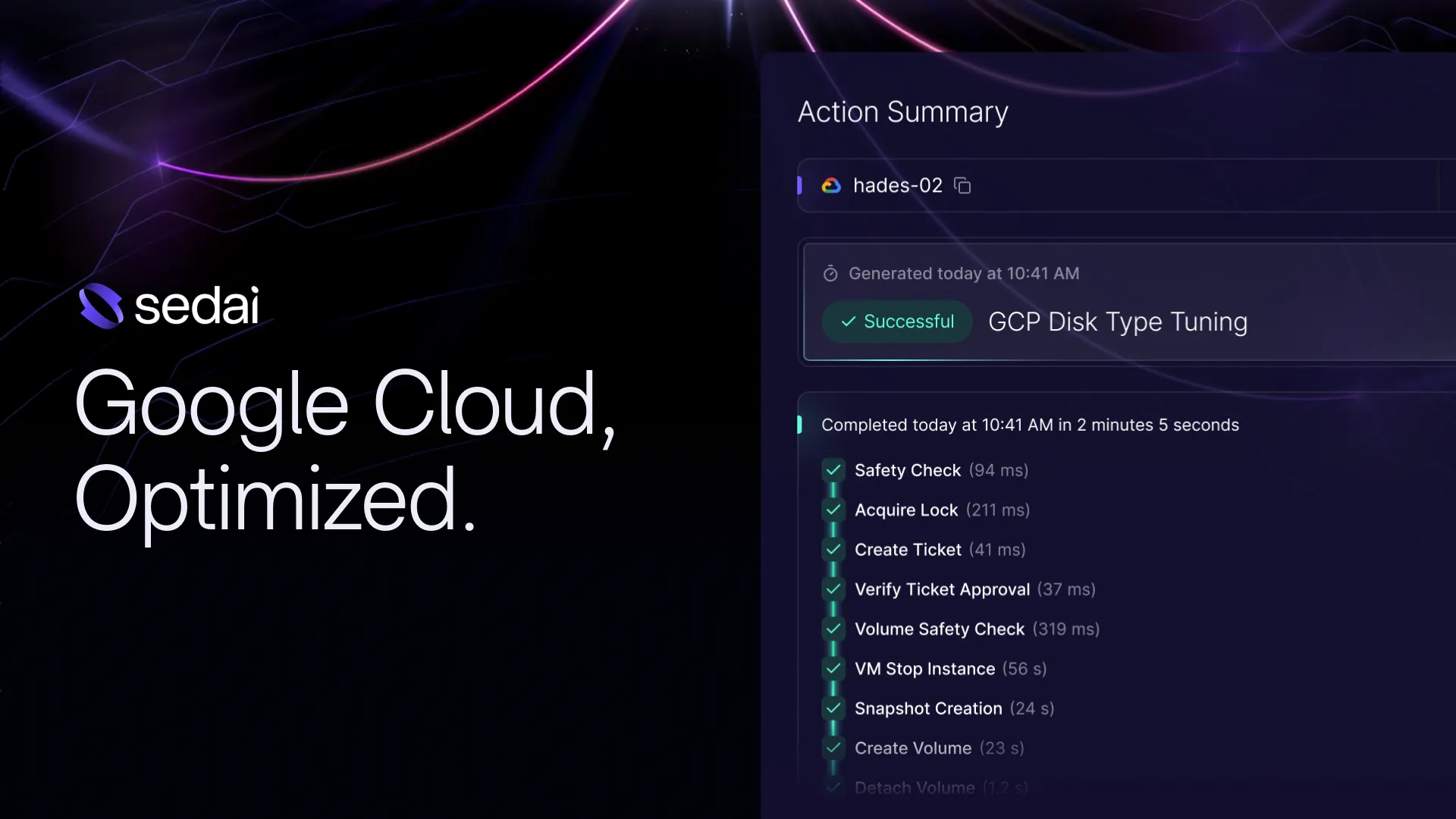
Today, we’re announcing new optimization capabilities for Google Cloud that help teams reduce VM and storage waste without risking availability or increasing operational burden.
With this release, Sedai extends its optimization platform to GCE virtual machines, block storage, and object storage, enabling teams to identify savings opportunities, execute changes safely through maintenance windows, validate application health after every action, and automatically roll back if issues arise.
The result: High-impact savings become realistic and achievable, even in complex, VM-heavy GCP environments.

The Challenge: Optimization Is Known, but Rarely Executed
Most VM- and disk-heavy estates are over-provisioned. Teams can see it in the data, but acting on it is where things break down. That’s because rightsizing changes feel risky, require coordination across teams, and come with real fear of performance regressions or outages.
That challenge is amplified on Google Cloud.
Resizing VMs or changing disk types often requires:
- Planned downtime
- Multi-step workflows
- Careful sequencing to avoid data loss
- Manual validation and cleanup
- A rollback plan if something goes wrong
Because optimization is risky and disruptive, teams defer action. Waste accumulates quietly for months or years, especially for legacy and VM-based workloads that can’t rely on container-style elasticity.
Meanwhile, native and third-party tools surface recommendations but stop short of safe execution, leaving teams stuck between cost pressure and availability risk.
How Sedai Makes Google Cloud Optimization Easier
Sedai closes that gap by pairing insight with safe, controlled execution, designed specifically for how GCP infrastructure actually works.
VM Right-Sizing and Group Optimization
Sedai analyzes real CPU and memory usage to recommend the right GCE machine types across individual VMs and load-balanced VM groups.
Optimizations are:
- Executed through approved maintenance windows
- Designed to preserve required capacity
- Validated after execution to ensure workload health

Disk Performance & Type Optimization
Persistent disks are frequently over-allocated or over-provisioned for performance, locking teams into higher IOPS and capacity tiers that workloads rarely use in practice.
Sedai:
- Evaluates IOPS and throughput usage
- Recommends right-sizing performance tiers
- Identifies safe disk type changes (e.g., SSD → HDD for low-performance workloads)
- Aligns disk capabilities with VM requirements to avoid paying for unused capacity
All changes follow GCP-aware safety workflows with validation and rollback.

Orphaned Disk Detection & Cleanup
Disks left behind after VM deletion are a common source of long-lived waste. That’s because teams delete compute first, lose track of dependencies, or hesitate to remove disks that might still be needed for recovery.
Sedai:
- Automatically identifies orphaned disks
- Flags 100% waste opportunities with zero impact on running workloads
- Enables safe cleanup to eliminate forgotten storage spend

Object Storage Intelligent Tiering
For Google Cloud Storage, Sedai analyzes access patterns to determine when intelligent tiering or auto-classification will actually reduce net cost.
This avoids:
- Blanket enablement that increases spend
- Unexpected transition or retrieval fees
And helps teams reduce storage costs without sacrificing data accessibility.

Built for GCP: Safe Execution & Rollback
What makes this release different isn’t just what Sedai recommends. It’s how those changes are executed.
Sedai orchestrates complex GCP workflows automatically:
- Snapshot creation for safety
- Disk detachment and migration
- VM or disk changes
- Reattachment and cleanup
- Post-action health validation
- Post-optimization snapshot back up lifecycle
- Post-optimization original disk termination lifecycle
If performance or stability signals degrade — for example from bursty traffic, changing query patterns, or noisy-neighbor contention — Sedai automatically rolls back, removing the fear that rightsizing opens the door to hard-to-detect performance regressions.
Just as importantly, teams stay in control:
- Execute immediately or defer to maintenance windows
- Start with recommendations only, then enable Copilot execution
- Apply guardrails that match operational risk tolerance
This is human-in-the-loop optimization by design, not blind, risky, rule-based automation.
Why This Matters More on Google Cloud
Many optimization steps that are single API calls in other platforms require multiple coordinated actions in GCP. When done manually, that complexity translates directly into toil, risk, and hesitation.
For example, resizing a VM often involves stopping or recreating the instance, coordinating changes to attached disks, instance templates, and managed instance groups, and validating that autoscaling and load balancing still behave as expected. Each step may be documented in a runbook, but small changes in configuration or workload behavior can cause those runbooks to fail in unexpected ways.
By handling those steps automatically and safely, Sedai:
- Makes regular, continuous optimization realistic
- Eliminates brittle runbooks that break when conditions change
- Reduces operational overhead
- Allows teams to capture savings they already know exist, but are not confident enough to make
Who This Is For
These capabilities are designed for:
- Platform Engineering, SRE, and Cloud Ops teams reducing VM and disk waste while executing changes safely within maintenance windows
- FinOps teams capturing reliable, provable savings without introducing availability risk
- Infrastructure and application owners right-sizing legacy and VM-based workloads with confidence
- Cloud architects enforcing consistent optimization patterns across AWS, Azure, and GCP
The value, summarized
- Cost: Meaningful, repeatable savings from right-sizing compute, tuning disk performance, and eliminating orphaned storage
- Reliability: Execute optimizations safely using maintenance windows, validation, and automatic rollback
- Productivity: Eliminate manual runbooks and multi-step GCP workflows so teams optimize more often with less effort
- Governance: Move from visibility to execution with clear controls that balance savings and uptime
Getting Started
You can begin using Sedai’s Google Cloud VM and storage optimization today, starting with recommendations, then progressing to Copilot-driven execution when ready.
We’re excited to help teams turn known optimization opportunities into safe, sustained outcomes across Google Cloud infrastructure.
Book a demo today to see it in action.