How did Informed use Sedai to reduce engineering toil and cloud costs?
Informed, an AI-powered loan verification and fraud detection platform, adopted Sedai's autonomous optimization to manage their complex AWS Lambda environment. Over three months, they saved 900+ hours of engineering toil, eliminated 26,000+ days of accumulated latency across Lambda workloads, and saved $7,000 on a single Lambda function. 100% of their production compute now runs on autopilot with zero production incidents caused by Sedai. Source: Informed Case Study. Note: Results may vary based on environment complexity and workload patterns.
What measurable results have other Sedai customers achieved?
Customers have reported up to 50% reduction in cloud costs, 75% fewer failed customer interactions, and 50% reduction in engineering toil. For example, KnowBe4 reduced their average response time from 18.5 seconds to 80 milliseconds (a 99.5% duration reduction) and saved $1.2 million on AWS costs. Palo Alto Networks saved $3.5 million through Sedai's optimization. Source: KnowBe4 Case Study, Palo Alto Networks Case Study. Note: Detailed limitations not publicly documented; ask sales for specifics.
Features & Capabilities
What is Sedai and how does it work?
Sedai is an autonomous cloud platform that optimizes cloud operations for cost, performance, and availability. It uses machine learning to manage production environments without manual thresholds or human intervention. Key features include autonomous optimization, application-aware intelligence, safety-by-design (with continuous health verification and automatic rollbacks), and release intelligence. Sedai supports AWS Lambda, Kubernetes, ECS, EC2, and more. Note: Best fit for teams seeking autonomous optimization; teams requiring manual-only control may want to consider alternatives.
How does Sedai ensure safe, autonomous optimization in production environments?
Sedai is designed with safety as a core principle. It uses a crawl-walk-run approach: starting in Datapilot mode (observability only), then Copilot (one-click optimizations with user approval), and finally Autopilot (fully autonomous execution). Sedai performs continuous health verification, incremental changes, and automatic rollbacks to prevent incidents or SLO breaches. In Informed's case, there were zero production incidents caused by Sedai. Note: Teams with strict change management requirements should review Sedai's safety documentation before enabling full autonomy.
What integrations does Sedai support?
Sedai integrates with monitoring and APM tools (Prometheus, Datadog, Cloudwatch, Azure Monitor), Kubernetes autoscalers (HPA/VPA, Karpenter), CI/CD and IaC tools (GitHub, GitLab, Bitbucket, Terraform), ITSM platforms (ServiceNow, PagerDuty, Jira), notification systems, runbook automation, and serverless platforms (AWS Lambda, AWS Fargate). Note: Not all integrations may be available in every deployment; check documentation for specifics.
What technical documentation is available for Sedai?
Sedai provides a Getting Started Guide, a Kubernetes Optimization Guide, and a Platform Overview. These resources are available at docs.sedai.io/get-started and sedai.io/resources. Note: Some advanced topics may require direct support from Sedai's technical team.
Pain Points & Problems Solved
What problems does Sedai solve for engineering teams?
Sedai addresses cost inefficiencies (reducing cloud costs by up to 50%), operational toil (automating repetitive tasks and freeing up engineering time), performance and latency issues (reducing latency by up to 75%), lack of proactive issue resolution (resolving issues before they impact users), and complexity in multi-cloud/hybrid environments. For example, Informed eliminated 900+ hours of engineering toil and 26,000+ days of latency in three months. Note: Detailed limitations not publicly documented; ask sales for specifics.
How does Sedai help with Lambda optimization and ML workloads?
Sedai autonomously optimizes AWS Lambda functions, including those running ML inference models. It analyzes real-time behavior to rightsize memory and configuration, reducing costs and latency. In Informed's case, some Lambda functions previously allocated up to 10GB of memory were optimized without manual intervention, saving significant costs and engineering time. Note: Teams with highly custom Lambda configurations should validate compatibility during onboarding.
Implementation & Onboarding
How long does it take to implement Sedai and what is the onboarding process?
Initial onboarding typically takes about 15 minutes for agentless or agent-based deployment to begin reading metrics from your environment. Additional setup for integrations (e.g., CI/CD) may require more time depending on complexity. Sedai offers a plug-and-play process and operates autonomously, minimizing manual oversight. Note: Complex environments may require additional configuration; consult Sedai's onboarding guide for details.
What modes of operation does Sedai offer for risk management?
Sedai provides three modes: Datapilot (observability only, no changes), Copilot (one-click optimizations with user approval), and Autopilot (fully autonomous execution). This allows teams to gradually increase autonomy and confidence in Sedai's recommendations. In Informed's experience, starting with Datapilot and moving to Copilot helped build trust before enabling full autonomy. Note: Teams with strict change controls may prefer to remain in Copilot mode.
Pricing & Plans
How is Sedai priced and is there a free trial?
Sedai uses a volume-based pricing model, charging based on the resources optimized (e.g., Kubernetes pods, ECS tasks, VMs). There is a free tier and a 30-day free trial available. All costs are transparently listed on the Sedai pricing page. For Kubernetes environments, a demo is recommended to determine the best pricing structure. Note: Pricing may vary based on resource usage and environment size.
Security & Compliance
What security and compliance certifications does Sedai have?
Sedai is SOC 2 certified, demonstrating adherence to stringent security requirements and industry standards for data protection and compliance. More details are available on the Sedai Security page. Note: For additional certifications or compliance needs, contact Sedai directly.
Industries & Target Audience
What types of companies and industries use Sedai?
Sedai is used by organizations in cybersecurity (e.g., Palo Alto Networks, KnowBe4), financial services (Experian), healthcare, e-commerce (Wayfair, Campspot), IT and technology (HP, Freshworks), consumer goods (Belcorp), and digital commerce (Informed). It is suitable for teams managing complex cloud environments, especially those using serverless, Kubernetes, or ML workloads. Note: Not all features may be relevant for every industry; review case studies for industry-specific results.
KO THE CLOUD TO ENTER OUR GIVEAWAYKO THE CLOUD TO ENTER OUR GIVEAWAY
Informed is an AI-powered loan verification & fraud detection platform trusted by seven of the top ten U.S. auto lenders.
The Challenge
The company's engineering team didn't have time to manage & optimize its complex Lambda environment. The result was wasted cloud costs, degraded performance, & mounting engineering toil.
The Solution
Informed adopted Sedai's autonomous optimization to manage their complex serverless architecture and dramatically cut engineering toil.
The Results
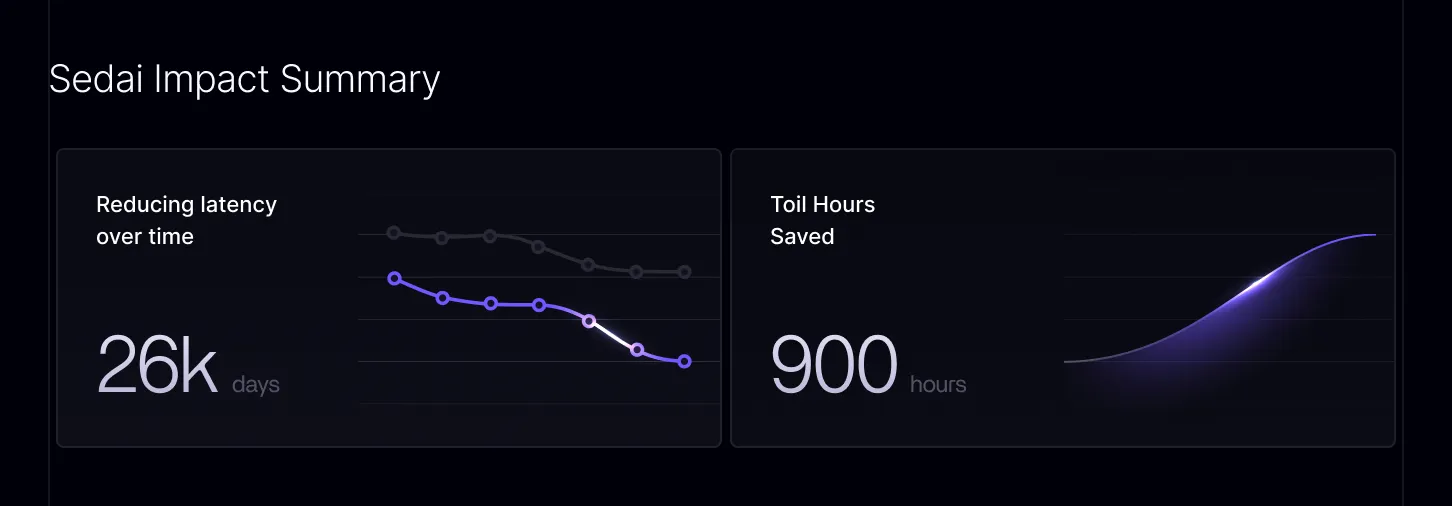
900+ hours of toil saved in 3 months
26k+ days of latency eliminated across all Lambda workloads
100% production compute runs on autopilot
$7K saved on a single Lambda function
Zero production incidents caused by Sedai
Building a Cutting-Edge Cloud at Startup Speed
Seven of the top ten U.S. auto lenders trust Informed’s AI platform to verify their loans. Its platform has processed over $350 billion in loan originations and counting. To meet Informed's complex infrastructure requirements, its engineering team runs everything on AWS Lambda functions.
For Rob Berger, Chief Architect, that last part was both a point of pride and a problem waiting to happen. Because Informed’s customers submit loan documents in bursts, Rob made a deliberate call early on to go serverless:
"Going serverless was pretty perfect, since we cycle between usage and no usage throughout a 24-hour period."
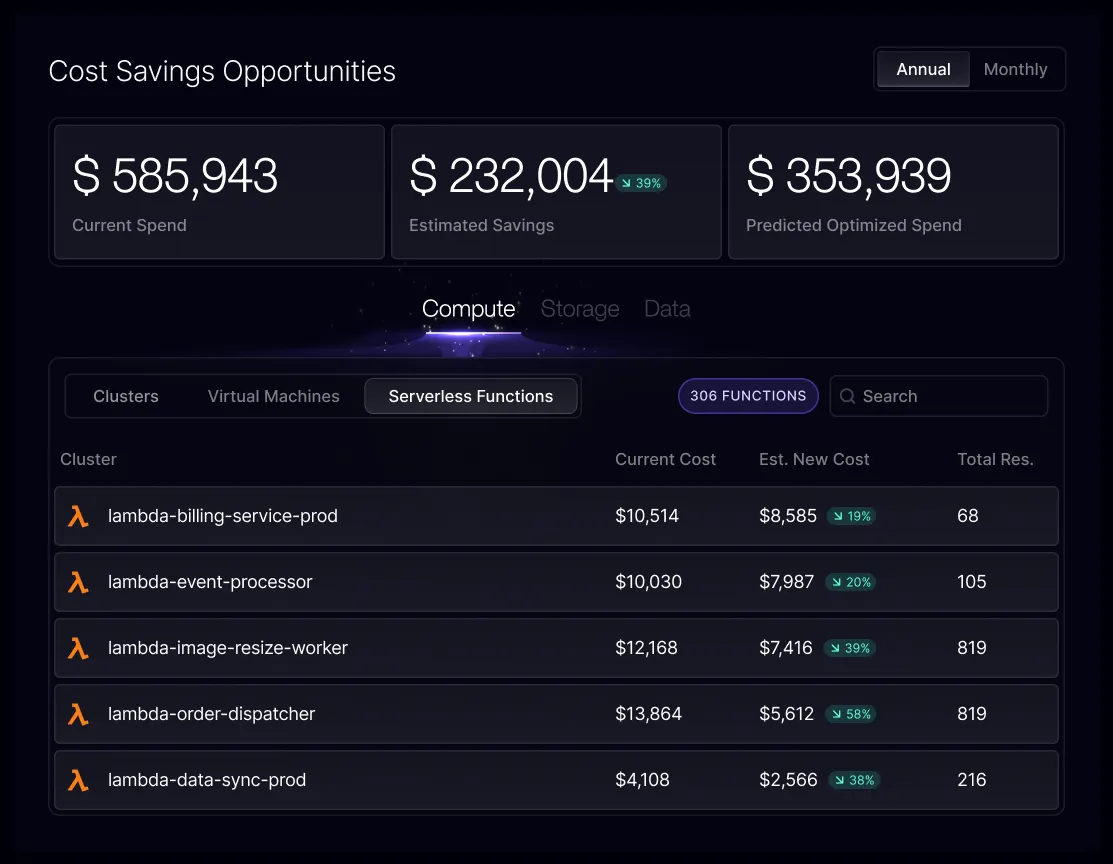
Rob rebuilt the company's infrastructure from the ground up on AWS. Each environment runs 306 Lambda functions, many dedicated to running ML inference models, and 37 Step Functions as orchestrators — all replicated across multiple environments.
For a lean engineering team, managing complex infrastructure at that scale is no small feat.
The Lambda Optimization Problem
Lambda optimization is one of those tasks that's easy to deprioritize, especially when you’re working at startup speeds. But when cost becomes impossible to ignore, teams like Rob’s find themselves spending an excessive amount of time on manual optimization.
"In the past, there were no tools to optimize Lambdas for cost & performance without a lot of manual work," Rob said.
The ongoing manual toil of checking configurations, monitoring costs, & tuning functions quickly consumed engineering capacity.
This problem was compounded by ML models running inside Lambdas and exploding their size. At the time, some functions were allocated as much as 10GB of memory — AWS Lambda's maximum limit.
While setting memory high guarantees functions won’t fail, it’s an expensive habit. The more Lambdas are provisioned, the costlier they become to run. But without a way to safely test and tune each function, Rob's team couldn't risk provisioning lower.
The Cost of Manual Optimization
Needing to drastically reduce costs, Rob planned to build an internal tool to handle optimization. But that would mean taking his engineers away from their day-to-day responsibilities just to build it, never mind spending time monitoring the tool continuously after it was implemented.
"We originally planned to write our own performance analysis and do traditional serverless optimization,” he said. “But that takes a lot of work, and you have to do it periodically. My team just didn’t have time for that.”
Building and maintaining that tool would have created a whole new source of toil for a team that was already stretched thin.
Then, right before the team was about to launch that internal tool, Rob came across Sedai.
"When I found Sedai, there was nothing else on the market that I could find that optimized Lambdas the way Sedai does."
The Autonomous Switch with Sedai
With Sedai’s integrated ML that optimizes Lambdas based on real-time behavior, Rob was able to skip the internal tool entirely, and get continuous optimization without any of the work.
However, finding Sedai was only the first step. Because Rob runs production infrastructure supporting hundreds of billions in loan originations, trusting an autonomous system to make changes in that environment wasn't something he took lightly.
“We were definitely hesitant with using Sedai at the beginning,” Rob said. “We were concerned that it would just start flipping things during production and cause production glitches.”
But Sedai's crawl-walk-run approach quickly dispelled these fears.
Before enabling any autonomous actions, Rob & his team began work in Sedai’s Datapilot mode. It provides full visibility into optimization opportunities & recommendations without executing any changes or risking production.
Rob’s engineers could see exactly what Sedai would do before it executed any optimizations.
“Having the ability to see how Sedai optimizes while giving me the control to execute gave me a lot of confidence to move forward with it at startup scale."
Trusting Sedai’s Impact in Production
With the confidence Sedai could accurately identify Lambda functions needing optimization, the team moved to Copilot mode, which reviews and approves changes before Sedai executes them.
Rob’s team watched the recommendations, verified the behavior, & then gradually expanded autonomy within their Lambdas.
"Sedai is completely transparent in what it optimizes. With that insight, we were able to confidently give it full autonomy. We just said, ‘Ok, let’s just turn it on.’"
Give Your Team Time Back
See how Sedai cut 900+ hours of engineering toil for yourself.
Today, 100% of Informed's production compute runs on autopilot, with zero production incidents caused by Sedai.
"We expected a full engineering effort to optimize Lambda functions. But Sedai just handles it for us, on autopilot."
The most remarkable part of Rob’s implementation of Sedai is how unremarkable it was.
"We pretty much got it set up and then ignored it," he said.
Impact that Goes Beyond Budget
By adopting Sedai, Informed has dramatically reduced their cloud costs. But beyond budget, Informed eliminated 900+ hours of engineering toil in three months and 26k+ days of accumulated latency — all without a single production incident.
For an AI startup processing loan documents for the biggest lenders in the country, that performance impact is significant. Faster Lambda execution means faster loan verification, faster fraud detection, & faster decisions for the banks that rely on Informed's platform.
Before Sedai, the team expected to spend engineering time building internal tooling, running test suites, & manually tuning functions on a recurring basis. Lambda optimization would have become a permanent drain on an engineering team that had no time for it.
"Sedai just takes off a whole area of worry,” said Rob. “Normally, we would probably always be looking at our AWS spend and where costs were spiking. We just don't have to do that anymore."
With Lambda optimization toil eliminated, Rob's engineers can focus on what they're actually there to do: building the product.
"My engineers want to learn and build new things, not worry about delivering new features or spending time on optimizations. Sedai handles that with autonomy, so my team can just build."
See how your team can stop toiling and start building. Book a demo.