What is Sedai and how does it help manage Kubernetes environments?
Sedai is an autonomous cloud management platform that delivers a control layer for Kubernetes, automating resource scaling, cost optimization, and anomaly remediation in real time. It analyzes live workload signals and adjusts cluster conditions dynamically, optimizing for cost, performance, and reliability without manual intervention. Learn more.
What are the key features of Sedai for Kubernetes optimization?
Sedai offers autonomous workload and node rightsizing, predictive autoscaling, cost-aware purchasing optimization, anomaly detection and remediation, comprehensive cost attribution, multi-cluster/multi-cloud coverage, release intelligence, and continuous workload behavior model updating. These features enable real-time, closed-loop optimization for Kubernetes environments.
How does Sedai use AI to optimize Kubernetes clusters?
Sedai uses machine learning to analyze workload behavior, traffic, and resource usage. It builds predictive models to proactively scale pods and clusters, rightsizes resources, and applies corrective actions for anomalies, ensuring optimal performance and cost efficiency without manual tuning.
What metrics demonstrate Sedai's impact on Kubernetes environments?
Sedai delivers 30%+ reduced cloud costs, 75% improved application performance, 70% fewer failed customer interactions, 6X greater engineering productivity, and manages over $3 billion in annual cloud spend for customers like Palo Alto Networks. See case study.
What types of Kubernetes environments does Sedai support?
Sedai supports Kubernetes clusters across on-premises, AWS EKS, Azure AKS, Google GKE, and hybrid setups, applying consistent optimization and automation across all environments.
How does Sedai's closed-loop optimization engine work?
Sedai's closed-loop optimization engine continuously reviews application behavior in production, responds to changes based on usage patterns, and autonomously adjusts resources and configurations to maintain optimal performance, cost, and reliability—eliminating the need for dashboards or manual tuning.
What is autonomous anomaly detection and remediation in Sedai?
Sedai autonomously identifies performance issues such as memory leaks, abnormal queue growth, or pod restarts, and applies corrective actions automatically to maintain service availability and minimize downtime.
How does Sedai attribute and track Kubernetes costs?
Sedai provides detailed cost attribution for Kubernetes workloads, tracking costs across pods, namespaces, GPUs, storage, and networking. This enables granular visibility into resource consumption and cost drivers beyond cluster-level totals.
What is release intelligence and smart SLO automation in Sedai?
Sedai reviews each release for latency, error rates, and cost impact, automatically tuning resources to meet Service Level Objectives (SLOs) and maintain error budgets, ensuring high-quality deployments and reliability.
How does Sedai continuously adapt to changing workloads?
Sedai constantly refreshes its understanding of workload patterns, updating optimization strategies as traffic, infrastructure, and clusters change, ensuring ongoing efficiency and performance alignment with real-time needs.
Use Cases & Benefits
Who should use Sedai for Kubernetes optimization?
Sedai is best for engineering teams running large-scale, business-critical Kubernetes environments who need to reduce cloud spend by 30–50%, improve performance, and eliminate operational toil without adding manual optimization workflows.
What business impact can Sedai deliver for Kubernetes users?
Sedai can reduce cloud costs by up to 50%, improve application performance by up to 75%, reduce failed customer interactions by up to 70%, and deliver up to 6X productivity gains by automating routine optimization tasks. See solution briefs.
How does Sedai help with cost optimization in Kubernetes?
Sedai continuously optimizes CPU, memory, and storage allocation to match current workloads, automatically rightsizing resources and recommending the optimal mix of on-demand, savings plans, and spot instances to prevent unnecessary spending and maintain cost-effective operations.
How does Sedai improve developer and operations team productivity?
Sedai automates routine Kubernetes tasks such as resource allocation, scaling decisions, and policy enforcement, freeing teams from repetitive work and allowing them to focus on higher-value engineering and innovation.
How does Sedai help maintain security and compliance in Kubernetes?
Sedai actively monitors configurations, detects risks, and automatically enforces security policies to maintain compliance, reducing security exposure and ensuring environments follow best practices. Sedai is SOC 2 certified. See security details.
What types of companies and industries use Sedai?
Sedai is used by organizations in cybersecurity (Palo Alto Networks), IT (HP), financial services (Experian, CapitalOne), security awareness (KnowBe4), travel (Expedia), healthcare (GSK), car rental (Avis), retail/e-commerce (Belcorp), SaaS (Freshworks), and digital commerce (Campspot). See case studies.
Can you share specific success stories of Sedai in Kubernetes optimization?
Yes. For example, Palo Alto Networks saved $3.5 million and reduced Kubernetes costs by 46% with Sedai. KnowBe4 achieved 50% cost savings, and Belcorp reduced AWS Lambda latency by 77%. Read the Palo Alto Networks case study.
How does Sedai help with unpredictable traffic and workload fluctuations?
Sedai continuously tracks workloads and responds to changes in real time, dynamically allocating resources as demand shifts. This ensures Kubernetes clusters remain efficient during sudden traffic spikes or drops, unlike static scaling rules.
Implementation & Technical Requirements
How long does it take to implement Sedai for Kubernetes?
Sedai's setup process is designed to be quick and efficient, taking just 5 minutes for general use cases and up to 15 minutes for specific scenarios like AWS Lambda. For complex environments, timelines may vary. Book a demo for details.
How easy is it to get started with Sedai?
Sedai offers plug-and-play implementation, connecting securely to cloud accounts using IAM without complex installations or agents. Customers benefit from personalized onboarding, detailed documentation, and a 30-day free trial. See documentation.
What integrations does Sedai support for Kubernetes environments?
Does Sedai provide technical documentation for Kubernetes users?
Yes, Sedai provides detailed technical documentation covering features, setup, and usage. Access it at docs.sedai.io/get-started and explore additional resources at sedai.io/resources.
What support options are available for Sedai customers?
Sedai offers personalized onboarding sessions, a dedicated Customer Success Manager for enterprise customers, detailed documentation, a community Slack channel, and email/phone support for ongoing assistance and troubleshooting.
Is there a free trial available for Sedai?
Yes, Sedai offers a 30-day free trial so you can experience the platform's value firsthand without financial commitment. Sign up here.
How does Sedai ensure safe and compliant automation in Kubernetes?
Sedai's safety-by-design approach ensures every optimization is constrained, validated, and reversible. It integrates with IaC, ITSM, and compliance workflows, and is SOC 2 certified for data protection and compliance.
Competition & Comparison
How does Sedai compare to other AI agent tools for Kubernetes?
Sedai stands out with 100% autonomous optimization, proactive issue resolution, application-aware intelligence, full-stack cloud coverage, release intelligence, and rapid plug-and-play implementation. Unlike competitors that rely on static rules or manual adjustments, Sedai operates autonomously and holistically, delivering measurable cost, performance, and productivity benefits. See solution briefs.
What makes Sedai different from traditional Kubernetes monitoring tools?
Traditional monitoring tools alert engineers after issues occur, requiring manual action. Sedai uses proactive, real-time data to automatically adjust resources, scale workloads, and resolve issues before performance is affected, reducing manual intervention and downtime.
How does Sedai's approach to optimization differ from competitors?
Sedai autonomously optimizes based on real application behavior, not just infrastructure metrics, and proactively resolves issues before they impact users. Many competitors operate reactively or require manual tuning, while Sedai ensures continuous, outcome-focused improvement.
What unique features does Sedai offer compared to other Kubernetes AI tools?
Sedai uniquely provides release intelligence, smart SLO automation, comprehensive cost attribution, and closed-loop optimization, along with rapid implementation and enterprise-grade governance. These features are not commonly found together in other solutions.
How does Sedai address the needs of different user segments?
Platform engineers benefit from reduced toil and IaC consistency; IT/cloud ops teams see lower ticket volumes and safer automation; technology leaders gain measurable ROI and reduced cloud spend; FinOps teams align engineering and cost goals; SREs experience fewer alerts and automated scaling. See solution briefs.
Pain Points & Problem Solving
What common pain points does Sedai solve for Kubernetes users?
Sedai addresses cost inefficiencies, operational toil, performance and latency issues, lack of proactive issue resolution, complexity in multi-cloud/hybrid environments, and misaligned priorities between engineering and FinOps teams. See solution briefs.
How does Sedai help with manual scaling and configuration challenges?
Sedai automates scaling, resource allocation, and configuration management, eliminating repetitive manual tasks and reducing the risk of misconfigurations or inefficient scaling in Kubernetes environments.
How does Sedai address the visibility-action gap in Kubernetes management?
Sedai bridges the gap between telemetry and action by autonomously implementing optimizations based on real-time data, ensuring that insights lead to measurable improvements without requiring manual intervention.
How does Sedai help with cost and performance trade-offs in Kubernetes?
Sedai's application-aware intelligence optimizes for both cost efficiency and performance, aligning engineering and financial priorities and making trade-offs transparent and actionable.
How does Sedai reduce failed customer interactions in Kubernetes environments?
Sedai proactively detects and remediates issues before they impact end users, reducing failed customer interactions by up to 70% and ensuring high availability and reliability.
6 Best AI Agent Tools to Use in Your Kubernetes Ecosystem
Benjamin Thomas
CTO
May 29, 2026
Featured
10 min read
Key takeaways
Use AI agents to automate Kubernetes optimization and reduce manual operational overhead.
Continuously optimize pod, node, and cluster resources based on real workload behavior.
Improve Kubernetes scaling decisions using AI-driven telemetry and performance analysis.
Reduce cloud waste by autonomously eliminating underutilized Kubernetes resources.
Managing Kubernetes clusters with AI-driven tools can drastically reduce manual oversight and optimize performance. From dynamic scaling and predictive autoscaling to continuous resource rightsizing, these tools automate resource allocation and improve cost-efficiency. By integrating real-time data analysis and proactive issue remediation, AI agents ensure high availability and minimal downtime. Tools like Sedai use machine learning to analyze workload behavior and adjust resources in real-time, providing smooth, continuous optimization for your Kubernetes environment.
As Kubernetes environments grow more complex, managing resources efficiently while maintaining performance becomes harder. Traditional scaling and monitoring often fall short, leading to underutilized resources or costly overprovisioning.
This challenge continues to grow as containerized workloads now account for55% of deployed applications, and Kubernetes adoption has surpassed70% among enterprises. It shows how mainstream cloud-native operations have become.
AI-driven tools now enable Kubernetes clusters to scale automatically, optimize resources, and resolve issues proactively with minimal manual effort. So, in this blog, you’ll explore the six best AI agent tools to integrate into your Kubernetes ecosystem.
Kubernetes management gets easier when optimization runs itself. Book a demo to see how Sedai reduces toil across your clusters without adding operational overhead.
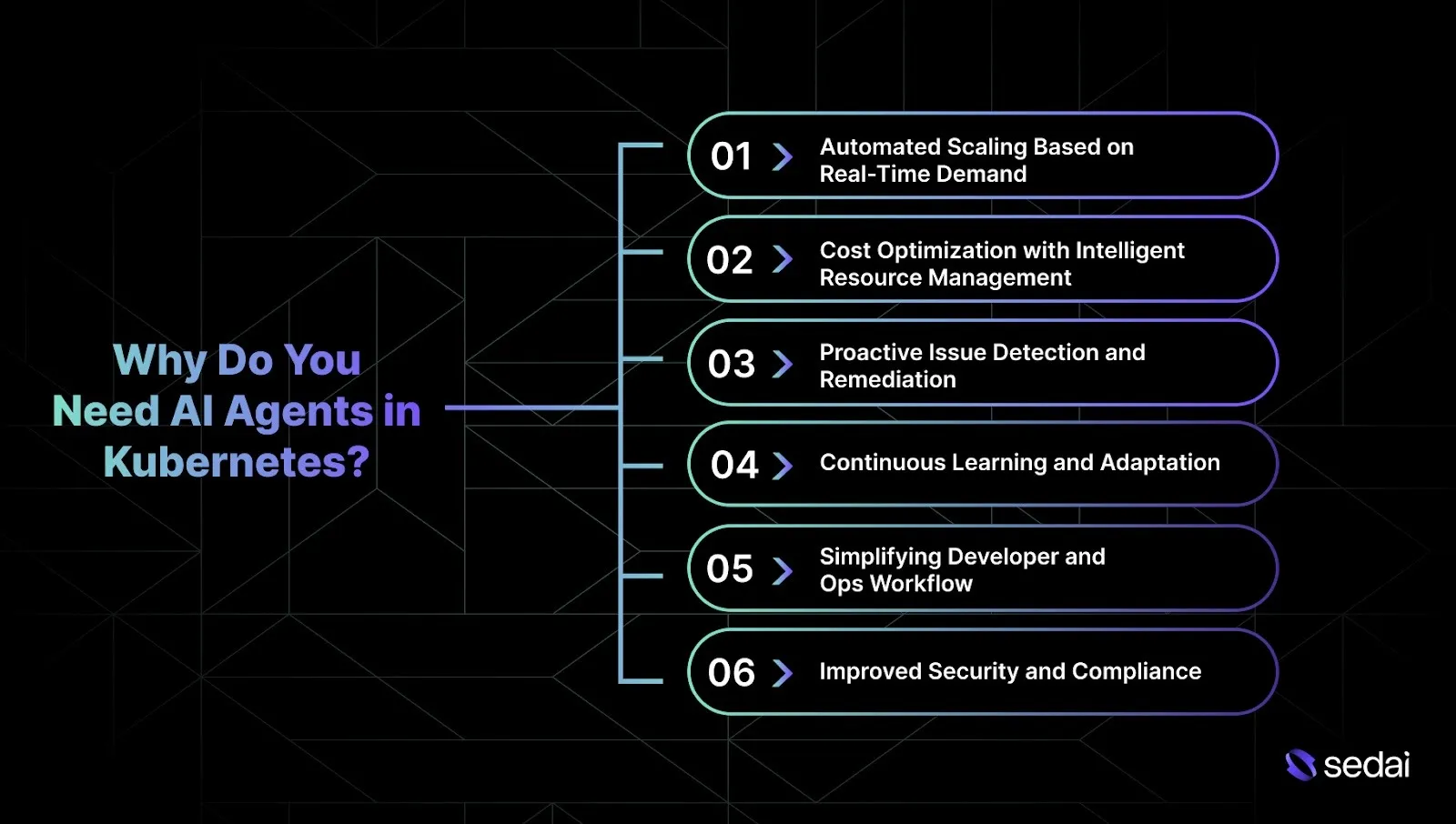
Why Do You Need AI Agents in Kubernetes?
As Kubernetes becomes more complex, managing clusters efficiently requires more than monitoring and manual intervention. Teams need solutions that automate resource management, proactively detect issues, and optimize performance without adding unnecessary overhead.
Here’s how AI agents bring intelligence into Kubernetes:
1. Automated Scaling Based on Real-Time Demand
Traditional autoscaling can miss real-time workload changes, leading to overprovisioning or underutilization. AI agents continuously monitor resource usage and dynamically adjust resources based on actual demand, maintaining efficient scaling without manual intervention. This ensures optimal performance while controlling costs.
2. Cost Optimization with Intelligent Resource Management
Kubernetes environments can waste resources due to misconfigurations or inefficient scaling, driving up costs. AI agents continuously optimize CPU, memory, and storage allocation to match current workloads. By automatically rightsizing resources, they prevent unnecessary spending and maintain cost-effective operations.
3. Proactive Issue Detection and Remediation
Manually spotting and resolving issues in Kubernetes clusters can be slow and error-prone, resulting in downtime or degraded performance. AI-powered agents analyze system behavior to predict potential failures and proactively address issues before they impact the system.
This includes automated actions such as pod restarts or resource reallocation, ensuring high availability and minimal downtime.
4. Continuous Learning and Adaptation
Static scaling policies often struggle to keep up with changing workloads, leading to suboptimal performance. AI agents continuously learn from cluster behavior, updating scaling and resource management strategies as workloads change. This keeps the system efficient even as application patterns shift over time.
5. Simplifying Developer and Ops Workflow
Repetitive Kubernetes tasks, such as scaling or configuration management, take time away from development. AI agents automate routine operations like resource allocation, scaling decisions, and policy enforcement, allowing your teams to focus on more complex work. This improves productivity and simplifies workflows.
6. Improved Security and Compliance
Maintaining security and compliance in Kubernetes can be complex, as misconfigurations can create vulnerabilities. AI agents actively monitor configurations, detect risks, and automatically enforce security policies to maintain compliance. This reduces security exposure and ensures environments follow best practices.
Seeing why AI agents matter in Kubernetes makes it easier to compare the best tools available for your ecosystem.
Book a Sedai demo to automate operations, improve efficiency, and reduce Kubernetes management overhead.
Top 6 AI Agent Tools to Use in Your Kubernetes Ecosystem
As Kubernetes environments become more complex, AI-driven tools are essential for proactively managing scaling, optimizing resource allocation, and autonomously resolving issues.
These top six AI agent tools deliver the automation and intelligence needed to simplify operations, reduce manual effort, and maintain high-performance cluster management.
1. Sedai
Sedai delivers an autonomous control layer for Kubernetes that cuts manual operations by analyzing live workload signals and adjusting cluster conditions in real time.
The platform continuously reviews application behavior in production and responds to changes based on usage patterns, optimizing Kubernetes clusters for cost, performance, and reliability.
By operating a closed-loop optimization engine, Sedai removes the need for dashboards, playbooks, or reactive tuning. It works autonomously, handling resource allocation and performance adjustments faster than human-led processes.
Key Features:
Autonomous Workload and Node Rightsizing: Sedai reviews container-level metrics and node utilization, dynamically tuning CPU and memory settings (including instance types) without your intervention.
Predictive Autoscaling and Behavior Learning: Sedai builds models of traffic, resource usage, and latency to proactively scale pods and clusters before demand spikes, ensuring optimal scaling before they occur.
Cost-Aware Purchasing Optimization: Evaluates workload patterns to recommend the optimal mix of on-demand, savings plans, and spot instances, driving cloud cost savings.
Autonomous Anomaly Detection and Remediation: Identifies performance issues such as memory leaks, abnormal queue growth, or pod restarts, and automatically applies corrective actions to maintain service availability.
Comprehensive Cost Attribution for Kubernetes Workloads: Provides detailed visibility into cloud costs, tracking costs across pods, namespaces, GPUs, storage, and networking. The platform offers deeper insights into resource consumption beyond cluster-level totals.
Multi-Cluster, Multi-Cloud Coverage: Supports Kubernetes clusters across on-premises, EKS, AKS, GKE, and hybrid setups, applying consistent optimization rules to all environments.
Release Intelligence and Smart SLO Automation: Each release is reviewed for latency, error rates, and cost impact. Sedai automatically tunes resources to meet Service Level Objectives (SLOs) and maintain error budgets.
Continuous Workload Behavior Model Updating: Sedai constantly refreshes its understanding of workload patterns, adapting optimization strategies as traffic, infrastructure, and clusters change.
Here’s what Sedai delivers:
Metrics
Key Details
30%+ Reduced Cloud Costs
Sedai uses ML models to find the ideal cloud configuration without compromising performance.
75% Improved App Performance
It optimizes CPU and memory needs, lowering latency and reducing error rates.
70% Fewer Failed Customer Interactions (FCIs)
Sedai proactively detects and remediates issues before impacting end users.
6X Greater Productivity
It automates optimizations, freeing engineers to focus on high-priority tasks.
$3B+ Cloud Spend Managed
Sedai manages over $3 billion in annual cloud spend for companies like Palo Alto Networks.
Best For: Engineering teams running large-scale, business-critical Kubernetes environments who need to reduce cloud spend by 30–50%, improve performance, and eliminate operational toil without adding manual optimization workflows.
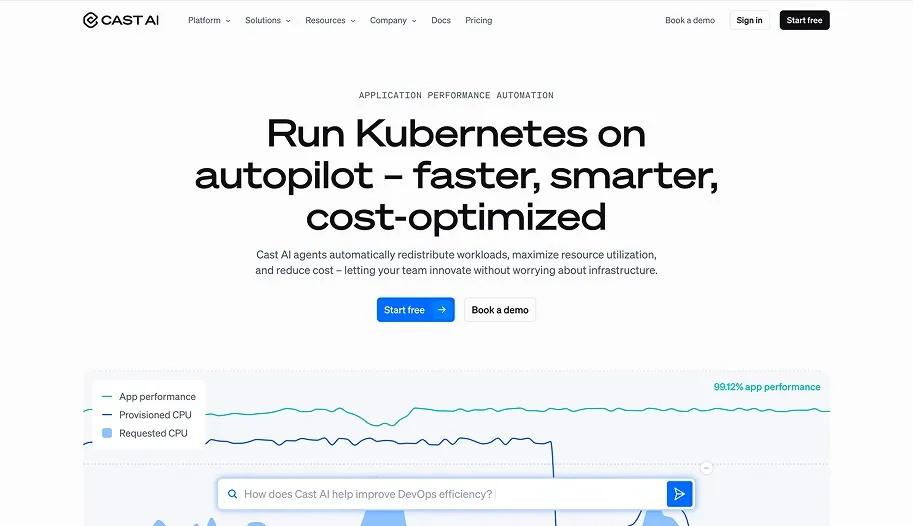
Cast AI is an AI-powered platform that optimizes Kubernetes workloads through automated resource management and cost optimization. It uses machine learning to dynamically scale Kubernetes clusters based on real-time demand, ensuring resources are allocated efficiently across cloud environments, including Azure and AWS.
Key Features:
AI-powered autoscaling: Dynamically adjusts compute resources in real time to match workload demands.
Multi-cloud support: Operates across cloud platforms such as AWS, Azure, and GCP for consistent optimization.
Workload efficiency: Continuously monitors workloads and fine-tunes resource allocation to reduce waste and improve performance.
Best For: Teams managing Kubernetes clusters across multi-cloud environments that need automated, dynamic scaling and cost optimization for Kubernetes workloads.
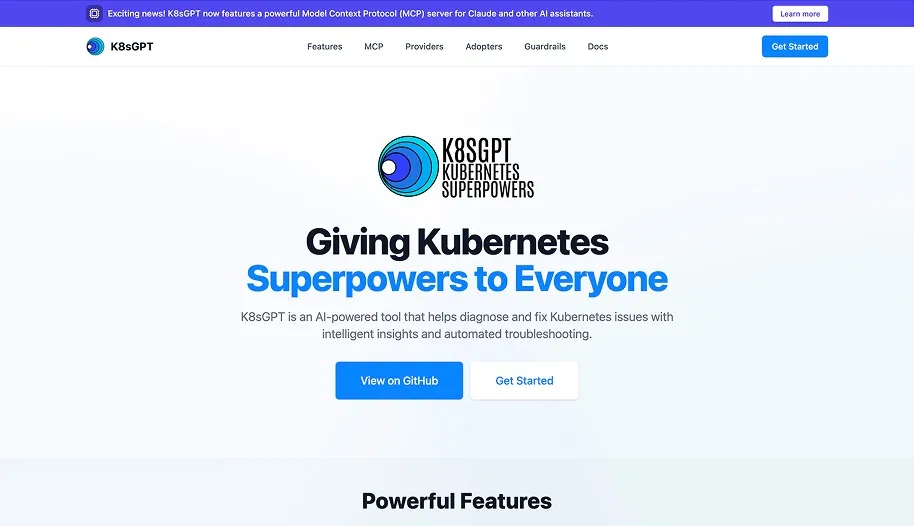
K8sGPT is an AI tool that delivers intelligent insights into Kubernetes cluster management through natural language processing (NLP). It helps engineers interpret complex cluster metrics and logs while providing proactive recommendations to improve performance and resolve issues.
Key Features:
NLP-powered insights: Converts Kubernetes logs and metrics into actionable recommendations using natural language.
Predictive analytics: Uses machine learning to identify potential performance issues and suggest proactive solutions.
Anomaly detection: Identifies inefficiencies or issues in real time and offers targeted remediation strategies.
Integration with existing Kubernetes tools: Improves existing monitoring platforms by adding AI-driven insights.
Best For: Engineering teams looking for an AI-powered diagnostics tool that delivers actionable recommendations and predictive visibility into Kubernetes cluster performance and optimization.
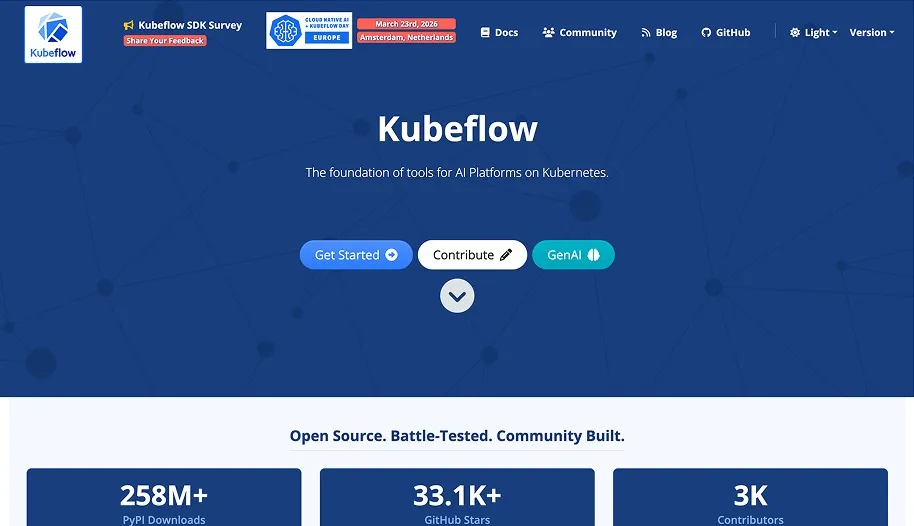
Kubeflow is an open-source platform for machine learning operations (MLOps) on Kubernetes. It enables the deployment, monitoring, and management of machine learning models in production, offering a comprehensive toolset to simplify ML workflows in Kubernetes environments.
Key Features:
End-to-end ML pipeline management: Supports the full lifecycle of machine learning models from training through deployment.
Integration with TensorFlow, PyTorch, and other ML frameworks: Enables easy deployment of models built with these frameworks.
Model monitoring and management: Provides tools to track model performance in production environments.
Scalable infrastructure: Seamlessly scales ML workloads across Kubernetes clusters.
Best For: Data scientists and DevOps teams that need a strong, end-to-end platform for managing machine learning workflows within Kubernetes environments.
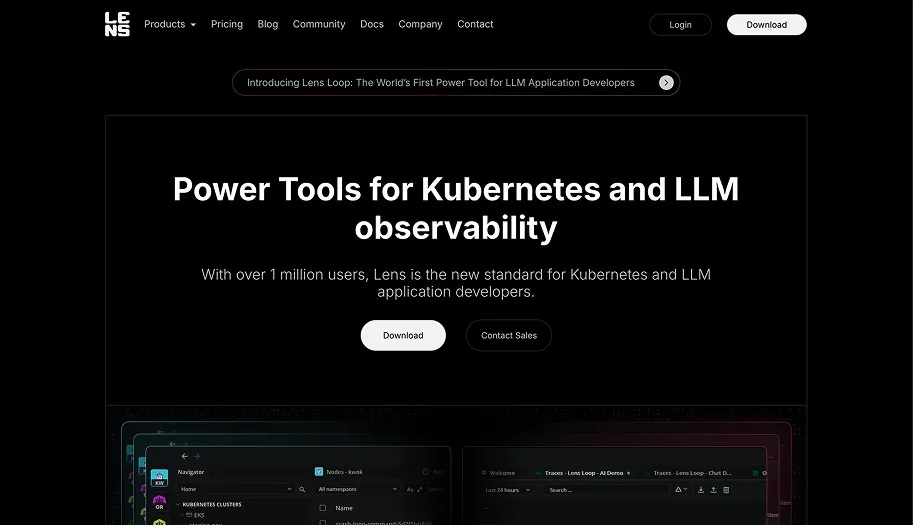
Lens Prism is an AI-powered tool integrated into Lens IDE that helps engineers manage Kubernetes clusters. It delivers real-time insights and recommendations through natural language processing, helping teams troubleshoot and optimize clusters without digging through complex logs or metrics.
Key Features:
AI-driven cluster insights: Delivers real-time, actionable insights and recommendations in natural language.
Integration with Lens IDE: Fully embedded within the Lens IDE, extending its Kubernetes management capabilities.
Workload efficiency: Helps engineers improve workload placement and resource utilization by suggesting optimizations based on cluster data.
Best For: Kubernetes operators and DevOps engineers seeking AI-driven insights and actionable recommendations to manage and optimize Kubernetes clusters.
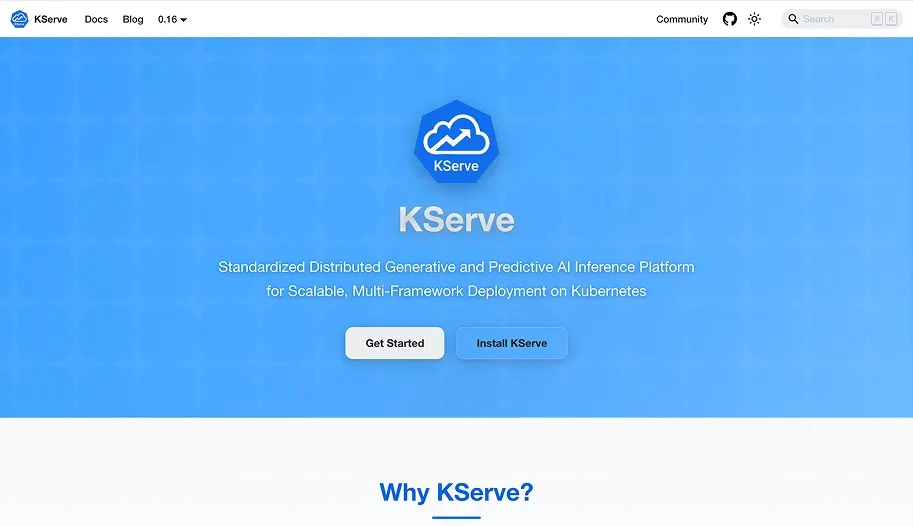
KServe is an open-source platform for deploying and serving machine learning models on Kubernetes. It integrates directly with Kubernetes environments, providing scalable, efficient, and serverless model serving capabilities that allow engineers to deploy models and handle inference requests at scale.
Key Features:
Serverless model serving: Automatically scales machine learning models based on demand to minimize resource waste.
Integration with Kubernetes and Kubeflow: Works alongside MLOps tools like Kubeflow for streamlined model deployment and management.
Multi-framework support: Supports models built with TensorFlow, PyTorch, and other widely used machine learning frameworks.
Auto-scaling: Dynamically adjusts compute resources based on inference traffic.
Best For: AI/ML engineers and data scientists who need to deploy and manage machine learning models in Kubernetes environments with serverless scaling.
Reviewing the top AI agent tools also helps clarify what to look for when choosing the right one for your Kubernetes ecosystem.
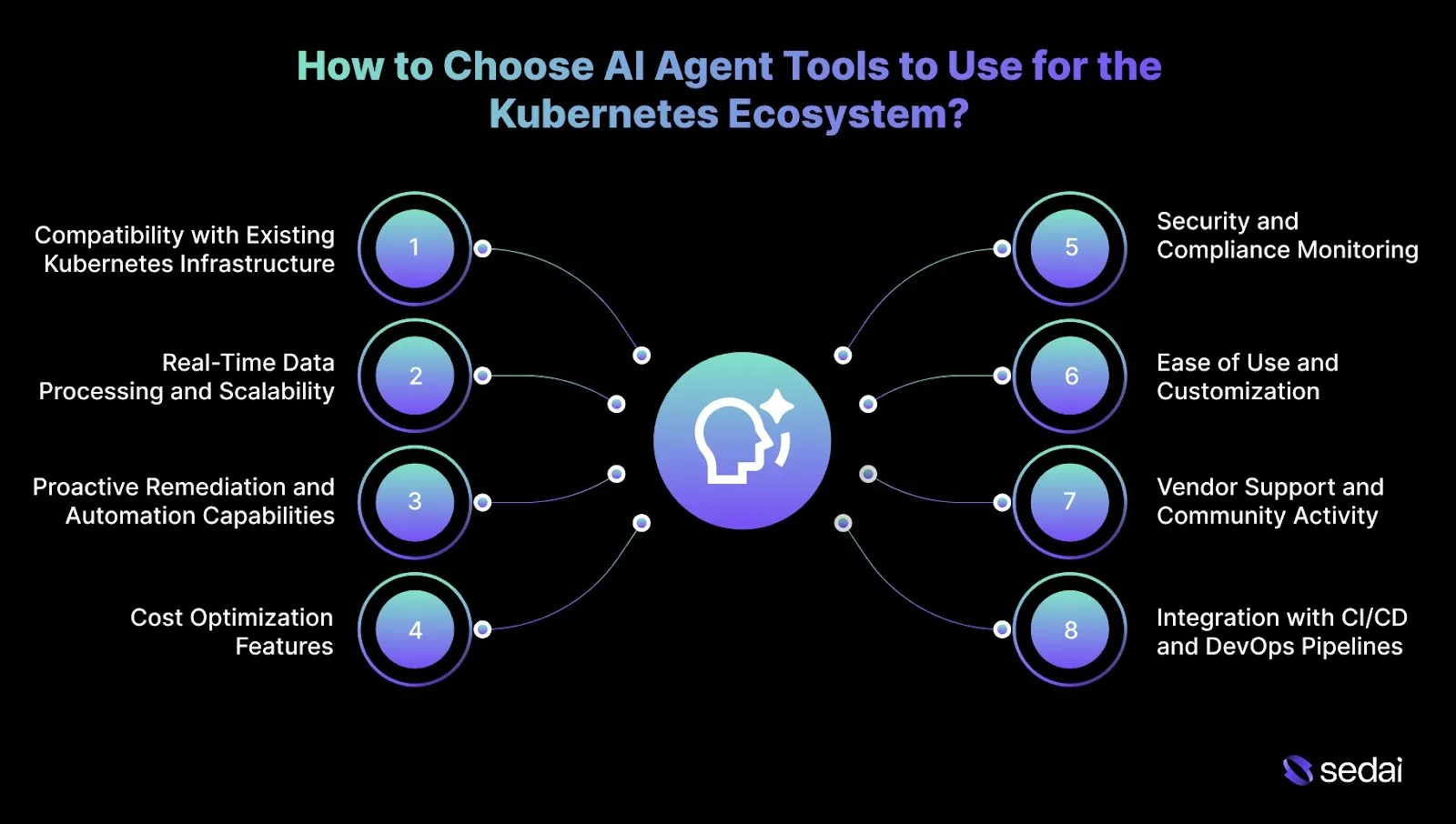
How to Choose AI Agent Tools to Use for the Kubernetes Ecosystem?
Choosing the right AI agent tools for your Kubernetes ecosystem is essential for optimizing performance, reducing operational overhead, and controlling costs. You need solutions that integrate smoothly with existing infrastructure and scale effectively with workloads. Here’s how to make an informed decision:
1. Compatibility with Existing Kubernetes Infrastructure
Ensure the AI agent tool works with your specific Kubernetes version and cloud provider (e.g., AWS, Google Cloud, Azure). It should integrate seamlessly with existing monitoring and resource management systems, without requiring major infrastructure changes.
2. Real-Time Data Processing and Scalability
Select AI agents that support real-time data analysis and can manage dynamic workloads efficiently. The tool should scale horizontally to match growing clusters and adapt to changing demands without impacting performance.
3. Proactive Remediation and Automation Capabilities
Choose AI agent tools that provide autonomous remediation, such as restarting failed pods, reallocating resources, or adjusting configurations based on predictive insights. These tools should follow well-defined action rules to ensure changes don’t disrupt your environment.
4. Cost Optimization Features
Ensure the AI tool can optimize resource allocation to prevent over-provisioning. Look for features like automatic rightsizing of containers and nodes, along with the ability to analyze historical resource usage to predict and avoid waste.
The AI should also offer cost-saving recommendations, such as switching to reserved instances when appropriate.
5. Security and Compliance Monitoring
The AI agent should incorporate security checks into its monitoring to maintain compliance with organizational and regulatory standards. Features like automated vulnerability detection, patching, and policy enforcement help ensure a secure and compliant Kubernetes cluster.
6. Ease of Use and Customization
Select AI agent tools with user-friendly interfaces and clear documentation for straightforward integration. The tool should also offer customization options to fine-tune resource allocation, scaling thresholds, and automated remediation actions according to your workload requirements.
7. Vendor Support and Community Activity
Prioritize AI agent tools backed by strong vendor support and an active open-source or community ecosystem. Resources such as forums, issue trackers, regular updates, and strong documentation help ensure ongoing optimization, bug fixes, and smooth implementation.
8. Integration with CI/CD and DevOps Pipelines
The AI tool should integrate seamlessly with your CI/CD pipelines and automatically adjust resources based on deployment patterns. This enables smooth application scaling and automated adjustments during continuous delivery cycles without manual intervention.
Final Thoughts
Optimizing your Kubernetes ecosystem goes beyond scaling clusters and allocating resources. High-performing teams treat Kubernetes optimization as a continuous process, adapting regularly to the changing needs of cloud-native applications.
The most effective organizations rely on automation and intelligence to strike the right balance between performance and cost. That’s where platforms likeSedai help.
By analyzing real-time workload behavior and automatically adjusting resources, Sedai enables your teams to sustain strong performance and cost efficiency without constant manual effort.
This results in a Kubernetes environment that continuously optimizes itself, with resource allocation always aligned with real-time needs, freeing you from repetitive tasks so you can focus on innovation.
SLO-aware cost decisions require continuous feedback between reliability signals and resource allocation. Book a demo to see how Sedai connects those two dimensions automatically across your Kubernetes environment.
FAQs
What’s the difference between AI agents and traditional monitoring tools for Kubernetes?
Traditional monitoring tools alert engineers only after an issue occurs, requiring manual action. AI agents, on the other hand, use proactive, real-time data to automatically adjust resources, scale workloads, and resolve issues before performance is affected.
How do AI agents improve Kubernetes cluster performance over time?
AI agents learn from workload behavior and fine-tune scaling, resource allocation, and configuration settings in real time. Over time, performance improves steadily as they identify traffic spikes, spot inefficiencies early, and ensure resources are aligned with actual workload needs.
How do AI agents predict failures before they occur in Kubernetes clusters?
AI agents rely on machine learning models that evaluate historical and real-time metrics such as CPU, memory usage, network traffic, and application logs. By identifying patterns and anomalies, they can forecast potential issues like pod crashes or resource contention and take proactive steps to prevent downtime or performance degradation.
Can I customize AI agent recommendations to match the unique requirements of my Kubernetes environment?
Yes, most AI agents provide customization options that let you adjust scaling thresholds, resource policies, and automated remediation actions. This flexibility helps align the AI agent with your specific Kubernetes setup and workload patterns, giving you more control over system behavior.
How do AI agents handle workload fluctuations in Kubernetes environments with unpredictable traffic?
AI agents continuously track workloads and respond to changes in real time. Unlike static scaling rules, dynamic scaling allocates resources as demand shifts, helping Kubernetes clusters remain efficient even during sudden traffic spikes or drops.


.webp%3Fv%3D2026-04-09T18%253A41%253A05.143Z&w=3840&q=75)