How do Sedai and Spectro Cloud work together to optimize Kubernetes environments?
Sedai and Spectro Cloud collaborate by addressing different layers of the Kubernetes stack. Spectro Cloud Palette governs and manages the infrastructure lifecycle, ensuring clusters are standardized, secure, and compliant. Sedai takes over at Day 2 and beyond, autonomously optimizing workload configurations in real time using patented machine learning models. This partnership enables enterprises to achieve both governance and continuous optimization, reducing cloud waste and improving efficiency. Source
What is the Sedai Smart Agent and how is it deployed with Spectro Cloud Palette?
The Sedai Smart Agent is available as a pack in the Palette Community Registry. Platform teams can add it to a Cluster Profile and deploy it, allowing Sedai to connect to the cluster through standard Kubernetes APIs. This integration requires no custom plumbing or separate installation, making it easy for Palette customers to enable workload-level optimization. Source
How long does Sedai take to learn workload patterns and start optimizing?
After installation, Sedai typically needs two to four weeks to learn workload patterns before optimizations reach full effectiveness. During this ramp-up period, customers can choose their preferred mode of operation: Datapilot (recommendations only), Copilot (review and approve each change), or Autopilot (full autonomy). Source
What modes of operation does Sedai offer for optimization?
Sedai offers three modes of operation: Datapilot (provides recommendations only), Copilot (allows users to review and approve each change), and Autopilot (enables fully autonomous optimization). Most customers start in Copilot mode to build trust and then transition to Autopilot for full autonomy. Source
How does Sedai ensure safe, autonomous optimizations in production?
Sedai is patented to make safe, autonomous optimizations in production. It performs gradual, incremental changes with continuous validation checks and automatic rollbacks if any optimization moves outside acceptable bounds. This safety-first approach ensures that Sedai never causes incidents or breaches SLOs, unlike risky optimizers that make all-at-once changes. Source
What are the benefits of running Sedai on well-governed clusters managed by Spectro Cloud?
Customers running Sedai on well-governed clusters see stronger optimization results and fewer edge cases compared to those with patchwork configurations. Palette's governance provides a stable, predictable foundation, enabling Sedai to learn faster and deliver impact more efficiently across diverse environments. Source
How does the Sedai and Spectro Cloud integration help FinOps teams overwhelmed by recommendations?
FinOps teams often face a backlog of recommendations from visibility tools like Kubecost or cloud cost explorers. The Sedai and Spectro Cloud integration enables Palette to govern the environment while Sedai autonomously eliminates waste, continuously optimizing resources. Customers typically see a 30–40% reduction in over-provisioned resources without manual intervention. Source
What happens if my Kubernetes transformation went well but efficiency has eroded over time?
After a successful Kubernetes migration, efficiency can erode as resource requests become stale and autoscalers are not revisited. Sedai continuously optimizes workloads post-migration, ensuring resource efficiency is maintained, while Palette keeps the infrastructure governed. This combination prevents rising cloud costs and operational inefficiencies. Source
How does Sedai help teams scale infrastructure without increasing SRE headcount?
As new clusters or cloud regions are added, the need for SREs to monitor and tune configurations grows. Palette extends the Golden Path to new environments, while Sedai manages resource efficiency at every node. Together, they enable organizations to scale infrastructure without proportional increases in ops team size. Source
Does Sedai overlap with Spectro Cloud in terms of functionality?
No, Sedai and Spectro Cloud solve different problems. Spectro Cloud governs and provisions infrastructure, while Sedai optimizes workload configurations after deployment. Their technologies are complementary and work better together, not as substitutes. Source
What is the main problem Sedai solves for enterprises using Kubernetes?
Sedai addresses the Day 2 optimization gap, where workloads and infrastructure need continuous, real-time tuning to prevent cloud waste. By autonomously right-sizing resources in production, Sedai eliminates manual backlog and reduces cloud costs, even in well-governed environments. Source
How does Sedai handle optimization for Helm-based add-on layers in Palette?
For Helm-based add-on layers in Palette, the integration works cleanly. Palette installs the Sedai Smart Agent pack, Sedai handles workload-level optimization, and both systems operate independently without interfering with each other. Source
What is the typical reduction in over-provisioned resources achieved by Sedai?
Customers using Sedai typically see a 30–40% reduction in over-provisioned resources, leading to significant cloud cost savings and improved operational efficiency. Source
How can I get started with Sedai and Spectro Cloud integration?
You can reach out to your Spectro Cloud or Sedai account team, or your preferred system integrator partner, to discuss integration and optimization strategies. The Sedai Smart Agent pack in Palette is the starting point for moving from well-governed infrastructure to self-optimizing infrastructure. Source
What is the difference between Day 0, Day 1, and Day 2 in Kubernetes management?
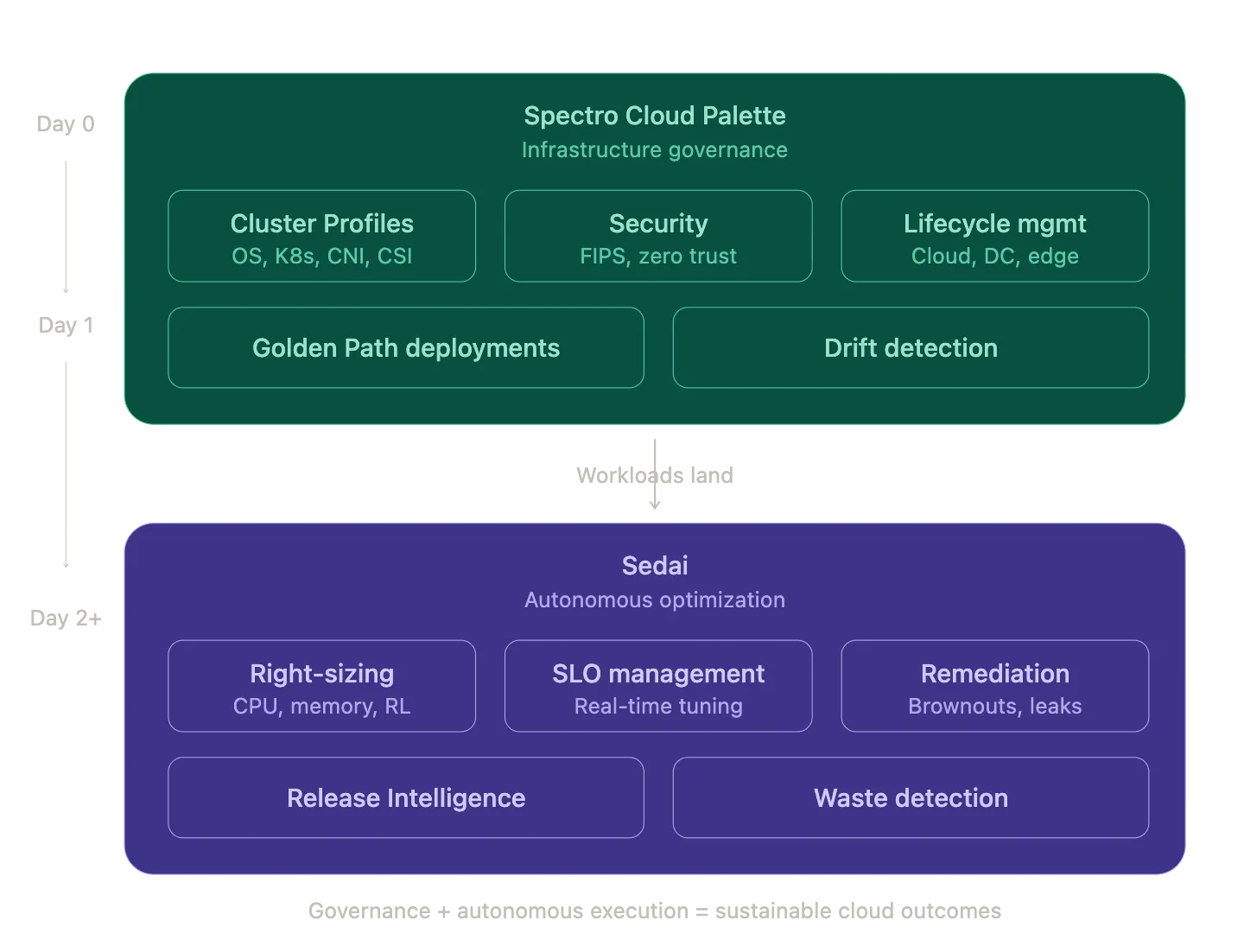
Day 0 and Day 1 refer to initial setup, provisioning, and governance of Kubernetes clusters, including standardization, security, and automation. Day 2 is ongoing operations, where workloads require continuous optimization to prevent cloud waste and maintain efficiency. Sedai focuses on Day 2, providing autonomous, real-time tuning of resources. Source
Why do cloud bills keep rising even with well-governed infrastructure?
Cloud bills rise because workloads and infrastructure need continuous, real-time tuning. Developers often pad resource requests, autoscalers are set to defaults, and manual optimization is time-consuming. Sedai addresses this by autonomously right-sizing resources, preventing waste and reducing costs. Source
How does Sedai handle automatic rollback during optimization?
Sedai performs automatic rollback if any optimization moves outside acceptable bounds, ensuring that changes are safe and do not cause incidents or breach SLOs. This safety-first approach is patented and unique to Sedai. Source
What technical documentation is available for Sedai and Spectro Cloud integration?
Technical documentation for the Sedai Smart Agent integration with Spectro Cloud Palette is available at Spectro Cloud Docs and Sedai's documentation at Sedai Docs.
Features & Capabilities
What features does Sedai offer for autonomous cloud optimization?
Sedai offers autonomous optimization using machine learning, proactive issue resolution, full-stack cloud coverage (AWS, Azure, GCP, Kubernetes), release intelligence, plug-and-play implementation, and enterprise-grade governance. It delivers up to 50% cost savings, 75% latency reduction, and 6X productivity gains. Source
Does Sedai support integration with monitoring and APM tools?
Yes, Sedai integrates with Cloudwatch, Prometheus, Datadog, Azure Monitor, and other monitoring/APM tools, ensuring seamless fit into existing workflows. Source
What are Sedai's modes of operation?
Sedai offers Datapilot (observability), Copilot (one-click optimizations), and Autopilot (fully autonomous execution), providing flexibility for different operational needs. Source
How does Sedai optimize Amazon S3 costs?
Sedai for S3 manages Intelligent-Tiering and Archive Access Tier selection, achieving up to 30% cost efficiency gain and 3X productivity gain by reducing manual effort in S3 management. Source
What is Sedai's release intelligence feature?
Sedai's release intelligence tracks changes in cost, latency, and errors for each deployment, improving release quality and minimizing risks during deployments. Source
How does Sedai proactively resolve issues before they impact users?
Sedai detects and resolves performance and availability issues before they impact users, reducing failed customer interactions by up to 50% and ensuring seamless operations. Source
What security and compliance certifications does Sedai have?
Sedai is SOC 2 certified, demonstrating adherence to stringent security requirements and industry standards for data protection and compliance. Source
Use Cases & Benefits
Who can benefit from Sedai's autonomous cloud optimization platform?
Sedai is designed for platform engineers, IT/cloud ops, technology leaders, SREs, and FinOps professionals in organizations with significant cloud operations across industries such as cybersecurity, IT, financial services, healthcare, travel, and e-commerce. Source
What business impact can customers expect from using Sedai?
Customers can expect up to 50% reduction in cloud costs, 75% latency reduction, 6X productivity gains, improved release quality, and reduced failed customer interactions by up to 50%. Case studies include Palo Alto Networks saving $3.5 million and KnowBe4 achieving 50% cost savings. Source
What are some of the pain points Sedai addresses for cloud teams?
Sedai addresses pain points such as fragmentation, operational toil, risk vs. speed, autoscaler limits, visibility-action gap, ticket volume, change risk, config drift, hybrid complexity, capacity/cost surprises, outcome gap, cloud spend pressure, tool sprawl, talent bandwidth, release risk, pager fatigue, brittle automation, and misaligned priorities between teams. Source
What industries are represented in Sedai's case studies?
Sedai's case studies cover cybersecurity, IT, financial services, security awareness training, travel and hospitality, healthcare, car rental services, retail and e-commerce, SaaS, and digital commerce. Source
Can you share specific customer success stories using Sedai?
KnowBe4 achieved 50% cost savings and saved $1.2 million on AWS. Palo Alto Networks saved $3.5 million, reduced Kubernetes costs by 46%, and saved 7,500 engineering hours. Belcorp reduced AWS Lambda latency by 77%. KnowBe4 Case Study, Palo Alto Networks Case Study
Competition & Comparison
How does Sedai differ from other cloud optimization platforms?
Sedai is the only patented platform for safe, autonomous optimization in production. It makes gradual, validated changes with automatic rollback, never causing incidents or SLO breaches. Unlike competitors that rely on static rules or manual adjustments, Sedai operates autonomously and proactively resolves issues before they impact users. Source
What advantages does Sedai provide for different user segments?
Platform engineers benefit from reduced toil and IaC consistency. IT/cloud ops teams see lower ticket volumes and safe automation. Technology leaders achieve measurable ROI and reduced cloud spend. FinOps teams gain actionable savings and simplified multi-cloud complexity. SREs experience fewer SLO breaches and reduced manual toil. Source
How does Sedai compare to visibility tools and recommendation engines?
Visibility tools and recommendation engines create backlogs that require manual action. Sedai autonomously executes optimizations, eliminating manual backlog and continuously improving efficiency without human intervention. Source
Technical Requirements & Support
How easy is it to implement Sedai?
Sedai offers plug-and-play implementation, connecting securely to cloud accounts via IAM. Setup takes 5 minutes for general use cases and up to 15 minutes for AWS Lambda. Personalized onboarding and extensive documentation are available. Source
What onboarding support does Sedai provide?
Sedai provides personalized onboarding sessions, a dedicated Customer Success Manager for enterprise customers, detailed documentation, community Slack channel, and email/phone support. Source
Is there a free trial available for Sedai?
Yes, Sedai offers a 30-day free trial, allowing customers to experience the platform's value firsthand without financial commitment. Source
Where can I find Sedai's technical documentation?
Sedai's technical documentation is available at docs.sedai.io/get-started. Additional resources, including case studies and datasheets, are available at sedai.io/resources.
Why Your Well-Governed Infrastructure is Still Wasting 30% of Your Cloud Budget (And How We’re Working with Spectro Cloud to Fix It)
DR
Darin Ritz
Head of Worldwide Partners and Alliances
April 21, 2026
Featured
At our KubeCon Europe after-party in Amsterdam this past March, someone walked up to the Sedai and Spectro Cloud crew — talking side by side — and asked the question we've been hearing for months: "Wait, don't you two kind of do the same thing?"
(Yes, it was hard to hear the question over the music)
We looked at each other and laughed. If you squint at a product page, sure, you could talk yourself into seeing overlap. Both companies work with Kubernetes. Both care about cost efficiency. Both say "optimization" a lot.
The truth is we solve different problems, at different layers of the stack. And the disconnect between those layers is where many enterprises (possibly yours too) are hemorrhaging money.
Spectro and Sedai have been collaborating for several months now — on projects with joint customers, on our technical integration… and yes, on the occasional bar tab in Amsterdam. The more we work together, the more obvious it becomes that these two products belong side by side.
Kubernetes management gets easier when optimization runs itself. Book a demo to see how Sedai reduces toil across your clusters without adding operational overhead.
So, we figured it’s time to write it down.
The Day 2 problem that dashboards don’t solve
A common scenario: your platform team spends months getting their Kubernetes house in order. They standardize clusters, lock down security policies, automate provisioning, build a golden path for developers. Day 0 and Day 1 are taken care of, and the infrastructure is consistent, compliant, repeatable. Phew.
But within a few months of workloads running, your cloud bills are climbing. Why?
In a tale as old as time, developers have padded their resource requests with generous safety margins (“just give me 4Gi of memory, I don't want to get paged at 2am”). Autoscalers don’t help: they were tuned to defaults that made sense during initial deployment but haven't been revisited since. Same for memory limits, set based on load testing that doesn't reflect actual production traffic.
Nobody's doing anything wrong in this story, exactly (we love a blameless retro, right?). It’s just that workloads and their underlying infrastructure need continuous, real-time tuning, and no human team can keep up with that across hundreds of services and dozens of clusters. The governance is solid. What's missing is the optimization.
Most enterprises try to close this gap with visibility tools: o11y dashboards, recommendation engines, FinOps reports. These are useful, sure! But they create a backlog, not a solution. Someone still has to read the recommendation, validate it, write the PR, get it reviewed, and apply it. Multiply that by every service in every cluster, and you've described a full-time job nobody was hired to do… not SREs, not DevOps, and certainly not the app developer who owns the workload.
The result is that cloud costs keep rising, putting platform teams in reactive mode. All that governance work from Day 0 and Day 1 is eroded — because nothing is actively protecting it on Day 2.
Two layers, one stack
The more we've worked together, the clearer this painful picture has become. And the solution is just as clear.
Spectro Cloud and Sedai sit at two distinct layers of the Kubernetes stack, and both layers need to work well for enterprises to get the outcomes they're paying for.
Spectro Cloud Palette owns the infrastructure lifecycle. Our Cluster Profiles give platform teams a declarative blueprint for everything from the OS and Kubernetes distribution to the CNI, CSI, and add-on layers. Palette deploys and manages that full stack across cloud, data center, and edge, with powerful drift remediation, built-in security and FIPS compliance if you need it. You can think of it as the governance foundation.
Sedai owns configuration optimization after the workloads get deployed, at Day 2 and beyond. Using patented ML models, Sedai continuously analyzes how each service actually behaves in production (CPU usage patterns, memory consumption, response latency, traffic patterns and dependencies). The platform then autonomously right-sizes resources, in real time. Not recommendations you'll maybe get around to next sprint — actual changes, executed safely, with automatic rollback if something moves outside acceptable bounds.
One builds and maintains the road. The other keeps every vehicle on it running at peak efficiency. You need both, and critically, each one makes the other better.
Why governance enables autonomy (not the other way around)
Autonomous optimization sounds great in a pitch deck, but it makes platform teams nervous for good reason. If your clusters aren't consistently configured, automated changes can have unpredictable side effects. Mixed Kubernetes distributions, different OS versions, inconsistent security policies: all of that creates a moving target for any optimization engine trying to learn your workload patterns.
That's where Palette's governance becomes Sedai's secret weapon. When every cluster is deployed from the same standardized Cluster Profile, Sedai operates on a stable, predictable surface. It's able to learn faster from this solid foundation, which ultimately means it can deliver impact faster, across a wide range of environments. Guardrails don't constrain autonomy; they make it safe.
From the Sedai side, this is a meaningful difference. Customers running Sedai on well-governed clusters see stronger optimization results and fewer edge cases than those running across a patchwork of hand-rolled configurations. The more uniform the canvas, the more precisely Sedai can tune what's running on it.
From the Spectro Cloud side, Sedai solves the question Palette customers inevitably ask three to six months after go-live: "Our infrastructure is standardized and secure, but our cloud bill is still climbing. Now what?" That "now what" is exactly where Sedai picks up.
How the integration works today
The Sedai Smart Agent is available as a pack in the Palette Community Registry. Add it to a Cluster Profile, deploy, and Sedai connects to your cluster through standard Kubernetes APIs. No custom plumbing, no separate installation: the same pack-based model Palette customers already use for everything else in their stack.
Once installed, Sedai typically needs two to four weeks to learn your workload patterns before optimizations reach full effectiveness. During that ramp-up, you choose your comfort level across three modes: Datapilot (recommendations only), Copilot (review and approve each change), and Autopilot (full autonomy). Most customers start in Copilot, build trust watching Sedai make the right calls, then graduate to Autopilot. Trust is earned, not assumed.
For Helm-based add-on layers in Palette, the integration works cleanly today. Palette installs the pack, Sedai handles workload-level optimization, and the two systems stay out of each other's way. We're also working on deeper integration patterns for tighter coordination between Palette's desired-state model and Sedai's runtime optimizations. More on that soon.
What this looks like for real teams
A few scenarios where the combination clicks.
The FinOps team drowning in recommendations. You've got Kubecost or your cloud provider's cost explorer showing waste everywhere, but nobody has bandwidth to action the findings. Palette governs the environment; Sedai eliminates the waste autonomously, continuously. Customers typically see a 30–40% reduction in over-provisioned resources, without anyone needing to touch a YAML file.
The enterprise that nailed the migration but lost the plot on Day 2. The Kubernetes transformation went well six months ago. But efficiency has eroded since. Resource requests are stale, HPAs haven't been revisited, and nobody's actively optimizing because everyone moved on to the next project. Palette keeps the infrastructure governed; Sedai keeps it efficient — continuously, not just at migration time.
The team that can't hire fast enough. Every new cluster or cloud region creates a linear need for more SREs to watch dashboards and tune configurations. Palette extends the Golden Path to new environments without proportional headcount growth. Sedai manages resource efficiency at every node. Together, they let you scale infrastructure without scaling your ops team at the same rate.
Optimize K8s with Sedai
Ready to start saving on your Kubernetes costs? Our team of K8s experts can help.
Answering the overlap question, for good
We get why people ask. The cloud native ecosystem is crowded, product positioning blurs together, and when two companies are standing next to each other at a party, it's natural to wonder.
The short answer: Spectro Cloud doesn't optimize your workloads, and Sedai doesn't provision or govern your infrastructure. Different problems, different technology, better together.
Combining cluster management with autonomous optimization ensures cost efficiency is built into the cluster lifecycle from provisioning through ongoing operation. Book a demo to see how the Sedai and Spectro Cloud partnership delivers that for your Kubernetes environment.
What's next?
We're deepening our mutual technical integration, and building out the playbook for customers who want to move from well-governed infrastructure to self-optimizing infrastructure. The Sedai Smart Agent pack in Palette is just the starting point.
If you're running Palette today and wondering what happens after Day 1, we should talk. If you're using Sedai and want a more consistent foundation to optimize against, same. And if you're stuck in the cycle of over-provisioning, manual tuning, and cloud bills that never seem to go down... that's exactly the problem we built this partnership to solve.
Reach out to your Spectro Cloud or Sedai account team, or get in touch with either of us directly, or your preferred system integrator partner. We're always up for a conversation about what the full cloud lifecycle looks like when governance and optimization work as one.