


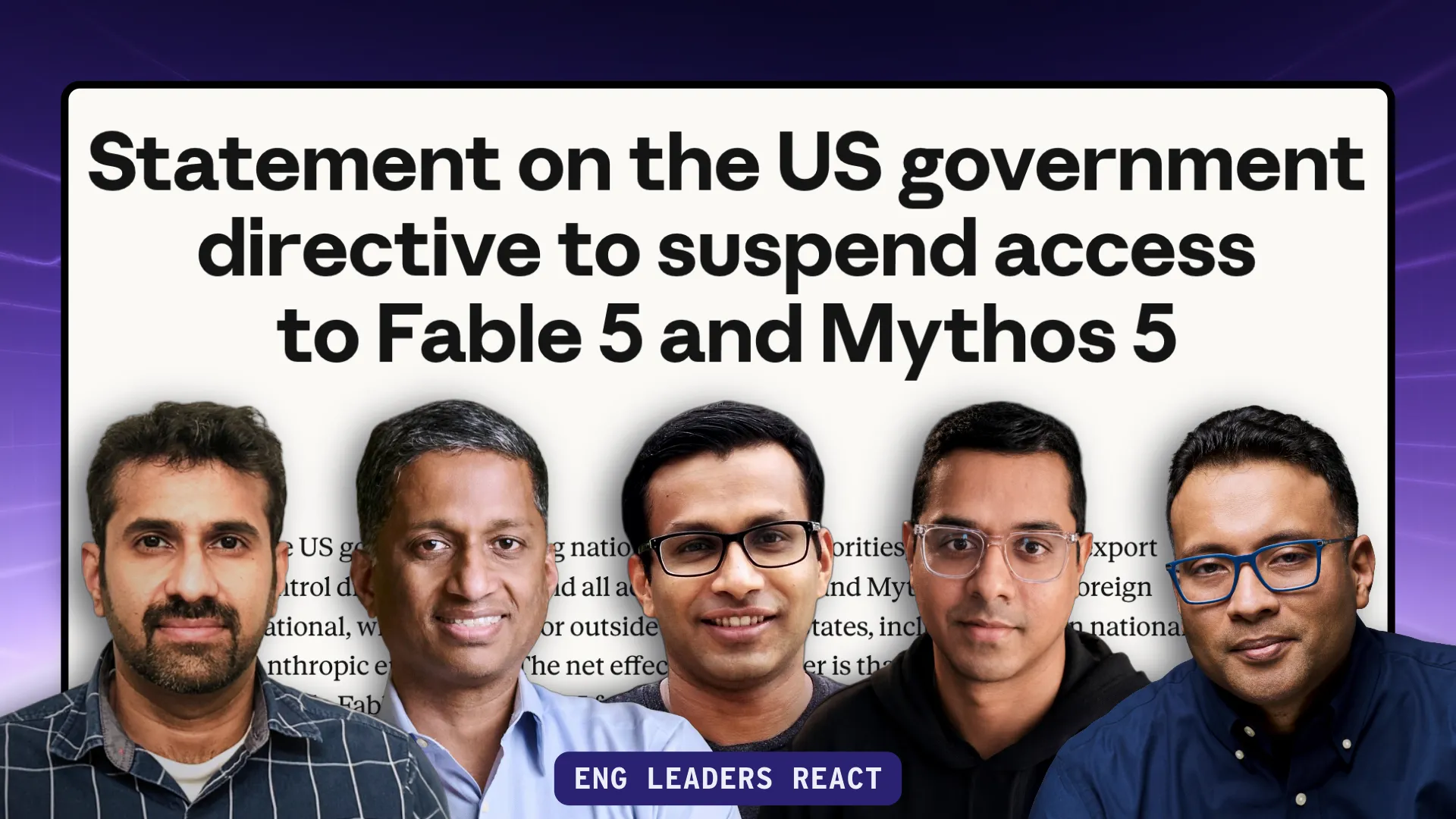
On Friday at 5:21pm, three days after Anthropic released its anticipated Fable 5, the U.S. government directed Anthropic to suspend all use of the model, citing national security concerns.
This is an earth-shaking moment for tech, and as we grapple with what this means for the evolution of AI, I asked my leadership team what they thought. This is what they said.
Controlled Release Is the New Reality for Frontier AI
Hari Chandrasekhar (SVP of Engineering, Core)
This Fable and Mythos situation is wild because what used to feel like a sci-fi movie plot is literally playing out in the real world.
The fact that the administration used an emergency export control directive to enforce a shutdown shows that our current global structures are scrambling to handle these frontier models. It's hard to judge how much of this specific pullback was politically or commercially motivated, but it proves one thing: the era of unregulated frontier AI model releases is likely over.
While putting immediate checks and balances in place makes sense while the world adjusts, a blunt rollback is rarely a viable long term strategy. Trying to restrict a capability like vulnerability scanning can only ever be a temporary pause. Eventually, cybersecurity infrastructure has to adapt to the new reality rather than relying on a ban.
"The era of unregulated frontier AI model releases is likely over. A blunt rollback is rarely a viable long-term strategy, but proves the world is scrambling to keep up."

Hari Chandrasekhar
SVP of Engineering, Core
This directly mirrors the transition we are seeing with quantum computing. As Google's CEO has noted about quantum capabilities inevitably reaching the point where they can break standard RSA encryption, we can’t just ban quantum research. Instead, the global security landscape has to actively adapt and update its systems to post quantum cryptography.
The same logic applies here too. These models can find software flaws, but defenders need that exact same automated capability to patch code at scale before those vulnerabilities can be exploited. Rather than permanently locking down the technology, the goal should be utilizing the staging period to harden our defensive systems so they are resilient enough to handle these advances.
From now on, expect frontier model releases to look entirely different. Major releases at the Mythos level or above are going to face state level gatekeepers, rigorous government staging environments, and heavily restricted deployments.
The technology will keep moving, but the regulatory guardrails are hardening right alongside it.
Have AI Coding Agents Hit a Public Access Ceiling?
Nikhil Gopinath Kurup (SVP of Engineering, ML)
This event is the perfect union of the zeitgeist of our time: geopolitics, AI, and cybersecurity, all colliding in one story.
A few observations from me.
On the capability itself: For the few days it was available, Fable 5 was clearly a big leap forward for AI coding agents and tools. It moved the needle by a meaningful degree. For a while I'd considered Opus 4.6 the pinnacle of AI-assisted coding and a solid baseline to measure future updates against.
But Fable 5 overtook it by a good margin. So I was genuinely excited about the chance to put it to work and get more out of AI coding tools.
But the bigger revelation: We've now established a baseline for LLM capability beyond which regulators and governments will step in. Future models from Anthropic, and soon enough from the other foundation model providers, will go through severe vetting and gatekeeping. And as outsiders we may never see the full extent of what they can actually do.
"We've now established a baseline for LLM capability beyond which regulators and governments will step in. As outsiders, we may never see the full extent of what these models can actually do."
.webp%3Fv%3D2026-04-27T14%253A05%253A45.876Z&w=3840&q=75)
Nikhil Gopinath Kurup
SVP of Engineering, ML
In that sense, it's fair to say we've effectively plateaued in the short term on what AI coding agents can offer regular programmers and consumers. How these models get made available to specific organizations or approved groups versus the general public is something we'll have to watch play out.
On the geopolitical knock-on: With the U.S. imposing export controls, every other country now has an incentive to fend for itself and pursue its own options. I'd expect this to accelerate fragmentation along national lines.
"Sovereign cloud" and "sovereign models" are going to become far more common in what we hear and build toward, as organizations and nations decide they can't depend on capabilities that another government can switch off in 90 minutes.
Model Access Is Now an Architecture Problem
Shankar Jothi (VP of Engineering, ML)
One thing that stands out in the Anthropic Fable 5 situation is how quickly AI deployment is becoming as much a governance and operational challenge as a technical one. Whatever side of the debate you land on (the government's national-security concerns, Amazon's decision to escalate, or Anthropic's argument that the capability already exists in other models) the bigger signal is that frontier model releases are no longer just product launches.
They now sit under scrutiny from regulators, partners, cloud providers, and national-security stakeholders. For engineering leaders, that means no longer designing for performance but for uncertainty.
The detail that caught my eye as an engineer is in the architecture, not the headline: Anthropic shipped Fable 5 with a runtime safety layer that intercepted sensitive queries and handled them differently at the model level. That's the same primitive a lot of us are now leaning on for an entirely different reason: controlling cost, availability, and risk.
"Frontier model releases are no longer just product launches. For engineering leaders, that means designing not just for performance, but for uncertainty."

Shankar Jothi
VP of Engineering, ML
"Which model" is quietly becoming an orchestration decision rather than a config setting. If access to a specific frontier model can change overnight due to policy, compliance, or a provider's call, teams must build architecture that can dynamically route workloads across models instead of depending on a single endpoint.
We're already seeing this play out. Products like Sedai's Smart Router send simpler tasks to cheaper models and harder ones to more capable ones automatically; you can stop paying frontier prices for work a lighter model handles fine.
On the other end, approaches like OpenRouter's Fusion fan a prompt out to a panel of models and let a judge synthesize the result; it costs more per call but earns its keep when being wrong is expensive.
Routing for safety, cost, quality — it's all the same control plane. And in the next phase of adoption, flexibility and resilience may end up mattering as much as benchmark leadership.
Curious how others are architecting this.