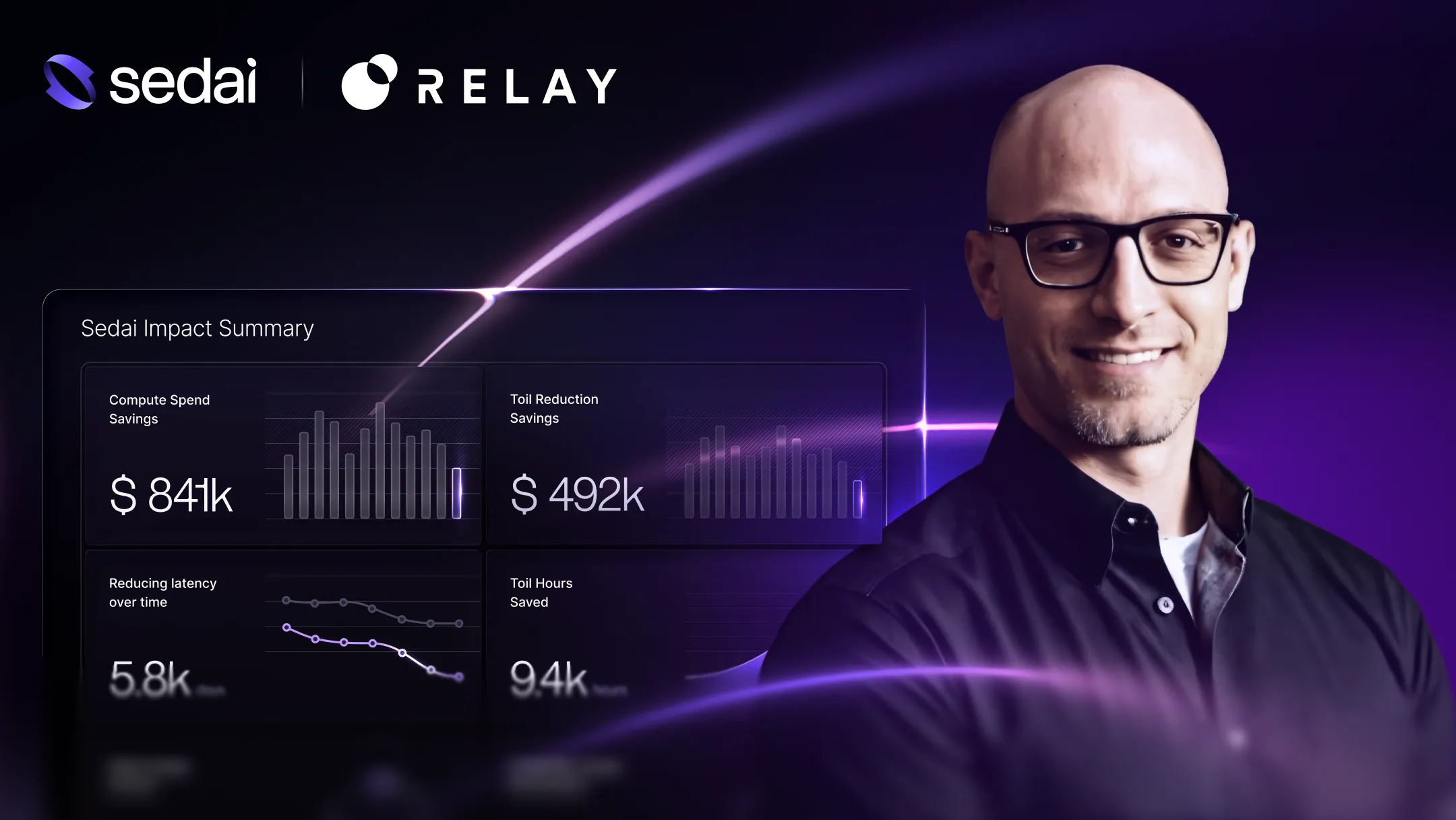
Story Highlights
The Company
Relay Network is a customer engagement platform with a lean, security-conscious engineering team and no dedicated CloudOps headcount.
The Challenge
Brendan Putek, Director of DevOps, was managing cloud infrastructure himself on top of platform, security, and DevOps responsibilities. Cloud optimization kept getting deprioritized.
The Solution
Relay Network adopted Sedai's autonomous optimization, starting in dev, QA, and staging environments and expanding to full Autopilot across production.
The Results
- 40% reduction of ECS container costs
- $12,051 saved on a single AWS ECS container
- 3,868 engineering hours saved in 2026 alone
- 4,699 days of latency improvement across AWS Lambda
- 900TB cut to 300TB on AWS S3
The Challenge: Running Cloud Infrastructure Without a Dedicated Ops Team
Brendan Putek doesn't have a simple job title. As Director of DevOps at Relay Network, he owns platform, security, FinOps, & DevOps as a single function. Developer enablement is his primary focus. Everything else, including cloud infrastructure, competes for whatever time is left.
When Relay Network came to Sedai, the team was deep in the middle of a major disaster recovery upgrade alongside a full slate of contractual and compliance milestones. Because of this, right-sizing infrastructure kept getting deferred.
"We have such an ambitious roadmap," said Brendan. "We want to spend as much time as possible innovating, and optimizing infrastructure was the piece that kept getting pushed to the next quarter."
Why Reactive Autoscaling Fails
Reactive autoscaling fails because it responds to a burst only after the burst starts, and by the time new capacity comes online, spikes are often over.
Relay Network felt this directly: Their EC2 services handled core messaging traffic that spiked predictably during peak hours. But without a dedicated ops team, Brendan's solution was implementing metric-based triggers to scale them up and down manually. That cost the team $1,000/month, and didn't actually solve the problem.
"By the time the VMs stood up, the burst was over," said Brendan. "And now we're just processing the backlog versus handling it more in real time."
The automatic scaling was an indication of a deeper limitation: reactive scaling. Conventional autoscalers poll metrics every 15 to 30 seconds, and new instances can take another minute or more to come online. For a burst that spikes and drops in under 60 seconds, the capacity arrives after the damage is done.
Predictive autoscaling works differently. But building that capability in-house wasn't an option for a small team that was already stretched too thin.
Why Cloud Automation Tools Can’t Be Trusted
Most cloud automation tools can't be trusted because they can't answer a basic question: How are decisions being made, and can they be audited? The market is full of these tools claiming to make autonomous infrastructure decisions with no proof behind them.
For a team that owns both DevOps and security, using tools like that was a dealbreaker. Brendan was direct about the problem, "Stuff goes into a black box, and then stuff comes out," he said.
A system making autonomous changes in production needed to be explainable at every step, from:
- The initial opportunity identified
- The validation process
- The action taken
- The record left behind
Without that, handing over production to an outside tool wasn't a risk any security-conscious team could justify.
Ultimately, Brendan needed an approach to cloud optimization that would completely remove the manual work without the fear of breakage. Most tools could offer one; finding both in the same platform was the harder problem.
As he put it, “My goal is to not have to think about auto-scaling, and not have to have my team think about auto-scaling."
The Solution: Replacing Manual CloudOps with Autonomous Cloud Optimization
When Relay Network partnered with Sedai in 2023, Brendan was focused on one thing: He needed autonomous scaling so his team could stop managing CloudOps and focus on shipping product instead.
"I didn't care about the cost savings implications. With autonomous scaling and not having to do that work ourselves, that's awesome,” he said.
That framing stuck throughout the entire engagement. Brendan has never described Sedai as a FinOps tool. To him, it's a cognitive load removal platform that allows his team to operate at scale, without needing specialized skills in load testing, right-sizing, or capacity planning.
The question wasn't whether to use Sedai. It was how to get to autonomy safely.
How Relay Brought Autonomous Optimization to Production Safely
Sedai has three distinct operating modes, which teams can move between at their own pace:
- Datapilot surfaces optimization opportunities without taking action
- Copilot lets engineers review and approve potential optimizations, before Sedai safely implements them
- Autopilot is fully autonomous: Sedai identifies, validates, and executes optimizations without any human review required
For Brendan, Autopilot was always the destination, but he needed confidence he could trust it in production. To do that, Sedai configured environment-level groupings so Autopilot could run in Dev, QA, and Staging first. Brendan was able to see the data in non-critical environments, and verify that changes were safe and incremental.
"Sedai’s approach really gives us that confidence at scale that, yes, we can allow this external tool to manage optimization for us,” he said. “And we're not going to suddenly find ourselves with a massive outage."
-2.webp&w=3840&q=75)
How Application-Aware Optimization Works
Application-aware optimization works by learning how each application actually behaves instead of applying static rules or wrapping LLMs around infrastructure metrics and calling it intelligence.
But Sedai’s patented machine learning (ML) model learns application behavior by monitoring traffic patterns, seasonality, dependencies, and performance. Every optimization decision flows from that deterministic knowledge.
For Brendan, that distinction was everything:
"You're not built on LLMs. Everything is deterministic. Every decision is backed by hard data and you can walk the entire chain back to determine why it was made. It's not a black box. That's a huge, huge selling point."
That determinism lets Sedai reach conclusions a human engineer wouldn't.
"In some cases, we've actually increased capacity to run faster and save money. Which, quite frankly, is not something any of my engineers would have ever been able to come up with," Brendan said.
-2.webp&w=3840&q=75)
Expanding Autonomous Optimization Across 16 AWS Accounts
By May 2025, ~55% of production resources were running on Autopilot. The results were so impressive that Brendan held an internal meeting with Relay’s engineering leadership to show what the platform could do. Their reaction was immediate: they wanted to expand further.
"I had provided ample proof the product worked. It was safe. So I just turned it on. There weren't any issues," he said.
By August 2025, all of Relay's 16+ AWS accounts were fully configured. Brendan's message to the team: Sedai would be enabled across production services by year-end.
Making Autopilot the Default for Every New Service
By October 2025, Relay Network shipped every new service on Sedai’s Autopilot by default.
"Autopilot is the most helpful to our engineers because then they don't have to think about it."
Engineering leads stopped making right-sizing decisions on every new deployment, and the team's focus shifted entirely to shipping product.
By February 2026, Brendan confirmed what the team had been working toward since September 2023: all eligible workloads were on full Autopilot.
The Results: How Relay’s Eng Team Stopped Managing Infrastructure
Eighteen months after Sedai's initial deployment, the impact shows up in three places: the AWS bill, the engineering team's workload, and how fast Relay ships.
By the numbers:
- 40% reduction of ECS container costs
- $12,051 saved on a single AWS ECS container
- 3,868 engineering hours saved in 2026 alone
- 4,699 days of latency improvement across AWS Lambda
- 900TB cut to 300TB on AWS S3
- No cloud specialist hire required
AWS ECS: Optimization at the Container Level
Across Relay Network's ECS workloads, Sedai has autonomously reduced container costs by an average of 40%, with $12,051 saved on a single container alone.
"No matter what we put in for configuration, right or wrong, we're going to be right-sized. It's just one less thing we have to consider when we're building a new service," said Brendan.
AWS S3: Visibility That Drove Action
Relay Network's S3 environment had years of accumulated data with no cleanup process. Sedai was able to surface which buckets were using the wrong storage classes for their actual access patterns.
Armed with that visibility, Brendan spent two to three months working through the data — classifying what was still needed, what could move to lower-cost tiers, and what could be deleted entirely.
"We just stored data in S3 forever," he said. "Sedai pointed me to the older data that should have been in a cheaper storage class but never was."
The result: Relay Network's S3 storage dropped from just over 900 terabytes to about 300 terabytes.
Cutting Engineering Toil by 3,868 Hours
In 2026 alone, Relay Network's engineers reclaimed 3,868 hours that would have gone to manual infrastructure management. With that time back, Brendan rebuilt the team's entire deployment process. Relay now ships 800-plus deployments a week across four environments with a team of 25.
"Sedai is a third, maybe a quarter of what we'd pay a specialist engineer when you count the benefits."
Brendan Putek
Director of DevOps, Relay Network
And nobody on that team thinks about infrastructure sizing to make it happen. "It doesn't even occur to them,” Brendan said. “We've just taken that cognitive load and totally removed it from their consideration"
But these results extend beyond just hours saved and increased shipping. Right-sizing and load testing requires a depth of infrastructure expertise that most engineering teams don't have in-house.
As Brendan put it, most SREs today are focused on incident management, not the kind of deep infrastructure tuning that was common a decade ago.
"Sedai is a third, maybe a quarter of what we'd pay a specialist engineer when you count the benefits. If we didn't have this, we'd need to hire one, if not two people who specialize in that functionality — and I don't have the capacity to pick that up myself."
Why Relay Chose ML-Based Optimization Over Rule-Based Autoscaling
Brendan came to Sedai looking for one thing: a way to remove infrastructure management from his team's cognitive load entirely. Eighteen months later, when asked about the most noticeable change in his environment, his answer wasn't a metric.
"The fact that the product runs in the background, makes changes to our services, scales them up and down as required, and we don't notice. That's exactly what we want. We want the product to be infrastructure. We don't want to have to think about it."
For Relay Network, CloudOps is no longer a backlog item. Sedai handles it.
Ready to optimize your cloud with zero toil for your team? Book a Sedai demo.