


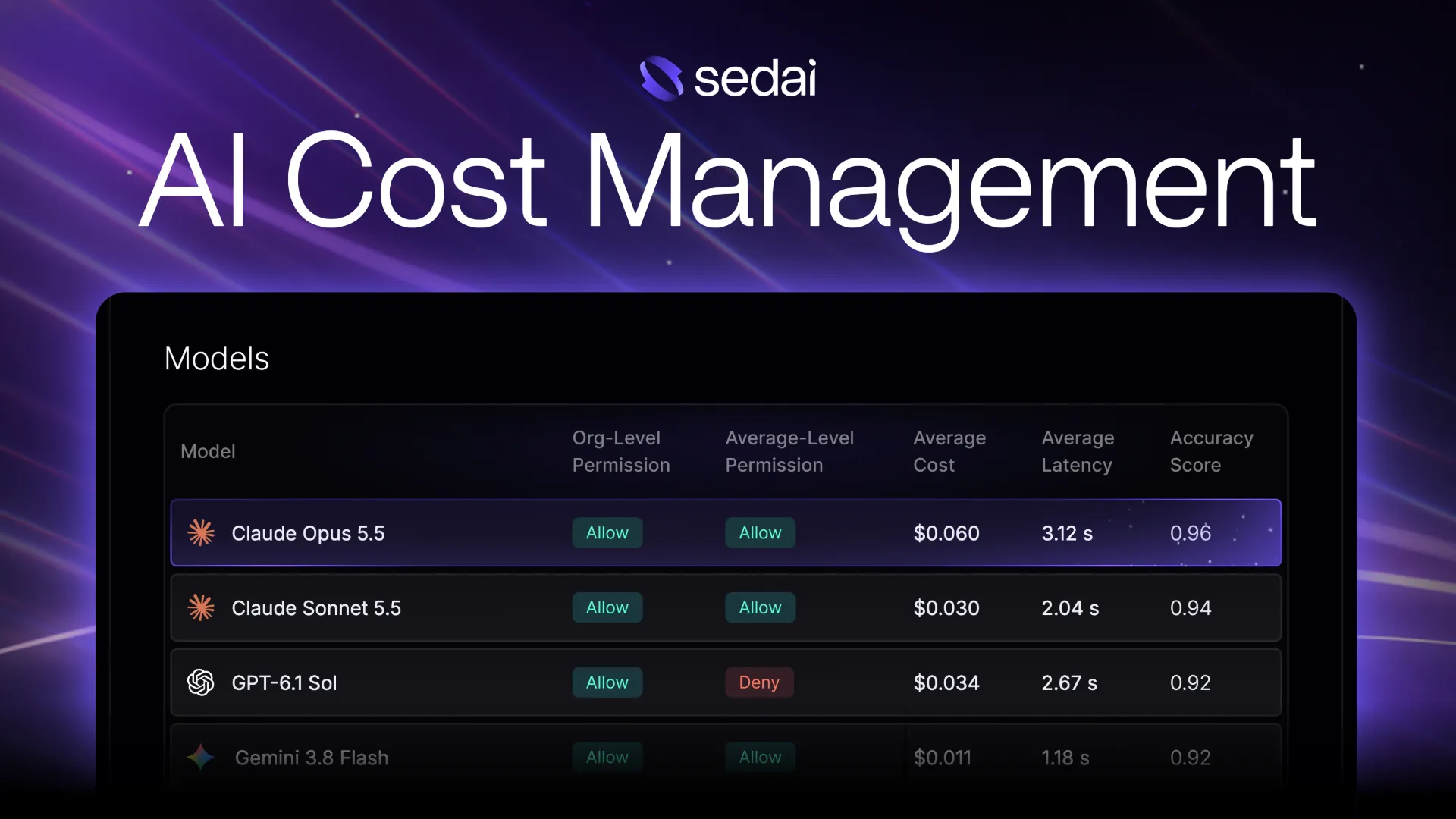
What is AI Cost Management?
AI cost management is the practice of tracking, controlling, and optimizing what an organization spends on artificial intelligence tools, cloud computing, and token usage.
Organizations that consume hosted AI models primarily manage variable usage costs. Providers operate the underlying infrastructure, while customers pay for resources such as input and output tokens, API calls, embeddings, images, or other model services. Cost management focuses on tracking usage by application and team, controlling token consumption, selecting appropriate models, and comparing providers.
Organizations that host or build their own models have a different cost structure. They are responsible for GPUs and other compute resources, training and fine-tuning jobs, inference capacity, storage, networking, and infrastructure utilization. Costs can continue even when models receive little traffic because provisioned hardware may remain allocated. In this context, cost management requires infrastructure rightsizing, utilization monitoring, capacity planning, and optimization of both training and inference workloads.
What drives AI costs:
- Hosted model usage: Token and API charges depend on model choice, input size, response length, request volume, and the services called across each workflow.
- Compute and training: GPU capacity, runtime, idle resources, data processing, and repeated training or fine-tuning experiments contribute to infrastructure costs.
- Inference infrastructure: Serving costs depend on model size, traffic, context length, and latency requirements. Batching, quantization, and autoscaling can improve efficiency.
- Vector databases and storage: Embeddings, datasets, model artifacts, and logs incur storage costs, with additional expenses for replication, indexing, and vector searches.
- Networking and data transfer: Moving data between regions, zones, services, or providers adds charges. Keeping related services close together reduces transfer costs and latency.
Key strategies to control AI spend include:
- Establish end-to-end AI cost visibility: Track costs across the full AI stack and combine billing, application, and infrastructure telemetry.
- Track costs at the workload and application level: Attribute spend to apps, models, teams, customers, and environments using tags or metadata.
- Track and attribute costs by agent and model provider: Separate costs by agent and provider, including tokens, tool use, retrieval, and model calls.
- Measure cost alongside performance and quality: Evaluate cost with accuracy, latency, quality, throughput, retries, and task completion rates.
- Optimize prompts and context windows: Reduce unnecessary tokens by trimming prompts, summarizing history, limiting retrieval, and caching reusable context.
- Route workloads dynamically between models: Match each request to the most cost-effective model based on complexity, latency, and quality needs.
- Evaluate models for each agent and task: Test models per workflow step using real workloads and compare cost, accuracy, latency, and completion rates.
- Use workload-specific analysis instead of generic model benchmarks: Base decisions on production-like evaluations rather than broad benchmark scores alone.
- Define allow/block policies by organization or agent: Control model and provider access by team, application, agent, or workload requirements.
- Detect AI cost anomalies in real time: Monitor usage and unit costs for spikes caused by bugs, traffic surges, loops, or misconfigurations.
- Automate rightsizing and resource allocation: Align compute, GPU capacity, replicas, and scaling policies with actual workload demand.
- Optimize AI infrastructure based on real workload behavior: Use production metrics to tune hardware, batching, autoscaling, and hosted versus self-hosted choices.
In this article:
- 5 Reasons Your Organization Needs AI Cost Management
- What Are the Main Components of AI Costs?
- How Does AI Cost Management Work?
- Cost Management for AI Agents: How Is It Different?
- How Is AI Cost Management Related to FinOps?
- AI Cost Management Best Practices and Strategies
5 Reasons Your Organization Needs AI Cost Management
As organizations rapidly adopt AI across teams and business processes, AI cost management is becoming critical to an organization's financial health. Here are the key reasons organizations today cannot afford to ignore or mismanage AI costs.
1. Rapid Growth of AI and LLM Spending
AI adoption can increase spending quickly as more applications move from experiments into production. Training jobs require expensive compute, while production inference generates recurring costs that grow with request volume. Teams may also pay separately for vector databases, storage, data pipelines, and observability.
Cost management helps organizations monitor this growth and identify its main drivers. Teams can compare model and infrastructure costs, find underused GPU capacity, and determine whether increased AI spending corresponds to increased application usage or business value.
2. Unpredictable Token-Based Pricing
Many LLM APIs charge according to the number of input and output tokens processed. Costs therefore depend on factors such as prompt length, generated response length, model selection, request volume, and repeated context. Small application changes can significantly affect the cost per request.
Tracking token consumption makes these changes visible. Teams can set budgets, detect unusual usage, reduce unnecessary context, cache suitable responses, and route simpler requests to less expensive models while preserving more capable models for tasks that require them.
3. Difficulty Attributing AI Costs to Teams and Applications
A single cloud account, API key, GPU cluster, or model endpoint may support several teams and applications. Provider invoices often show aggregate usage, making it difficult to determine which product, feature, customer, or environment generated a specific cost.
AI cost management adds allocation data such as application IDs, team tags, model names, environments, and customer identifiers. This allows organizations to calculate costs at a useful level, assign ownership, implement chargeback or showback, and evaluate the unit economics of individual AI features.
4. Limited Visibility Into Costs by Agent, Model, and Provider
As organizations deploy more AI agents, maintaining visibility into their usage becomes increasingly difficult. Agents can operate across sanctioned applications and shadow AI tools, making it harder to maintain a complete inventory and understand which systems are active.
Centralized agent inventories can help organizations discover and categorize agents across applications. Ongoing monitoring can then track agent usage, identify anomalous behavior, verify policy compliance, and flag agents that operate beyond their intended scope. This visibility provides the foundation for applying controls based on the risk associated with each agent.
5. AI Agent Sprawl and Governance Challenges
AI agent adoption can create significant management challenges as organizations deploy agents at scale. Gartner predicts that an average global Fortune 500 enterprise will have more than 150,000 agents in use by 2028, compared with fewer than 15 in 2025. Uncontrolled growth can increase IT complexity and introduce risks such as misinformation, oversharing, and data loss.
Organizations can manage this sprawl by defining policies for creating and sharing agents, maintaining a centralized inventory, and controlling agent identities and permissions. They also need processes to review and retire redundant agents, govern the information agents can access, and continuously monitor agent behavior. These controls help organizations manage agent growth without relying solely on restrictions that may encourage employees to use unsanctioned shadow AI tools.
What Are the Main Components of AI Costs?
The following table summarizes the main components of AI costs. We explore each component in more detail below.
Type of Cost | Cost Component | Description | Cost Drivers |
AI model consumption | LLM input and output tokens | Costs based on tokens sent to and generated by hosted models. Input tokens include prompts, system instructions, retrieved context, and conversation history. Output tokens are generated responses. | Model choice, context size, response length, request volume, conversation history length |
AI model consumption | API and model usage fees | Fees charged by managed AI providers for model requests and related services such as images, embeddings, speech, or search. | Provider pricing, model type, number of API calls, number of services used per workflow |
AI model hosting and training | GPU and accelerator costs | Costs for specialized hardware used to train, fine-tune, or serve AI models. | Hardware type, runtime, cloud pricing model, utilization, reserved capacity, idle resources |
AI model hosting and training | Model training and fine-tuning | Costs from training runs, fine-tuning jobs, data preparation, storage, and experimentation. | Accelerator time, CPU usage, dataset size, number of experiments, distributed infrastructure needs |
AI model hosting and training | AI inference infrastructure | Costs of running self-hosted models in production to process user requests. | Model size, request rate, context length, batching, latency requirements, peak capacity |
AI model hosting and training | Vector databases and data storage | Costs for storing embeddings, source documents, model artifacts, datasets, logs, and generated outputs. | Data volume, replication, retention periods, indexing, query volume, provisioned capacity |
AI model hosting and training | Networking and data transfer | Charges from moving data between regions, availability zones, services, or cloud providers. | Dataset size, cross-region transfers, cross-cloud architecture, service placement, inference data movement |
Costs of AI Model Consumption
These are costs incurred by organizations using hosted AI models from providers like Anthropic and OpenAI.
LLM Input and Output Tokens
LLM providers commonly meter usage by tokens. Input tokens include prompts, system instructions, retrieved context, and conversation history. Output tokens cover the text generated by the model. Providers may price input and output tokens differently.
Token costs depend on model choice, context size, response length, and request volume. Applications that repeatedly send large documents or long conversation histories can therefore become expensive even when their number of requests remains stable.
API and Model Usage Fees
Managed AI services may charge for model requests, images, embeddings, speech processing, searches, or other operations. Pricing units differ between providers and model types, which makes direct cost comparisons difficult.
Applications may also call several models or AI services during one user request. Measuring the total cost of the complete workflow provides a more useful metric than monitoring each API independently.
Costs of AI Model Hosting and Training
These are costs incurred by organizations who self-host models (for example, open source models like DeepSeek), or go further by fine tuning or even training their own models.
GPU and Accelerator Costs
Training and serving AI models often require GPUs or other specialized accelerators. Costs depend on hardware type, quantity, runtime, cloud pricing model, and utilization. Reserved capacity and dedicated hardware can also create costs while resources are idle.
Low utilization is a major source of waste. Scheduling workloads efficiently, sharing accelerators where appropriate, and matching hardware capacity to model requirements can reduce compute costs without changing the model itself.
Related content: Read our guide to AWS GPU instances.
Model Training and Fine-Tuning
Training costs include accelerator time, CPU resources, training data processing, storage, and experiment runs. Large training jobs can also require distributed infrastructure, increasing networking and orchestration costs.
Fine-tuning is generally less compute-intensive than training a foundation model from scratch, but repeated experiments can still accumulate substantial costs. Teams should track costs by training run and compare them with improvements in model quality.
AI Inference Infrastructure
Self-hosted inference requires compute capacity to load models and process production requests. Costs are affected by model size, request rate, context length, batching, latency requirements, and the amount of capacity maintained for peak demand.
Inference efficiency can be measured using metrics such as cost per request or cost per generated token. Techniques including batching, quantization, autoscaling, and model routing can improve hardware utilization and reduce unit costs.
Vector Databases and Data Storage
AI applications often store embeddings in vector databases and retain source documents, model artifacts, training datasets, logs, and generated outputs. Storage costs grow with data volume, replication, retention periods, and indexing requirements.
Vector search may introduce additional charges for compute, memory, queries, or provisioned capacity. Teams should account for these expenses when calculating the total cost of retrieval-augmented generation and similar architectures.
Networking and Data Transfer
Moving data between cloud regions, availability zones, services, or providers can generate network charges. AI workloads may transfer large datasets during training or move significant amounts of context between application components during inference.
Architecture decisions can therefore affect costs beyond compute and model usage. Keeping frequently communicating services close together and avoiding unnecessary cross-region or cross-cloud transfers can reduce both network costs and latency.
How Does AI Cost Management Work?
AI cost management solutions typically provide the following capabilities.
AI Usage and Cost Data Collection
The first step is collecting cost and usage data from model APIs, cloud platforms, GPU clusters, databases, and application telemetry. Relevant metrics include token counts, API requests, GPU hours, storage consumption, network traffic, and provider charges.
Combining billing data with operational telemetry provides more detail than invoices alone. It allows teams to connect spending changes to specific models, deployments, requests, or infrastructure resources.
Data should be collected at a sufficiently granular level to support later analysis. For example, recording token usage for each model call makes it possible to calculate the cost of a feature or user workflow. Historical data is also important for identifying trends, forecasting future spending, and comparing costs before and after infrastructure changes.
Cost Allocation and Attribution
Collected costs are assigned to meaningful business or technical dimensions. These can include teams, applications, models, environments, customers, features, and projects.
Allocation may use cloud tags, API keys, request metadata, Kubernetes labels, or internal account identifiers. Shared infrastructure costs can be distributed using metrics such as GPU time, request volume, or resource consumption.
Accurate attribution establishes ownership for AI spending. For example, a shared inference cluster may serve several applications, but each application can be charged according to its share of compute or requests. This supports showback and chargeback models and helps teams calculate the actual cost of individual AI products.
AI Workload Monitoring
AI workload monitoring tracks how models and supporting infrastructure behave over time. Common metrics include request volume, token consumption, GPU utilization, latency, throughput, error rates, and queue depth.
Monitoring helps teams distinguish between expected cost growth and operational problems. For example, higher spending caused by increased customer traffic differs from higher spending caused by an underutilized GPU deployment.
Teams can also monitor workload patterns by time, model, endpoint, or environment. This can expose idle development resources, unnecessary peak capacity, or sudden increases in token consumption. Alerts can notify teams when usage exceeds expected ranges or predefined budgets.
Cost and Performance Analysis
Cost data becomes more useful when analyzed alongside performance and quality metrics. Teams can calculate measures such as cost per request, cost per customer, tokens per task, GPU cost per inference, or cost per successful outcome.
These metrics expose trade-offs between cost and performance. A cheaper model may reduce API spending but become less economical if lower accuracy causes retries or additional processing.
Analysis can also compare different architectures or model configurations under the same workload. Teams might evaluate whether a smaller model, quantized model, hosted API, or self-hosted deployment provides the best balance of cost, latency, throughput, and output quality.
Identification of Inefficient AI Usage
Cost analysis can reveal inefficient patterns such as oversized models, excessive prompt context, unnecessary output tokens, repeated model calls, idle GPUs, or overprovisioned inference endpoints. It can also identify workloads running on more expensive infrastructure than necessary.
Teams can prioritize these findings based on potential savings and their effect on latency or model quality. This prevents optimization efforts from reducing costs at the expense of application requirements.
Application-level inefficiencies also matter. For example, an agent may repeatedly call an LLM when a cached response or deterministic function could perform the same task. Retrieval pipelines may send too many documents to the model, increasing input tokens without improving answer quality.
Automated Optimization
Some cost controls can be applied automatically. Examples include scaling inference capacity with demand, shutting down idle development resources, enforcing token limits, routing requests between models, or scheduling flexible workloads when cheaper capacity is available.
Automation should operate within defined performance and reliability constraints. Policies can specify acceptable latency, model quality, capacity, or availability before an optimization is applied.
More advanced systems can use workload characteristics to select models dynamically. Simple requests may be routed to smaller models, while complex requests use more capable and expensive models. Infrastructure automation can similarly select appropriate GPU types, adjust replicas, or use discounted compute capacity when workloads can tolerate interruptions.
Continuous Cost Monitoring
AI costs require ongoing monitoring because workloads, models, prices, and user behavior change. Dashboards and alerts can track budgets, unit costs, spending trends, and unexpected changes in usage.
Continuous monitoring also verifies whether optimization measures remain effective. When costs exceed thresholds or unit economics deteriorate, teams can investigate the underlying workload before the increase becomes a larger budget problem.
Teams should also compare actual spending against forecasts and budgets over time. Tracking metrics such as cost per request or cost per active user can reveal efficiency changes that total spending alone may hide. Regular reviews help ensure that cost controls continue to match evolving AI workloads and business requirements.
Optimize Your AI Costs with Sedai
Our patented platform can lower your AI costs by 50%

Cost Management for AI Agents: How Is It Different?
AI agents introduce additional cost-management challenges because a single user request can trigger multiple model calls, tool executions, searches, and retrieval operations. Unlike a simple chatbot request, the total cost may depend on how many reasoning steps the agent performs before completing a task.
Agent costs should therefore be measured at the task or workflow level, not only per model call. Useful metrics include cost per completed task, model calls per task, tokens per agent run, tool costs, and the percentage of runs that require retries. These metrics help identify workflows where additional reasoning does not produce enough value to justify its cost.
Cost controls can limit the number of agent steps, token usage, tool calls, or execution time. Model routing can send routine steps to smaller models and reserve more expensive models for complex decisions. Caching, prompt optimization, and deterministic code can also replace repeated model calls when the required operation does not need generative AI.
Teams should monitor failed and looping agent runs closely. An agent that repeatedly retries a tool call or generates unnecessary intermediate steps can consume substantial resources without completing useful work. Setting execution budgets and termination conditions limits this risk.
How Is AI Cost Management Related to FinOps?
AI cost management is increasingly being treated as an extension of FinOps practices to AI workloads. The FinOps Foundation describes FinOps for AI as applying the FinOps framework to the cost complexity, rapid development cycles, unpredictable spending, and governance requirements associated with AI. Rather than creating an entirely separate cost discipline, organizations can adapt established FinOps practices such as allocation, forecasting, optimization, and accountability to AI-specific consumption models.
The same core FinOps principles still apply. Engineering, finance, product, and business teams collaborate to understand technology spending and connect it to business value. For AI, however, the units being managed may shift from traditional cloud resources such as instances and storage to tokens, model API calls, GPU hours, inference endpoints, training jobs, and agent workflows. The FinOps Foundation specifically recommends granular tracking that can reach the token or GPU level when managing AI investments.
FinOps practices are therefore being adapted in several ways for AI:
- Allocation: Attribute token, model, GPU, and infrastructure costs to applications, teams, customers, or AI products.
- Forecasting: Account for highly variable AI usage, rapid experimentation, and changing model prices.
- Optimization: Reduce unnecessary token consumption, improve GPU utilization, rightsize inference infrastructure, and select models based on both cost and required performance.
- Unit economics: Measure metrics such as cost per inference, cost per task, cost per customer, or cost per successful AI outcome rather than looking only at total cloud spend.
- Governance: Establish budgets, ownership, policies, and review processes that allow teams to experiment while maintaining financial accountability.
This reflects a broader expansion of FinOps beyond traditional cloud infrastructure. According to the FinOps Foundation, 98% of FinOps practitioners reported managing AI spend in 2026, compared with 31% two years earlier. The Foundation has also broadened its mission from managing the value of cloud to managing the value of technology, with AI becoming an important FinOps scope.
Related content: Read our article about AI for FinOps.
AI Cost Management Best Practices and Strategies
1. Establish End-to-End AI Cost Visibility
Track costs across the entire AI stack rather than monitoring model APIs or cloud infrastructure separately. This includes training, inference, GPUs, model APIs, vector databases, storage, networking, observability, and supporting data services.
Combine provider billing data with application and infrastructure telemetry in a common view. End-to-end visibility helps teams find costs that would otherwise be hidden across different services and providers. It also provides a more accurate total cost for each AI product.
2. Track Costs at the Workload and Application Level
Aggregate cloud bills provide limited information about which workloads create spending. Attribute costs to applications, models, features, teams, customers, and environments using tags, request metadata, API keys, or other identifiers.
Track useful unit metrics such as cost per request, inference, agent run, or completed task. These metrics make it easier to compare workloads with different traffic levels and identify applications whose cost per unit is increasing even when total spending appears stable.
3. Track and Attribute Costs by Agent and Model Provider
Track spending separately for each agent and model provider so teams can identify which components drive overall costs. Agent-level attribution should include model calls, tokens, tool usage, retrieval operations, and other resources consumed during execution.
Provider-level tracking helps compare pricing and usage across hosted model services and self-hosted models. Normalize costs into workload-level metrics such as cost per task or successful agent run. This makes comparisons useful even when providers use different pricing structures.
4. Measure Cost Alongside Performance and Quality
The lowest-cost model or infrastructure configuration is not necessarily the most efficient option. Reducing model capability may increase errors, retries, latency, or human review requirements, resulting in higher total costs.
Evaluate spending alongside metrics such as response quality, accuracy, latency, throughput, and task completion rates. Teams can then determine whether a cost reduction produces an acceptable trade-off rather than optimizing financial metrics in isolation.
5. Optimize Prompts and Context Windows
Large prompts increase input-token costs and can add latency. Review system prompts, conversation history, retrieved documents, and other context to determine whether every token contributes useful information to the model.
Remove redundant instructions, summarize older conversation history, and limit retrieval to relevant content. Applications can also cache reusable context or responses. These techniques reduce token consumption while preserving the information needed to generate accurate results.
6. Route Workloads Dynamically Between Models
Using the most capable model for every request can create unnecessary spending. Model routing selects a model based on factors such as task complexity, latency requirements, expected quality, and cost.
For example, classification and extraction tasks may use a smaller model, while complex reasoning requests are routed to a more capable model. Routing policies should be tested against quality metrics so that lower model costs do not produce unacceptable output.
7. Evaluate Models for Each Agent and Task
Evaluate model selection at the individual agent and task level rather than choosing one model for an entire application. Different steps such as classification, extraction, planning, reasoning, and summarization can have different requirements.
Test candidate models using representative workloads and measure cost, accuracy, latency, and task completion rates. A smaller model may be sufficient for structured extraction, while a more capable model may be required for planning or complex reasoning. Repeat evaluations as models, workloads, and provider pricing change.
8. Use Workload-Specific Analysis Instead of Generic Model Benchmarks
Generic benchmarks measure model performance on standardized tasks, but they may not reflect an application's actual prompts, data, tools, or quality requirements. Cost decisions based only on benchmark scores can therefore lead to unnecessary spending or inadequate performance.
Build evaluations from representative production workloads and measure the outcomes that matter for each use case. Include token consumption, latency, accuracy, failure rates, retries, and total cost per successful task. This provides a more reliable basis for comparing models and configurations.
9. Define Allow/Block Policies by Organization or Agent
Define policies that specify which models and providers can be used by particular organizations, teams, applications, or agents. Allow lists can restrict workloads to approved models, while block lists can prevent access to models that exceed cost, security, compliance, or operational requirements.
Policies can also enforce different limits for different workloads. For example, routine agents may be restricted to lower-cost models, while selected workflows can access more expensive models when their requirements justify it. Review these policies regularly as model capabilities, pricing, and application requirements change.
10. Detect AI Cost Anomalies in Real Time
AI spending can increase rapidly because of traffic spikes, application bugs, agent loops, unusually long prompts, or misconfigured infrastructure. Monthly billing reviews may detect these problems too late.
Monitor token usage, API spending, GPU consumption, and unit costs against historical baselines and expected ranges. Alerts can identify sudden changes by application, model, customer, or endpoint. Where appropriate, automated limits can prevent abnormal workloads from consuming an unrestricted budget.
11. Automate Rightsizing and Resource Allocation
Provisioning too much accelerator capacity creates idle resources, while insufficient capacity can increase queues and latency. Rightsizing aligns CPU, memory, GPU type, GPU count, and replica capacity with actual workload requirements.
Autoscaling can add or remove inference capacity as demand changes. Development resources can be stopped when unused, while interruptible or discounted compute can support fault-tolerant training jobs. Automation reduces the operational effort required to keep resource allocation aligned with demand.
12. Optimize AI Infrastructure Based on Real Workload Behavior
Infrastructure decisions should use production workload data rather than assumptions or isolated benchmarks. Measure request sizes, concurrency, model memory requirements, latency targets, batch sizes, GPU utilization, and traffic patterns under realistic conditions.
Use these measurements to select hardware, configure batching, adjust autoscaling, and decide whether workloads should use hosted APIs or self-hosted models. Reevaluate these choices as traffic and models change. An architecture that is cost-effective at one scale may become inefficient as request volume or workload characteristics evolve.
How to Manage AI Costs with Sedai
Sedai for AI Agent Optimization is a unified SDK that sits between your AI agents and every LLM provider they call, bringing governance, observability, reliability, and intelligent routing to every LLM call without rewriting code. Sedai learns how your agents behave in production, including prompts, models, cost, and latency patterns, and continuously matches each agent to the right model for its workload. Because it is part of the Sedai platform, teams can optimize both AI model costs and the cloud, Kubernetes, and GPU infrastructure their agents run on, with customers achieving up to 40% reduction in LLM spend.
Key capabilities of Sedai for AI Agent Optimization:
- Real-time cost observability: Consolidates cost, token, and latency visibility across every provider, project, and model, showing where LLM spend lives across teams and how optimization reduces cost over time.
- Model governance: Enforces organization- and project-level model access policies with automatic fallback routing, without relying on developer self-governance.
- Traffic-aware smart routing: Automatically clusters production prompts into groups by domain and task type, so each group gets its own model set and optimization preference.
- Workload-specific model selection: Tests every candidate model on every routing group for accuracy, cost, and latency, using your actual production traffic rather than public benchmarks, and adapts continuously as models change.
- Waste detection across agents: Surfaces inefficiencies across your agent fleet, such as stale model choices, over-provisioned calls, and unattributed spend, and routes around them automatically.
- Built-in reliability: Provides automatic retries, cross-provider fallbacks, and load balancing, configured once.
- No code changes: Applies routing updates, fallback chains, and policy enforcement through the SDK with a single import line, sub-millisecond overhead, and support for OpenAI, AWS Bedrock, Vertex AI, and Azure Foundry.
Learn more about Sedai for AI Agent Optimization and take control of your AI spend.