What is Sedai and how does it turn cloud infrastructure into a strategic advantage?
Sedai is an autonomous cloud management platform designed to optimize cloud operations for cost, performance, and availability. By leveraging machine learning and a patented safety-by-design approach, Sedai transforms cloud infrastructure from a collection of disparate resources into a strategic command center. It provides multi-cloud observability, granular cost visibility, and autonomous optimization grounded in real application behavior. This enables organizations to operate across AWS, Azure, and GCP, gain actionable insights, and continuously adapt their cloud environments for efficiency and resilience. Note: Sedai is best suited for teams seeking autonomous, safe optimization; organizations requiring highly customized manual control may need to supplement with additional tools. Source
How does Sedai ensure safe, autonomous optimization in production environments?
Sedai is the only cloud optimization platform with patented technology for making safe, autonomous optimizations in production. It performs slow, incremental changes with continuous health verification and automatic rollbacks, ensuring that no optimization causes incidents or breaches SLOs. Unlike tools that make all-at-once changes or rely on static rules, Sedai's approach validates every adjustment in real time, minimizing risk. Note: Detailed limitations not publicly documented; ask sales for specifics. Source
What is Sedai's approach to multi-cloud and hybrid environments?
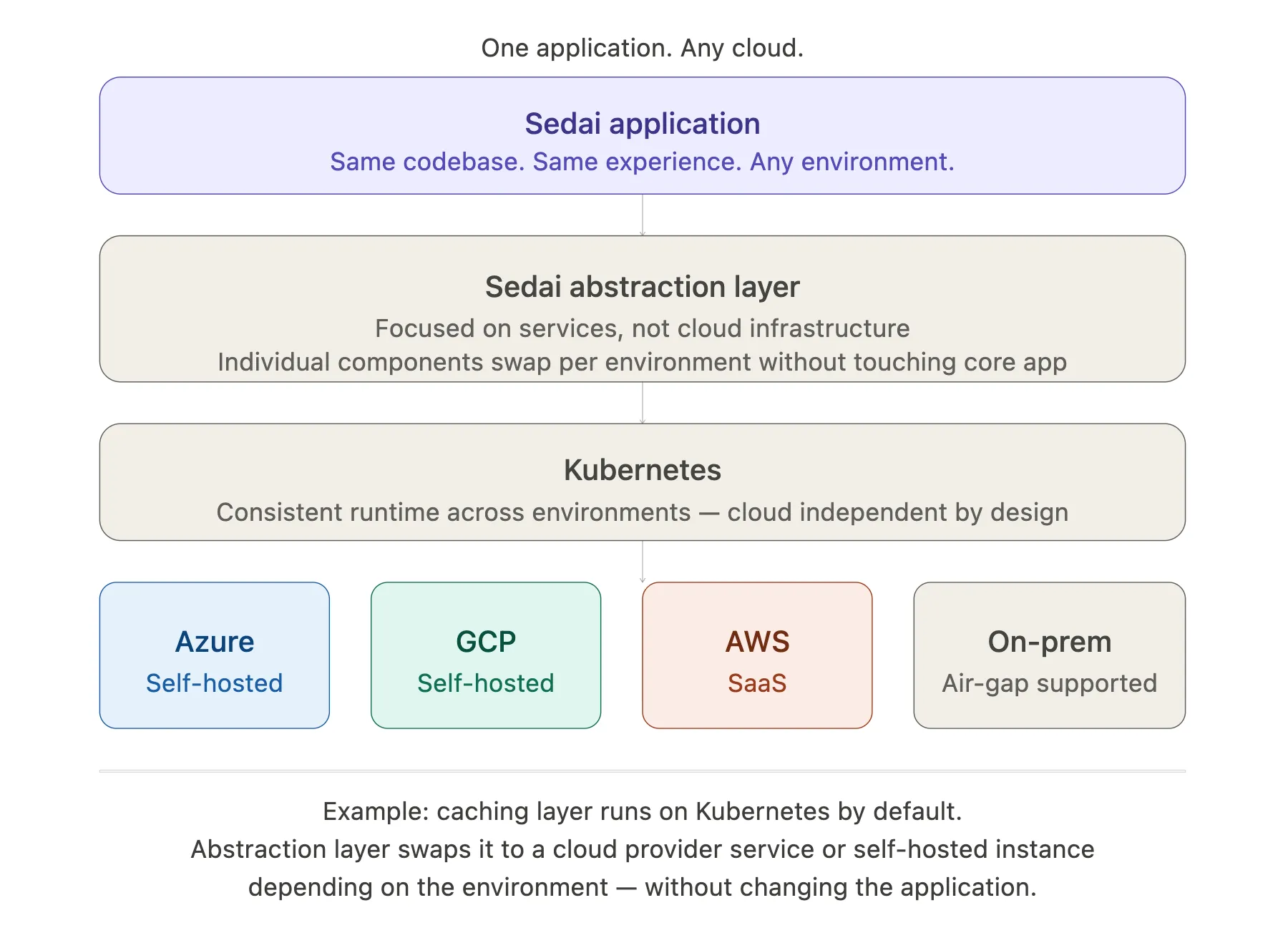
Sedai is built for multi-cloud observability and optimization, supporting AWS, Azure, and GCP. It uses Kubernetes as a cloud-agnostic abstraction layer and can manage workloads across EKS, GKE, and AKS by container or cluster. Sedai's architecture allows components to be swapped per environment, supporting both managed cloud services and self-hosted (air-gap) installations. Note: Some advanced features may require integration with specific cloud services; verify compatibility for highly specialized environments. Source
Autonomous optimization with safety-by-design (continuous health checks, rollbacks, incremental changes)
Multi-cloud support (AWS, Azure, GCP, Kubernetes)
Granular cost and performance visibility down to namespace and component level
Release Intelligence for per-deployment impact analysis
Integration with monitoring, APM, CI/CD, ITSM, and notification tools
Note: Some features may require integration with specific cloud providers or tools. Source
How does Sedai provide actionable cost visibility across clouds?
Sedai ingests and normalizes billing data from AWS, Azure, and GCP, providing granular visibility into costs at the cluster, VM, serverless function, and service level. Users can drill down to the namespace and component level, benchmark environments, and identify exactly where to act to reduce hidden costs. This enables precise scaling and resource allocation decisions. Note: For organizations with highly custom billing models, additional integration may be required. Source
What is Release Intelligence and how does it help teams?
Release Intelligence is a feature in Sedai that analyzes the impact of every software deployment in real time, providing a per-deployment scorecard on cost, latency, and error rates. This gives teams immediate, data-driven feedback on whether a change improved or degraded service, connecting development activity directly to operational outcomes. Note: Release Intelligence requires integration with CI/CD and monitoring tools for full functionality. Source
What integrations does Sedai support?
Sedai integrates with monitoring and APM tools (Prometheus, Datadog, Cloudwatch, Azure Monitor), Kubernetes autoscalers (HPA/VPA, Karpenter), IaC and CI/CD (GitHub, GitLab, Bitbucket, Terraform), ITSM (ServiceNow, PagerDuty, Jira), notification tools, runbook automation, and serverless platforms (AWS Lambda, AWS Fargate). Note: Some integrations may require additional setup or permissions. Source
Business Impact & Performance
What measurable results have customers achieved with Sedai?
Customers have reported up to 50% reduction in cloud costs, 75% fewer failed customer interactions, and 50% reduction in engineering toil. For example, KnowBe4 reduced their average response time from 18.5 seconds to 80 milliseconds (a 99.5% duration reduction) and saved $1.2 million on AWS costs. Palo Alto Networks saved $3.5 million through Sedai's optimization. Note: Results may vary based on environment complexity and integration depth. Source, Source
What business impact can customers expect from using Sedai?
Customers typically achieve a financial payback in under six months and an ROI greater than 400%. Benefits include up to 50% cloud cost reduction, 75% latency reduction, 6X productivity gains, and improved release quality. These outcomes are supported by case studies from companies like KnowBe4, Palo Alto Networks, and Belcorp. Note: ROI and payback period depend on environment size and adoption scope. Source
Use Cases & Target Audience
Who can benefit from using Sedai?
Sedai is designed for IT/cloud operations, FinOps, technology leadership (CTO, CIO, VP Engineering), platform engineering, and site reliability engineering (SRE) teams. It is used by organizations in cybersecurity, financial services, healthcare, e-commerce, IT, consumer goods, and digital commerce. Note: Teams with highly specialized, non-cloud-native environments may require additional integration work. Source
What common pain points does Sedai address?
Sedai addresses pain points such as cloud cost overruns, operational toil, performance and latency issues, lack of proactive issue resolution, complexity in multi-cloud/hybrid environments, and misaligned priorities between engineering and finance. It automates repetitive tasks, provides actionable cost visibility, and proactively resolves issues before they impact users. Note: For organizations with unique compliance or regulatory requirements, additional configuration may be necessary. Source
Implementation & Technical Requirements
How long does it take to implement Sedai and how easy is it to get started?
Initial onboarding for Sedai takes approximately 15 minutes for agentless or agent-based deployment to begin reading metrics. Additional setup for CI/CD and other integrations may require more time depending on environment complexity. Sedai offers a plug-and-play process and operates autonomously, minimizing manual oversight. Note: Complex environments may require additional integration steps. Source
Where can I find technical documentation for Sedai?
Sedai provides a Getting Started Guide, Kubernetes Optimization Guide, and a detailed Platform Overview. These resources are available at docs.sedai.io/get-started and sedai.io/resources. Note: Some advanced topics may require direct support from Sedai's technical team. Source
Pricing & Plans
What is Sedai's pricing model?
Sedai uses a volume-based pricing model, charging based on the resources optimized (e.g., Kubernetes pods, ECS tasks, VMs). Pricing is transparent, adapts to usage, and includes a free tier and a 30-day free trial. For Kubernetes environments, a demo is recommended to determine the best pricing structure. Note: Detailed pricing for large-scale or custom environments may require a direct quote. Source
Security & Compliance
What security and compliance certifications does Sedai have?
Sedai is SOC 2 certified, demonstrating adherence to stringent security requirements and industry standards for data protection and compliance. For more details, visit Sedai's Security page. Note: For additional certifications or compliance needs, contact Sedai directly. Source
Customer Success & Case Studies
Can you share specific case studies or success stories of Sedai customers?
Yes. Notable examples include:
KnowBe4: Achieved up to 50% cost savings and saved $1.2 million on AWS, reducing response time from 18.5 seconds to 80 ms. Case Study
Palo Alto Networks: Saved $3.5 million through Sedai's autonomous optimization. Case Study
Belcorp: Reduced AWS Lambda latency by 77%.
Campspot: Achieved a 34% reduction in AWS Lambda latency.
Inflection and Freshworks: Improved platform performance and reduced cold start latency.
Note: Results are specific to each customer environment. Source
At most companies, the cloud is not built with a clear strategy from day one. Instead, the cloud becomes the product of countless decisions, made by different teams, at different times, to handle different tasks.
One team picks AWS for website hosting. Another spins up a GCP instance for data analytics. A new integration must run on Azure. After a few years, you’re running a complex multi-cloud, with 40 different services and thousands of resources.
It’s chaos. And no one has visibility over everything.
So at Sedai, we asked ourselves: How can we eliminate this chaos in the cloud? And what would it mean for the cloud to become a true strategic advantage?
This is an especially pressing problem, because so much of cloud spend is completely wasted. In 2026, 73% of companies run hybrid or multi-cloud, and cloud waste has ticked up to 40%. Getting out of that chaos requires a strategic philosophy for how companies build their clouds.
At Sedai, we believe the modern cloud must be built to become a command center, where one team has full visibility across every provider and every service, optimization happens autonomously, and cost data informs engineering strategy.
Companies can no longer treat the cloud as infrastructure to simply monitor; instead it must become a strategic initiative that informs how applications are built, scaled, and optimized.
Here’s our philosophy for building your cloud as a strategic initiative:
Your platform should run cohesively across any cloud and environment
Your visibility should tell you where to act, not just what you're spending
Optimization must be grounded in real application behavior & context
Your cloud should continuously evolve
That's the cloud Sedai was built for, and what we've built for ourselves, and we’ve seen it pay off.
Run Across Any Cloud, Any Environment
A strategic cloud must be built to run across any cloud or environment. We built our platform for multi-cloud observability from day one because we knew the market demanded it; a majority of our customers run on multiple clouds, covering Azure, GCP, and AWS.
That meant building Sedai to be fault tolerant, resilient, & designed to recover from failure.
To do this, we built Sedai on Kubernetes & an abstraction layer. We chose Kubernetes because it’s inherently cloud-agnostic by design and deployable anywhere. But Kubernetes alone wasn't enough. We needed to handle different services for different clouds, and Kubernetes doesn't abstract those differences. It just runs the containers.
“The cloud is a living system that requires continuous adaptation, validates release impact, & makes safe decisions in real time.”
Hari Chandrasekhar
VP of Engineering
That meant if we hardcoded Sedai to depend on specific cloud services, it would break the moment it was deployed in a different environment.
To solve this, we built an abstraction layer where individual components can be swapped per environment without touching the core application. Essentially, what runs on Kubernetes today can flip to a managed cloud service tomorrow, or be fully self-hosted for air-gap installations.
As organizations continue to race against growing costs, the flexibility of Sedai in conjunction with customers’ cloud readiness creates a single pane of observability, regardless of cloud provider.
By ingesting and normalizing billing data from each provider, organizations can get an accurate picture of how they’re spending across clouds. And this extends to Sedai’s autonomous optimization: with cross-cloud Kubernetes support built in, Sedai can manage EKS, GKE, & AKS workloads by container or clusters.
Spend Visibility That Tells You Exactly Where to Act
Our platform was built for multi-cloud cost visibility, and we believe high-level spend reports don’t provide the visibility needed to uncover & reduce hidden costs.
Instead, Sedai breaks down costs granularly: you can drill down into individual clusters, VMs, serverless functions, & services. This level of detail provides broader insight to what each environment costs, down to the namespace & component level.
Engineers can easily benchmark these against each other, and know where exactly to put their engineering effort & toil to fix any inefficiencies or broader issues.
We experienced this when we were monitoring our own platform for inefficiencies, especially in how infrastructure was allocated across internal environments and services.
Without granular visibility, it was harder to see where capacity was actually needed, where resources were over-allocated, and which parts of the system could be scaled more precisely.
But with Sedai monitoring our own infrastructure, we got a clearer view of where resources were actually needed and where they could be scaled down or repurposed. By exposing more direct performance metrics and breaking broad services into more specific components, we could make more precise scaling decisions instead of scaling broad services indiscriminately.
This is how we strive to build our own strategic cloud: granular-level visibility pinpoints exactly where issues are occurring, all without the added toil of digging through dashboards and infrastructure code.
Optimize Around App Context & Behavior
The blueprint for the strategic cloud cannot stop at visibility. Knowing exactly where your money is going is only useful if you can act on it safely, and that means building in enterprise context and application understanding from the start.
Automated optimization tools rely on fixed rules that can fail when application behavior changes. For example, a tool might react to a CPU spike and recommend a change, but if the spike falls outside its predefined rules, that change could cause a production outage.
This forces engineering teams to spend their time manually validating changes instead of shipping. This is where Sedai’s context graph comes in.
From the start, Sedai builds a context graph of your cloud, including the topology of your environment, the dependencies between applications & cloud services, and how your infrastructure actually connects.
That context extends all the way down to Kubernetes, where Sedai maps deployments, pods, autoscalers, & their relationships to understand how workloads behave in practice.
By analyzing this context alongside your app’s historical load patterns, Sedai makes autonomous optimizations that are safe & effective.
You can’t have a strategic cloud where engineers spend their time validating changes. A strategic cloud is one where the platform understands your applications well enough to act on your behalf, confidently, safely, & without manual intervention.
That's the standard we hold ourselves to. And it's the standard we build toward for every customer.
Close the Loop With Release Intelligence
A key part of Sedai’s intelligence is understanding that app behavior changes with every new software release. An optimization platform that understands your application today, but fails to understand the impact of a deployment tomorrow, is incomplete.
This is where Sedai’s Release Intelligence provides the crucial feedback loop that makes a strategic cloud possible.
While Sedai’s context graph builds a deep historical model for workloads, Release Intelligence analyzes the impact of change in real time. For every deployment, Sedai provides a per-deployment scorecard that analyzes the impact on cost, latency, & error rates.
This gives teams immediate, data-driven feedback on whether a change improved or degraded the service. It connects development activity directly to operational outcomes.
This creates a powerful cycle:
Sedai understands the baseline behavior of a service, enabling safe, autonomous optimizations
When deploying a new version, Release Intelligence measures its precise impact on performance & cost.
New data continuously refines the application's behavior model, ensuring future optimizations are based on the most current reality
This is what elevates the platform from simply making a one-time recommendation to becoming a continuously learning system that adapts alongside apps.
The strategic cloud continuously evolves. By measuring the impact of every change and release, it learns what works, adapts over time, and makes optimization a natural part of software delivery.
A Strategic Cloud Is an Autonomous Cloud
Simply put, you need an autonomous system to operate the cloud in 2026.
At Sedai, we believe the modern cloud should do more than react to problems or surface generic utilization data. It should drive strategy through portability, actionable visibility, and continuous optimization based on real-world behavior.
That’s how we built Sedai’s own infrastructure, and we’ve been able to drive real strategy & product decisions because of it.
At one point, Sedai identified that we were overspending on metric scraping for a customer’s AWS environment. The issue wasn’t just resource consumption, it was architectural.
Our exporter component was stateful, meaning it handled scheduling, execution, & resiliency internally. That made the system expensive to run and difficult to scale precisely. The solution was to separate those responsibilities entirely.
Build Your Strategic Cloud
See how Sedai can turn your cloud from chaos into strategy.
Now, a centralized state manager determines which scraping jobs should run and when, while stateless workers execute those jobs independently. By decoupling orchestration from execution, Sedai can calculate exactly how many workers are needed for a given workload and scale only what’s necessary.
The result was a more resilient & cost-efficient system. Failed workers can simply restart without carrying recovery logic inside the app itself, and scaling decisions became significantly more precise.
More importantly, it reinforced our core belief: When infrastructure continuously learns from real application behavior, optimization becomes a strategic advantage instead of a reactive task.
The Future of the Cloud Is Autonomous
As cloud environments become more complex, teams can no longer rely on static data & isolated recommendations to manage them effectively.
The cloud is no longer something teams configure once and maintain manually; it’s a living system that requires continuous adaptation, validates release impact, & makes safe decisions in real time.
That’s why we believe the future of cloud management is autonomous.
This doesn’t mean removing engineers from the loop, but rather removing the repetitive operational burden that prevents them from focusing on higher-value work.
The truth is, you simply can't manage a modern cloud by asking different teams to optimize individual resources. The scale is too big. The complexity is too great.



%2520(1).webp&w=3840&q=75)
-1.webp&w=3840&q=75)
-2.webp&w=3840&q=75)
.webp&w=3840&q=75)
