Frequently Asked Questions
About Sedai & AWS Lambda Ready Designation
What does it mean that Sedai achieved the AWS Lambda Ready designation?
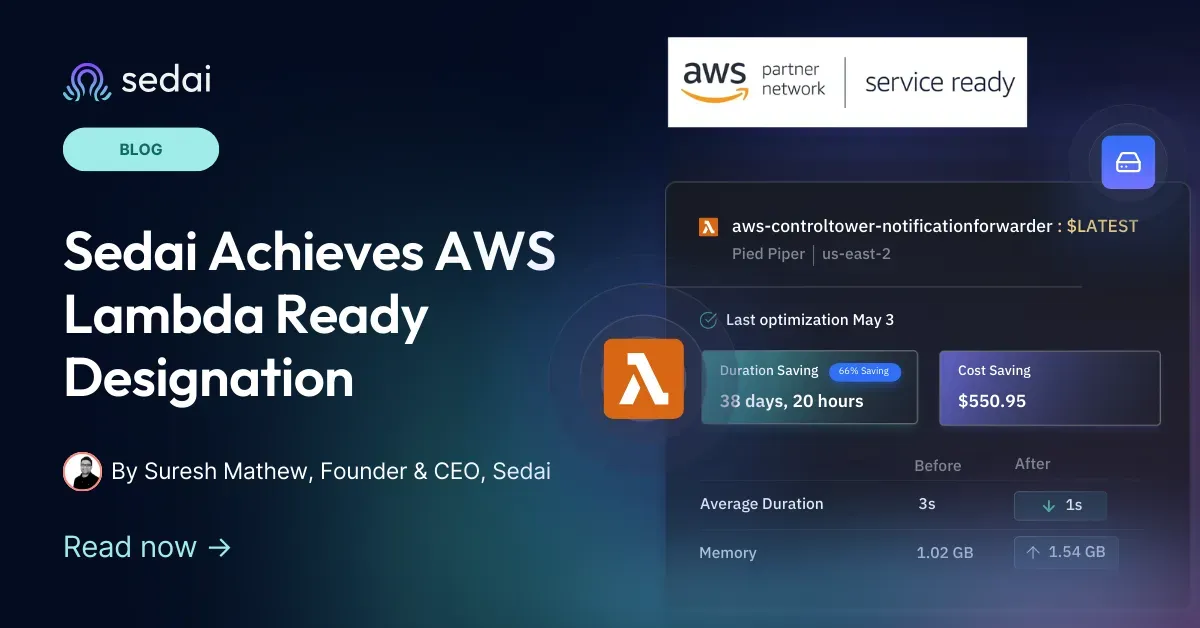
The AWS Lambda Ready designation is part of the Amazon Web Services (AWS) Service Ready Program. It recognizes that Sedai has demonstrated successful integration with AWS Lambda, is generally available, and is fully supported for AWS customers. This designation helps AWS customers identify products that are proven to work with AWS Lambda and can be used productively at scale and varying levels of complexity. [Source]
How does Sedai integrate with AWS Lambda?
Sedai's Autonomous Cloud Platform integrates with AWS Lambda to provide autonomous optimization, cost savings, and performance improvements. Sedai has also developed a Lambda extension to support its unique Autonomous Concurrency feature, which virtually eliminates cold starts. This extension is listed in AWS's Lambda documentation. [AWS Docs]
Where can I find Sedai for AWS Lambda?
Sedai's Autonomous Cloud Platform for AWS Lambda is available in the AWS Marketplace, making it easy for AWS customers to find, buy, deploy, and manage Sedai's solution directly within their AWS environment.
What is the AWS Service Ready Program?
The AWS Service Ready Program helps customers identify products that are integrated with AWS services, so they can spend less time evaluating new tools and more time scaling their use of products that are proven to work with AWS. Sedai's Lambda Ready designation is part of this program. [Source]
What is Sedai's Autonomous Concurrency feature for AWS Lambda?
Sedai's Autonomous Concurrency feature is a Lambda extension that virtually eliminates cold starts for AWS Lambda functions. This helps improve performance and user experience by reducing latency during function invocations. The extension is officially listed in AWS's Lambda documentation. [AWS Docs]
How does Sedai's AWS Lambda integration help customers?
Sedai's integration with AWS Lambda enables autonomous optimization of Lambda workloads, reducing cloud costs by up to 50%, improving performance by up to 75%, and multiplying SRE productivity by up to 6X. Customers can focus on innovation while Sedai optimizes resources and remediates issues in the background. [Source]
Is Sedai's Lambda extension officially recognized by AWS?
Yes, Sedai's Lambda extension is officially listed in AWS's Lambda documentation as a supported partner extension, validating its integration and reliability for AWS Lambda users. [AWS Docs]
How quickly can I set up Sedai for AWS Lambda?
Sedai is designed for rapid, plug-and-play implementation. For AWS Lambda, setup typically takes up to 15 minutes, allowing you to start optimizing your Lambda workloads with minimal effort. [Source]
Can I try Sedai for AWS Lambda before purchasing?
Yes, Sedai offers a 30-day free trial, allowing you to experience the platform's value and AWS Lambda integration firsthand without any financial commitment. [Start Free Trial]
Features & Capabilities
What is Sedai's Autonomous Cloud Management Platform?
Sedai's Autonomous Cloud Management Platform is an AI/ML-powered solution that delivers continuous optimization for cloud operations teams. It maximizes cloud cost savings, performance, and availability at scale by automating resource optimization and issue remediation across AWS, Azure, GCP, and Kubernetes environments. [Solution Briefs]
What are the key features of Sedai's platform?
Sedai offers autonomous optimization, proactive issue resolution, full-stack cloud coverage, release intelligence, plug-and-play implementation, and enterprise-grade governance. It supports Datapilot (observability), Copilot (one-click optimizations), and Autopilot (fully autonomous execution) modes. [Solution Briefs]
How does Sedai ensure safe autonomous optimizations?
Sedai is the only cloud optimization platform patented to make safe, autonomous optimizations in production without causing incidents or breaching SLOs. It performs slow, gradual optimizations with continuous validation checks, ensuring every change is constrained, validated, and reversible. This safety-first approach differentiates Sedai from risky optimizers that make all-at-once changes. [Solution Briefs]
What integrations does Sedai support?
Sedai integrates with monitoring and APM tools (Cloudwatch, Prometheus, Datadog, Azure Monitor), Kubernetes autoscalers (HPA/VPA, Karpenter), IaC and CI/CD tools (GitLab, GitHub, Bitbucket, Terraform), ITSM platforms (ServiceNow, Jira), notification tools (Slack, Microsoft Teams), and various runbook automation platforms. [Source]
Does Sedai provide technical documentation?
Yes, Sedai provides detailed technical documentation to help users get started, understand features, and troubleshoot. Access the documentation at docs.sedai.io/get-started and explore additional resources at sedai.io/resources.
What security and compliance certifications does Sedai have?
Sedai is SOC 2 certified, demonstrating adherence to stringent security requirements and industry standards for data protection and compliance. Learn more on the Sedai Security page.
What are the modes of operation in Sedai?
Sedai offers three modes of operation: Datapilot (observability), Copilot (one-click optimizations), and Autopilot (fully autonomous execution). This provides flexibility to match different operational needs and risk tolerances. [Solution Briefs]
How does Sedai's Release Intelligence feature work?
Sedai's Release Intelligence tracks changes in cost, latency, and errors for each deployment, improving release quality and minimizing risks during deployments. This feature is especially valuable for teams managing frequent releases. [Solution Briefs]
Use Cases & Business Impact
What problems does Sedai solve for cloud operations teams?
Sedai addresses cost inefficiencies, operational toil, performance and latency issues, lack of proactive issue resolution, complexity in multi-cloud environments, and misaligned priorities between engineering and FinOps teams. It reduces cloud costs by up to 50%, improves performance by up to 75%, and delivers up to 6X productivity gains. [Solution Briefs]
Who can benefit from using Sedai?
Sedai is designed for platform engineering, IT/cloud operations, technology leadership, site reliability engineering (SRE), and FinOps professionals in organizations with significant cloud operations. It is ideal for companies in cybersecurity, IT, financial services, healthcare, travel, e-commerce, SaaS, and more. [Resources]
What business impact can customers expect from Sedai?
Customers can expect up to 50% cloud cost savings, 75% latency reduction, 6X productivity gains, and up to 50% fewer failed customer interactions. Notable results include Palo Alto Networks saving $3.5 million and KnowBe4 achieving 50% cost savings in production. [KnowBe4 Case Study] [Palo Alto Networks Case Study]
What are some real-world success stories with Sedai?
KnowBe4 achieved 50% cost savings and saved $1.2 million on AWS. Palo Alto Networks saved $3.5 million and reduced Kubernetes costs by 46%. Belcorp reduced AWS Lambda latency by 77%. See more at Sedai Resources.
Which industries are represented in Sedai's case studies?
Sedai's case studies cover cybersecurity, IT, financial services, security awareness training, travel and hospitality, healthcare, car rental services, retail and e-commerce, SaaS, and digital commerce. [Resources]
Who are some of Sedai's notable customers?
Notable customers include Palo Alto Networks, HP, Experian, KnowBe4, Expedia, CapitalOne Bank, GSK, and Avis. These organizations trust Sedai to optimize their cloud environments. [Resources]
Implementation & Support
How long does it take to implement Sedai?
For general use cases, Sedai's setup process takes just 5 minutes. For AWS Lambda and similar scenarios, setup may take up to 15 minutes. More complex environments may require additional time. [Get Started]
How easy is it to start using Sedai?
Sedai offers plug-and-play implementation with agentless integration via IAM, personalized onboarding sessions, a dedicated Customer Success Manager for enterprise customers, and extensive documentation and support resources. [Get Started]
What support resources are available for Sedai users?
Sedai provides detailed documentation, a community Slack channel, email and phone support, and one-on-one onboarding calls with the engineering team. Enterprise customers receive a dedicated Customer Success Manager. [Documentation]
What feedback have customers given about Sedai's ease of use?
Customers highlight Sedai's quick setup (5–15 minutes), agentless integration, comprehensive onboarding support, and risk-free 30-day trial as key factors making the platform simple and efficient to adopt. [Get Started]
Competition & Differentiation
How does Sedai differ from other cloud optimization platforms?
Sedai is the only patented platform for safe, autonomous optimizations in production. It uses gradual, validated changes to avoid incidents and SLO breaches, unlike competitors that may make risky, all-at-once changes. Sedai also offers application-aware intelligence, proactive issue resolution, and full-stack coverage, setting it apart from traditional tools. [Solution Briefs]
What makes Sedai safer than other cloud optimization solutions?
Sedai's patented safety-by-design approach ensures every optimization is constrained, validated, and reversible. Continuous health verification and automatic rollbacks prevent incidents and SLO breaches, making Sedai uniquely safe for production environments. [Solution Briefs]
How does Sedai's approach to optimization differ from static rule-based tools?
Unlike static rule-based tools, Sedai uses machine learning to optimize based on real application behavior, traffic patterns, and dependencies. This ensures continuous improvement and outcome-focused optimization, rather than relying on fixed thresholds or manual adjustments. [Solution Briefs]
What advantages does Sedai offer for different user segments?
Platform engineers benefit from reduced toil and IaC consistency; IT/cloud ops teams see lower ticket volumes and safer automation; technology leaders achieve measurable ROI and cost savings; FinOps teams gain actionable savings and multi-cloud simplicity; SREs experience fewer alerts and less manual toil. [Solution Briefs]