What is AI tokenomics and why does it matter for AI agent workflows?
AI tokenomics is the governance of how token consumption impacts cost and business outcomes in AI agent workflows. It measures what organizations spend on AI inference, attributes that spend to specific agents and workflows, and connects it to results that justify the cost. This is critical because token spend is growing rapidly—large enterprises now spend an average of $11.6M annually on AI models (A16z, 2026)—and most teams lack visibility into which agents or workflows are driving costs or whether the output justifies the spend. Note: AI tokenomics is distinct from crypto tokenomics, which deals with blockchain-based tokens.
How are AI model calls billed and what drives token costs?
Every AI model call is billed in tokens, with input and output tokens priced separately. Output tokens can cost up to 8x more than input tokens (see Anthropic, OpenAI, Google pricing, June 2026). In agent workflows, costs compound with every turn: context accumulates, tool definitions add overhead, and retrieval-augmented generation (RAG) multiplies input token count. For example, a 20-turn agent loop includes the full conversation history as input, increasing costs with each turn. Note: Pricing varies significantly across providers and model tiers; always verify current rates before budgeting.
What are the typical token costs for popular AI models?
Token costs vary by model and provider. For example, as of June 2026: Claude Fable 5 charges $10 per 1M input tokens and $50 per 1M output tokens; GPT-5.5 charges $5 per 1M input tokens and $30 per 1M output tokens; Gemini 2.5 Flash charges $0.30 per 1M input tokens and $2.50 per 1M output tokens. Cache reads are typically 10% of the base input rate, offering significant savings. Note: These rates change frequently; always check provider pricing pages for the latest information.
Optimization & Governance
How can organizations reduce AI token costs in agent workflows?
Organizations can reduce AI token costs by implementing prompt caching (cache reads cost 10% of the base input rate), optimizing prompt design, managing context accumulation, and routing tasks to the most cost-effective models. For example, ProjectDiscovery achieved an 84% cache hit rate and cut LLM costs by 59% by restructuring system prompts. The gap between an unoptimized and optimized deployment can be 30x–200x in cost (FinOps Foundation, 2026). Note: Achieving these savings requires automated enforcement at the platform layer; manual policy review does not scale for large agent fleets.
What governance controls are required for effective AI tokenomics?
Effective AI tokenomics governance requires six controls: model routing, prompt governance, caching strategy, cost attribution by agent and team, context management, and cost guardrails (usage limits, quotas, anomaly detection). These controls must be enforced automatically at the platform layer, especially when managing dozens of agents across multiple providers. Manual enforcement is not scalable. Note: Most organizations lack automated enforcement at the inference layer, which is a key gap in current practices.
How does Sedai help enforce AI tokenomics governance for agent workflows?
Sedai's AI Agent Optimization platform enforces governance at the inference layer by autonomously observing agent behavior, optimizing token consumption, and applying safety-by-design principles. Sedai performs continuous health verification, automatic rollbacks, and incremental changes to ensure safe optimizations without causing incidents or breaching SLOs. This approach enables organizations to scale governance across large agent fleets without manual intervention. Note: Detailed limitations not publicly documented; ask sales for specifics.
AI Tokenomics vs. FinOps for AI
What is the difference between AI tokenomics and FinOps for AI?
FinOps for AI is the broader discipline governing AI spend across the full stack, including compute, storage, and inference. AI tokenomics is a more granular practice focused specifically on how individual tokens are consumed, routed, and connected to outcomes at the inference layer. FinOps answers "How much are we spending on AI?" while tokenomics answers "What’s our ROI per token, and which agent is burning what?" Note: Both require attribution as a foundation; without it, optimization and accountability are limited.
Use Cases & Pain Points
What are the main pain points organizations face with AI tokenomics?
Common pain points include: AI spend outpacing budgets (costs double in a quarter without clear triggers), provider billing lacking attribution (no visibility into which agent or workflow drove spend), FinOps tools not mapping to token consumption, and governance frameworks without enforcement at the inference layer. These issues lead to uncontrolled costs and difficulty justifying AI investments. Note: Addressing these pain points requires automated, inference-layer governance.
Who needs AI tokenomics and why?
Engineering leaders, FinOps practitioners, and platform teams need AI tokenomics to attribute and control AI spend. Engineering leaders face AI spend scaling faster than they can attribute it; FinOps practitioners have tools that show the total bill but not which agents are driving it; platform teams manage many agents with no central visibility into costs. As token usage is projected to multiply 24x between 2026 and 2030 (Goldman Sachs Research), these roles require tokenomics for cost control and accountability. Note: Teams without automated attribution and enforcement will struggle as usage scales.
Sedai Platform & Technical Details
What is Sedai's approach to safe, autonomous optimization for AI agents?
Sedai is the only cloud optimization platform patented to make safe, autonomous optimizations in production without causing incidents or breaching SLOs. Unlike optimizers that make all-at-once changes, Sedai makes gradual, incremental optimizations with continuous validation checks, automatic rollbacks, and health verification. This safety-by-design approach enables organizations to trust autonomous enforcement at the inference layer. Note: Best fit for teams prioritizing safety and compliance; teams needing custom manual controls may require additional configuration.
What technical integrations and platforms does Sedai support?
Sedai integrates with 12 APMs (including Prometheus, Datadog, AWS CloudWatch, Azure Monitor, Google Cloud Monitoring), Kubernetes autoscalers (HPA/VPA, Karpenter), IaC and CI/CD tools (GitHub, GitLab, Bitbucket, Terraform), ITSM tools (ServiceNow, PagerDuty, Jira), notification platforms, and runbook automation. It optimizes resources across AWS, Azure, and GCP environments. Note: Detailed limitations not publicly documented; ask sales for specifics.
What security and compliance certifications does Sedai have?
Sedai is SOC 2 certified, demonstrating adherence to stringent security requirements and industry standards for data protection and compliance. For more details, visit Sedai's Security page. Note: For additional certifications or compliance requirements, contact Sedai directly.
Implementation & Support
How long does it take to implement Sedai for AI agent optimization?
Initial setup for general use cases can be completed in as little as 15 minutes using agentless or agent-based deployment. For AI Agent Optimization, implementation typically takes two to three weeks. Sedai provides comprehensive onboarding resources, documentation, and support channels to ensure a smooth adoption process. Note: Implementation time may vary based on environment complexity.
What support and documentation does Sedai provide for AI tokenomics and agent optimization?
Sedai offers comprehensive getting started guides, Kubernetes and Databricks optimization documentation, and GPU optimization resources at docs.sedai.io/get-started. Personalized onboarding, a community Slack channel, and real-time assistance are also available. Note: For advanced use cases, consult Sedai's support team for tailored guidance.
Pricing & Business Impact
What is Sedai's pricing model for AI agent optimization?
Sedai uses a resource-based pricing model, determined by the resources optimized and the value delivered. For Kubernetes environments, tailored pricing is available. All costs are transparently outlined on Sedai's pricing page, with no hidden fees. Discounts from cloud billing accounts (e.g., Reserved Instances, Savings Plans) are factored into cost and savings calculations. Note: For specific pricing details, contact Sedai's sales team or request a demo.
What business impact can organizations expect from using Sedai for AI agent optimization?
Organizations can achieve up to 50% reduction in cloud costs, reduce failed customer interactions by up to 70%, and deliver up to 6X productivity gains for engineering teams. Sedai's autonomous optimization also improves release quality and proactively resolves issues before they impact users. Note: Actual results may vary based on environment and usage; detailed limitations not publicly documented.
Customer Success & Industry Adoption
What are some real-world success stories of organizations using Sedai for AI agent optimization?
KnowBe4 achieved up to 50% cost savings and a 99.5% reduction in average response time for AWS Lambda workloads. Palo Alto Networks saved $3.5 million through Sedai's optimization. Belcorp reduced AWS Lambda latency by 77%, and Campspot achieved a 34% reduction in latency. For more case studies, visit Sedai's resources page. Note: Results are specific to each customer environment.
Which industries and companies have adopted Sedai for AI agent optimization?
Industries represented include cybersecurity (Palo Alto Networks, KnowBe4), security awareness training (KnowBe4), beauty and personal care (Belcorp), travel and hospitality (Campspot), background check services (Inflection), and customer engagement software (Freshworks). For more details, see Sedai's resources page. Note: Adoption varies by industry and use case.
AI tokenomics is the governance of how token consumption impacts cost and business outcomes. It covers how organizations measure what they're spending on AI inference, attribute that spend to specific agents and workflows, and connect it to results that justify the cost.
Token spend is growing faster than organizations' ability to explain it. The average large enterprise now spends $11.6M annually on AI models alone (A16z, 2026). Most teams can see what they're spending, but many don’t know whether the model they chose was necessary, or whether the output justified the cost.
In response, the Linux Foundation's new Tokenomics Foundation validates the reality that this is a new era of cost optimization.
In this blog post, I'll cover how AI token billing works, what drives cost in agent workflows, and what organizations need to govern it effectively.
Key Takeaways
Every AI model call is billed in tokens. Input and output priced separately, with outputs costing up to 8x more than inputs.
In agent workflows, costs compound with every turn: context accumulates, tool definitions add overhead on every request, and RAG retrieval multiplies input token count.
Prompt caching is the most underused optimization lever. Cache reads cost 10% of the base input rate, and teams achieving 60–85% hit rates have reduced effective input costs by 90%.
The gap between an unoptimized and optimized deployment running identical workloads is 30x–200x in cost.
FinOps tools govern AI spend at the infrastructure layer; AI tokenomics operates at the inference layer, where model routing, prompt design, and caching decisions happen.
At agent scale, the six governance controls can't be enforced manually; they require automated enforcement at the platform layer.
How AI Tokenomics Works
AI tokenomics works by treating token consumption as the unit of cost. It measures what every model call spends, attributes it to the agent or workflow that made it, and connects that spend to a business outcome.
Every time your application calls a language model, the model doesn't process raw text, it processes tokens. Tokens are the chunks that a tokenizer breaks your text into before the model ever sees it. For example, in English, one token is roughly four characters or three-quarters of a word (although code, JSON, and non-Latin languages compress less efficiently).
The model then reads those chunks, generates a response token by token, and the bill reflects exactly how many tokens went in and how many came out.
What You’re Actually Being Charged For
The AI billing model has more layers than most teams realize. Every API call charges for input tokens and output tokens separately, and outputs cost up to 8x more than inputs (Anthropic, OpenAI, Google pricing, June 2026) because generating tokens requires continuous autoregressive computation rather than a single encoding pass.
On top of that, reasoning models like Claude’s extended thinking or OpenAI's o-series, bill reasoning steps at the full output rate; those steps are hidden from users but still charged. For example, a response that returns 500 tokens may have consumed 5,000 reasoning tokens to produce it.
Pricing varies significantly across providers and model tiers:
Model
Input (Per 1M Tokens)
Output (Per 1M Tokens)
Cache Read
Claude Fable 5
$10.00
$50.00
—
Claude Opus 4.8
$5.00
$25.00
$0.50
Claude Sonnet 4.6
$3.00
$15.00
$0.30
Claude Haiku 4.5
$1.00
$5.00
$0.10
GPT-5.5
$5.00
$30.00
$0.50
GPT-5.4
$2.50
$15.00
$0.25
GPT-5.4-mini
$0.75
$4.50
$0.075
Gemini 3.5 Flash
$1.50
$9.00
$0.15
Gemini 2.5 Flash
$0.30
$2.50
$0.03
Source: Provider pricing pages, June 2026. Verify current rates before budgeting.
Where Costs Compound in Agent Workflows
Context accumulation is where multi-agent costs compound. In a multi-turn agent loop, each API call includes the full conversation history as input. For example, in a 20-turn loop, by turn 10 the input includes the full history of 9 prior exchanges, so the cost per call grows substantially even if the underlying request hasn't changed.
Tool definitions also add overhead to every request. The more tools an agent exposes, the more input tokens every call consumes, even when those tools are never invoked. You can measure the exact overhead for your own agents using Anthropic's token counting API.
RAG adds its own cost structure. Retrieval is cheap, but what gets retrieved is what’s expensive: every document chunk fed into the LLM as context is billed as input tokens at the full rate. Retrieve 10 large chunks per query and your input cost doubles.
How Prompt Caching Reduces AI Token Costs
Prompt caching is the most underused lever for optimization. For instance, Claude's cache reads cost 10% of the base input rate, which is a 90% discount. ProjectDiscovery, a security testing platform, achieved an 84% cache hit rate after restructuring their system prompts to keep static content in a fixed prefix, cutting their LLM costs by 59% and bringing effective input costs from $3/M to $0.30/M on Claude Sonnet.
The net result: the gap between an unoptimized and an optimized deployment running identical workloads is 30x–200x in cost (FinOps Foundation, 2026).
The Three Layers of AI Tokenomics
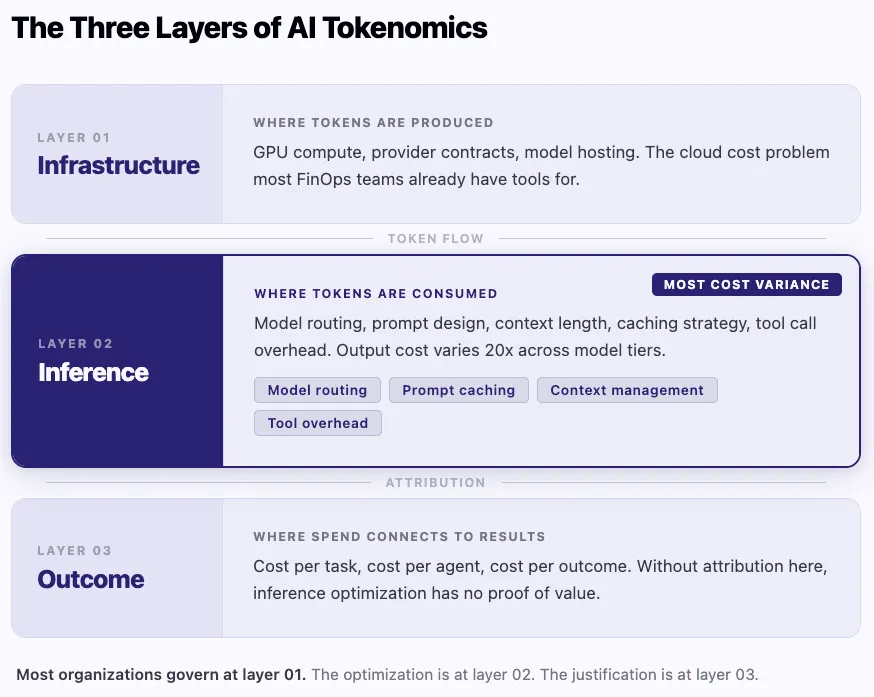
AI token costs operate across three distinct layers, each requiring a different governance approach for the best optimizations. They are:
The infrastructure layer
The inference layer
The outcome layer
Understanding these layers means understanding where cost is produced, controlled, and connects to results. This is the foundation of an effective tokenomics practice.
Most organizations govern their AI costs in the wrong layer, and it’s most often the infrastructure layer since it’s the layer with the most visible FinOps insights, like GPU spend, provider contracts, and how model hosting is structured.
The inference layer is where tokens are consumed. Model routing decisions, prompt design, context length, caching strategy, and tool call overhead determine what you actually spend per task.
For example, output token cost varies more than 20x across model tiers, from $2.50/M on Gemini 2.5 Flash to $50/M on Claude Fable 5 (provider pricing pages, June 2026). Most teams have the least visibility and control here, but it’s one of the best places to optimize.
The outcome layer is where token spend connects to business results, like cost per task, cost per agent, and cost per outcome. Without attribution at this layer, inference optimization is just cost reduction with no proof of value.
FinOps for AI vs. AI Tokenomics
FinOps for AI is the broader discipline: it governs AI spend across the full stack, including compute, storage, and inference. AI tokenomics is the more granular layer underneath it, focused specifically on how individual tokens are consumed, routed, and connected to outcomes.
Both require attribution as the foundation. Without that, FinOps can tell you what you spent with a provider but can't allocate it or forecast it. Conversely, tokenomics can identify optimization opportunities but can't tell you whose problem it is to fix.
FinOps for AI
AI Tokenomics
Scope
Cloud cost governance applied to AI workloads
Inference economics specifically (the consumption layer)
The situation one Sedai customer described is representative: "We're seeing agent-level workflows going through the roof, but we're not even sure what we're getting out of it."
What AI Tokenomics Governance Requires
Governing AI token spend requires policy, visibility, and enforcement across every model call your agents make. In practice, that breaks down into six controls:
Model routing // Direct tasks to the right model based on cost and capability; do not default to frontier models for every call
Caching strategy // Avoid redundant model calls for repeated inputs, particularly stable system prompts and shared context
Cost attribution by agent and team // Use token proxies and tagging that identify which agent or workflow is driving spend
Context management // Control how much conversation history accumulates across agent turns
Cost guardrails // Have usage limits, quotas, and anomaly detection to catch runaway costs before the bill arrives
However, for most organizations, this governance framework is only useful if it can scale. When a team has 50 agents running across multiple providers, with different prompting strategies, context depths, and task frequencies, the number of optimization decisions per hour exceeds what any ops team can monitor and act on in real time.
Achieving optimization scale through manual policy review is not a viable operating model.
Instead, engineering teams need AI agent optimization systems that learn from their own agents' behavior. This means observing and autonomously optimizing:
How each workflow consumes tokens
What routing decisions reduce cost without degrading output
Where spend is increasing before it becomes a problem
AI Tokenomics Use Cases
AI Spend Outpacing Budgets
Most teams don't have a mechanism to catch AI costs until the bill arrives. Spend scales with usage — not headcount or provisioning — so it can double in a quarter without any single decision triggering it. By the time the bill comes in, the budget is already gone, compounding costs.
Provider Billing Lacks Attribution
AI providers only show total cost. So when leadership asks which team, agent, or workflow drove the spend, engineering typically has no answer. Without attribution at the inference layer, there’s no way to know how much was being spent on what.
FinOps Tools Haven’t Evolved for AI Costs
FinOps teams being asked to govern AI costs are working with infrastructure tooling built for compute, storage, and networks. Token consumption doesn't map to that model. They can report what was spent but have no way to effectively reduce it.
Governance Without Enforcement
Engineering, FinOps, and platform teams are all reaching for "AI governance," but without an inference layer, there's nothing to enforce model access policies, routing rules, or cost guardrails against. The goal is named but the mechanism doesn't exist.
Conclusion
The four use cases above share a root cause: token spend is happening at the inference layer but being governed (if at all) at the infrastructure layer. But the controls exist: Model routing, caching, attribution, and cost guardrails. What doesn't exist for most teams is autonomous enforcement at the layer where the spend actually happens. That's the gap AI tokenomics is designed to close.
FAQ
Sedai’s AI Agent Optimization enforces governance at the inference layer — autonomously and safely. Book a demo to see how.