What is Sedai for AI Agent Optimization and what problems does it solve?
Sedai for AI Agent Optimization is a middleware SDK that provides unified visibility, governance, and intelligent routing for all LLM (Large Language Model) calls made by your AI agents. It addresses common challenges such as model selection staleness, fragmented cost tracking, lack of centralized governance, and compliance gaps. By sitting transparently between your agents and LLM providers, Sedai enables real-time cost and usage telemetry, org-level access controls, and dynamic model routing based on your actual production traffic. Note: Teams requiring on-prem LLM support or custom model training pipelines may need to evaluate fit, as Sedai's initial focus is on cloud-based LLM providers. Source
Who should use Sedai for AI Agent Optimization?
Sedai for AI Agent Optimization is designed for engineering teams, FinOps stakeholders, and organizations running multiple AI agents in production. It is especially valuable for teams facing challenges with model selection, cost tracking, governance, and reliability across diverse LLM providers. Typical users include platform engineers, SREs, FinOps leads, and technology leaders responsible for AI agent operations. Note: Teams with highly custom, on-premise LLM deployments may require additional evaluation. Source
Features & Capabilities
What are the main features of Sedai for AI Agent Optimization?
Sedai for AI Agent Optimization offers:
Unified SDK integration (one pip install, one import, no code rewrites)
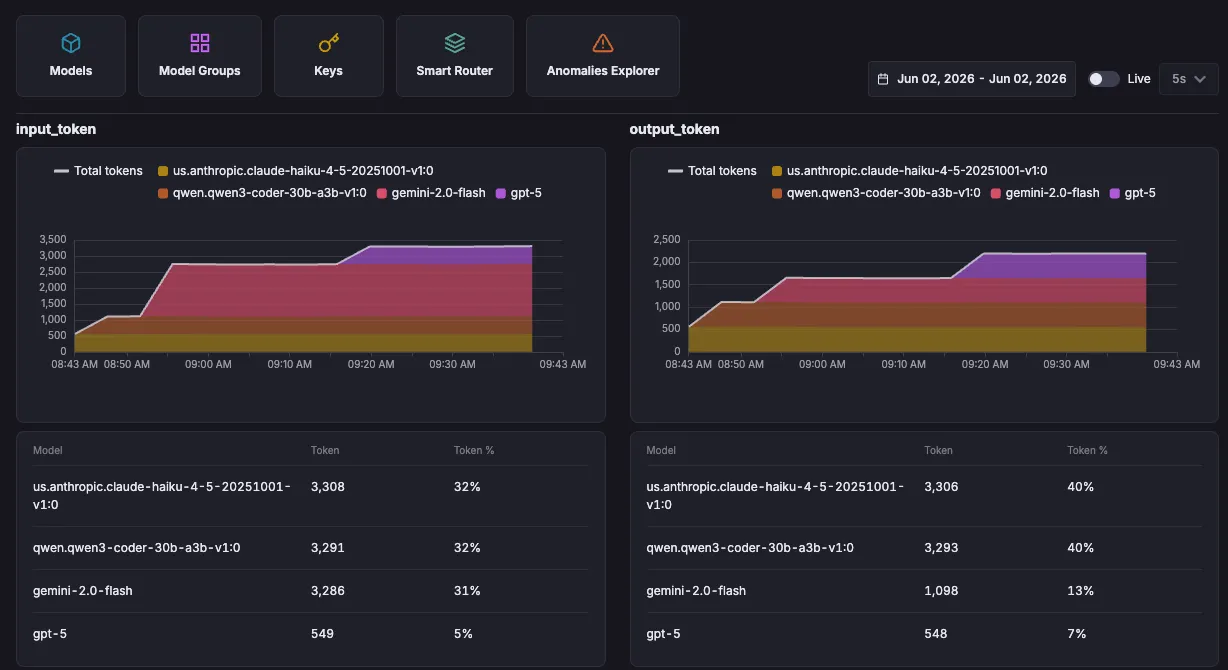
Real-time cost and usage telemetry across all models and providers, including cross-provider drill-downs, token-type breakdowns, latency tracking, and anomaly detection
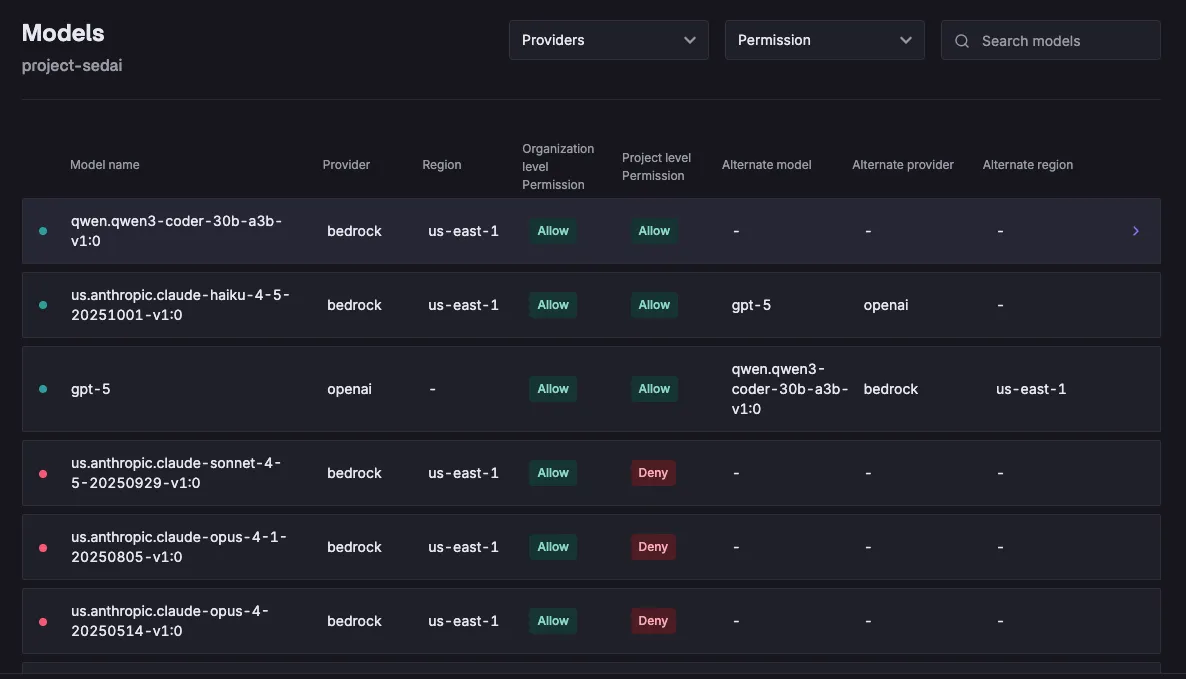
Automatic enforcement of org-level and project-level model access policies
Centralized credential management and usage attribution for chargeback/accountability
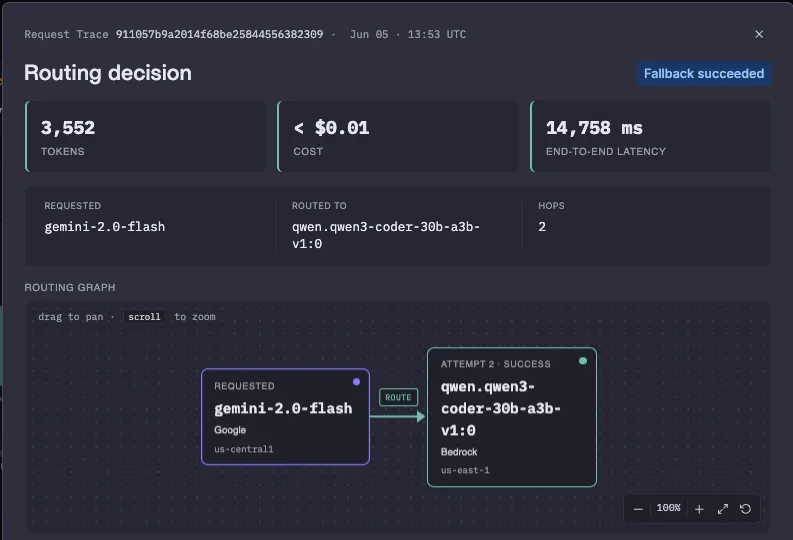
Built-in reliability with retries, cross-provider fallbacks, and client-side load balancing
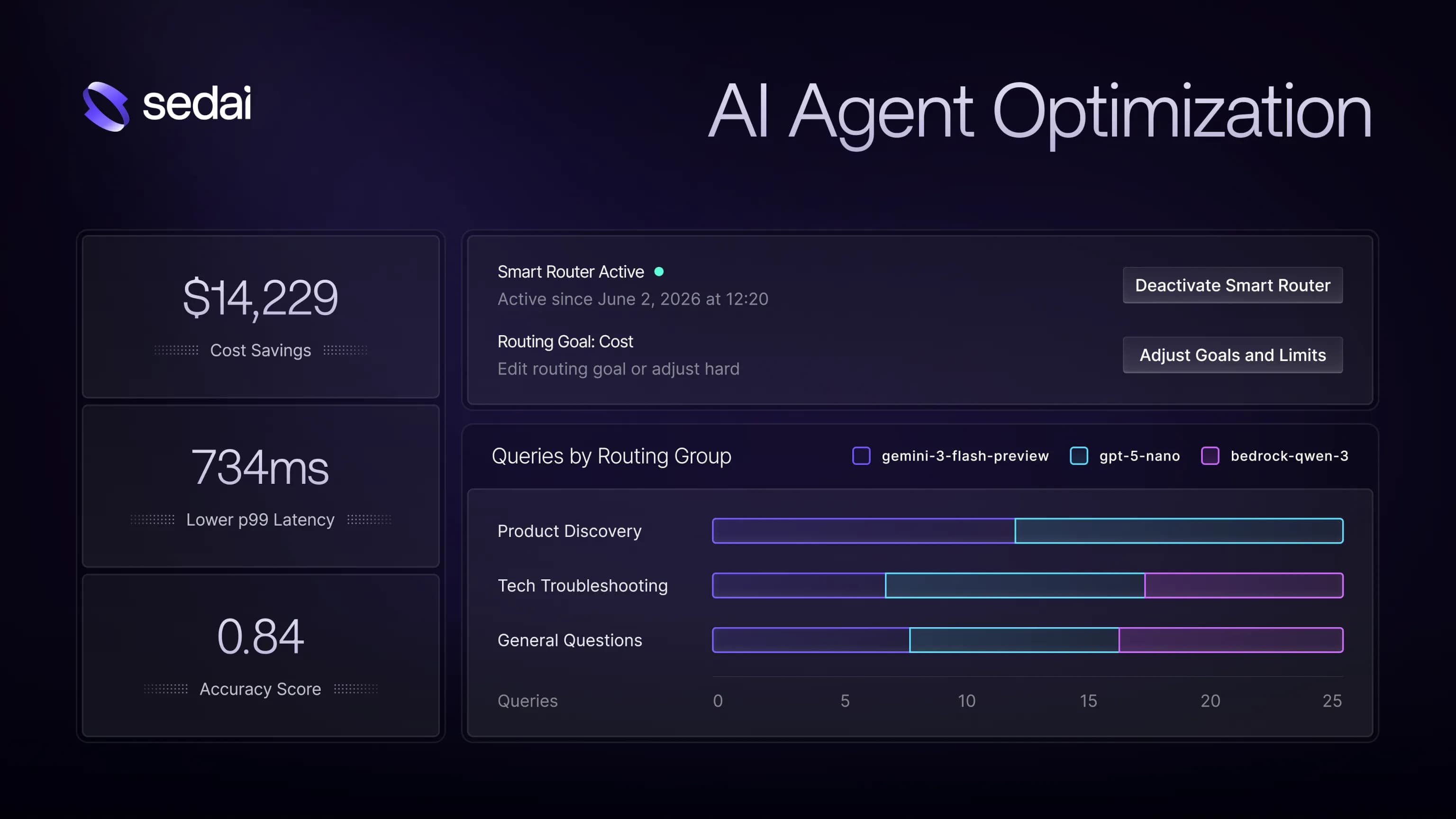
Smart Routing that dynamically selects the most accurate, fastest, and cost-effective model for each prompt, based on your production traffic and priorities
Self-serve onboarding and configuration
Note: Some advanced customization may require additional setup or technical expertise. Source
How does Sedai's Smart Routing work for AI agents?
Sedai's Smart Routing builds a custom router for each agent, trained on your actual production traffic. It clusters prompts into routing groups by domain and task type, then explores candidate models for each group, evaluating them on cost, latency, and accuracy. The result is a Pareto-optimal set of models per group, allowing you to choose the tradeoff that fits your product. Sedai then routes each prompt to the optimal model based on your priorities. Smart Routing adapts as new models are released and benchmarks shift. Note: Teams requiring static, one-model-only routing may not benefit from this feature. Source
Which LLM providers does Sedai for AI Agent Optimization support?
At launch, Sedai for AI Agent Optimization supports OpenAI, AWS Bedrock, Vertex AI, and Azure Foundry. Additional providers are planned for future releases. Note: If your organization relies on other LLM providers, check with Sedai for the latest compatibility roadmap. Source
How does Sedai ensure safety and reliability when optimizing AI agents?
Sedai's platform is designed with safety-by-design principles, including continuous health verification, automatic rollbacks, and incremental changes for real-time validation. For AI Agent Optimization, the SDK handles retries, cross-provider fallbacks, and client-side load balancing, ensuring that model routing changes do not cause downtime or SLO breaches. Sedai is SOC 2 certified, demonstrating adherence to stringent security and compliance standards. Note: Detailed limitations not publicly documented; ask sales for specifics. Source
Implementation & Onboarding
How long does it take to implement Sedai for AI Agent Optimization?
Onboarding for Sedai for AI Agent Optimization is designed to be low-friction, typically taking two to three weeks from start to finish. The process involves a one-line SDK install, connecting your dataset, and working with Sedai to review usage data and refine configuration. No code rewrites are required, and existing agents continue to function as before. Note: Integrating with complex, highly customized environments may require additional time. Source
Is Sedai for AI Agent Optimization available now?
Sedai for AI Agent Optimization is available in early access as of June 2026, with general availability planned for later in 2026. Interested teams can book a demo or request access to the early program. Note: Early access may have feature or provider limitations compared to general availability. Source
Pricing & Plans
How is Sedai for AI Agent Optimization priced?
Sedai uses a volume-based pricing model, charging based on the specific resources optimized (such as pods, tasks, or agent calls). All costs are transparently outlined on Sedai's pricing page, with no hidden fees. A free tier and 30-day free trial are available for evaluation. For AI Agent Optimization, contact Sedai for a tailored quote based on your agent volume and usage. Note: Pricing for AI Agent Optimization may differ from core cloud optimization offerings; confirm details with Sedai sales. Source
Security & Compliance
What security and compliance certifications does Sedai have?
Sedai is SOC 2 certified, demonstrating adherence to industry standards for data protection and compliance. This certification covers the platform's handling of sensitive data, including AI agent telemetry and credentials. For more details, visit the Sedai Security page. Note: For specific compliance requirements, contact Sedai for documentation. Source
Technical Documentation & Support
Where can I find technical documentation for Sedai for AI Agent Optimization?
Sedai provides detailed technical documentation, including a Getting Started Guide and platform overview, available at docs.sedai.io/get-started and the resources page. These resources cover onboarding, configuration, and best practices for using the SDK. Note: Documentation for AI Agent Optimization may be updated as the product moves from early access to general availability. Source
Limitations & Considerations
What are the limitations of Sedai for AI Agent Optimization?
Sedai for AI Agent Optimization is currently available in early access, which may mean limited provider support and evolving feature sets. The platform is focused on cloud-based LLM providers (OpenAI, AWS Bedrock, Vertex AI, Azure Foundry) at launch. Teams requiring on-premise LLM support, custom model training pipelines, or highly specialized routing logic should consult with Sedai to confirm fit. Detailed limitations are not publicly documented; contact Sedai sales for specifics. Source
Your AI agents are in production. Now comes the hard part: keeping them fast, cost-efficient, and under control — without touching your code.
Over the last two years, teams across every industry have built and deployed AI agents. Customer Support bots, coding assistants, document processors, research tools — agents are no longer experiments. They're running in production, and the teams that built them are now living with the consequences of the choices they made early on.
Those choices are starting to show their age.
The model that was the obvious pick six months ago may now be twice the cost of a newer alternative, and score ten points lower on accuracy. The team that hard-coded GPT-4 into their agent last year has no easy way to know whether it's still the right call. And because model selection typically happens once, at build time, most teams are flying blind: no unified view of what they're spending across providers, no mechanism for token cost optimization as models and pricing evolve, no governance to control which models different teams can use.
This isn't a gap that observability tools fill. It's not an infrastructure problem. It's a new layer of the stack that didn't exist until now.
Today, Sedai is launching Sedai for AI Agent Optimization: a middleware SDK that gives teams complete visibility, governance, and intelligent routing across every LLM call their agents make.
The Problem Nobody Owns
Here's what we consistently hear from engineering teams and FinOps stakeholders:
"We did a bunch of work at the beginning to pick the right model, but we never really had a standardized way to go about it. Each team picks whatever they think is best. And now those choices are getting stale."
This problem is structural. Modern engineering organizations run multiple agents, built by different teams, calling different models through different providers. Cost tracking is inconsistent or nonexistent. Access controls are enforced by convention, not policy. And nobody has a single view of what the organization is actually spending on AI — let alone whether those dollars are being spent well.
Two specific problems keep surfacing:
The model landscape moves faster than teams can track. New models release constantly. Benchmarks shift. The right choice for your customer service agent isn't the right choice for your document summarizer. Keeping up requires ongoing benchmarking that no team has the bandwidth to do manually.
Fragmented usage creates hidden costs and compliance gaps. When every team makes model selections independently, you end up with cost spikes nobody saw coming, credentials scattered across codebases, and no way to enforce policies at the organizational level.
Gartner has raised the alarm that without reliable cost estimation and ongoing optimization of LLM-based agents, software engineering teams will blow past budgets, misallocate resources, and ultimately undermine the business case for AI. They’re right, and the fix isn't more dashboards. It requires understanding the complete cost stack and building systematic optimization into how agents run.
That’s exactly what Sedai for AI Agent Optimization is designed to do.
What It Does
Sedai for AI Agent Optimization is a unified SDK that sits transparently between your agents and every LLM provider they call. One pip install. One import. No code rewrites. Your agents keep working exactly as they do today, but now every LLM call flows through a governance, observability, and routing layer you control.
Observability: See Every Token, Every Dollar
The SDK provides real-time cost and usage telemetry across all models and providers, consolidated in one place. Not just totals, but cross-provider drill-downs, token-type breakdowns, latency tracking, and anomaly detection. For the first time, teams can see exactly what they're spending, where, and why.
Governance: Control Without Bureaucracy
Sedai enforces org-level and project-level model access policies automatically. You define which models teams can use; the SDK enforces it. Centralized credential management replaces scattered API keys. Usage attribution makes chargeback and accountability straightforward. No developer self-governance required.
Reliability: Built-In Resilience
The SDK handles retries, cross-provider fallbacks, and client-side load balancing out of the box. If your primary model is unavailable, Sedai routes automatically to your configured fallback — no downtime, no custom engineering. Teams stop reinventing reliability infrastructure and get back to building.
Smart Routing: The Right Model for Every Prompt, Automatically
This is where things get interesting.
Most teams pick one model and use it for everything. That's not because it's optimal; it's because the alternative – continuous benchmarking across a fast-moving model landscape – is impractical. Sedai's Smart Routing eliminates that tradeoff.
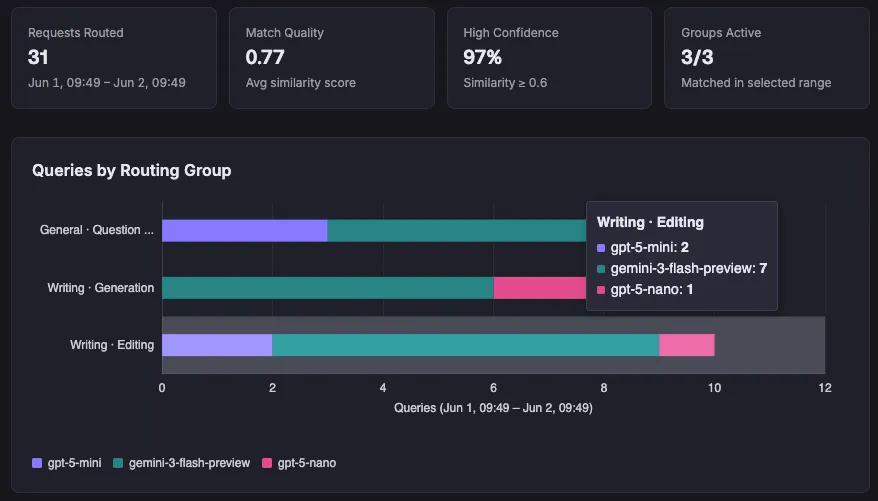
Smart Routing builds a custom router for each of your agents, trained on your actual production traffic. Not generic benchmarks — your queries, your use cases, your accuracy requirements. Sedai clusters your prompts into routing groups by domain and task type, then explores candidate models across those groups, evaluating them on cost, latency, and accuracy together. The result is a Pareto-optimal set of models per routing group: you choose the tradeoff that fits your product, and Sedai handles the routing from there.
Every incoming prompt gets routed to the most accurate, fastest, and cheapest model for that task, based on your priorities, not a one-size-fits-all heuristic.
Teams that want full control can configure their own evaluators, define their own routing groups, and customize every aspect of the router. Teams that want results faster can use Auto Mode, where Sedai handles the entire process end to end: you connect your dataset, and Sedai builds and activates your router. Either way, no code changes required to go live.
And unlike static model selection, Smart Routing keeps working as the landscape evolves. As new models release and benchmarks shift, your router adapts.
Why Sedai
Sedai has been optimizing cloud infrastructure — Kubernetes, GPU, VMs — for years. The approach has always been the same: don't just surface data, act on it. Optimize autonomously. Reduce toil. Let teams focus on shipping, not tuning.
AI Agent Optimization extends that same philosophy to the LLM layer. And because Sedai already runs in your infrastructure, existing customers get this as a natural extension of the platform they already use — no new vendor, no new contract, no separate deployment.
A few things set Sedai's approach apart from the growing field of routing and observability tools:
Traffic-aware, not benchmark-aware. Routing groups are built from your production queries, not from public benchmarks that may have nothing to do with your workloads.
Efficient exploration. Sedai's hybrid predict-then-explore approach builds routers at 30% of the cost of brute-force model testing, without sacrificing accuracy.
Full-stack context. Sedai is the only platform that combines cloud infrastructure optimization, agent observability, governance, and intelligent routing in a single SDK. Competitors address one layer. Sedai covers the stack.
Self-serve, from day one. You log in, connect your dataset, and build your router. No professional services engagement, no long onboarding, no waiting.
Ready to optimize your AI Agents?
Book a Sedai demo to speak with a technical expert.
Get Started
Sedai for AI Agent Optimization is available today in early access, with general availability planned for later in 2026. The platform supports OpenAI, AWS Bedrock, Vertex AI, and Azure Foundry at launch, with others being added over time.
Onboarding is designed to be low-friction — two to three weeks from start to finish, with Sedai working alongside your team to review usage data and refine configuration.
If your team has already built agents and is starting to ask the harder questions — what are we actually spending, are we using the right models, how do we keep this from becoming a mess — this is the layer you've been missing.