Frequently Asked Questions

Onboarding & Implementation

How can I onboard AWS, Kubernetes, Azure, and GCP resources into Sedai using Terraform?

The Sedai Terraform provider allows you to onboard AWS accounts, Kubernetes clusters, Azure, and GCP resources directly into Sedai as part of your existing Terraform workflow. By adding the Sedai provider to your Terraform configuration, you can provision and onboard resources in a single step, eliminating the need for manual onboarding or separate tooling. The provider is open source and available on Terraform's public registry. Note: The provider is best suited for teams already using Terraform for infrastructure provisioning; those not using Terraform may prefer Sedai's UI or API onboarding options. Documentation

How long does it take to onboard resources into Sedai?

Initial setup for Sedai can be completed in as little as 15 minutes using agentless or agent-based deployment. For onboarding via Terraform, the process is integrated into your existing Terraform apply, so onboarding occurs automatically alongside resource provisioning. For AI Agent Optimization, implementation typically takes two to three weeks. Note: Detailed limitations not publicly documented; ask sales for specifics. Getting Started Guide

What documentation is available for onboarding Sedai via Terraform?

Comprehensive documentation for the Sedai Terraform provider, including setup instructions and provider details, is available through the public Terraform registry. Additional onboarding guides for Kubernetes, Databricks, and GPU optimization are accessible at docs.sedai.io/get-started. Note: Documentation is updated regularly; check for the latest version before starting.

Features & Capabilities

What are the key features of the Sedai Terraform provider?

The Sedai Terraform provider enables provisioning and onboarding in one step, supports both short-lived and long-lived resources, and fits seamlessly into existing infrastructure-as-code (IaC) playbooks. It is powered by Sedai's SDK and APIs, ensuring trusted integration. Platform and architecture teams can standardize onboarding across multiple teams without requiring engineers to learn new tools. Note: The provider is open source and published on Terraform's public registry. Provider Details

What integrations does Sedai support beyond Terraform?

Sedai integrates with 12 APMs (including Prometheus, Datadog, AWS CloudWatch, Azure Monitor, Google Cloud Monitoring), Kubernetes autoscalers (HPA/VPA, Karpenter), CI/CD tools (GitHub, GitLab, Bitbucket, Terraform), ITSM tools (ServiceNow, PagerDuty, Jira), notification platforms, runbook automation, and cloud providers (AWS, Azure, GCP). Note: Integration coverage may vary by environment; check documentation for specifics. Platform Integrations

What are Sedai's core capabilities for cloud optimization?

Sedai provides autonomous cloud management, release intelligence, intelligent topology inference, safety-by-design (continuous health verification, automatic rollbacks, incremental changes), and full-stack cloud coverage across AWS, Azure, GCP, and Kubernetes. It delivers up to 50% cost savings, 75% latency reduction, 6X productivity gains, and reduces failed customer interactions by up to 70%. Note: Best fit for teams seeking autonomous optimization; teams needing manual control may want to consider alternatives. Platform Capabilities

Use Cases & Benefits

Who should use the Sedai Terraform provider?

The Sedai Terraform provider is especially relevant for platform engineering, architecture review, and governance teams responsible for defining infrastructure provisioning standards. It enables central teams to embed Sedai onboarding into shared IaC patterns, making Sedai coverage an inherited default. Engineers and DevOps teams benefit by receiving Sedai optimization automatically, without needing to learn Sedai's UI or request manual onboarding. Note: Teams not using Terraform may prefer Sedai's UI or API onboarding options.

What business impact can customers expect from using Sedai?

Customers can achieve up to 50% reduction in cloud costs, 75% latency reduction, 70% fewer failed customer interactions, and up to 6X productivity gains for engineering teams. Sedai's autonomous optimization ensures business continuity, improved release quality, and measurable operational efficiency. Note: Actual results may vary by environment and workload; detailed limitations not publicly documented. Business Impact

Can you share specific customer success stories related to Sedai onboarding?

KnowBe4 achieved up to 50% cost savings and reduced response time from 18.5 seconds to 80 milliseconds (99.5% duration reduction) using Sedai. Palo Alto Networks saved $3.5 million through Sedai's optimization. Belcorp reduced AWS Lambda latency by 77%. Campspot achieved a 34% reduction in AWS Lambda latency. Inflection improved platform performance and reduced cold start latency. Freshworks optimized AWS Lambda for better user experience. Note: Results are specific to each customer and environment; see Sedai's resources page for case studies.

Technical Requirements & Security

What are the technical requirements for using the Sedai Terraform provider?

To use the Sedai Terraform provider, you need an existing Terraform workflow and access to the Sedai SDK and APIs. The provider is compatible with AWS, Azure, GCP, and Kubernetes resources. Documentation and setup instructions are available on the Terraform registry and Sedai's documentation site. Note: Teams not using Terraform may prefer Sedai's UI or API onboarding options. Provider Documentation

What security and compliance certifications does Sedai have?

Sedai is SOC 2 certified, demonstrating adherence to stringent security requirements and industry standards for data protection and compliance. For more details, visit Sedai's Security page. Note: Additional certifications may be available; contact Sedai for specifics.

Pricing & Support

What is Sedai's pricing model?

Sedai uses resource-based pricing, determined by the resources optimized and the value delivered. For Kubernetes environments, tailored pricing is available. All costs are transparently outlined on Sedai's pricing page, with no hidden fees. Discounts from cloud billing accounts (e.g., Reserved Instances, Savings Plans) are factored into cost and savings calculations. Note: For specific pricing, contact Sedai's sales team or request a demo. Pricing Page

What support options are available for Sedai onboarding?

Sedai offers personalized onboarding sessions, extensive documentation, and a community Slack channel for real-time assistance. Customers can also access a free Proof of Value and a 30-day free trial to evaluate the platform. Note: Support coverage may vary by region and environment; contact Sedai for details. Support Documentation

Product Information & Limitations

What is the primary purpose of the Sedai Terraform provider?

The Sedai Terraform provider is designed to enable teams to onboard cloud resources into Sedai without leaving their existing Terraform workflow. It eliminates operational toil by automating onboarding, ensuring resources are optimized throughout their lifecycle. Note: The provider is best suited for teams using Terraform; those not using Terraform may prefer Sedai's UI or API onboarding options.

Are there any limitations or edge cases for Sedai onboarding via Terraform?

Detailed limitations for Sedai onboarding via Terraform are not publicly documented. For edge cases or specific scenarios, it is recommended to contact Sedai's sales or support team for guidance. Note: Teams not using Terraform may prefer Sedai's UI or API onboarding options.

Sedai Logo

Onboard to Sedai Your Way: Introducing the Sedai Terraform Provider

Ethan Andyshak Headshot

Ethan Andyshak

VP of Product

September 15, 2026

Onboard to Sedai Your Way: Introducing the Sedai Terraform Provider

Featured

If your team already manages infrastructure through Terraform, you shouldn't have to leave that workflow behind just to bring your resources into Sedai. Starting today, you don't have to.

We're excited to announce the Sedai Terraform provider, a new way to onboard AWS accounts, Kubernetes clusters, Azure and GCP resources into Sedai — no UI, no separate tooling, no new process to learn. If you already know Terraform, you already know how to use it.

Why we built this

Sedai's onboarding has always evolved alongside how our customers actually work. It started as a point-and-click, UI-driven experience. Over time, we added SDKs and APIs so teams could onboard resources programmatically as part of their own automation. The Terraform provider is the next step in that same journey: giving teams the flexibility to onboard resources in whatever way fits best within their existing tooling and processes.

This particular capability was shaped directly by customer need. A large, highly federated organization using Sedai asked for exactly this: a way to standardize onboarding across dozens of internal teams without asking every engineer to learn a new tool or process. Their central platform team already maintains shared infrastructure-as-code patterns for provisioning cloud accounts and clusters; they just wanted Sedai onboarding folded into that same workflow.

How it works

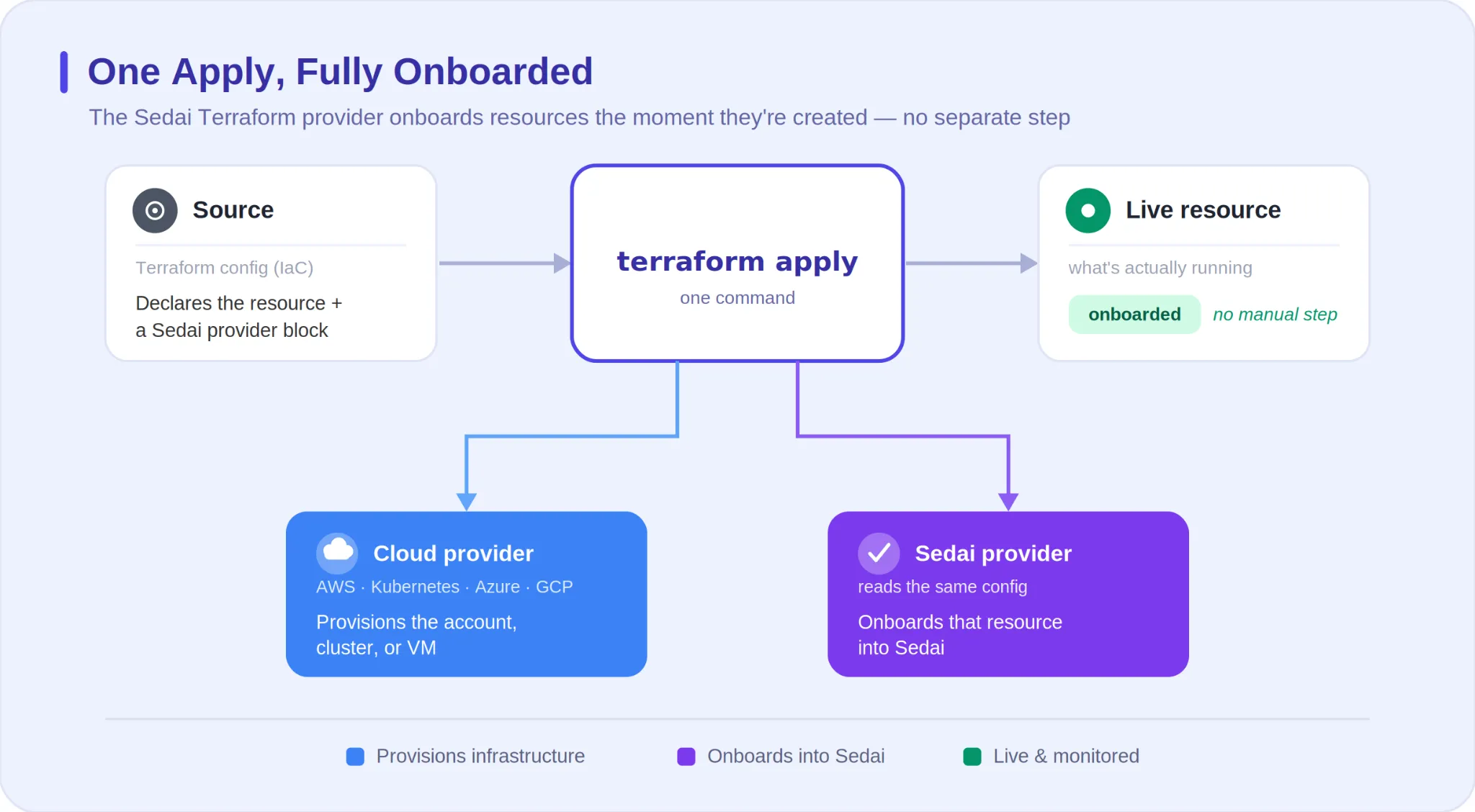
Terraform providers are the standard way infrastructure-as-code tools read your configuration and provision resources, whether that's an AWS account, a set of VMs, or a Kubernetes cluster. The Sedai Terraform provider works the same way: it reads your existing Terraform configuration and onboards the corresponding resources into Sedai automatically, right alongside the infrastructure being provisioned.

In practice, that means:

  • Provision and onboard in one step. Spin up an AWS account, Kubernetes cluster, Azure resource, or GCP resource, and onboard it into Sedai as part of the same Terraform apply. No separate manual step required.
  • Built on our existing SDK and APIs. The provider is powered by the same SDK and APIs that already back Sedai's programmatic onboarding, so it's a natural extension of infrastructure you can already trust.
  • Works for short-lived and long-lived resources alike. Whether it's a cluster spun up for a few weeks of feature testing or a permanent production account, the provider makes sure Sedai optimization is available for the full lifecycle of the resource, not just the resources that happen to get onboarded manually.
  • Fits your existing playbooks. Platform and architecture teams can add the Sedai provider to the shared IaC patterns they already hand down to other teams, so onboarding becomes an inherited default rather than an extra checklist item.

The provider is open source and published on Terraform's public registry, so it's easy to find, inspect, and adopt using the same conventions you already use for any other provider.
Onboarding via Terraform

Who this is for

This is especially relevant if you're on a platform engineering, architecture review, or governance team responsible for defining how infrastructure gets provisioned across an organization. It lets you build Sedai onboarding directly into the standards you already maintain, rather than layering on a separate process for individual teams to follow. The engineers and DevOps teams actually building and owning that infrastructure benefit too — they get Sedai coverage automatically, without having to learn Sedai's UI or talk to a separate team to get set up.

Part of a bigger picture

This launch is one piece of a broader goal: making Sedai easy to work with wherever your team already operates — through APIs, SDKs, and now infrastructure-as-code tooling — rather than requiring everyone to come to a single interface. Meeting teams in their existing tools, instead of asking them to adopt new ones, is a theme you'll continue to see from us.

Get Started

The Sedai Terraform provider is generally available today. Documentation, setup instructions, and provider details are available through the public Terraform registry.


Terraform Onboarding