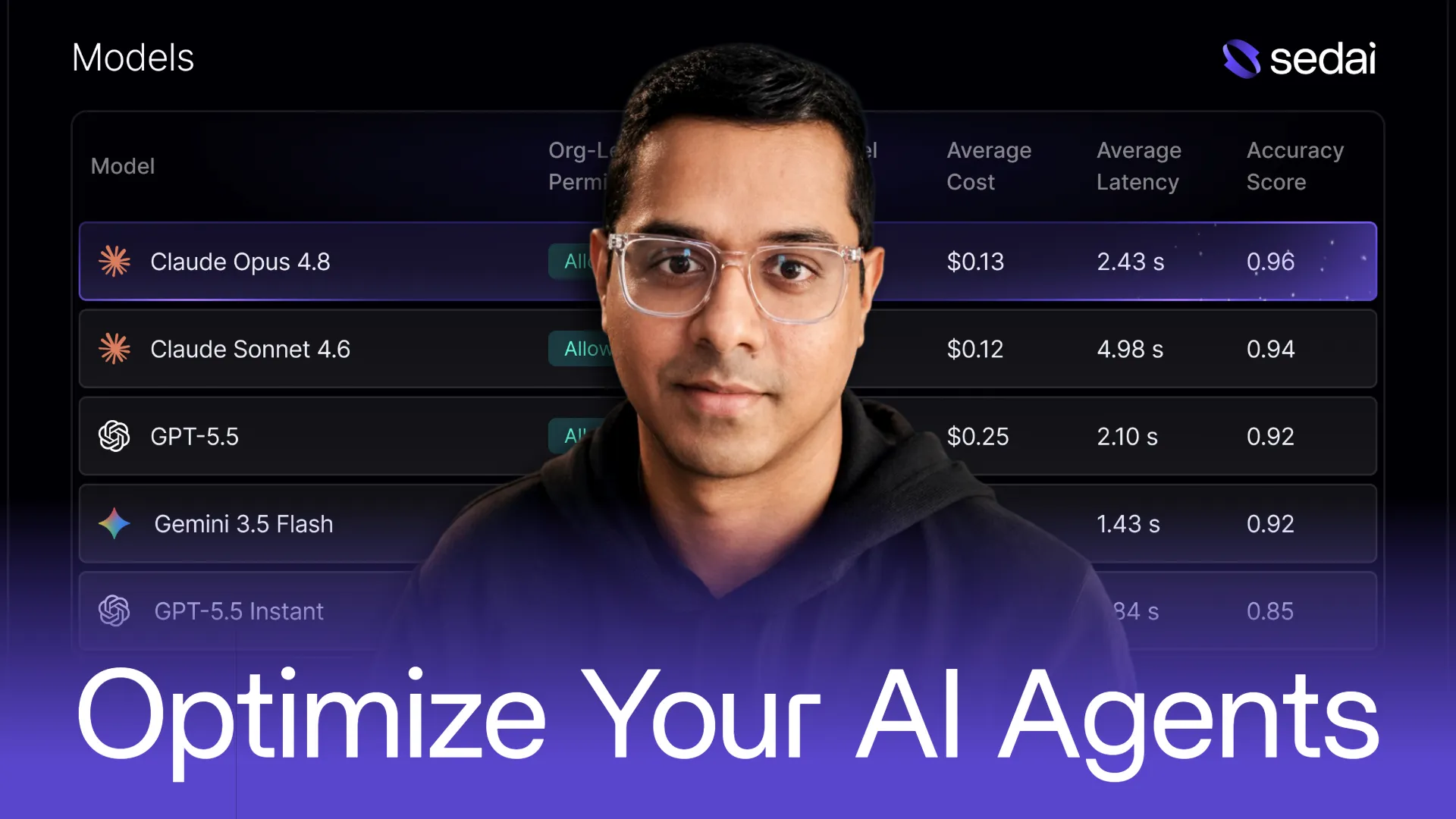
AI agent optimization is the ongoing practice of improving an AI agent's cost, quality, latency, and reliability in production. It operates across four layers—observability, governance, reliability, and optimization—treating the full agent runtime as a production system rather than a static configuration. This approach tracks and optimizes the entire agent execution loop, not just individual model calls. Note: AI agent optimization is distinct from prompt engineering or model fine-tuning, which focus on single interactions or model weights, respectively. Source: Sedai Blog.
How does AI agent optimization differ from LLM optimization?
AI agent optimization is a system-layer intervention that manages routing, governance, observability, and reliability for multi-step agent execution loops in production. In contrast, LLM optimization is a model-layer intervention focused on fine-tuning, RLHF, and prompt engineering for single model calls. Each addresses different failure modes: agent optimization ensures cost control, reliability, and governance at scale, while LLM optimization improves model output quality. Note: Both are necessary; optimizing only one layer leaves gaps in production reliability and cost attribution. Source: Sedai Blog.
What are the four pillars of AI agent optimization?
The four pillars of AI agent optimization are: Observability (instrumenting every agent call and decision to surface failures), Governance (setting spend limits, model allowlists, and access controls to prevent runaway spend), Reliability (handling retries, fallbacks, and context window limits to maintain pipeline continuity), and Optimization (routing calls, tuning prompts, and caching repeated inputs to reduce cost and latency per task). Note: Each pillar addresses a different failure mode in production agent systems. Source: Sedai Blog.
What metrics define a well-optimized AI agent?
Three key metrics define a well-optimized AI agent: Task success rate (the rate of correct outcomes, not just plausible responses), Unit economics (total cost per completed task, including model tokens, tool calls, retries, and human review), and Risk (the rate of policy violations, unsafe actions, or irreversible mistakes per task run). All three must be tracked together to ensure optimization does not sacrifice quality or safety for cost. Note: Focusing on cost alone can degrade output quality if not balanced with success rate and risk controls. Source: Sedai Blog.
Can AI agent optimization be applied to agents already running in production?
Yes, AI agent optimization can be applied to agents already running in production without requiring a rewrite. Instrumentation and optimization layers can be added to existing agents to improve cost, reliability, and governance. Note: Some legacy agents may require additional integration work if they lack standard observability hooks. Source: Sedai Blog.
Features & Capabilities
What are the main features of Sedai's AI agent optimization platform?
Sedai's AI agent optimization platform includes:
Observability for every agent call, tool invocation, and decision, using standards like OpenTelemetry GenAI semantic conventions
Governance with spend limits, model allowlists, and centralized credential management
Reliability infrastructure with retries, typed fallback chains, and circuit breakers
Optimization features such as smart routing, automated prompt optimization, caching, and context window management
Note: While Sedai automates these optimizations, teams with highly custom agent architectures may need to validate compatibility with their existing systems. Source: Sedai Blog.
How does Sedai ensure safety and reliability in AI agent optimization?
Sedai's platform is designed with safety-by-design principles, including continuous health verification, automatic rollbacks, and incremental changes. Reliability features include retry logic with exponential backoff and jitter, typed fallback chains for different failure types, and circuit breakers to prevent retry spirals during provider outages. These mechanisms ensure that optimizations do not cause incidents or breach SLOs. Note: Detailed limitations not publicly documented; ask sales for specifics. Source: Sedai Platform.
What technical documentation is available for implementing Sedai's AI agent optimization?
Sedai provides comprehensive technical documentation, including getting started guides, Kubernetes optimization, Databricks optimization, and GPU optimization. These resources are available at docs.sedai.io/get-started. Note: Some advanced use cases may require direct support from Sedai's engineering team. Source: Sedai Docs.
Use Cases & Benefits
What business impact can customers expect from Sedai's AI agent optimization?
Customers can achieve up to 50% reduction in cloud costs, reduce latency by up to 75%, and decrease failed customer interactions by up to 70%. Engineering teams may see up to 6X productivity gains due to automation of repetitive tasks. These outcomes are based on real customer deployments and case studies. Note: Actual results may vary depending on workload and integration scope. Source: Sedai Platform.
Who owns AI agent optimization within an organization?
AI agent optimization is typically owned by Platform Engineers and VPs of Engineering, as they manage the infrastructure and see AI cost spikes without attribution. FinOps practitioners are responsible for cost attribution but often lack visibility into model call attribution. Enterprise Architects and CISOs own governance, ensuring model approval, credential management, and audit trails. Note: Effective optimization requires collaboration across these roles. Source: Sedai Blog.
What are common use cases for AI agent optimization?
Common use cases include:
Cost attribution by team and agent, tagging every LLM call for accountability
Cost anomaly detection to prevent runaway AI spend
Routing low-complexity subtasks to smaller, less expensive models
Enforcing model governance fleet-wide with centralized policies
Cross-provider fallback during outages for uninterrupted service
Note: Some use cases may require integration with existing monitoring or governance systems. Source: Sedai Blog.
Pricing & Implementation
How is Sedai's AI agent optimization priced?
Sedai uses a resource-based pricing model, where costs are determined by the resources optimized and the value delivered. For Kubernetes environments, tailored pricing is available. All costs are transparently outlined on Sedai's pricing page, and discounts from cloud billing accounts are factored into calculations. Note: For specific pricing details, contact Sedai's sales team. Source: Sedai Pricing.
How long does it take to implement Sedai's AI agent optimization?
Initial setup for general use cases can be completed in as little as 15 minutes using agentless or agent-based deployment. For AI Agent Optimization specifically, implementation typically takes two to three weeks. Databricks environments can be set up in under 15 minutes. Note: Complex environments or custom integrations may require additional time. Source: Sedai Platform.
Security & Compliance
What security and compliance certifications does Sedai have?
Sedai is SOC 2 certified, demonstrating adherence to stringent security requirements and industry standards for data protection and compliance. For more details, visit the Sedai Security page. Note: For additional certifications or compliance questions, contact Sedai directly. Source: Sedai Security.
Customer Success & Case Studies
Can you share specific case studies or success stories of customers using Sedai's AI agent optimization?
Yes. For example, KnowBe4 achieved up to 50% cost savings and reduced average response time from 18.5 seconds to 80 milliseconds (a 99.5% reduction) using Sedai. Palo Alto Networks saved $3.5 million through Sedai's optimization. Belcorp reduced AWS Lambda latency by 77%, and Campspot achieved a 34% reduction in latency. For more, see the Sedai resources page. Note: Results depend on workload and integration scope. Source: Sedai Resources.
Limitations & Trade-Offs
Are there any limitations or scenarios where Sedai's AI agent optimization may not be the best fit?
Detailed limitations are not publicly documented. Teams with highly custom agent architectures or unique compliance requirements should contact Sedai sales for specifics. Note: Admitting limitations helps buyers make informed decisions; always validate fit for your environment. Source: Company documentation.
KO THE CLOUD TO ENTER OUR GIVEAWAYKO THE CLOUD TO ENTER OUR GIVEAWAY
AI agent optimization is the practice of improving an AI agent so it completes tasks more reliably, at lower cost, and with less risk. In practice, it means managing the full runtime system: routing decisions, model selection, tool use, context management, guardrails, evaluation, and reliability infrastructure.
Key Takeaways
AI agent optimization improves task success rate, cost per task, and risk controls across the full agent execution loop rather than a single model call.
Observability, governance, reliability, and optimization are the four pillars to AI agent optimization, and each addresses a different failure mode.
"FinOps for AI" is the emerging practice of applying cloud cost attribution models to the model call layer.
AI agent optimization applies to agents already running in production without a required rewrite.
What Is an AI Agent?
An AI agent is a software system that uses a large language model (LLM) to plan and execute multi-step tasks autonomously. Unlike a single model call that takes an input and returns an output, an agent operates in a loop, calling tools, retrieving information, making decisions, and taking actions across a sequence of steps to complete a goal.
What Is AI Agent Optimization?
AI agent optimization is the ongoing practice of improving an AI agent's consistency, cost per task, and risk controls under real production conditions. In practice, this means managing routing decisions, model selection, tool use, context management, guardrails, evaluation, and reliability infrastructure across the full agent execution loop.
Three metrics define a well-optimized agent:
Task success rate: The rate of correct outcomes, not plausible responses
Unit economics: The total cost per completed task; combines model tokens, tool calls, retries, and human review
Risk: The rate of policy violations, unsafe actions, or irreversible mistakes per task run
All three must be tracked together. For example, optimizing cost without tracking task success rate means an agent will route calls to a cheaper model regardless of whether output quality is degrading or not.
What makes this distinct from prompt engineering or model fine-tuning is the unit of work:
Prompt engineering improves a single interaction
Model fine-tuning changes the weights of a specific model
By contrast, AI agent optimization addresses the full runtime system. So, for example, a customer support agent making eight LLM calls per ticket has eight opportunities to overpay, use the wrong model, or retry unnecessarily.
Only some of those calls need a frontier model, and without routing, all eight go to the same expensive endpoint. That inefficiency compounds across thousands of tickets a day. Addressing it at scale requires instrumentation across every agent call and continuous optimization of what that data surfaces.
Engineering teams can build these layers manually per agent, or an infrastructure layer can manage it automatically across every agent already running in production.
How AI Agent Optimization Works
AI agent optimization works through four pillars:
Pillar
What it does
Outcome
Observability
Instruments every agent call, tool invocation, and decision
Surfaces what's failing
Governance
Sets spend limits, model allowlists, and access controls
Prevents runaway spend
Reliability
Handles retries, fallbacks, and context window limits
Maintains pipeline continuity
Optimization
Routes calls, tunes prompts, and caches repeated inputs
Reduces cost and latency per task
Observability
Agent observability instruments every step an agent executes, including LLM calls, tool invocations, retrieval steps, planning decisions, memory operations, and agent-to-agent handoffs.
By contrast, standard monitoring only tracks HTTP latency, error rates, and CPU utilization, which tells you whether a request completed, but not whether the agent took the right action or why a multi-turn sequence failed.
The standard for agent instrumentation is OpenTelemetry GenAI semantic conventions, which define standardized attribute names for LLM spans so traces are queryable the same way, regardless of which framework or provider produced them. A single agent conversation can generate megabytes of deeply nested spans across dozens of runs, which is why agent-specific observability tooling exists as a category separate from APM.
Agent observability addresses two distinct operational gaps that standard APM cannot fill: trace level visibility and fleet-level visibility.
With trace-level visibility, you can see what happened inside a specific agent run, and it requires a dedicated tracing provider such as LangSmith or Langfuse.
With fleet-level visibility, you can see what the entire agent fleet is spending and where. This means token usage, cost, errors, and latency across every provider and model. Standard APM doesn't provide this because it tracks infrastructure metrics, not model call costs across external providers.
Governance
Governance sets the constraints an agentic fleet operates within. It controls which models and providers teams can use, and enforces that control automatically rather than relying on developer self-governance.
Specifically, governance prevents model sprawl. This means when teams independently select models, credentials scatter across codebases, and there’s no single view of what the organization is spending or whether they’re using approved models.
When every team makes model selections independently, cost spikes arrive without attribution and compliance gaps accumulate without visibility.
To manage this, governance must use a two-tier model access control, consisting of organization-level policies and individual agents:
The organizational policy tier sets Allow/Deny policies for the entire fleet
The agent tier overrides those policies for teams with different requirements
Every agent in the fleet inherits the org-level policy by default; agent-level configuration narrows or extends it.
Alongside access control, governance at the agent layer addresses credential sprawl and missing usage attribution. Centralized credential management replaces scattered API keys with consolidated provider authentication per agent, removing the credential sprawl that makes model sprawl hard to detect. Usage attribution maps every LLM call to the team and agent that originated it, which is the prerequisite for chargeback.
These controls apply automatically to every agent in the fleet, including newly deployed ones, without requiring developers to implement them per agent.
Reliability
Reliability is the infrastructure layer underneath observing and governing agents. Unlike a single API call, an agent makes dozens of LLM calls per task, which means every failure mode that exists in a standard API integration compounds across the full sequence.
LLM API calls fail in production from:
Rate limits (429)
Server errors (500, 502, 503, 504)
Timeouts
Partial responses
Without reliability infrastructure, any single failure cascades into full pipeline abort for every LLM call that follows in the sequence.
The first line of defense is retry logic, which handles transient failures on the same provider.
Retryable Status Codes
Non-Retryable Status Codes
429
400
500
401
502
403
503
404
504
-
However, client-side errors don't resolve on retry. Implementation uses exponential backoff with jitter and respects rate limit headers when available. Retrying without jitter produces thundering herd problems when multiple agents simultaneously hit the same rate limit and retry at the same interval.
Typed fallback chains handle failures that retries cannot resolve. A single ranked provider list fails because different failure types need different fixes. The correct implementation uses three pools, each keyed to a specific failure type. For example:
General API errors and timeouts should route to an alternative provider
Context window exceeded errors should route to a model with a larger context window, not just a different provider
Content policy violations route to a different provider entirely, not a smaller model from the same provider
So routing a context window error to a provider with the same window size or a policy violation to a smaller model on the same provider wastes the fallback. Each pool exists because the failure it handles has a different correct fix. But fallback chains don’t address repeated retries against a provider in a full outage.
Circuit breakers prevent these retry spirals from compounding. Without a circuit breaker, an agent retrying against a provider in a full outage burns time and compute indefinitely. A circuit breaker opens after a failure threshold is exceeded within a rolling time window, routes immediately to the fallback chain for the timeout duration, then closes after confirming recovery.
A provider outage that would abort a pipeline becomes a transparent fallback the application layer never sees.
Optimization
Smart Routing
With the fleet observed and governed, routing optimizes which model handles each call. Most teams pick a model at build time and use it for everything. But new models release constantly, benchmarks shift, and the cost-accuracy tradeoffs change with them.
So a model that was the right choice six months ago may now cost twice as much as a newer alternative with better accuracy on the same tasks. And manual re-evaluation across an agent fleet is not feasible at scale.
Production-traffic-aware routing replaces that manual process. Rather than manually defining which model handles which task type, it analyzes actual production traffic to cluster prompts into routing groups by shared behavior and optimization needs. It then explores candidate models across those groups, evaluating them on cost and latency directly from API responses, and on accuracy through a separate evaluation step.
Because live traffic is unlabeled, evaluating accuracy requires a labeled dataset per routing group scored by an LLM judge, a reference model, or human review.
The result is a router built from actual queries and accuracy requirements rather than generic benchmarks that may have nothing to do with the real workload. Unlike static model selection, a traffic-aware router continuously re-evaluates as new models enter the market and as the agent's own traffic evolves.
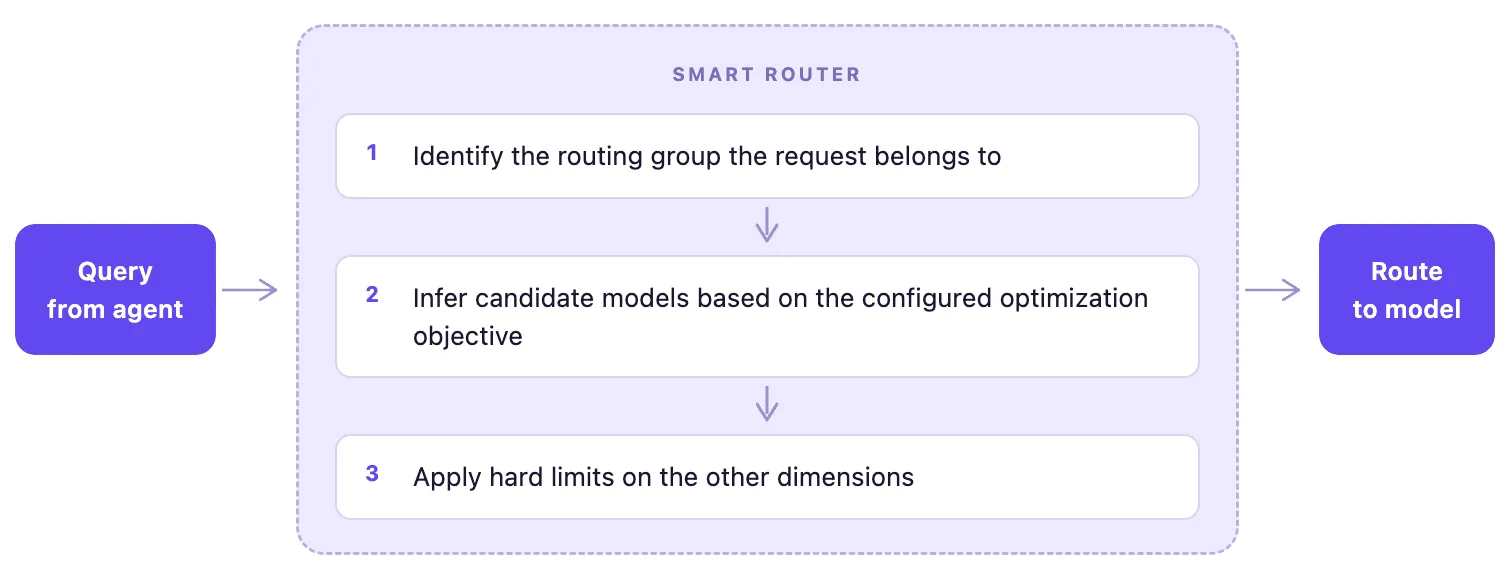
Once live, the router directs each incoming prompt to the best model based on stated priorities, like minimizing cost, reducing latency, or protecting accuracy above a defined threshold. Those priorities are configured through goal and limit controls, which let you optimize for one primary objective while setting hard limits on the others. So a cost-optimized router won't exceed a latency SLA, and an accuracy-first router won't exceed budget.
Then, at inference time, the router:
Identifies which routing group the request belongs to
Infers the candidate model list based on the configured optimization objective
Applies any hard limits on the other dimensions
Routes to the model
Prompt Optimization
Prompt optimization treats prompts as versioned, tested artifacts rather than static text. In production agent systems, a poorly structured prompt doesn't just produce worse outputs but also more tokens, which multiplies across every call the agent makes.
To optimize, manual prompt tuning is possible, but it’s based on trial and error. Engineers will often write a prompt, test it against a few examples, and adjust based on intuition.
Automated prompt optimization replaces that with systematic evaluation against a held-out test set and a defined metric, then iterates programmatically.
DSPy, an open-source framework from Omar Khattab at Databricks, compiles LLM pipelines into self-improving programs. In benchmarks, DSPy-optimized prompts outperformed expert-written few-shot prompt chains by up to 46% on complex reasoning tasks (Khattab, 2023).
The implication for agent systems is that prompt quality is not fixed at deploy time. An agent running in production accumulates signals that can feed back into prompt improvement continuously, including:
What queries the agent handles
Where the agent fails
What outputs score well
Caching
Prompt caching reuses the processed computation from stable parts of a request so the provider doesn't reprocess them on every call. The stable portion of most agent requests like system prompts, tool definitions, policy documents, and RAG context, appears identically across thousands of requests per day.
Without caching, every request pays the full input token cost for that repeated content. With caching, those tokens bill at a significantly reduced rate. Both Anthropic and OpenAI support prompt caching natively.
Whether a cache hit occurs depends on how the prompt is structured: stable content must appear first in the prompt and dynamic content last. If the ordering is wrong, the cache never hits. Get it right and the majority of input tokens in a high-volume agent system cost a fraction of what they did before.
Cache hits also reduce latency. The provider skips reprocessing the cached prefix, which means time-to-first-token drops alongside cost. For customer-facing agents where latency affects user experience, caching addresses both dimensions at once.
Context Window Management
Agent costs compound with context length. In a multi-turn agent loop, every step appends to the context and input token count grows with each step. The problem is structural: an agent carries accumulated context from prior calls into each new request.
The techniques for managing this fall into three categories:
Trimming
Compression
Retrieval
Trimming removes low-value content from history, like redundant tool results, verbose intermediate steps, and turns that no longer affect the current decision.
Compression summarizes prior context rather than including it verbatim, using hierarchical summarization where older content gets progressively compacted as the conversation grows.
Retrieval replaces full context inclusion with selective injection. The agent fetches only the specific prior context relevant to the current step, rather than maintaining the full history in every request.
The practical question is which prior context actually affects the current decision, and which is just overhead. In most production agent systems, the answer is that most context is overhead, and trimming or compressing it has no measurable effect on output quality.
Ready to optimize your AI Agents?
Book a Sedai demo to speak with a technical expert.
AI Agent Optimization vs. LLM Optimization
AI agent optimization is a system-layer intervention. It decides:
What an agent is allowed to call
What those calls cost and return
Whether failures are handled gracefully
Whether each call is routed to the most cost-appropriate model
LLM optimization is a model-layer intervention:
Fine-tuning adjusts weights
RLHF aligns outputs
Prompt engineering structures inputs more effectively
AI Agent Optimization
LLM Optimization
Unit of work
Multi-step agent execution loop
Single model call
What it changes
Routing, governance, observability, reliability
Fine-tuning, RLHF, prompt templates
Where it applies
Production systems already running
Model development and evaluation
Who owns it
Platform Engineering, FinOps
ML Engineering
Each optimization process addresses a different failure mode and are not substitutes. A poorly prompted model produces bad outputs regardless of how well the agent system is optimized. A well-prompted model running in an unobserved, unrouted, ungoverned agent system still produces unpredictable costs, governance gaps, and reliability failures in production.
Most engineering teams have more mature tooling at the model layer than at the agent system layer, and that’s where AI agent optimization comes in.
Why AI Agent Costs Are Hard to Attribute and Control
AI agent costs are hard to attribute and control because agent systems make dozens of LLM calls per task, and most of those calls are unrouted, unattributed, and unmonitored.
The average large enterprise spends $11.6 million annually on AI models , up from $4.5 million in 2024 (A16z, 2026). And monthly token spend has increased 13x in the last 18 months (Ramp, 2026).
At the developer level, Microsoft has pulled engineers off Claude Code when usage ran up to $2,000 per engineer per month, a threshold that arrived faster than finance teams anticipated (Yahoo Finance, 2026).
Visibility is the core problem. Engineering teams can see that AI spend is growing on their cloud invoice, but cannot see which agent drove which cost, which team is responsible, or whether the outcome justified the expense.
And this cost problem compounds because of how agents are built. Every unoptimized call type multiplies across every task, agent, and team running in production simultaneously.
"FinOps for AI" has emerged to address this issue because the cost attribution model FinOps built for cloud infrastructure does not formally exist yet for the model call layer.
Who Owns AI Agent Optimization?
Platform Engineers and VPs of Engineering
Platform Engineers and VPs of Engineering own AI agent optimization in practice because they see AI cost spikes without attribution. They own the infrastructure agents run on, but not the model selection decisions individual teams make. So when FinOps asks what the agents are spending per task, they have no answer.
FinOps Practitioners
While FinOps owns cost attribution for cloud infrastructure, that visibility does not extend to model call attribution; they can't see what the agent fleet is spending or which team is responsible.
They need the same cost ownership model for agents and LLMs that was built for cloud, meaning attributing costs:
Per-team
Per-project
Per-workload
Enterprise Architects and CISOs
Enterprise Architects and CISOs own the governance problem, typically escalated from legal or compliance. That means knowing which models are approved for use, who holds the credentials, and who is accountable for every LLM call.
Without centralized controls, none of those questions have a reliable answer because model selection happens team by team, credentials scatter, and there's no audit trail.
AI Agent Optimization Use Cases
Cost Attribution by Team and Agent
With cost attribution, every LLM call is tagged with team, agent, and workflow identifiers. Engineering leadership can see which agents are driving token spend, at what cost-per-task, and whether that cost is producing measurable outcomes.
Cost Anomaly Detection
Cost anomaly detection catches and prevents runaway AI costs before it compounds. For example, if a retry loop misfires against an LLM provider returning errors or a single agent makes unnecessary frontier model calls, it can exhaust a daily budget in minutes.
Fleet-level monitoring catches these patterns early by surfacing call frequency cost-per-task spikes.
Routing Low-Complexity Subtasks To Smaller Models
Not every call in an agent workflow needs a frontier model. Summarization, classification, and extraction run accurately on smaller models at a fraction of the cost. Routing by task complexity reduces per-task cost without changing output quality on the full workflow.
Enforcing Model Governance Fleet-Wide
As agent fleets scale, new agents get deployed without inheriting existing governance controls.
Org-level model access policies and centralized credentials are enforced automatically across every agent, including those deployed by teams who don't know the policy exists. A new agent gets the same approved model set and usage attribution as every existing agent, without any per-agent configuration from the developer.
Cross-provider fallback during outages
When a primary provider rate-limits or goes down, typed fallback routing shifts traffic to the appropriate alternative automatically. So, for example:
Context window errors will route to a model with a larger window
Content policy violations will route to an alternative provider
FAQ
LLM optimization is a model-layer intervention, which encompasses fine-tuning, RLHF, and prompt engineering. AI agent optimization is a system-layer intervention, which includes routing, governance, observability, and reliability applied to the agent's full execution loop.
LLM optimization addresses a single model call, while agent optimization addresses the multi-step system making dozens of calls per task. Both layers require investment and address different failure modes.
Observability instruments every step in the execution, which includes LLM calls, tool invocations, retrieval steps, latency, and cost. The standard for this instrumentation is OpenTelemetry GenAI semantic conventions, with fleet-level consolidation across every provider and project.
Governance enforces two-tier model access control at the org and project level, with centralized credential management and usage attribution per team.
Smart routing analyzes production traffic, clusters prompts into routing groups, and surfaces a Pareto-optimal model set per group, continuously updated as new models enter the market.
Reliability handles typed fallback chains keyed to failure type, exponential backoff with jitter, and circuit breakers that prevent retry spirals from compounding.
The average large enterprise spends $11.6 million annually on AI models , up from $4.5 million in 2024 (A16z, 2026).
LLM routing classifies each call in an agent workflow by task type and directs it to the model matched to that task's requirements. Without routing, every call in a multi-step agent workflow hits the most expensive model regardless of whether the task warrants it.
Summarization, classification, and entity extraction subtasks that run accurately on a smaller model consume frontier model compute unnecessarily. Routing applies the correct model to each call, reducing per-task cost without changing output quality on the full workflow.
Yes. Agent optimization operates as an infrastructure layer below application code, which means it applies to agents already running in production without requiring rewrites. The instrumentation, governance, routing, and reliability controls attach to existing agent calls rather than replacing them.
Agentic AI governance controls which models and providers agents in a fleet can use, and enforces that control automatically across every deployment. The core mechanism is two-tier model access control: org-level policies define the approved model set for the entire fleet, with project-level overrides for teams that need different configurations.
Centralized credential management replaces scattered API keys, and usage attribution maps every LLM call to the team and project that originated it for chargeback and accountability.
Application-layer optimization improves how an agent is built: routing logic, prompt structure, tool selection, guardrails, and evaluation pipelines.
Infrastructure-layer optimization controls what the agent runs on: which models are allowed, how calls are routed across providers, what each task costs, and how failures are handled automatically.
Application-layer work typically happens at build time. Infrastructure-layer optimization runs continuously in production, across every agent already deployed, without requiring a rewrite.
See how Sedai manages AI agent optimization across your entire fleet — no code changes required. Book a demo to see how.
Similar Resources
AI Cost Management: How It Works and 12 Tips to Cut Your Costs
Your guide to tracking, controlling, and optimizing the cost of artificial intelligence
Sed is Sedai's cloud & AI assistant. Here are 8 things you can do plus 20 real questions you can ask it, from what is driving your spend to what to fix next.